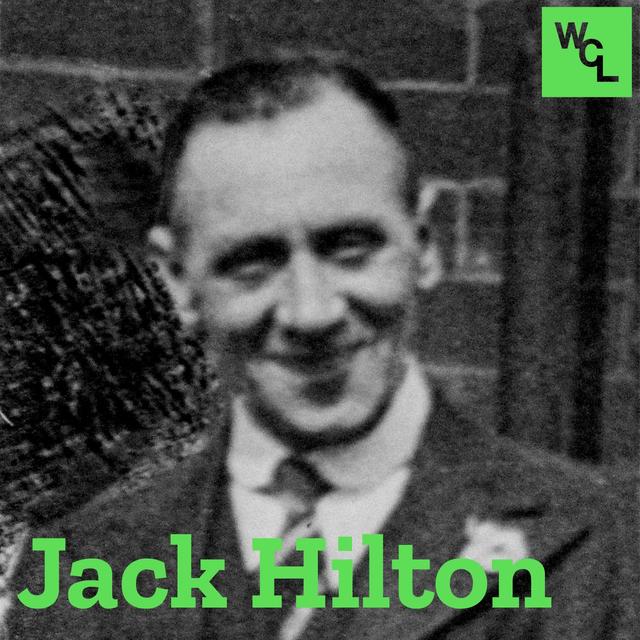



Welcome back to part two of our double episode about the life and literature of working class writer Jack Hilton. If you haven't listened to part one yet, we suggest you go back and listen to that one first.
Alamatina happen. Oh, very large child, very large child. Be large child, child child Alamatina.
Before we start, just a quick note to say that we're only able to continue making these podcasts, both working Class History and working Class Literature because of the support of our listeners on Patreon. If you like what we do want to help us with our work, join us on patreon dot com slash working Class History, where you can get benefits like early access to episodes, exclusive bonus content,
discounted books, merch and more. For instance, Patreon supporter has got early access to both episodes about Jack Hilton and get exclusive access to a Patreon only bonus episode. They also get access to two series of Patreon only bonus content, Radical Reads and fireside chat link in the show notes. As we mentioned in part one, Jack Hilton's experience of long term unemployment was all too common during the Great
Depression in Britain. But out of that mass experience of unemployment, and in part because of the extra time that unemployment allowed came a huge upsurge in writing not just about working class people, but actually by them, recounting their experiences of both work and worklessness, as well as their hopes for change. The result was that the nineteen thirties was an extremely rich decade for working class literature, arguably even the high point in the history of British working class writing.
Caliban Shrieks was very much a part of this literary moment. Here, Jack Chadwick, who we spoke to in Part one and whose tireless efforts brought Caliban Shrieks back into print, reads a passage from Hilton's text on the effects of hard work on working class minds and bodies.
Most of my mates have uneventually fallen into the way of working for their living. Most of them greet me and seem proud of Ela. They think they can perform the function of his favorite recreation of a working class bester than their fellows. I can eat the bloody job is a common expression. Beastly blondes of toil, willing eagers, eaters up of production. To me, they are overdoing it. I think they work too hard and think too little.
But they know they are good ones at it, and work never killed anyone, not hard work, even workingmen do at times die. The stimulus to existence is work. It is life's sole purpose. Work for a decent wage if possible, but work, certainly for regularity, and plenty of it hard. Many are prepared to do it under the odds. Of course, they thought the work game would go on forever. Rationalization
has now made their services less important. Thank goodness, poor cattle full of pomposity when adorned in a new suit of Montague Burtons tailor made. What tailor could meet their slender purses and yet hide the fact that they are toilers? Where is their poise, straightness carriage? Where is their elasticity of heel? What collar could rest unwrinkled when their bony collar bones stick out so generously? How can one's head sit graciously when the nape of vertebrate aches with jaded exhaustion?
Such is the price of eating the bloody job. What mental returation is acceptable to the fatigued body? None? Only the artificial manufactured kind. Horse ology, cardology, rology, and sexology. Man is the creature of conditions environ. If the bruise is overworked, he generally cannot think what must be done for him by ed Go Wallace win a lot on the bow Street reporter. Of course this is for the good.
What is nicer than hewing wood and drawing water to the thoughts of what's going to win the two thirty or yes, he has to hang by the neck until dead possible fortune on the one hand, and glorious better than he on the other.
In this passage, Hilton aims his trademark sarcasm at the cult of hard work under capitalism. But what's interesting here is that he's directing that sarcasm at other working class people, specifically those workers who pride themselves on their hard work, on their ability to, as he says, eat the bloody job. Work is life's sole purpose, jokes Hilton. So work for
a decent wage if possible, but work certainly. Hilton is being sarcastic here because his fellow workers belief in hard work for its own sake is actually damaging to themselves, not just because of their bony collar bones or how their vertebrate ache, but because of how overwork exhausts the mind. Again, Hilton's working class background is so important here because a passage like this by an upper class writer would risk
being condescending. Hilton, meanwhile, strikes a fine balance between concern for his fellow workers but also frustration with them, precisely because he shares their experiences. The period that Hilton was writing and saw a huge huge interest in working class writing, as publishers and literary journals increasingly wanted to document the experiences of the Great Depression. This was one of the
most productive periods in British working class literary history. So there are far too many authors and novels from this period to mention here, but two of the most famous working class novels from the nineteen thirties were Love on the Doll and Means test Man. Love on the Doll depicts the effects of unemployment on a young working class
couple in depression hit Northwest England. It was probably the most successful working class novel from the period, being reissued ten times between nineteen thirty four and nineteen thirty seven. On the other hand, Means test Man was written by outer work Derbyshire coal miner Walter Brierley and follows an unemployed miner and his wife in the week leading up to their invasive means test inspection. We go into a bit more detail about the means test and how it
worked in Part one. Both Love and The Doll and Means test Man are what's known as realist novels in that they attempt to depict reality quote unquote as it is, making sure to accurately describe the details of the external world, what the characters look and sound like, etc. But perhaps because of its origin as Hilton substitute for speech writing, which we discussed in Part one, Caliban Shrieks is very different from both these novels.
Really with you other sort of quite well known working class texts from this period, like Lavoma Dol and Meancess Man. He was so so so removed from the styles of these texts and the sort of way they're structured. The fact that he never set out to be a writer meant that he wasn't oblivious to how these texts were being written, but he just didn't care because he wasn't
writing to fit into any mold. He wasn't make You know, even if you're not conscious of it, if you're trying to write something with the idea of it getting published and read, even if you're not conscious of the fact that you're doing this, you are still going to be
writing it with these norms in mind. So like Walter Greenwood's Love on the Door would have been written with the idea of it having the kind of structure that it really ended up having, even if Greenwood wasn't exactly like I'm going to write this and it's going to tick all these boxes or whatever. Hilton just did not have any kind of sense of needing to tick off certain rules of what constitutes a good piece of prose
when he was writing his own masterpiece. And I think because of the rough draft of Caliban, Shrieks and what would become colorb and Streaks made it to listenerary people and publishes before Hilton even knew that he could publish it, it meant that they then encouraged him to keep going with his eccentricities and the things that defined his debut
novel as completely uncategorizable. So I think that the main point is that there's just absolutely there's just nothing to compare Hilton too, or if there is, I think there probably is, you know, but it's completely buried and completely forgotten and lost. I mean, I wonder how any other private journals remained private journals from this period and from
afterwards and from before. You know, there's probably scores of them that just never had for good luck to have the sort of a fluke exposure at Hilton had, and maybe the only text would ever have any kind of similarity tiltings of those ones people's private diaries and journals. He wasn't writing to be read. He just didn't care.
And by the time but his writing had been discovered the fact that it was so form less or he had its own form, and that this was something that made it so special to people that you know, got the hands on it, and the encouragement from these people was then emphasizing the uniqueness of Hilton's pros. So Hilton never had to really fit inside any of the uh, you know, the accepted rules of writing, and he was, before he even knew it, he was being celebrated for
flouting these rules. I certainly, I think, you know, his editors would have had a hard time because although you know, he taught himself to write in the face and it's unduskly the case for his pros at that point would have been probably quite hard to read in the sense that it would have been if you read some of his letters and stuff correspondence, even from the late thirties, it's sort of like its punctuation and spelling and stuff.
It's not it's like you can understand it, but it's far more it's vernacular Lancastrian, and I think his editors tried to keep as much of it as possible, but still had to sort of put a bit of a stret jacket on his writing.
However, Hilton was not always happy to receive this kind of straight jacket from his editors. A few years after Caliban Shrieks was published, one of Hilton's stories was due to appear in the literary journal New Writing, but he pulled it when he found out he'd gotten a book deal elsewhere. In a letter to friend and fellow working class author Jack Common, Hilton explained that he didn't want what he referred to as the New Writing editors amendments
and cuttings. Quote he takes the bloody life out of a job. These parts of university boys with a flairy flair for lit in the worst form are too dictatorially important. End quote. In another letter to Common, Hilton explains how he was determined to quote break through the independence of this lot of little big men, these silver spoon progressive editors. End quote.
I don't want anyone to get the impression from what I've said that Hilton didn't know what he should be doing with Caliban Shrieks, because you know, like I say, he did read hundreds and hundreds of novels from the English canon, and including like modernist texts like Lawrences, Sons and love It. He'd read it all, and so you know, he would have had an idea of what a novel should have been in the eyes of the people that
over time held the purse strings that publishes. But so many people, even critics nowadays, responding to Caliban Shrieks, have this tendency to view what Hilton does as being just either completely acts or just not giving him the credit. But it's due for the effects. But his book has it's almost like, oh, it's just a it's just a happy accident that he has. It's this stirring effect and that he takes you on this emotional journey.
Indeed, Hilton was well acquainted with the works of the literary canon, not to mention it's various techniques and motives, as shown in this next passage that Jack is about to read out.
The lily painted descriptions of nature by an artist in the throes of hypnotic rapture is but the expression of the dualism of being well fed and ideally imaginative. The Grecians, with their culture, belong to the well fed minority, while their slave brethren are more or less inexpressive. So it is that we paint pictures according to our stage of evolution. Well fedness is the objective stimulus for the nice abstract
words or canvas painting. A hungry man has a hungry outlook and little or no interest in the octanmbulist wall gatherings of a nature devotee who raves away. You know how a sky of silk and blues stuck ord with the golden riplets, sunny tints above hills of green brown majesty overmook of metaphor how U kid for soft high falutin hungering shop assistance with such stuff and send them
on their Sunday hikes with those back to nature. Rook's acts to the hobover sky is hardly ever noticed unless it is to be seen whether it offers mildness or storm pleasant scenery is totally ignored. Only nature, in differambic humor is worthy of concern, and only because of its possibility of discomfort. The miles are long and reary, They lead uninterestingly from one town to another. Man must have some purpose walking from one town to another is the tramps.
There's a biting cynicism here which seems aimed at the writings of romantic nature poetry or Victorian landscape painters, which he calls noctanbulist wall gatherings, that is, the pointless daydreams of a sleepwalker. Basically, Hill unmocks their descriptions of silken blue skies and stockered sunny tints, saying that they have no interest to the hobo, which he'll was for about a decade. As we discussed in Part one, the hobo's relationship to nature and the sky is entirely practical. Will
it rain? Will I be able to walk for miles or sleep outside comfortably? In stark contrast to the scenes of nature poets or painters. Then, Hilton writes that the hoboes paths are long and weary and lead uninterestingly from one town to another. But this contrast is not necessarily
a total rejection of the literary canon. As mentioned previously, Hilton frequently quotes Shakespeare in his novel, and in this passage itself, he even drops little mentions of the ancient Greeks, like his comments about Grecian culture belonging to a well fed minority and nature's dithrambic humor, with the dithorm being
an ancient Greek form of choral song or poem. So while it might seem at first that Hilton's point is that literary tradition is of no interest to the poor, on closer inspection, it's more that the conditions of the poor detach them from literary tradition. Hilton's mockera tradition, while drawing on parts of it, can be reared as another example of his attempt to seize it for the working class.
As much as it's a comment about bourgeois literature, it's also a comment about what society does both to the poor and to culture, and how that might be different if only everyone was well fed. The success of Caliban Shrieks opened up new opportunities for Jack hillan.
After Caliban Shrieks was met with critical acclaim and you know, favorable reviews from the likes of All Well and Order and the rest of the source of moderness circle around Fidelphi. It gave Hilton this confidence to pursue writing, even though he'd never in his entire life thought that he could one day do this. He never thought of himself as ever having the ability to make money from his expression.
He'd only ever thought of his expression as being potentially useful in getting a better quality of life for his class. But he took the opportunity presented by the success of Calaban Shrieks to go and study at Ruskin College. And he studied there, And I'd not be able to find it exactly what he studied, but it would have been, I think, quite an all encompassing course, maybe evolving politics, economics, literature.
Ruskin College was set up in eighteen ninety nine with the aim of providing education to the working classes. The college received funding from trade unions and sympathetic wealthy benefactors, and provided working people with the opportunity to do long distance and evening courses. However, its main function was as a residential college where working class people could live and study for a minimal price, with many attending on scholarships.
Over the next few years, Hilton would publish two more novels, Champion in nineteen thirty eight and Laugh at Polonius in nineteen forty two.
Both of these have fantastically written demonstrations for his ability to write a very neat novel that gets across working class life in a really powerful way, but they weren't really, I don't think, the kind of things that he wanted to write. And by this point there was just this general turn away from working class writers on the part of publishing houses, and it became more and more of
an uphill struggle. And it had always been steep, it became almost vertical struggle to get publishers to pay any mind to people like Hilton, even though he did have the assistance of people with big profiles, of more respected writers like Orwell. And in the case of Orwell, he received a lot of help, particularly into the forties, and this help was I think, really it's quite fair to say that Orwell gave more support and more concrete help to Jack Hilton than he gave to any other writer
in his life. And this, you know, it took the shape of in the I think nineteen forty five the two after making their correspondence because of the war, because of Orwell's illness, is just in general, because of you know, we'd both been busy with other things. That Hilton had been doing something for the war effort, I think working
in you to put out fires. They got back in touch with each other, and Hilton asked Llwell for help with moving forward with the kinds of things he wanted to write, and all Well not only putting a good word for Hilton with his publisher at Jonathan Cape, but he invited Hilton to come and take tea with him in his Latin Islington, which was incredibly rare. Or Well did this with only might be like less than a handful of other people, you know, inviting around for tea
and ren rental publim. He was a very guarded private man, and so was Jack Hilton. I'm really intrigued by what the dynamic between Orwell and Hilton would have been like.
I think because Orwell was a listener as well. I think it was really unusual because with Hilton, Orwell was in the position of actually having talk, which is enough really quick thing about their relationship with it from the accounts of their meetings, I think both of them sort of had to sort of talk more than either were used to with each other, because I Fee would have been silenced and black Pudding theilibscot Or. I went to support Hilton, a really remarkable he even you know, often
negotiating on his behalf with Jonathan Cape. He even came with Hilton to meet the bearer of bad news from the publisher in which you know, Hilton found out that he wouldn't be commissioned to write the kinds of books but he really wanted to write.
Indeed, All would arranged a dinner for Hilton with Veronica Wedgwood, a reader for the publisher Jonathan Cape, who had already published some of Hilton's work. All Well in Hilton's hope was that Wedgwood might be able to secure a three book contract for Hilton, which would give him the kind of longer term financial stability to be able to leave
his plastering job and pursue a career in writing. However, as Jack mentioned, the tide was to against working class literature, with Wedgewood herself writing an internal memo at Jonathan Cape saying that quote, the Proletarian novel, in my opinion, is finished completely end quote. Before this, however, Hill and also experimented with another literary genre, the travelogue.
One of these sort of other forms of the writing that he sort of thought he could play a lot with and develop in the same way as he did with his pros and Caliba tricks. It was sort of like the form of a travelogue. I think my second favorite of his books is English Ways, is a sort
of dare I say, satire or sort of. It takes the popular format of the travelogue, which is really like probably like the most sold books of a time, where of these travelogs about like, you know, trips our English countryside, quite quaint narrations of these journeys by upper middle class writers.
And Hilton, you know, took this format and turned it on its head by using it as a way to talk about different working class difminnities across the country and exploring the people of these communities and the types of people in these certain places. And you know, he was the only person who wrote a travelog to start in the north of England. All the other start either in London or in places just on the outskirts.
As Jack mentioned, English Ways is fundamentally satirical in tone, but as some have pointed out, Hilton's travelogue seems to
be a satire specifically directed at George Orwell. The writer Andy Kroft argues that English Ways can be read as an answer to the Road to Wig and Pier, while literary scholar Ben Clark points out that while Hilton doesn't mention all Well by name, he does mention quote a best seller from a middle class socialist who was at particular pains to stress the acuteness of his sense of smell and insisted that working men's stank end quote.
So he wrote English Ways n First seven, ten years later, English Ribbon. And they're quite cocky and quite cheeky, and I think there's more of a sort of humor. There's certainly less bleakness and tragedy in these texts, but they are nonetheless really special for the way that Hilton's found his voice, and he is the voice of the same Caliban you know of nineteen thirty four, but Caliban after Prosperous Ireland, really Caliban or Once. He's got a full
mastery of himself. Really, and it's really terrible that the publishers didn't jump on these books and really back them in a way that would have got Hilton a proper lifelong literary career, especially because after the refusal to give him a kind of contract would guarantee him a good quality of life and writing. After that refusal, he sort of gave up, and within five years he's sort of
after English Ribbon. He sort of just gave up on the idea of being a full time writer because he realized that to do it, to sort of get those kinds of contracts where he wouldn't have to go begging back after writing each book, where he'd have the sort of guarantee of stable work, to do that, he'd have to really censor himself in a way, the garbling effects of mortgage respectability. He would have to really sort of change his tone and write differently, and he never wanted
to do that. His voice and its routiness. In his status as a manual politarian, it's a worker from Rochdale, from a north so far outside of London. It was more important to him to keep that than to be paid for writing more. I guess the word is tasteful, more tasteful as an essential more of works that were more sort of in keeping with the taste for people who held the purse strings, so he chose to stop trying to get his writing published. He kept on writing
throughout his life. Unfortunately, a lot of what he wrote has been lost.
This really highlights a common theme in the production of working class writing. That is that beyond the struggle to find time between long working hours to actually write, and even after the struggle to actually get published, is the struggle for that work to actually be remembered and valued. As Jack mentioned in Part one, Hilton was celebrated by some of the biggest writers of his time, thought of
as possibly the next d. H. Lawrence. That a working class author is appreciated as Hilton could be forced to drop out of writing and then fall immediately into almost total obscurity really demonstrates just how easy it is to lose such authors, and Hilton would have been lost, possibly forever, had it not been for Jack's determination, and what, it has to be said, was quite an amazing series of lucky events.
I'd sort of given up on finding anything more I could about Jack Hilton, So after reading Caliban Shreeks in the Working Class Movement, I had been salted. I was just desperate to find out whatever I could about him and finish his story, find out what had happened to this man. You know, after you've taken you through this psychic tour of his first thirty five years, you just left with his desperate feeling of money no more. And so I set about doing things of googling. I even
used ash jews. I was desperate. I just I was trying to think of whatever I could to try and find out whatever I could. I spoke to the librarian and she only added fuel to this fire. She just was able to tell me that he'd mysteriously left righting for reasons, but no one that she knew could really speak to. I even went on ancestry dot co dot uk transfer like to find out more about his family, to see if any of them, would you know, still be alive, still know anything about what happened to Jack
that you know got me nowhere at all. The last thing that I could think to do was after finding out that he died in Chaddleton and Oldham in nineteen eighty fourth and his death or I can't remember if it was his death stificult. I found some kind of proof that he died in Oldham in nineteenth fourt and so I went as a last ditch effort, I went to what would have been his old locals, I think herself, with the intention of going to like four pubs. So I was still standing from when he have lived there
in the late seventies and early eighties. So I went around these pubs with a poster that I had printed out that had the only picture I could find of him printed on it in big letters, do you remember Jack Hilton or something to that effect, And then never bottom that'll like tear off tassels with my number, asking
people to get in touch of fame. And I had any vague recollections of this man, and it was in I went around two pubs, put up these posters had a pine, and you know, I was continuing going down this bus route towards Chatterton. Then in the third pub I go in and I start talking. You have the two pubs before, no one had been ver interested in what I was doing, so I've been in and out
after the pine. But in the third pub, the last pound of bar was really interested, and so I started talking to her about it, and I think she just thinks I'm a little bit mad. But then from like the bar's got like columns along it, and from behind this column so out of side to me but not to the bar made it was like a woman. It must have been like in a seventies, late seventies maybe who I'd been basically just eavesdropping on my conversation with
a bar maid. And she after about like five minutes, she just popped up like sticked to her head forward so I could see her, and was say, oh, you know what, love, I think I might know who you are about. And basically she had only the vague she'd been drinking in the pub for decades and decades from the time of Hilton, but she only the vaguest memories of Jack. But she could tell me a lot about Jack's best friend, a guy called Brian, who was much younger than Jack and had gone on drinking the same
pub for you know, about thirty years more. He'd in fact, only died the year before I went to visit his pub. He's old local. So she was able to give me Brian's name and tell me that, you know, he used to hang around with his kind old man Jack Hilton. He was dead quiet. He used to come sit in a pub if there was three of them, she said there was Brian, there was another blow whose name she forgot, and then there's Jack, and we used to just keep themselves to themselves. But she was able to tell me
Brian's full name. I looked up immediately. I tried to find anything I could, and an old Yellow Pages had his address as listed as being just around the corner from the pub. So I went and a nocton and I had no response on the knock. So there's no cars of my drive, So I thought, you know why, you know, it's pissy down the rain, So I felt, you know what this might be. I got excited, but
probably is not going to lead to anything. But I thought, you know what, I've got these posters with me, and just pure look, I had a Bira on me, so I put a note through the door. And one thing I've said since is, you know, and I never was the kind of person to carry pen and paper around with me until that date, but ever since I realized, you know that basically the rediscovery of Hilton rested on the fact that I had a Bira on me that day.
I've always carried one with me since, and I'd left my email and my phone number about week later, I got an email back from a woman called Mary Hassel, who was Brian's widow, informing me that Brian had passed away, but that she remembered Jack. Dear old Jack, she called him, who used to come over for his tea at her and Brian's house several times a week, especially after Jack's wife had died, you know, and he was on his own. He was sort of like a sorry good grandfather to
her two kids. And so she invited me over for a couple of tea and some custard tarts. And I went over, and you know, we talked for hours about Jack. And as we're talking more and more memories and come back, you know, I go around again. We keep talking. I'm recording, and I'm writing everything I can about about her memories of Jack, and then we ad one time, she tells me this story about how when the kids were bored,
he could blow smoke rings. He was he was a chainsmoker, and he could blow smoke rings with his pipe, which you know, would would do the trick most of the time to instant the kids, but if they were being particularly rowdy, Hilton had another part of trick up his sleeves, which was that he could blow smoke through his ears. And I at first when Mary told me this, I was just like, what are you sure, because I've never
heard of this before in my life. And I looked into I actually got in touch with a friend of mine who's the GP the strangest request for medical advice I think this mate of mine's ever received in his life. I was like, would he ever be possible for someone to blow smoke through their ears? And he told me, yeah, but only if you've had severe damage to your ears.
The kind of damage that could in the case of Hilton, it could have come from the mill machinery when he was eleven working with cotton mill in Rochdale, could have come from the trenches, could have even come from like breaking rocks in the poorhouses in the nineteen twenties. So this was, you know, one of the tricks he would do to keep the kids of used.
The fact that Hilton could take what were likely perforated ear drums that he'd gotten from one or another of the traumatic experience is that he'd lived through and used them for the entertainment of others, is in a way a miniature version of what he did with Caliban Shrieks. Mary also told Jack about Hilton's pet buddy, which in its own way led indirectly to the republishing of Caliban Shrieks.
When he passed away, as his best mate Brian you know, was at his death bed and Brian and Mary took on agreed to take on the sort of efforts of like organizing funeral and clearing out his flat, and they also decided to adopt Hilton's budgy. They brought it into their house and within a day or so the budgy
was at death's door and then it just died. And now for the reason, according to the vet Mary Tolby that had just passed away after Jack's death, it was suffering from nicotine a straw because he was such a heavy smoker and the budget had been just used to being absolutely just hot boxed with nicotoon all of his waking life. But you know, without it was such a stress on its little anatomy it packed itself in. But that made me think, what else had Brian and Mary
been left by Jack Kilton? And so using information from Mary, I was able to check down his probate and the probate was he was small he didn't. He had very little when he died, he'd left most of it to Mary. And you know, as you get with probates, at the end of it, you have a clause where it's like and anything not named in this last interestament goes to, and in this case the everything else goes to. The
clause was to Brian. So, without ever knowing that Jack had been a writer, Brian hassell is mate inherited all of the literary rights to his collected works. And then Mary, again without ever knowing that that Brian had had the rights to Jack's work or that Jack had ever been a writer, then inherited the author's rights to his writings
when Brian passed away. And so after realizing this, I told Mary about it and said, you know, but this is fantastic because this means that we can get Hilton back in print potentially, you know, if we can make
the case to publish it and get someone interested. At that point I thought, you know, the best case scenariould be getting a small independent publisher to maybe do a small run of of you know, a few hundred or something, or potentially, you know, if that wasn't possible, we could maybe raise some money to get some copies self published. So I had no idea that it would ever end up with a publisher of the world's largest literary publisher, Penguin,
and Mary was thrilled. But she said, you know what, Jack, it sounds like a lot of work, and it kind of worked that really it should be for you to do. And so she said, you know, I don't know how to do this exactly, but I'll sign over whatever these rights are to you on the provisor that you do your utmost to get Hilton back in print. And that's
what happened. We ended up looking up, you know, how to do this and found a Google template for we had to look up what exactly a literary right was and look up how to do like transfers and stuff like that and it, and then I ended up with the rights. And then I started to turn the story of my discovery of Hilton and my feelings about what I found, and then the story of finding Mary and
reminiscing about Drack. I started to turn that into an article for a small independent Manchester based magazine called The Mill. But then when it was eventually published a few mouths after I first met Mary, had the most amazing response and became one of the outlets best reads ever pieces and it caught the ear or the eyes rather of
people working at various media outlets. So within a couple of months of that, I was on Times Radio, BBC six Music, even you know, it was in national print of The Independent, the Guardian, and then it all culminated
in being invited for a segment on BBC front Row. Now, of all the people listening to that segment, there was one bloke, Nick, who was publishing director of a vintage classics and imprint of Penguin Books, and he was listening to this segment at fifteen minute long segment waiting for the good news at the end to be and so Hilton's Caliban Troocks will be republished with you know, ex publisher.
But by that point I had no idea how to approach publishers, and I had no idea what it would take to get a book back in print, and so there was no deal done. So Nick was listening to this segment on front Row waiting for the good news story and then to reasa to disbelief there was no and then the book will be brought back out with brother you know in so and so time period. So he found me on Twitter and he sent me a direct message and then we had a conversation on the phone.
He was on paternity to leave, so he ducked out of paternitally to basically say, you know, let's go ahead, let's try to get this bought out with Vintage. And that's what happened. Within a few months, it was all agreed, and then about a year and a half later, here we are with the book out and with a response to its publication that I could never have ever imagined. It became for number one seller for Vintage and entered the top one hundreds on Amazon and has sold incredibly well.
It cleared ten thousand copies. I don't think Hilton could ever imagined. I don't exactly know how many were printed in the thirties, but my suspicion is that it was only, you know, in the hundreds. So to say that his legacy is exploded now, you know, ninety years after the book was first published, as an understatement.
Finally, then Jack Hilton is getting the recognition he so richly deserves. But as Jack points out, well Hilton absolutely should be remembered for the excellent writing that he left behind. His legacy also needs to be thought of in relation to his trade union activity outside of his writing.
He never saw himself as a writer, and he did. He just he loved the work of plastering so much, and he loved due by this point after the war, it was it was a decent pay he got from plastering. It was enough to have quite a decent life by his standards at least, so he kept to it. And he loved the union work. He loved the fact that this craft gave him an opportunity to better the lives of working class people through the strengthening of the establishment
of union in the Northwest. You know, we talk about the legacy of Jack Hilton, and I think if you were to talk to Jack Hilton about his legacy for him, this sort of new look at his books which were never popular back in the first and force we're never that well read. The credit that he's been given now and the celebration of him now is an important part of his legacy. Bought no less important to me, or
to him or to the people. But his life touched is his work in the trade union movement and the fact that you know, he was a plasterer who was proud of his work. He founded the Rochdale Bruanch of the Plasters Union and was its first president, and I believe potentially also this branch was you know, integral to forming the wider sort of Lancastrian chapter of the Plasters Union. And Hilton was involved in and senior in the regional sort of union structure in Torbet think that nineteen fifty five.
And he was proud of not only of the work that he did as a plaster and the buildings that he beautified and the you know, the frescoes and stuccos that he was able to do in these big houses across Greater Manchester, but he's also proud of the fact that, you know, he'd be passed on not only of these skills to younger workers, but he also founded these branches
that won't better lives for our members. And if he wants to look for a material legacy for Jack Hilton, it is in the better life space is union brunches left for his workers, and that's just as important a legacy as his writing The luck Out.
The luck Out, They luck Out, Dody.
That's it for this double episode. On the life and work of working class author Jack Hilton. We also have a bonus episode where our interviewee, Jack Chadwick reads and discusses more passages from Caliban Shrieks. That bonus episode will be available soon exclusively for our supporters on Patreon. It is only support from you, our listeners, which allows us to make these podcasts, So if you appreciate our work, please do think about joining us at patreon dot com
slash working Class History link in the show notes. In return for your support, you get early access to content, as well as ad free episodes, exclusive bonus content, discounted merch and more. And if you can't spare the cash, absolutely no problem. Please just tell your friends about this podcast and give us a five star review on your favorite podcast app. Thanks also to our Patreon supporters for making this podcast possible. Special thanks to Jazz Hands, Fernando
Lopez Ojeda, Nick Williams, and Old Norm. Our theme tune is Bella Chow. Thanks for permission to use it from Disky de sale. You can buy it or stream it on the links in the show notes. This episode was edited by Jesse French. Anyway, that's it for today. Hope you enjoyed these episodes and thanks for listening.