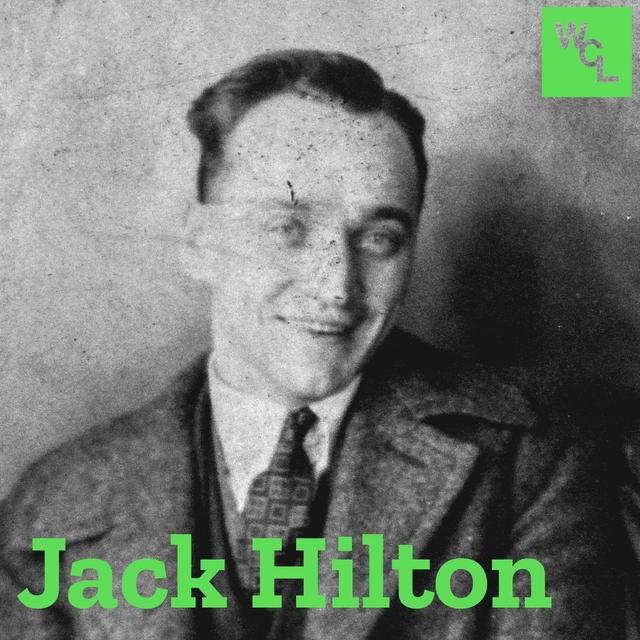



Jack Hilton was a plaster trade unionist, survivor of World War One, and local activist in Lankash's Unemployed Workers' Movement who turned to writing while banned from political activity. But despite being celebrated by some of the most respected writers of his generation, Hilton and his work faded into obscurity, only to be rediscovered now, some ninety years after he was first published. This is Working Class Literature.
Alamatina Happena Oh, very large Child, Very large Child, Very large child, Child Child, Alamatina.
Before we start, a quick note to say that we're only able to continue making these podcasts, both Working Class History and Working Class Literature because of the support of our listeners on Patreon. If you like what we do and want to help us with our work, join us on patreon dot com slash working Class History, where you can get benefits like early access to episodes, exclusive bonus content,
discounted books, merch and more. For instance, Patreon supporters can listen to both episodes about Jack Hilton now and also have exclusive access to a special Patreon only bonus episode where we discuss more passages from Jack Hilton's brilliant novel Caliban Shrieks. Patrioon supporters also get access to our two Patreon only podcast series, Radical Reads and fireside Chat link
in the show notes. In this double episode, we're going to look at the life and work of British working class author Jack Hilton, with a particular focus on his
nineteen thirty five auto biographical novel Caliban Shrieks. To do that, we spoke to Jack Chadwick, who chanced upon Hilton's novel back in twenty twenty one, and through what can only be described as an incredible feat of literary detective work, managed to track down some of Hilton's old friends and get his book back into print almost ninety years after it was first published. We discussed this incredible story of how Jack got the book back into print in Part two.
So turning to Jack Hilton himself, then it's fair to say that he had an extremely difficult start in life.
One of the things that makes him easy to sort of date is he was born in nineteen hundred. For someone who's not particularly good at mental maths, that makes it a lot easier to sort of work out how old he was at any given point. So born in a slum terrace in Rochdale, the house where he was born and is still standing. The only difference is but it's no longer pact. But I think it would have
been two families. Now it's I presume just one. I've not knocked on to check, but yes, so he was born into this one room, but his two parents lived in he was I've never been able to work out where he was exactly in the order of the children born. I think he was about maybe the third, the third child,
and potentially the first son. Part of why it's impossible to know exactly where he came in the order of a family is because of his siblings, so many of them died within the first you know, before they even reached adulthood. I think only one of his siblings out of seven reached adulthood alongside him. I think a lot of his siblings were even missed out by the censuses because obviously they were born and died within a period, so unless they reached ten, they were sort of like
missing from the records. His dad was from what Jack Hilton described as being it's a sort of a lump proproletariat, the lowest of the low.
But despite that, he was at.
The forefront of for sort of a meager early efforts of socialist organizing in Rochdale, and so his dad had, you know, quite like Jack Hilton went on to achieved. He'd sort of scraped a little bit of an education for himself, but it's not the kind of thing that his father's work allowed him to pass on to his children.
So Jack Hillson would have.
Got, you know, little scraps of his father's knowledge because obviously his father was working hard with all these children, with all this death around him. But it still is the case that Hilton was sort of given this sort of early orientation towards socialism and towards the working class and sort of knew he stood up and put on
firm ground. It was a solid foundation for what he went on to do and what he went on to do in terms of his own efforts to educate himself and and as we'll talk about later, the direct inputs he had into building the movement that his father was sort of a father of in Rochdale.
As was common at the start of the twentieth century, Jack Hilton was denied in education and forced into employment as a child.
So Hilton grew up and like all of the kids of his class and age in Rochdale at that time went under the halftime system, went to work at the age of nine, and there one small victory for a working class around that time was that when you went to work at the age of nine, you weren't since for mill. Yet you got a bit of a grace period of two years before you were sent to the
local mills. I say the local mills was about I believe our three towering, dark buildings covered in black ash smoke that you know, we're blackening the skies of rushed Owe. All of these buildings within a stone's throw of where Jack Hilton grow up. They're no longer there, but Hilton was after about two years. I think he worked for
a grocer's. He did some sort of errand boy kinds of jobs in his afternoons after school, and then he was sent for mill at the age of eleven, waking up at at you know, five point thirty in the dark and carrying himself you know, up for Hill Downhill to the local mill to do labor. That left him absolutely knackered, to say the least. By the time he was supposed to start what really has no right to call itself an education.
Which would have been in the afternoons.
So he speaks about what this education entailed in Caliban Shrieks, and if the image he gives of it is so distinct and so different to what any kind of ideal sense of what that word means now, or you know, even at the time, it was jingoistic, it was patronizing. It was very much about teaching the kid the web along and under the Victorian scheme of class, rather than giving him any sense of what they could be or
what the world is. So I think perhaps Jack Hilton had the gift of knowing the limitations of what was being presented to him as an education because of his father. Even if his father wasn't able to give him any kind of other education, he was able to let him know the limitations of what was on offer in this you know, authoritarian brutal school with its religious sealousy and just quite frankly brutal floggings of the kids, which I
think he speaks about a little bit. And that was a really bleak early instruction for Jack too, the worst of capitalism, the worst of life.
It gave him the bleakest outlook. I think you could have.
Well Hilton's earliest experiences were already extremely difficult. They would be compounded by the onset of the First World War and the horrors that he would live through there.
He was at first too young to be sent to the trenches, so he began a series of jobs in the sort of logistics and a sort of support auxiliary auxiliary roles in England. One of the jobs did for the longest was looking after the horses of a marshal who was sort of being kept back in England in preparation for being sent to Belgium. Hilton did this job for a while and it gave him this relationship with this instruction to the ruling class. He was working for
the officer types. And I think this is another really important influence on the man he would become, because you know, unlike many of the other boys who were said off to fight, he wasn't around his own type from the
very beginning of the war. The war brought him into the world of class and it gave him a bit a window onto the lives of how other richer Britain's lived, and I think part of why he was selected for his work working for the offices and why he was able to do it for so long, I think about two years, was because they recognized that there was a brilliant brain in this lad Even though he lacked any formal education.
He could just about write and read.
But this is again the gift of his father, who had instilled in this sort of advantage of I guess you would call it a cultural capital really that enabled him to be distinctish from the other working class lights is potentially having some kind of ability to do the sort of more administrative taxs that were predominantly given to middle class boys. So he was then when he was of age, he was sent to the trenches.
And he writes.
Very little about this in the grand scheme of things, but very powerfully. And I think it's one of those cases where you know, a lot of the meaning is contained in the gaps as opposed to in what's actually communicated in the actual words on the page. So if you read between the lines of his account of the war and what came after for him, you get this, I think, particularly brutal and personal explanation of the effects
of the war on this young working class boy. And I say that because the following chapters, so he talks about the experience of being sent to the trenches and describes the the sort of a harrying how can I put the very sort of a quick fire, rapid fire sort of weight.
It's very visceral.
His account of what happened, but it does only run maybe two three pages. But then what happens afterwards is you have this pair of chapters covering ten years of Jack Hilton's life from the end of the war until he was mentally able to settle in Rochdale again at the end of the twenties. And this period of ten years is a direct response to what happened in the war. And it's clear this period of homelessness and rough sleeping and vagrancy which he went through, but it wasn't unique
to him. It was actually sort of hundreds and hundreds of thousands of veterans from the First World War went through this long period of wandering. That it's timeless and the account that he gives of this period tells you so much about his experiences in the war, And that's what I mean by you really have to sort of read between the lines of his account of the war to get a sense of how much trauma he was carrying around with him afterwards, and that was all he
was carrying with him. He didn't have anything to his name. He was wandering the countryside from town to town, made it to London, made it out of London, and made it back to London, back up north, back down south, from Spike to Spike, poorhouse to poorhouse. He was carrying nothing but this immense trauma that completely prevented him from settling his own mind and settling down anywhere for at least ten years, potentially eleven or twelve.
In the UK, we talked quite a lot about the First World War, but often gloss over the sheer scale of the horror and destruction they involved. So in total, around twenty million people were killed and around another twenty
million were wounded. During the Battle of the Somme, over fifty seven thousand soldiers died on one single day, but it wasn't on common for hundreds to die, even on supposedly quiet days, so it's not surprising that anyone who found themselves in the middle of all that would come home with severe post traumatic stress disorder, as indeed hundreds
of thousands did. Harry Patch, the last surviving British combat veteran from World War One went on to describe war as quote organized murder and nothing else end quote, and said that the politicians who had dragged them into it should have quote been given the guns and told to
settle their differences themselves end quote. Jack Hilton lived through all of this, as did many others, but as if that wasn't enough, Hilton and his generation would have yet another era defining catastrophe to come, the Great Depression.
He had just got to that point in his life where he was able to overcome the trauma of the war and of what he saw and begin to settle in Rochdale, which is where he was born. But he'd settled into doing you know, odd jobs predominantly in the construction industry. For Great Depression hits, and his entire generation just has the worst luck when it comes to the sort of the ages at which they hit these events.
You know, he's young enough to go to the trenches, he's young enough to be still dealing with the effects of the First World War as the Great Depression hits, and he finds himself trying to settle in Rochdale but unable to find work, and groups together with some of his friends in the local library. There's only one library
and the whole of the town or its area. It had been built about thirty years before, and they go to this library predominantly for warmth because they have no they're living in I think he was in a fixed abode at that point, but no heating and no food and sharing with like five of the lads, I believe. So they're going to the library to sort of keep warm in between the odd jobs that they're able to
pick up from arrival of this work. So these lads were all clinging to each other out of desperation in the library, and as the mobs passed by, they sort of turned towards what they can do to improve their situation out of sheer desperation. If they think, you know, we're just doing nothing, what can we do to even to make us feel like we're doing something.
It's worth mentioning just how bad the Great Depression in Britain was. In nineteen thirty one, for instance, almost a quarter of men and one in five women were recorded as unemployed. Rather than do anything to help the unemployed, the government introduced the means Test, whereby inspectors would visit unemployed people's homes to see if they were living fecklessly or had any items that they could sell before giving
them their unemployment benefit. On top of that, the means test applied to the household, meaning that if one of the children got a job, they're earning would be deducted from the parents dole money. Unsurprisingly, this meant that families would often be broken up, with children leaving home in the event that they found work. It's also really important to highlight as well that despite these harsh conditions, the unemployed were never given the sympathy that you'd expect from
the influential voices of their time. So, just like the demonization of the unemployed today, newspapers during the Great Depression depicted them as irresponsible, lazy, and having brought their poverty upon themselves. In nineteen thirty one, The Times ran an article in favor of the means test, claiming that the doll had become quote an alternative source of almost permanent
maintenance end quote. Similarly, the Scotsmen published a piece claiming that quote income taxpayers are unlike the unemployed, paying out and getting no return directly for their money. While many of the workless marry and breed families while in receipt of the doll end quote. While many, perhaps even most, of the unemployed responded to this situation with a deep sense of hopelessness, others like Jack Hilton, began to get politically active.
The first thing what happens is they hear about the National Unemployed Workers Movement, which had been founded by the Communist Party of Great Britain to represent the unemployed masses after the end of the First World War. Now, this organization existed for ten years but didn't really achieve anything like the breakthroughs, but it managed in the first years of the Great Depression. I think the biggest march that they held was one hundred and ten thousand people in
nineteen thirty two to present a petition to Whitehall. Whitehall responded with seventy thousand police mobilized from across the country to brutally intercept this crowd of desperate people and steal the petition they'd gathered, and then beat them out of London over a few days of actively.
The march that Jack is talking about here is the nineteen thirty two Hunger March, when two and a half to three thousand unemployed workers set off from Glasgow to London, one of many similar cross country marches that took place in that period. In London, they were joined by over one hundred thousand other demonstrators and attempted to present a petition with over a million signatures to the government, but were stopped by police, resulting in huge clashes in central London.
So I think this is the camera vendor would have got Hilton and his mate's attention in Rochdale, and that's what led them to attempt to found a chapter of the NUWM in the town. The first meeting they held was dire. These weren't educated men, like I say. They had no concept of how to make a speech or how to explain what was going on in their lives.
They just knew that they.
Needed to be able to explain it. They need to understand themselves. So after their first meeting they go back to the library and they just swallow book after book after book. And Hilton is not alone in this. It's about him and about five of them mates who do this. Who read marks, He read the classics of the English Canon, he read Shakespeare, and it does spare through. Their meetings start to pick up steam and every single new meeting.
They talk with more eloquence, They're able to explain things in more detail, with more credibility, and the crowds grow and grow riven a matter of months, these men are giving speeches that are drawing people from all over the town, men and women, young and old, and the meetings become rallies,
and then the rallies become riots. And the riots, obviously, for the powers that be in Rochdale, were completely unacceptable and scary, and the local business leaders, the locals lean on the local judges and the local police and anyone who will listen to sort of put a stop to this.
And Jack Hilton is seized in the midst of a demonstration and thrown in the cells and then taken to Strange Rays prison, and he's let out after a matter of weeks, but he's only let out on the privize over he never, for I think a period of three years, never make another political speech in that time, on pains of being sent straight back to Strange Rays.
However, it was precisely a result of the conditions of Hilton's release that he would go on to write his first novel.
In this period that he's bound over, having taught himself how to make the speeches that can move hundreds and hundreds of people to action, But now being completely unable to do this anymore, he instead turns to pen and paper, and the speeches that he would have been giving to these crowds are kept for himself and his scrappy little notebooks. He starts to write in these notebooks what he would
otherwise have been saying to the crowds. And then one evening a night class organized by the Workingmen's Educational Association, which I think he started going to around the time but him and his mates were begin to educate themselves to make speeches.
You've been going to these night classes.
Well, whenever he went to these classes, he was either you know, knackered after a day of work or starving because he hadn't had any work. So after one of these classes, for whatever reason, he left his notebook behind, and the education or association suitor picked up the notebook and, being a nosy booker, took it home and leafed through it, and you know what he had in his hands was the clamoring nucleus of what would then become caliban shrieks. I think it equates to being about the first and
second chapters or thereabouts. What this nosey booker does is he sends Jack Hilton's notebook without his permission to the editor of a modernist literary magazine called Viadelphi, which was I don't know how to promis really it was a sort of a haven for the misfits and the most sort of unpopular figures of the literary world at that time in England, like DH Lawrence, D. H.
Lawrence was an author and son of a Nottinghamshire coal miner, closely connected to the literary avant garde of the early twentieth century. His works frequently dealt in themes of sexual desire that scandalized the literary mainstream, not to mention British authorities. A number of his novels were subjects to obscenity trials, like nineteen fifteen's The Rainbow, whose copies were seized and burnt.
Obviously not learning his lesson, in nineteen twenty eight, Lawrence published Lady Chatterley's Lover, about a steamy love affair between the wife of a wealthy landowner and her working class gamekeeper. That book was similarly banned and not published in full until Yeah, another obscenity trial resulted in the band being lifted in nineteen sixty, by which time Lawrence had been dead for thirty years. Well, Lawrence was still alive, however, the Adelphi was a firm supporter of his work.
So when Jack Hilton's notebook was sent in and they saw that what they'd been given was such a radical, unusual but brilliant piece writing, the editors jumped on it, especially because it was sort of one of the unspoken missions of this magazine after d. H. Lawrence's death had sort of been to put it quite crudely, to sort
of find the airs of Lawrence. It's no exaggeration to say that with Jack Hilton, at least John Middleton Murray, the editor, was so exciting and enamored of what he'd been sent that he thought this could really be, you know, the second coming of a figure that was the reason this journal existed. So he wrote to Jack Hilton Vivi Tutor asking him to write more and to expand on just tied you up this fragment for a publication in a journal, and that's what he did. About was the
first piece of published writing by Jack Hilton. So The main takeaway here is that Hilton at no point ever believed he would ever be a published writer, and never sought out publication himself, despite clearly having the talent to achieve publication and to warrant other people reading his writing.
One of the interesting things about Hilton's book, and probably a result of the fact that he started writing because the state had banned him from making speeches, is the way that it differs from a traditional novel. So rather than a linear narrative that follows the characters from the beginning to the middle and end, Hilton narrates episodes or whole periods of his life in a style that the writer Andrew McMillan has described as poetic monologues.
It's completely resistant to to any kind of neat category, any kind of recognizable form of writing of prose. Is This is something that Andrew mc millan really gets across very well in his instruction to the new edition, where he sort of says, is this impression. There's different impressions at different points in the text that you could sort of pass as being different poetic monologues.
There's one thing that.
Andrew says that I love, and it's in this instruction where he says, it's as if Hilton is running down the street shouting at points. And the way I think about it is that I have to reflect on my own first time reading Caliban Tricks in the library where I found it, and I remember when I first took a break to have a cigarette, and I've reflected on what I've been reading. I just thought to myself, it didn't feel like I've been reading something similar to anything
I've ever read before. It felt very much like i'd been, at points, listening to someone I already knew from across a pub table, recounting stuff to me, recounting their impressions to me. It sounds to you like it's coming from above a soapbox. What Andrew McMillan says is the novel you're about to read runs shouting down the street, trying
to break everybody up at points. The novel is a conundrum that can only be answered by reading it, And there is a narrative, but not in any conventional sense. It's almost filmmaking in its sensibilities. It sort of anticipates the nature of episodic boxet TV shows. Each scene here could be a different, self contained novel shifting location and
constantly oscillating between eccentricity and stark social realism. Now, what Andrew means by eccentricity here is I think it's a real sense that Hilton is trying to sort of make you smile at points, make you laugh sor it's the kind of thing that your mates would do if you're trying to tell you a story in an interesting ways.
But I think I'm interesting. Comparison, the best one that I've been able ever able to find to sort of draw any kind of similarities between Calabatricks and other pieces of culture is in the sort of punk poetry of the sixties, because those punk poets of the sixties, seventies and eighties, I think come closest to sort of doing the same things as what Hilton's in terms of creating this warm, accessible Also, I think of it as sort of like he's placing himself in your head and you
are at the same time being welcomed into his head with a red carpet of a pint waiting for you there. And it's the most sort of intimate connection I've felt with another with reading an author before. I think in a sense that you're taken through these junctions in his life, not in a sense of a description of events as he lived them, which actually, as McMillan touches on, there's
not much of that in the novel. It's not about you know, it's not about valved This happened, and I did this, and then you know, there's no sort of or at least not much cause and effect. It's not a historical document in that way.
It is a.
History of his internal life and the responses of his sort of mind and personality to the things he lived through and the ideas he came into contact with. And there's sort of the rules of the world that he had to crash up against. That's what's brilliant about Hilton.
And he achieves this with poetic monologues, which I think McMillan just after talking about these monologues a little bit, he sort of asks the question, you know, who is being addressed with invent And there's a sense that Hilton is writing if you go off how he addresses his audience in the text, it's almost as if he's writing for people that he's quite disdainful of, for writing for a middle class crowd, and this might be because I'm
undecided on this. I think his sort of instruction to the network of the Adelphi magazine, which was a very middle class, upper class outfit, but with I think the most working class people in the Adelphie subscribers list would be like teachers and academics, people who lived in worlds
far far removed from Hilton's own. So he knew that these people were the ones who are reading and applauding he's writing, and so that's expressed in Caliban trias in but he is sort of directly addressing McMillan says, you know, there's a nonsense for art for the people who were so central to Hilton. The people in the pub, ordinary soldiers, the wider community aren't imagined as the readers of the book.
His imagined reader is Prospero, not Caliban. Now, I think this is a very fair reading of the book, but I also don't necessarily agree with I think, actually this is quite a clever way of Hilton actually addressing his ideal reader for working class reader who definitely he would have been aware weren't reading the book in the same magnitude. Is the middle class audience that gave birth to his writing career. But I think there's a sort of a
sort of I don't know. It's quite cheeky, really to address a book to one audience in a sort of scathing way, in a sort of dismissive way, and then all along. I actually hope this is a device forgetting the attention of readers from another class. I think that's potentially what he was doing that. I think he's like ushering the working class readers into the jewry box in a way while he takes the stand, and then the rest of them are in I guess, in the doc or in the sort of court gallery.
Just interrupting this episode to give you a quick podcast recommendation. If you're looking for an excellent philosophy podcast, then here's the show for you. The Partially Examined Life is a philosophical podcast by four guys who are at one point set on doing philosophy for a living. For each episode, they pick a text and chat about it with some balance between insight and flippancy. You don't have to know any philosophy or even to have read the text they're
discussing to be able to follow and enjoy. With a thirteen year plus catalog of episodes, The Partially Examined Life has probably covered any philosophical topic you're interested in, from practical ethics to theoretical foundations of science. They go deep into the history of philosophy while making it personal and funny. Join the over forty five million downloads already pondering with the Partially Examined Life. Find new episodes wherever you stream
your podcasts or at partially Examined life dot com. In a moment, Jack is going to read the preface to Caliban Shrieks, where this narrative style, in which Hilton is ostensibly addressing and denouncing a middle class reader but almost for the entertainment of an imagined working class onlooker, may become clear. However, first we should probably explain that the Caliban in the title of Hilton's novel is a reference
to William Shakespeare's play The Tempest. Set on a remote island, The Tempest follows Prosper, the exiled Duke of Milan, who uses his magical powers to seek vengeance on his brother. Caliban, meanwhile, is a native inhabitant of the island that Prosper has been exiled to, and who Prospero has both taught language and enslaved anyway. Here is Jack Chadwick reading the preface to Jack Hilton's Caliban, shrieks.
Caliban is a man ye should know well, a freckled whelp hagborne, not honored with a human shape. He holds opinions about his rights. Such foolishness. He should overcome hag seed. Hence fetch us in fuel and be quick vout best to answer for businessman, say, I must eat my dinner. This island's mind, which vou takest from me? When val Camest first stroked me and made as much of me, which give me water with berry sints, and teach me how to name the bigger light and halve less for
burned by day and night. And then I love thee and showed the over qualities of the aisle, the fresh springs, brian pitts, barren places, and fertile curse beavers.
I did so vi.
I am all the subjects that you have, which first was my own king. I know the musings in the rays of my modern Caliban flout all the accepted rules of writing. But you taught me a language, and my prophet huntint is I know how to curse the red plague. Rid you for learning me your language. I break from a personal to a dire tribe against alden sundry. But here is neither bush nor shrub to bear off any
weather at all, and another stormy brewing. You may not want to be disturbed by Caliban's inflated, inflicted importance.
Still he is here.
I give you his story from infancy to infirmity, as clear as my feeble ability can arrange it for you. The jargon is one of a clamorous demagogue for which there is no apology yours, Jack Hilton.
When Hilton writes in this preface that you should know Caliban well but may not want to be disturbed by him, we can begin to see what Andrew McMillan means when
he says Hilton's imagined reader is Prospero, not Caliban. But the mockery and sarcasm of Hilton's tone also lends itself to what Jack says about this also being done for the benefit of a working class audience, or, to go back to Jack's analogy, Hilton puts the middle and upper classes in the dock, while the working class reader is ushered into the jury box and court gallery to watch as Hilton puts them on trial and, by extension, the
society that they represent. Hilton also uses a number of quotes in this preface, not just from The Tempest, but from a number of Shakespeare's other plays as well, often doing a way with quotation marks completely so that Shakespeare's words are integrated into the language and rhythms of Hilton's
own words. In his book chapter on Working Class Writing and Literary Experimentation, BENK Clark argues that this is Hilton's way of reclaiming Shakespeare so that his work should not be quote the property of the dominant classes, to which others may be granted conditional access, but a common resource end quote. This struggle with, but also for the established canon of English literature can also be read as a
struggle both for and against literary language. As Hilton writes his modern Caliban flouts all the accepted rules of writing, followed by a line from The Tempest quote you taught me a language, and my profit on it is I
know how to curse end quote. Hilton is acknowledging that it's not just the text of the English literary canon that have been kept as the property of the dominant classes, but the very language of literature itself, regional working class accents and dialects were for a long time excluded from conventional ideas of what is literary. Against such a literary tradition, then Hilton could do nothing but flout its accepted rules.
They are the nucleus of calibantrieks. Obviously really roughly written, just scribbled down account of Jack Hilton's early life, but he just got out, probably out of just boredom or desperation to express himself in some way in the notebook that he took along to a tutorial of a workingmen's educational association in Rochdale. In his writing at that point was purely way for him to vent the frustration of being bound over by the courts and prevented from making
political speeches. So he started to write more and developed this fragment of the encouragement of Johnason Murray from the Fiadelphia, who asked him to turn it into an entry in
the journal, which he did. He tied it up a little bit Middleton Murray edited it and it became one of the most impactful, popular unique entries in the magazine of that period, and then a publisher that had links to the journal, Cobden Sanderson, approached Hilton at the behest of of Generald to murray to turn this entry into develop it into a longer book, a debut novel. If you're reading it out loud, you really tell that the energy of the text transforms according to the meter that
Hilton writes it in. And the point right this is most obvious is it's often at the end of chapters, particularly the end of the last chapter, where he breaks off from his I would say, is that in his normal style of writing in the book, But there really is no normal for one normal style of writing in this book. He breaks off from from one approach to this new approach based on a sort of hidden meter, but just climbs and climb in energy as it goes.
In the monologue at this point is is a toast to you know, here's to you, mister landlord, here's to you, mister bootstrapper, here's to you the working man of England.
It's it's like five or so big paragraphs of text, the effect of which you can only really get it by reading it out loud and reading it directly as a follow on from a previous start of a chapter, and obviously he would have learned about meters from I think he read a lot about speech making, about the sort of theory of varration, because you have to remember this was the main challenge. But him and his mates had set themselves when they went to the library to
learn how to make political speeches. They'd sort of read I guess the guidebooks, probably like Victorian guidebooks, maybe even earlier, on how to make good speeches, which would have introduced them to concepts and to the various different options to use. And so I think that's kind of the biggest influence
on the form of the text. It really is such a unique creation, and it's unique because of he didn't have access to the kinds of writing that you may have in a different world used to give his own writing more of a recognizable form.
And also he didn't.
Have the sort of a motivation to follow any form because he wasn't writing to be recognized as a writer.
And so we have the biggest influence his.
Sort of start, the sort of the origins of his creative output being in speechmaking, and the understanding of me to v picked up for that purpose.
Hilton's writing was widely appreciated in nineteen thirties literary circles, not just by John Middleton Murray of the Adelphi, but also a number of other highly respected literary figures. The famous poet W. H. Jordan, for example, described Hilton as quote the finest writer of them all end quote and praised what he called the books magnificent moby dick rhetoric. But the most famous of Hilton's literary supporters was probably
George Orwell. Interestingly, the two of them had actually met previously as part of their political activism.
When he and his mate set up this chapter of the National Unemployed Workers Movement in Rochdale, it brought them into contact with the Independent Labourer, which was undergoing a big sort of I guess crisis really in the Northwest where many of its members were in the early thirties. And this is quite important because it potentially is what brought Jack Hilton into contact with another key figure from Viodelphi, potentially even before Hilton had been contacted by John Milton.
A fragment from the Notebook, and that's George Orwell. Over time, Eric Blair, who was up north for the founding conference of the Independent Socialist Party, which was a sort of northwest breakaway from the ILP, and Hilton was at this conference in Manchester and would have met some of the figures from Fiadelphi through this and certainly another writer called Jack Common, I believe was he first came into contact with Hilton at this point.
There are a couple of groups and names here that might need some explaining. So the Independent Labor Party was a British political party that predated the main Labour Party, then later affiliated and eventually merged into it. The ILP was generally to the left of the mainstream Labour Party. The Independent Socialist Party was a short lived splinter from the ILP, which had Hilton's native Lancashire as its base. Jack Common, meanwhile, was a working class from Newcastle in
the northeast of England. Common worked at the Adelphi and went on to write a number of books, most famously his autobiographical debut novel Kidder's Luck Anyway. Orwell was also a big fan, writing that Hilton had quote a considerable literary gift. End quote for Orwell, Hilton embodied the quote humorous courage, the fearful realism and the utter imperviousness to middle class ideals which characterizes the best type of industrial
worker end quote. Furthermore, Hilton also had a hand in the evolution of Allwell's famous piece of Depression era and non fiction, The Road to Wigan Pier.
In the early conferences they attended in Manchester around the time of the founding of the Independent Socialist Party in
the Northwest. But they would have come across each other, and maybe Hilton remembered Orwell, but Orwell didn't really remember Hilton or what happened after that was Orwell was commissioned by his publisher to write a sort of documentary work about conditions for the working class in the North of England, and he turned to his network of friends that he had through Fiodelphi and the ILP slash isp and but one of the names that was given to him to sort of use as a first port of call for
getting a sort of advantage point on where we would be useful to go was Jack Hilton. So a few of Allwill's contacts told him to go and to write to Jack Hilton asking him if it would be possible to come and live with him in Rochdale for I think a period of like a month or so to structure of a book that he'd been commissioned to write around the experiences of the Rochdale mill workers. Now, the
story of Jack's response to it is fascinating. It says a lot about the sort of cultural differences between a working lass man like Jack Hilton and someone of the
background of all Well. Orwell was asking to come and stay with Hilton in his tiny little set of rooms like two rooms, where Hilton and his wife were living, and it was it was a bizarre request for someone like Hilton to be fielded, because it just wasn't a done thing to ask to stay in someone's house when that house was so small, and when Hilton himself was out working for most of the day, and so Orwell would have been left alone in the house with Hilton's wife,
which was it would have been something it just never happened in the community. But Hilton lived in to have like a male visitor staying at home where it's just just.
Him and your wife.
And Hilton said this to him in his letter back and said, you know, I can't host you. Maybe, but maybe didn't sort of emphasize how much of a weird request. It was, I guess for him to have. He did, however, recommend to or Weell to go to Wigan for Veril good Folk, for Wigan colligues is. I think Harry puts him and he even gave him some contacts to people
to write to in Wigan. And I believe it was one of those contacts who either was able to host or Well or to put him in touch with the place he ended up staying, which was above a tripe shop in Wigan. Now Orwell went to Wigan and did his investigation, and then what resulted was for Rosewig and Peter, a copy of which made its way to Hilton.
Hilton, however, did not think much of what went on to become one of Allwell's most celebrated works.
He was aghast, to be honest, he was very It's a really difficult thing to explain his response because I think at first on behalf of the people documented in
this book. He was insulted by the emphasis but all Well placed on the smell and the lack of hygiene, and how these people would go to the toya and not wash their hands, and how breath stank, and how the smell of the tripe shop below and just critical little nitpicking of their personal hygiene in a situation where they actually had no running what and no money for soap and stuff like that. It made Hilton think that
basically what we had done is not much better. Or Well had taken no more sort of care, to be quite respectful, than a wildlife documentarian would take in writing about the habits and lives of apes. It was as if he was making a sort of taxonomous study of this community without taking into account of that these were people that he was writing about in some ways with such derision and just I guess rudeness. Really, it was
no other way to put it. But that said, what or Well was attempting to do enamored him to Hilton, and what grew out of this dismissal of the road compare on the part of Hilton was a sort of respect for the fact that this Exitonian old Etonian ex officer type, as he puts it, this lanky, well spoken, teetotal because guy who was completely detached in all of his characteristics from the kind of people who went to study. But he'd made an effort to go and study this
community because he did care. He did genuinely want to communicate their conditions of life to his middle class leadership. I think Hilton recognized that this was an impossible challenge for a man like Eric Blair to undertake in a respectful way. But nonetheless he was impressed that he'd gone off and tried to do it. So he yeah, I can't think of the exact phrase, but he did say a few years afterwards, you know that it shows that this or Well it was there was something special.
Indeed, while Hilton and all Well stayed in touch and in many ways were quite close to each other, Hilton was no fan of the Road to Wigan Pier. Writing some years later, Hilton said that while Orwell quote went to Wigan, he might as well have stayed away end quote, as what he ultimately produced was quote color that wasn't worth the paint mixes end quote. Hilton's main issue with all Wor's texts was its failure to understand poverty from
the inside. One example that Hilton gives is Alway's description of mister Brooker, the keeper of a tripe shop and lodging house, as he carries a chamber pot full of excrement which he gripped with his thumb well over the rim. The same thumb, or Will points out that touches the swages mister Brooker gives to his lodgers. In response, Hilton writes that when he's carried chamber pots downstairs, he also has always gripped the pot with his thumb well over
the rim. As Hilton explains, quote one inexperienced in pots should get hold of one, feel its weight, and carry it end quote.
Well.
Hilton does acknowledge Orwell's text as one of very few genuine attempts by upper class writers to describe working class life. In his opinion, it fails due to all Well's distance from the experiences he's trying to depict. This is one of the key differences between all Worll's text and Caliban Shrieks.
As Jack explains, now, in terms of the similarities of the Road Twig and Pare and Caliban Shreeksbey are none whatsoever. They are totally different. It could not be more different in a way in their sort of guiding values and form, and you know what they're attempting to get across, in their relationship to the people form the subjects of these two works. They are so different, and they say if Hilton had been commissioned to write something similar, he would
have knowlt it. Either at this point in his life, he wouldn't be able to write a documentary sort of study of working class people in the North of England because the sort of enlightenment idea of writing a sort of objective study of such working class communities wouldn't have been something that Hilton could could have done, because you know, he was of these communities. Yeah, that's an important thing to know.
Here, Jack is about to read another passage from Calabana Shrieks. This passage focuses on Hilton's time as a public speaker with the National Unemployed Workers Movement and in particular the fate of Bill, a fellow unemployed activist in Rochdale. To this passage, he should get an idea of just how different it is from the top down in more ways than one. Style of the road to wig and Pier.
Bill was ever trying to improve. He started to swallow a dictionary page by page. Somehowever, he could not stop. It was words, words, words. He was sitting in the library hours upon hours writing and pronouncing the words. Then at night he would deliver himself. What a strain he put on himself, underfed, rushing from inarticulateness to eloquence, mastering the fluency of speech, the meaning of words, words, words, More and more bills swallowed and delivered. The task was
too mighty. He nearly conquered. Then snap, he became potty. He flew off at a tangent. He became a reincarnation of a French revolutionary, made the hottest speech of his speeches. Years of starvation, consuming of words for fire in his soul, his mind became unbalanced. He left us in a fit of derangement. He was done for, moody and melancholy, never again normal, sometimes walking excessively brisk, with eyes staring vacantly about him. Later he was running for purloining a motor car.
Poor Bill, the whitest man I've known, more harmless than Christ. A life celibate, possessing no vice, Bill of all people. In prison there he started to chew the printed regulations. There they found he was gone. After treatment, he returned to Rochdale a strange man, his mind far away from everything, walking about with eyes that never seemed to see a head, always looking upwards in a nervous habit of continually pulling
his neck above his collar. Later, he again, in an act of unaccountableness, purloined another car, drove it for about a mile, got out and lay on the grass. The police searching for the car found him. He was arrested, muttering there's something doing. He came up in front of the bench. They did not know him, nor his strangeness. The evidence was convincing, previous conviction mentioned and low a prison medical view of him. It showed him to be an artful dodger. He put the loopiness on sowers to
get off easily. For bench, acting on the evidence before them, administered justice according to their consciences.
He went down.
It may sound of no account but knowing Bill as I know him, nothing will convince me of the criminality of his acts. The poor blighter had gone potty, poverty, and overstudy of the causes. He is a case for treatment instead of punishment. Humanity may seem as though wis in powers of endurance are limitless, but many reach that point when too great an effort sends them over the line. Often in the case of exceptional beautiful innocence, they become irresponsible.
Bill came out in a very brief period, committed the same act purloined another car. This time he gets the assizes eighteen months, poor Bill, Reader, I cannot dwell on it. There may be some mistake. Superficial judgment can commit mistakes. I know Bill was strange. He was once potty cause poverty and overstudy. Is he now saying?
Eighteen months? Hard Bill?
The cleanest liver I knew?
In this heartbreaking passage, Hilton returns to that theme of the working class struggle for literary language. Like Hilton himself, Bill is another caliban, teaching himself the words words words of prosperos language, a language from which, by virtue of his class, he has always been excluded. Unlike Hilton, however, the struggle for that language, combined with the hardships of
the Great Depression, proved too much for Bill. But this passage also brings us back to that fundamental difference between Hilton's book and a documentary work like Allwell's Road to Wig and Pier. Hilton isn't observing Bill from a distance
as someone going through an experience that's completely alien. When Hilton writes, reader, I cannot dwell on it, he's struggling to retell the suffering of a friend, struggling not just because the memory itself is painful, but because Bill's suffering could just as easily have been his own.
At our propaganda meetings, we at first only got little lad and a dog. If our audience increased, it was generally hostile collections We dare not ask for. We could not speak for nuts. We were badly clobbered. We had not that respectable appearance.
We were raw and very green.
Still we had within our breasts what people call inspiration. This was viurge viewerage, out of which all lost and hopeless causes get the sustenance to continue. Laughed at and ridiculed, we were dubbed workshires or idiots and what convey dos. Slowly and surely we improved, improved to be able to get a platform perform the crude rudiments of stating our case. It became our existence. Bill would be what we termed coming out. That would mean he had spoken some words
continuously for fifteen minutes. Joe would get confidence to be the chairman. Frank would be able to conclude with a peroration about the good things that could be if only we got together. Gradually, we got better, got wise to for many little tricks of a talkie game, how not to get hoarse, how not to say it all at once, how to dress it up, humor it. Get our listeners a little grieved about misfortunes, indignant at how they were treated.
Get them optimistic, feeling that something could be done, would be done, and must be done. We grew. We whitewashed the flags with our slogans as a form of publicity to awaken our fellow sufferers. We painted our posters, became our own sandwich meny lucky, luck out.
That's all we've got time for in this episode. Join us in part two, where we will discuss Jack Hilton's writing in relation to some of the other working class novels of the time. We'll also talk more about his later life and continuing relationship to George Orwell, his struggles with middle class editors and publishers, and how his writing was almost lost forever had it not been for quite
an amazing series of events. We also have a bonus episode where our interviewee Jack Chadwick reads and discusses more pass from Caliban Shrieks. That bonus episode will be available soon exclusively for our supporters on Patreon. It is only support from you, our listeners, which allows us to make these podcasts. So if you appreciate our work, please do think about joining us at patreon dot com slash working
Class History link in the show notes. In return for your support, you get early access to content as well as ad free episodes, exclusive bonus content, discounted merch and more. And if you can't spare the cash, absolutely no problem. Please just tell your friends about this podcast and give us a five star review on your favorite podcast app. Thanks also to our Patreon supporters for making this podcast possible special thanks to Jazz Hands, Fernando Lopez Ojeda, Nick
Williams and Old Norm. Our theme tune is Bella Chau. Thanks for permission to use it from Disky del sale. You can buy it or stream it on the links in the show notes. This episode was edited by Jesse French. Anyway, that's it for today. Hope you enjoyed the episode and thanks for listening.
Mister Fielded BiONO Moto Linia
Mister Fiordedo Moto be liniverda Montoli