



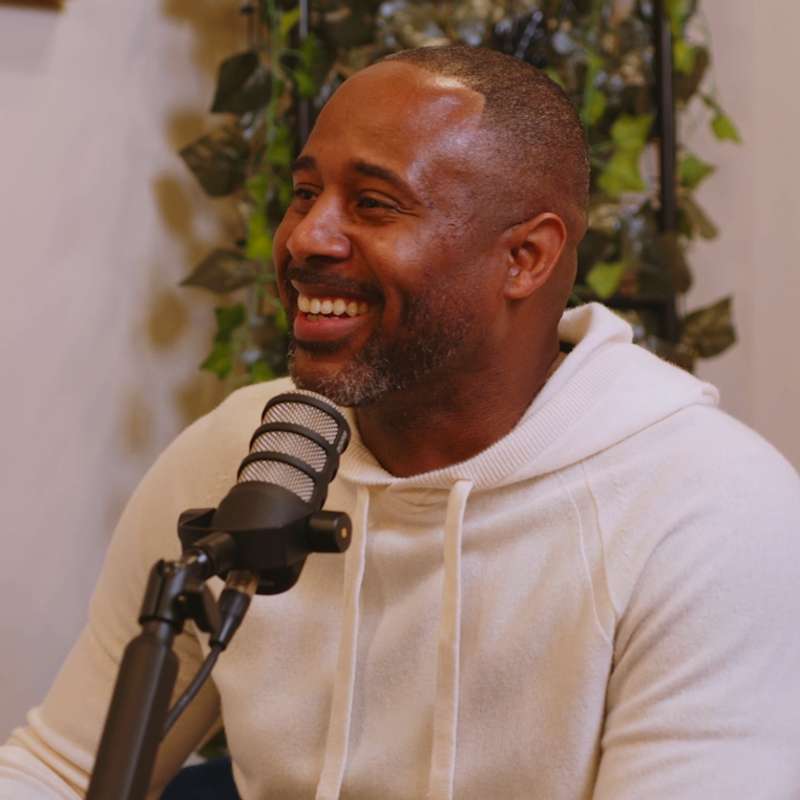
 Chris King
Welcome. Welcome. Welcome. I'm Chris King. I wanna welcome you to the When All Hell Breaks Loose podcast, where we are here to
give you practical tips on how to succeed and thrive during life's most difficult challenges. Now I am here with a great crew. I'm here with an exciting audience, but most of all, I'm here with an exciting guest. But before that, I wanna give a big shout out to DJ All Stars, spinning the ones and twos over here. And I want y'all to give a welcome, a warm welcome from the bottom of your heart.
I want you to put some stank on it as they say. Put some stank on it and welcome miss Marnia Mitchell. Now today, we have an exciting show for you. We're gonna be talking about transition. Now that's a broad topic, but we're gonna really hit it, and we're gonna really talk about some things. So let me just first say this. I'm a preface this. Look. If you're crispy, don't get mad at me. I might say something that you may not like.
I might say something that you may not be accustomed to because this is my forum. I got my wine, which I love, and I'm going to be relaxed. Now, miss Marnia, how are you doing today?
I am great, Chris. Thank you. Thank you so much for having me here today.
Chris KingAre you nervous?
A little bit. Yeah. Scared? A little scared.
Chris KingYou don't know what I'm a say?
I don't know what you're gonna say. Yeah.
Chris KingAnd I
have a feeling you're gonna switch it up on me. Yeah.
Chris KingI am. I gave her some notes, but you know what? I always fly off the cuff. But, hey, we'll we'll we'll be good. Marnia is a pro. She is great, and I want her to introduce herself briefly. Just tell us we're gonna be talking about transition today.
Mhmm.
Chris KingAnd, Marnia, we've had some conversations, and transition is your middle name. I call you a transition specialist. Yes, sir. So just briefly talk about some of the ways that you have gone through transition and what that has looked like for you.
Transition started day 1 for me. Born to, a mom who was engaged but not married, living with another generation of people, at 3 months of age, and, then matriculating at 3 years of age when my grandmother purchased her home, growing up primarily with her, in a small town in Southwestern Virginia in Martinsville. And, you know, having more education than social skills, being around more white kids and black kids per se, a grandmother who was extremely protective, but a lot of white parents who came along and literally claimed me as their own and guided me, onto the University of Virginia, onto New York, and then a crash course to Los Angeles where my mom was paralyzed at the age of 49 from metastatic breast cancer. So I shifted from New York to LA. She died 5 months later.
I flew her body back one way ticket to Virginia, buried her 4 plots down from her mom. I was 26 years old, back to LA for 10 years, and then eventually married, to Atlanta for a year, Gulf Coast, London, England for 3, back to Atlanta after that, and then, 3 years later, divorce. So,
Chris Kingyeah. Transition. Transition. Transition. And I the I talked to Marni and I said, you know, there's a theme. When I talk to people, I like to hear a theme. Yeah. What's the theme of your life? And I I immediately said, there's a theme here of transition. So I want us to really talk about transition, but transition from a sense of transitioning up.
You see, Marnia, you mentioned that you grew up in a in in Virginia, but a lot of white families took you took you in. Yeah. Now contrast that to me, I grew up in an all black community. Everything it was all black everything, black schools, black, little league sports, black church. And I hate that terminology. Right? But that's the reality of it. And then I transitioned to Des Moines, Iowa of all places where I think it was me, my brother, and, yeah. That's about it. Right?
You know, that was about it.
Just like
Chris KingYou know, just about 2. Right? I transitioned to Des Moines, Iowa, and that was different in of itself. But what I went up there with was a certain type of mentality that was passed on to me from black world.
Right.
Chris KingAnd so I had to transition into that space and try to learn how to be successful. And that in of itself was chaotic. It was a culture shock and everything in between. But you're saying that you grew up in a different type of environment. Right. So help me understand. Let's unpack that a little bit. Sure. So I'm I'm looking at you, Marnie.
Right.
Chris KingAlright? You know, you got your Beyonce hair blowing in the wind. Okay. Alright. Yeah. Alright. Stop. You got Beyonce hair blowing.
I love my peroxide. Yes. I do. Yeah.
Chris KingBut when you you you look like you're you're black. You look like me.
I am black. Right? I am black. I'm through and through. I know my history. I love my people. The diaspora of my folks.
Chris KingOkay.
But it was a way my my grandmother was in her sixties when I was born. She had been a nanny for a wealthy Jewish on Long Island. So by the time I came along, she and her elder sister and her husband, I'm the baby there with them on a small farm in Southwestern Virginia, and I I liken it unto, like, a Montessori school almost growing up. And it's funny. They rude me differently than they did their own kids.
But in still, she would say to me, okay. I'm gonna show you this a couple of times and you better have it by the 3rd time because I'm not gonna be with you always. So it was like a mix of of hovering between multiple worlds. So I knew I was black. I was with black folks, but it was just interesting.
Educationally, I topped out with the white kids whose parents were lawyers and doctors, and those are the people who were my friends. So whereas you had the flip in Des Moines, I had the flip at UVA where I was meeting black educated wealthy black kids.
Chris KingMhmm.
And that was a transition for me. Black sororities and fraternities. I had a counselor at my high school who wanted me to attend an HBCU, and I'm like, they would have killed me there. Like, I I wouldn't have even known what to do. I mean, I love them, you know, all praises to them, but that just wasn't the thing for me.
So at UVA, I already knew the system. I knew what to do. And even there, I never had a black roommate. My 1st year, my roommate was from was Korean. My 2nd year, I lived with all women, multiracial. 3rd year, I had a room by myself. Then my 2nd semester, here comes another Korean student. And then my 4th year, I was an RA for a hall of all white girls, 1 black student, 1 Indian student. Wow. So it was almost like, I don't know, the fates of the university just never had me with my people.
I mean, now going back for black alumni weekend, which UVA claims to be the largest, you know, HBCU inside of a PWI. That's our claim to fame. I love it and I enjoy it, but it took me a while to learn how to be there. And it's not like my grandmother steered me from it. It was just that the people I was constantly around and with whom I studied and I excelled and I competed, they just did not look like me.
Chris KingWow. So I'm thinking about my experience and there were certain rules that I grew up with. Right? Growing up in black world, there were rules. My mother was from Mississippi. My mother and father, they're from Mississippi and my father lives on the land that the it was the family land.
You
Chris Kingknow? And, you can still go back. And it was a it was a plantation. So historically, it was a plantation. He bought a lot of land there, but there were rules that I was given. Number 1, it was, you know, it it was basically rules that about competition. So I played basketball in college and everything was about competition. It was about don't let those white boys beat you. Right? Everything the interaction between black and white was really about competition.
And then and from a dating standpoint, it was like, if she can't use your cone, don't bring her home.
My god.
Chris KingYou know? But not bring her lighter at home. Yeah. And I used to tell my mom, mama, you will never catch me. Yeah. You won't catch me. Yeah. But, you know, you'll never catch me. Right? But but that was the rule. So there were rules that I was given. And then as I'm transitioning, there's some things that I'm thinking about, and that's in the back of my mind. And it's it's I'm not I'm not sure if at that time it hindered
Mhmm.
Chris KingOr if I was just at that time, just really just being defiant Yeah. Just for the sake of being defiant. But it may have hindered how I showed up in the rooms that I was now being accustomed to and being invited in. But with you, you grew up where people were taking you in Yeah. And helping you. So help me understand some of the rules that you were and the beliefs that you were building along the way and how later on that was challenged.
I was one of the first kids, I'd say, in my community where I was with a grandparent at that time. So a lot of the black kids who had, you know, 2 parents, it was like I was kind of I felt like I was an outcast to them. And on top of it, my grandmother was very strict. She wouldn't let me sleep over at anyone's home. It was only always with family or school activities.
And, plus, we didn't have a ton of money, so I didn't play a lot of sports. So for me, it was student body government, marching band, stuff like that. And the competition for me was books. So when these my rich white friends would go off to ski during winter break and, you know, some island during spring break, I would walk to the public library, get a VHS tape about Hawaii and watch that. And then I would study because I knew I had one teacher who was always gonna do a pop, wink, and a nod quiz because we always knew it was coming.
So my goal was people who were failing with the curve, it would become a c. But I was gonna get that a, and I was gonna get both extra credit questions so that I had a real a, so they were failing. So the negative nasty eye I got was legit. But guess what? I was competitive because I got everything right.
So that's where I competed in the realm that I could, the books that were available, and what was accessible to me and my imagination. So what you were talking about the rules for me, it flipped. It was when I got to Virginia and again, it was like black world at UVA And I I just I wasn't used to that, and it was an anomaly. It was only something I'd seen on television. Now it wasn't like they were negative or nasty.
I think I was more of a separatist because I didn't understand it, and it was very uncomfortable. I'd only really dated 1 of 2 guys in high school. There was a white guy I liked who wanted to take me to my high school prom. But because we were both student leaders, his mom and my grandmother had met in the grocery store and agreed I could we could go to prom together. Allegedly, the vice principal got a call from some white parents saying, well, that means black guys are gonna wanna take our daughters, which they didn't know the white cheerleaders were probably already with the athletes.
But, that was a a hold was put on there.
Chris KingYou know what?
He was called to the principal's office.
Chris KingI can attest that that's probably true.
All I was to that part. Okay. And all I was told was I can't take you to prom. And I didn't know the answer to why up until our 10th year high school reunion when I happened to come back for a funeral to town. And I just I just bought an extra dress just in case I happened to go to the reunion.
And John and I sat down and talked and he told me what happened. But for all those years past high school, I never knew why he couldn't take me to prom. I ended up going, but it was somebody I didn't like and he liked some other chick and it was just drama. So
Chris KingWow. So it's it's funny because as we're talking about transitioning Mhmm. I think about as we transition and we're talking about our experiences as we furthered our education.
Right.
Chris KingRight? And in community in various communities, definitely in my community, you know, I'm not my I'm not the 1st generation college graduate, but I know many people that are. I even know many people that are first generation high school graduates. And so as you move up and you transition and you're growing and you're bettering yourself, you start to find doors opening to you. And there are moments where you have to adjust.
Right? Because I went to this the university that I went to, 1, because it was as far away from home as I could possibly get, from Houston, Texas to Des Moines, Iowa, without my mama catching me doing nothing. Right. Right? So I went there for that. And then also, I knew that the world was not black.
Yeah.
Chris KingSo I wanted a different experience. And being invited into certain rooms afforded me that experience, but I felt like I had to act a different way.
Yeah.
Chris KingYou know, you you hear the word code switch. And code switching, for those that don't know, I'll tell you if you're if you're white and you got black friends, they don't really talk like that. Right? They, you know, they they they code switch. Right?
They they they they switch to to be sometimes less threatening. They they switch to fit in. Because a lot of times, you may be the only person of color in the room where you are. Correct. So I want to understand your experiences with being in certain rooms and places that you may have been the only one that looked like you, and you had to what you had to do to try to fit in, and what that made you feel like.
Initially, it was really challenging. Our one memory, came to mind. I was, a beta club inductee in the 8th grade. And I had the clothes like the white kids, and, you know, the polos, and the wrap skirts, and espadrilles, and all the things. But when we had the reception afterwards in the library, there was nobody there apparent to represent me.
So I had to hold the position of student and the position of adult with the mothers who I didn't go to, I didn't know what a country club was, you know, I hadn't been skiing in a chalet and all the whatever. So it it was interesting, and a lot of times I was kind of back in a corner and just being smiling and nodding and being kind, but I I I didn't initially know. I would just watch and observe and listen. Another memory, I couldn't have planned this if I wanted to. The University of Virginia, I happened to be in the president's house and there were some deans there with several students.
I was the only black in the student in black student in the house. I had no idea there was a black student union march planned up to the president's house. And here I am inside at the same time, and I'm seeing them marching up and I'm the face in the window and then, you know, president O'Neil, last year there as as our president at Virginia, and and the deans are looking at me and they're asking me what's going on. I'm clueless and I'm just trying to be the interpreter on the inside of the I was like, how did this ever happen?
Chris KingYou gotta speak for all
things black. God. Yeah.
Chris KingAll things black.
And then I thought some of my friends saw me inside, so now I'm, you know, the turncoat. I'm like, but y'all didn't let me I didn't get the memo, you know. I didn't know this was happening. So it there there have been some interesting situations and I think I've gotten through it in just being a human first, and just being a a person who could communicate. Yeah.
It's been frustrating sometimes being in the midst of both things I don't understand, I didn't learn the slang. A traveling dictionary salesman sold us some books one time and I remember the first time I heard the word ho. I go to the dictionary looking it up. I had no idea it was w h o r e. I'm I'm in the h o h o e. I knew I, like, knew nothing. So, it's it's been a journey. It's been
Chris Kinga journey. So you were that black I was a black nerd. You were black on the outside.
Yeah. Yeah. Yeah.
Chris KingAlright. I mean, so now with that though Mhmm. Given how you grew up, tell me about what your experience is like with black folks, because you grew up different. Right?
Well, I had older black people always around me who like the first black pharmacist in our town. His widow lived at the end of our street. The black physics teacher lived at the end of our street. All the black people on my street were entrepreneurs. He owned his own paint company, owned his own service station.
So my grandmother made sure I spent time around them and their families. So again, I knew who I was, It was just the fact of the younger black kids that were my age, I had nothing in common with them. I had no interest. I had nobody to take me anywhere to do anything social unless I went with a cousin or something. So it it was just very and I had no siblings.
So it was just very different in that way. I knew I was black, we played Martin Luther King speeches in my home, I I respected Arthur Ashe, we had Wimbledon on, Calvin Pete, God rest his soul when golf was playing, I knew exactly who he was, the green the green jumpers in the masters. I knew who all those people were, respected and honored them. It just the limited access to somebody who When you grow up with older people there's an expectation of how you carry yourself and what your interests are.
Chris KingRight.
So again, it was generational and not so much racial, but it it I just fell somewhere in the gap, somewhere in the middle. Yeah. And nobody else who, you know, had a mom that was not there. Right.
Chris KingBut yet
she was in a bigger city and she sent me back beautiful clothes and books. Literally at 7, I had a reader's digest, Ebony, Essence, and, Jet Magazine subscription in my name. And those came to the house, and I read those. So it was just it was just a whole different world that was set up for me.
Chris KingWow. We have to actually explore another topic later. Just remind me, because what you were exposed to to was different. I was exposed to Jet 2
Okay. For page 42.
Chris KingPage 1, 2.
I'm sorry. Does Lamont Macklemore mean anything to you?
Chris KingNo. It didn't mean nothing to me. It just I
was the photographer for the Jet Beauties, everybody.
Chris KingI just knew Detroit. I knew Houston. Dallas has some great Jet Beauty. Oh, and DC has some great Jet Beauty of the Weeks. It was the Beauty of the Week for me, so I'm just I'm just saying. But, I digress.
Yeah.
Chris KingBut but but but with that being said, there's that element of you you know who you are, but in society, you don't fit in on one side and you don't fit in on the other. Right? It's like you're not white enough over here Yeah. And you're not black enough over here, especially from a generational standpoint because you were exposed to something that was different from people your age at that time. Right?
So it's almost like the element of dual consciousness. Right? It's like I exist here, but I don't know exactly where I fit in. Alright. And so for me, as I started growing and going through corporate America and you know, I went to Drake University in Des Moines, Iowa.
Now there were slightly more than 2 black folks. I was being, you know, a hyper I was speaking hyperbolically there, but, you know, you know, pledging a black fraternity and things of that sort. Having all of that history in my family, just being able to navigate that, as I came back and I started to interact, I started finding myself in the only one in certain rooms. I'll never forget going to a conference and I was working for a large technology company, and I was the only one only black male in my role across the entire United States. Wow.
And I didn't have anybody I could do the head nod to. I was just like, you know, because you know you don't even speak. You just walk past me, like, yeah. It was a brother. I see you. Yeah. But but I didn't have anybody like that. I was the only one, and so I had to I felt like I had to play a role that was exhausting. Now real talk, I didn't really know myself like that then. Right?
I was trying to discover myself. I was trying to, I was letting my my success at that time, my education, my, my job, my career define that
for me. So may if I may ask you a question. So in that case, what did you do? Like, how did you, like, play that off or manipulate it?
Chris KingYou know, y'all are real good about throwing questions to me when I'm supposed to be interviewing y'all, but, you know, I will let you I will let you ask me that.
I appreciate that.
Chris KingYou know, I didn't woah. I had some it took me some time.
Okay.
Chris KingRight? I had some slip up moments. Right? Do share. Okay. Now, a slip up moment in the culture, like when you are in the midst of, you know, your white counterparts and you are a black brother and you slip up, that's called a nigga moment. Okay? So that's what that was. So I he he I'll just share I'll share one. I was in a meeting.
Okay.
Chris KingOnly well, actually it was 2 brothers. My my my buddy Rodney, he's still he's still kicking. He's a good brother. He was next to me and they were going through a project and task that they had assigned. And they said, Chris, you were supposed to do x y z. You know, what's the status? I said, yeah. I've been and done that. And Rodney looked at me. He he kicked me under the table. He was like, what'd you say?
Evonics.
Chris KingI said and I and I repeated it again. I was loud. I said, I've been done done that. And everybody looked at me like all the white people was like, what the hell did he just say? And Rodney was hitting me. He was like, boy, if you fix fix it. And I was just frozen. So I had one of those moments, and I at that point, I was like, you know what? This is exhausting. Yeah.
Having to come up with all these rules that mama gave me and that society has given me and that everybody else is saying to do this, don't do that, and, you know, be with this person. You can't talk this way. And I was like, you know what? I'm tired. Yeah.
I have physically been exhausted trying to be somebody else in the midst of other folks, and I don't care who it is. So the reason why we wanted to talk about this is because as we're growing, as we're growing in our education, in our fields of interest, as we're growing financially, and and doing all this growing at impact and influence, we're gonna be in rooms that we may not have been accustomed to growing up.
Right.
Chris KingWe're transitioning up as I say. And one of the things that I had to realize, to answer your question, is I had to realize that if I'm invited in the room, I deserve to be there.
There you go. Yep.
Chris KingThat's the first thing. If you are invited, don't let anybody make you feel like you don't deserve to be there. You you're supposed to be there. Right. And so you're not invited because you act like somebody else. You're invited because of who you are. Be true to that. Stick to that. That's why I love this person. I'm not y'all might trip on me.
Cardi b. I love you, girl. I love Cardi b because Cardi b is just crazy. Everybody knows she crazy, and she acts crazy. But and she can be that way, but I just say you have to just stick to who you are. Yeah. And that was the thing I learned. It took me a while to learn that lesson and I really I think I struggled even in my career, trying to be somebody I wasn't.
Yeah. I think placating the room, not sharing who you really are, is it a safe place, are they gonna understand me, are they gonna judge me? I mean all all those things. Yeah.
Chris KingYeah. Absolutely.
Time and again. Yeah. And I think even growing up because my situation was so different, Yeah. I was in the midst of, you know, my white friends but there were things I couldn't talk about because I had parents at home. Right. And, you know, it was like something that was so foreign to them. So, yeah, there were there were a lot of lonely moments. Yeah.
Chris KingYou know, one of the things I had to adjust is I naturally thought all white people were racist.
Yeah. No.
Chris KingAnd you didn't grow up like that. No. Right? You grew up the opposite.
Mhmm.
Chris KingBut in our conversation you told me about times where you had that shock to where Yeah. You had to experience it.
Yeah.
Chris KingRight? What was that like?
It it sent shock waves through my system. I, there was one, a stationary company that I had worked for, and I rose to greet them as they came in because we did retail in addition to printed product. And I was welcoming the women as they came in. And as soon as I saw their face, I knew. I was like, here we go.
So I was like, hi. You know, welcome in. And and the greeting wasn't the same. And how they walked in, how they slammed their purse down. They were looking at some intricate Italian paper that the system was very, very complicated in what to pick and what to match, etcetera. So I went over to offer to help them. And, you know, a couple of questions. What type of pen? What's the nib? Color?
Da da da. All the things. Why do you need to know that? I mean, just nasty responses. And then I asked a couple more questions. I continued on being my professional self. Didn't matter. She was like, I'm gonna grab my bag and scream and run out of here. And I'm thinking, oh my god. This is the same me.
So the owner of the shop happened to be there that day so I quickly went around the other way and went into her office and sat. She's a Jewish woman. She proceeds to open her purse and give me her American Express card and tell me to go across the street and get something to drink to calm my nerves. I mean, she's of such wealth that she didn't encounter that. So to her defense, she didn't know what to do.
But she should have gotten up and gone out and told them to leave her store, and she didn't do that. And and first thing I thought about is this what happened to our indigenous Americans? Is that, you know, you got a problem. Don't complain. Just go get something to drink. And so I told her about herself. She and I had that type of relationship. I declined the card and eventually went back to my desk. She went and got another worker to come take the order. They had a $200 sale.
And I was just like, are you eff that that are you kidding me?
Chris KingThere you go.
Are you effing kidding? Are you effing kidding me? And I I was just, you know, I'm the same me. It was the ire of it all. You know, but it took a minute because I had to just sit for the rest of the day because anybody else who walked in, it's like, then you're skittish.
Chris KingYeah.
Because I'm the same me, but but it's them. They didn't know as a cousin explained to me, she's like, Marnia, they didn't know what box to put you in because you wouldn't fit into the angry black woman box because you weren't angry. You are black, but you don't look like anybody that's in their community. You are poised. You carry yourself.
You probably frighten them, truth be told. And they didn't know how to explain it so they just wanted you to get away as fast as possible. Wow. Now how old were you when This was just a few years ago.
Chris KingWow. So about 22?
Bless you. Yes. Okay.
Chris KingAlright. Yes.
Good good and grown. Good and grown. Yes.
Chris KingYou know, I, I I talk about the rules and my my dad often tells me stories of how when he grew up in Mississippi being hit across the head by police officers with with billy clubs. And my dad, you talked about first black pharmacist and and whatnot in your town. My dad was a pharmacist.
Wow.
Chris KingAnd so by the age of 27, he owned several of his own pharmacies. So I saw excellence in my family. And then he went back and retired, to Mississippi, bought up a bunch of the land. And you know what he did? He built a white house on that land.
I love it. I love it.
Chris KingAnd they they told him, what are you doing? Nobody builds a white house. You can't build a a black man can't build a white house. Yeah. Right? But this wasn't white people. This was black people telling them that.
See. Yeah.
Chris KingYou know, and so we have certain types of rules and things that we just cannot get over that keep us from being able to move into spaces that would really allow us to be influential, impactful, and really pursue what I believe God has for us. And those are the those are the people that I wanna really talk to today and just you know, if you find yourself, wanting to elevate Mhmm. And as you're transitioning, I I want people to really have some tips and we've told them, hey. Just understand that you are you. Be yourself.
But what's something else that you would that you've had to leverage that has helped you navigate during those times?
I would say going back to, the black alumni at the university. I mean, now we're older, more mature, so kinda like the beef or whatever you may have had in college has passed. Everybody's kinda had ups and downs and it's great that familiar relationships have been reestablished or newly established. I've been blessed since one of my big birthdays to go to Martha's Vineyard every summer and they are nothing but black excellence and literally people speak to each other. It's not the bougie thing that everybody thinks.
Yes, they are. That's not that stupid TV show. Sorry. But it's it's literally you see black children running free, shoes off, catching fireflies, cops not bothering anybody. I say always if Tulsa hadn't been destroyed, the months May through September is is that in Martha's Vineyard.
It's like the black excellence you see, and literally just starting up a conversation with somebody. I'd also say traveling. You'd be surprised who you can meet. Absolutely. And just start up a conversation with, I think social media, even joining certain groups where you have different interests, Sports. I'm an avid tennis player. I was a golfer for many years. Getting out to sports where normally we aren't there, and you'll be able to meet somebody who looks like you.
Chris KingMhmm.
And then you branch out from that area as well. Faith based groups as well. I did not pledge a sorority. You know, I love everybody. Go d nine. But even my friends, like, I come along, I support, I help, and even just a charitable organization, like, whatever it may be. You know, I think just getting involved as a person first and then linking up with brothers and sisters, people who look like you, who have similar interests.
Chris KingNo. That is excellent. All of those are spot on. I think we just need to really feel comfortable stepping out and doing it.
That part. And, you know, but sitting home is not gonna accomplish anything. You know, I I always say, you know, some of my lowest moments in these last couple of years and financially has been challenging, but I always give myself grace and time to do something I love, and that's moving my body. And that was finding an affordable tennis place to play and going and just cheering somebody on. And you'd be surprised once you say good shot, how somebody else will loosen up.
I think, you know, you have to start with that first step, getting up and getting out of your own way.
Chris KingYeah. And in in doing that, I I would advise everybody to take stock of what you like. Yes. Separate yourself from the noise of social media. Separate yourself from the noise of anything of what you think is appropriate Correct. For your age group or whatever. There are certain things I found out that I like that's like, you know, I'm kinda nerdy. Right? So, and once you find that out, go to those spaces and really just ask somebody their story.
Yeah.
Chris KingAnd if you ask someone their story, you start to find commonality.
Mhmm.
Chris KingRight? The biggest thing that I've learned to do and here's here's there's a game that I like to play. And the first thing I do when I meet somebody, I find a common bond.
Okay. Okay.
Chris KingRight? Regardless of whether they're white, black, Asian, whatever, find a common bond. And you can always find a common bond. I might start off by giving a compliment. I love the sweater. I love, you know, your shoes. Starting it and then find a common bond. Then find out something new.
Mhmm.
Chris KingRight? And then as you find out something new, you just start digging and just learning about and just be curious about people. And it will start to open up your eyes. But you also said joining the groups.
Right.
Chris KingRight? Being open to joining groups and being able to, get engulfed in those groups can help you navigate those those moments.
You know, and I'll even say, I mean, for some people who perhaps are more loners, just start out slow. If you just have to go somewhere out to eat by yourself and sit at the bar, bartenders are great conversationalists.
Chris KingYes.
They I mean, that's what they do. And then the person next to you, you're right, you're left, say hi, whatever. I mean, it's just something, you know, so easy that you can just, you know, or go sit out by a fountain or something. I mean, you you just or or the great thing if you have a pet. Walking having a child or having a pet, you're sure to meet some people.
Chris KingAbsolutely. Yeah. Absolutely. So we're talking about meeting people, but we're really talking about transition because as we're transitioning, it's important to have community. Yeah. Community is so important during transition because we were not meant to live life alone.
Correct.
Chris KingAnd I think that's where some people struggle because when you get into some of these places and you don't see anyone that looks like you or comes from your background, you start to feel like you're all alone and you can then, you start to fade into the background. Correct. And so we wanna encourage you to really engage and find as I tell my daughter, I'm so happy you're finding your tribe. Mhmm. Find your tribe, little things that you like, and get involved with people.
It helps during transition.
And something you talked about with rules is also, you know, a lot in the black community, vulnerability. Don't tell anybody our business. Don't tell anybody what's going on in this house. Keep your mouth shut. Blah blah blah.
You talk too much. But in the vulnerability of sharing, I mean, what you feel is safe, you find a common goal and more times than not somebody who will assist and help. At least an outlet if for nothing more than, you know, talking to a stranger at the tennis court, you'd be shocked what other people have gone through. Right.
Chris KingYou
know, I I I say in the midst of my divorce, and I'm very thankful to my former first lady, Martika Jenkins.
Chris KingShout out.
Shout out. You know, she didn't sit me down, you know, as most of the time you're going through a divorce, you know. She was like, no. No. You can stand up here, hand out these programs, tell the people I love them, hand them a tissue, and send them into the sanctuary.
But in that, she allowed me to stand through my shame, my perceived shame and guilt and whatever, and it was empowering. And a lot of times, I wouldn't even make it into the sanctuary for service. I would be standing alongside somebody else serving, and we would begin to talk. And what they shared with me, I was blown away by their story because they didn't look like what they've been through. And that would help me stand for another week or another day or another whatever was coming down the pipe.
So I think sometimes I kinda don't tell anybody, you know, don't be so suspicious of everyone. Everybody's not out to get you. Nobody has that time of energy, effort, or money.
Chris KingAbsolutely. They
would they're too worried about their
Chris Kingown stuff. You know, you mentioned that and in one of my toughest moments, I mentioned I went to school, Drake University, Des Moines, Iowa and I went to school with the mentality that white people were were racist.
Yeah.
Chris KingNow, my mother passed away during college so I didn't have any way of paying for school anymore. I had I was I had done some stupid stuff, got kicked off the basketball team, so I'm just spending for myself at this point. But I shared my struggles with someone and the way that I finished college was by the hands of a white man.
Wow.
Chris KingRight. A white man came alongside by hearing my story and he paid for the rest of my school. And the funny thing is is that it was said that he was racist. And so apparently, he had gone to an HBCU and he got the mess beat out of him at the HBCU And it hardened his heart.
Yeah.
Chris KingBut at that point, he had gone through life and he had been known as racist, but he came alongside me and paid for my education. And I became the 3rd or 4th black I think my brother was the first, black computer science major to ever graduate from that university
Yeah.
Chris KingBecause of a racist white man.
Right.
Chris KingAnd I had gone into the situation thinking that I can't trust people. If they're white, they're out to get me and everything else. Because on college campuses, you get all kinds of rhetoric and all kinds of stuff thrown at you. And so it's important to, 1, find community, to 2, be willing to share. Don't be so suspicious of everyone, but then also open yourself up to allow people to pour into you and be willing to pour into somebody else.
That's true.
Chris KingBecause as you were serving, you were lifted up and blessed in the midst of your your your chaos.
Yeah.
Chris KingRight? So all those all those things are important if you're going through transition. And so we're gonna wrap up here soon. I wanna get one last thought from you about how to deal with transition or some of the things that you have gone through that you wanna leave other people.
You know, I with transition, the the word that just keeps coming back to me is vulnerability. And they say pride goeth before a fall. It's really just letting the pride go. I think, you know, 1 or 2 trusted people, and and we all go through transitions. It's it's a function of life.
It's just really interesting when it hits your door, and you don't necessarily know how long it's gonna last. You don't know to what extent, and you don't know what it's gonna look like. I I just say, you know, have your tribe, you know, ready and here with you. There's somebody in here today who's part of my tribe who actually came along beside, did a silent fundraiser for me actually to help me pay my rent not too many months ago. And I was very thankful. It was very humbling. But
Chris KingYou know, that's the biggest thing I'm learning is how to lean on people. Yeah. I have several people here as part of my tribe, and they have talked me off the ledge. They have kept me out of jail. They have they have just really just blessed me in ways that they could never ever imagine, and you can't say thanks enough. So I just want people to understand that you cannot do life alone.
Exactly.
Chris KingThere's no way you can do life alone. You have to have a group of people. You were not meant to do it alone. So find that tribe. Open your mouth And when you're going through transition, let's not be married to the history
Correct.
Chris KingOf what we've experienced. Sometimes we're just married to the history or to the things that parents have passed down. And fear was passed down to me and I get it. My dad, my mom, Mississippi
Right.
Chris KingBack in the forties, fifties, it was not a nice place. But as I traveled the world and I began to meet new people, I allowed other people the opportunity to show me who they are.
Right.
Chris KingAnd I decided to show them who I am. And I've met some wonderful people along the way.
Yeah.
Chris KingSo I wanna encourage everybody. As we wrap up here, you'll always be going through transition, but god is really taking you trying to take you to another level. And as we transition up, we get better with with with some of the challenges that we're going through. And as we're transitioning up, you'll be invited into spaces that you would have never imagined, but you first have to just allow yourself to be used, be open, be vulnerable, have people around you, and to actually be willing to bless other people in the midst of your storm and challenges. And then as you transition, you'll never be the same.
You'll get some great people along the way, and your life will be blessed. So I wanna encourage everybody, send in your questions. There's a QR code. You can send in your questions. You can also rate questions. We will answer your questions. We will answer some live here with the audience here. But those that are watching at home or online, we just want you to send questions and be engaged with us. Join the community. This is the When All Hell Breaks Loose podcast.
We want you to like, subscribe, share it with your friends, family, share it with your neighbors, even share it with your enemies, but share it with love. Let them know to come to the When All Hell Breaks Loose podcast where life is worth it and so are you. Y'all be blessed.