


¶ Introduction to AI's Core Strengths
Welcome to What Happens Next. My name is Larry Bernstein. What Happens Next is a podcast which covers economics, politics, and culture. Today's topic is AI. and robotics. Our speaker is Myron Scholz, who is the Frank E. Buck Professor of Finance Emeritus at Stanford Graduate School of Business. Myron was awarded the Nobel Prize in Economics for his groundbreaking work in options theory.
I want to learn from Myron about why AI needs to work with humans due to uncertainty and the importance of exceptions. Myron's an investor and on the board of a robotics company that focuses on installing solar panels in the desert where laborers don't want to work. I want to hear about the challenges that robots have in these kind of assignments and how AI...
can improve their performance. Myron, can you please begin with six minutes of opening remarks? What is AI good at and what can't AI handle? It can summarize the past and make inferences based on past data.
¶ AI's Limitations and Human Creativity
It will not be able to handle the unanticipated or be creative or innovative. AI will help innovators to produce solutions faster, more individualized. AI will diffuse through the economy. AI will not produce massive changes all at once. Induction precedes deduction. AI systems gather data. They observe spatial relations.
They are the inductive mechanism. Under uncertainty, induction must precede deduction, as I said. We gather data. AI will gather data. And that data will be used to make deductions. A creative person knows, however, when to stop and can read from the data that they have gathered. The creative person sees the exceptions, the unusual. AI has to miss the exceptions or will need to help to handle the exceptions. The unknowns that are not in the data set.
For AI to operate, it needs data from which to provide an answer, needs to know the boundary of its computation. AI will reduce the cost to answers about the middle of the distribution. the typical. As well, AI systems must be built to handle the exceptions. Creative people see the exceptions and concentrate on the exceptions and not the middle of the distribution. In a creative environment, they are crucial.
We have chaos or disorder. Although AI will be able to handle massive amounts of history and cross-sectional spatial activities, such as depth and height, it won't be able to handle uncertainty and changing uncertainty. Because humans have the skills to do that. We have the skills to understand the exceptions and handle exceptions and analyze the exceptions. We can teach the AI to handle those exceptions, but there'll always be new exceptions that it must.
¶ Uncertainty, Models, and Human Skills
really handle. To summarize, under uncertainty, we model the world around us. If we were certain, we don't need a model. It is a fact. Under uncertainty, models are an incomplete description of reality. AI can help us reduce the error of our models by allowing us to access more data quickly, suited to analyze our problem, and then we can gather additional data.
AI can help us increase the dimensionality of our model, that is, make it richer. AI won't be able to tell us whether to ignore the error with a new result or to incorporate the new information from the error. AI must worry about data mining, that is, using past data to build a model. Model might fail in the future because it was built only using data from the past, which is the incomplete description of reality. Time is really volatility time.
With low volatility levels or low levels of uncertainty, we have more time to adjust our models and gather new information. With increases in uncertainty, however, time compresses. The more volatility we have, we have to make decisions. more quickly. And sometimes with extreme volatility, nothing works. The model fails. And when the model fails, time stops. The errors are not normally distributed.
The exceptions are tails and changing circumstances are the most important considerations. We as humans can handle those more important considerations after analysis and time to digest them. AI will fail here. And so we have to train AI in how to understand the exceptions to the model it is using and how to erect it on a different course or model. The fastest way to evolve... AI systems is to let it discover what it does not know. Humans are creative.
They create through the exceptions. Einstein had his physics books, and he read them in his patent office. He read them all from past scholars. And just as AI must read physics books from all the past and current scholars. But he saw there was something wrong. There was something that he needed to address. And he developed a new theory.
where no one had thought about that before, even considered the possibility that energy was preserved. So as a partner, we'll work together and we'll create a more efficient system.
¶ Robotics for Solar Panel Installation
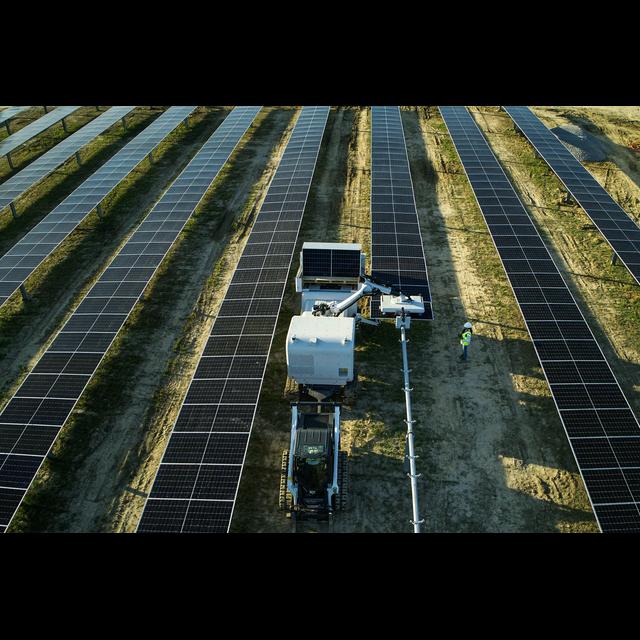
You recently invested in a robotics company. First, let's talk about what that robotics company does, and then I want to apply the model you've given us for AI to the problems that the robot faces. I became very interested in robots because of my desire to foster a movement towards more decarbonization. So I invested in a robots company to install solar panels.
Why? Because solar panels need labor, and labor is very expensive if you can even find it in areas that are not hospitable to human beings generally. That's how I became interested in making my investment initially, the marriage together of robots that can augment labor in areas where labor is very scarce at the same time to be able to.
install solar panels, which are very valuable for our society generally. There are these solar panels. They have to install something into the ground. A stand. A stand. And then they have to, to that stand, put up the mirror and then take some screws and tighten them up. Tell us about the challenges. that a robot faces to do what would otherwise be pretty normal human tasks. Well, I've learned in interactions with the robotic scientists and engineers that you can make a robot.
to be a general robot that does myriad things, but that's very expensive and also becomes very inflexible. The process of the future with AI and the robotic design is actually to make the robot idiosyncratic. So one robot would bolt the panels in place.
and able to extend itself or contract itself depending on the height of the panel. Another robot would be able to lift the panel off a card and put it on the stand. And a third robot, which is idiosyncratic and individual, eyes would be able to push the bottom to put the pole into the ground.
¶ Designing Idiosyncratic Robots
And a lot of technology is evolving in the direction for making it idiosyncratic and not general, as I said. You need to have a robot that has skills. It has to be able to move itself, move its arms, have visual things, be able to figure out what it sees and to be able to act on what it sees. And it also might have touch and what it touches and do various things.
And it has to be able, if you're installing solar panels, to work at night, you have to work in the daytime, you have to work under myriad conditions. So I call these country robots and not city robots, which are going to be in your house. and you would instruct it to make your coffee or fold your laundry. So the first step is to design the robot.
for the task involved, not to design a general robot that can do any task. Many people are building robots that don't know what the robots are going to be used for specifically. So the interesting thing in developing a robot is you need... You need a general robot to do things, but you need one that's trained in domain specificity. What I mean by that is they know what their tasks are going to be and you train it to do those tasks.
So why you need to train it is because there's not general knowledge. A foreman who's going to work with you as a worker or a laborer has to train you to do the specific task, and they have the expertise to do that. I wanted to find some terms for the audience. The first is this concept of idiosyncratic versus general. As I understand it, idiosyncratic means that it's a very specific task.
General means it can do lots of tasks. And with regard to idiosyncratic, let's use an example from our stand. So we have a solar panel and we have a stand. And the task at hand is to take a bolt. put that bolt on the stand with the panel and fasten it appropriately. The torque necessary to do that has to be uniform all the time, so you have to teach the robot.
the torque that's necessary to do that for that specific task. One of the difficulties that's found when human beings install solar panels is they don't provide the same torque all the time. And sometimes too much torque in it, that paddle flies off because the bolts break in the future or the paddle flies off because there's not enough torque. So the beauty of having a robot do that.
is that the torque would be the same all the time. This idea of putting in a bolt seems like a relatively easy project, but in reality it's not. You've got to find the hole and then you've got to put the bolt on the screw. But it's very bright. The sun is glaring off of all sorts of things and our poor robot. is confused by the glare. The bolt is over here, but it's not. It's over there. And we now have an error term. We're stuck.
¶ Human-AI Problem Solving in Robotics
And now we need the help of a combination of AI and humans to get the robot back on track. Take us through an error. and how technology in this form of people and AI can solve this problem. One of the interesting things in AI is it can address.
the database quickly and efficiently and very fast to change and to ask questions and very fast to alter what it does. But the beauty of having a domain-specific robot such as installing solar panels is that the foreman can be asked by the robot when it has an exception which is the key to AI is having a large database.
repeated tasks, information from what other robots supply, etc. So that's the database in which the robot will now decide how to do things that it sees that are different or exceptions. It will be able to address the database to find. exceptions of others and how a foreman had treated them. But once it sees an exception that AI cannot provide the answer for, they'll ask the foreman for advice on how to do something different.
time and information that could be used in the AI system to judge the efficacy of what the instructions the foreman is giving to the robot. Because once you accept it into the system, it becomes... The dogma, the dogma of what's going forward, but it's this interaction, exception upon exception, interactions accepting exception, learning how to do it, which AI can be helpful in, but human beings have to be involved with because...
their creative. I'm going to repeat that back. Our task is to put the bolt on a screw and fasten up the solar panel. Because of the glare, it's struggling. And the first step is it may ask the AI program, can you give me some advice? I'm having trouble. Here's the factors I'm seeing. Here's the conditions I'm in. What should I do first, second, third, and fourth? Give me a list of priorities. And I'll do those.
But it still fails. It still is unsuccessful. And then it calls out to the foreman and he says, I see it. Here's what you're going to do. And then it informs the AI that this was an error. AI tried and failed, which is fine. And then a human being was able to give it a better result. And then AI would be informed of that so that in the future, it would consider that as a potential option.
¶ AI in Customer Relations and Digital Twins
Many companies are looking at using AI customer relations over the phone. And the AI will be informed based on tens of thousands, maybe even millions of conversations. Customer wants to open a new brokerage account. And then they ask, well, is this individual account or a trust? Oh, it's a trust. Okay, fine. Is it a grantor trust? Is it a non-grantor trust? Is it an American trust? Do you know who the trustee is?
What are your objectives? In the previous example with the robots, we were in a physical environment doing a physical task. And when we're in the brokerage firm, we're trying to fill out at the end of the day a brokerage opening an account form. But it's really not a physical task, but a mental task. Tell us a little bit about the interrelationship between humans and...
these AI programs to achieve any task. One of the interesting developments that have been done in manufacturing that there is this thing called the digital twin. And the digital twin is a simulation. of a physical process. That model is put into the simulation and then basically it's perturbated and there's an error to the model essentially. In the idea of filling out the brokerage form or asking questions about your account, you have a simulation that's being built, okay?
And the interesting thing is AI will help you in building that simulation faster. and be able to answer questions about it and potentially reduce the error of your model that's put into the simulation because you're trying to design something that can be applied broadly. In fact, with AI, it'll help you code or help you create ways, as I said earlier, will move you closer to a solutions focus and away from a product.
Program changes more quickly, be able to answer questions more quickly and more richly because it'll have domain expertise that it's developed.
¶ Human Role in AI Learning
From the simulation, now that it's applied directly to a physical system. Everything we do in life goes from our brain thinking about a model and then implementing it in various activities. AI speeds us up. because we can address large databases and get the average, you get the typical more quickly, whether it's robots I talked about previously or in your brokerage accounts, exceptions will always come up.
People will be unusual. Some question that the person will have that it didn't understand or didn't hear before. So then the AI system, that's the co-pilot we hear about a lot. Someone has to teach the co-pilot and keep training the co-pilot to do better. And AI can do that because you can program more efficiently and more jointly, have AI working for you to do things faster and give the average solution in the middle of distribution. But we have to realize.
that everything in life is also the exception. And so the AI system has to be trained to say, I don't understand this. This is an exception. and not just gloss it over. But right now, we're getting these things called a lot of hallucinations, which is making up the answers. If life is always changing and new information has occurred, that's what makes us.
grow, that's what makes human beings so much fun, is we think about the exceptions all the time. How are we going to learn from the exceptions? How are we going to change what we do from the exceptions, or not change from the exceptions we have, or to worry about how we expand?
the dimensionality of what we're dealing with so in the system you described which is the brokerage house accounting or asking for information It will speed up the process and get rid of a lot of the infrastructure, which is a constraint on the system, by reducing the constraints with always the fear that we have to worry that the system is not sufficient.
¶ Human Intuition Versus AI Navigation
and has to be planned in terms of having the exceptions. I had on the podcast the Dean of Computing at Georgia Tech. And I asked him about the interrelationship between humans and AI on that program. And he gave me two interesting examples, similar to what you described. His wife works at Princeton, and he's a professor at Georgia Tech. So he goes to Princeton and then spends a week there and then drives back from Princeton to Atlanta. And...
He always goes the same way, basically. He takes I-95, and then around Washington, D.C., he takes another highway and heads west. He's worried about traffic, so he put in ways Atlanta. Waze came back with a route that he had never considered. It would save him five minutes. And it turned out it was a superior way because he could speed through West Virginia without getting caught.
And it also reduced its variance because there's always traffic on 995 and it seems to be come out of nowhere. The second example, you're in Santa Barbara and you want to go to Disney. And you're driving on PCH. And you see traffic being a disaster and ways of saying to get off and take a different route. But you look ahead and you see that there's like a wildfire and you're like, wait a minute, I don't want to get off.
and find another route to Disneyland, I want to abandon Disneyland as a goal and objective and come up with a completely different goal and objective. And AI can't do that. AI can't recognize the environment and that the problem has changed. It's like Apollo 13. We're no longer on the moon. Our new objectives get home. What your example exemplifies is the idea that there's history, which is the data we put into the AI system. But the important part...
is not only the data from the past or cross-sectional information that we have, but what is the signals that you use? What is that? signal that today to tell you what the unusual is or the exception is. The forest fire, the fire that you have is the unusual. So you have a signal. Use your eyes and say, I see that. That is completely an exception. So the same way as I talked about my robots, okay, that...
If they find an exception or something unusual, an idiosyncratic exception only to that one event, how do I inform the general system that it should make changes going forward? And that's exactly what a model is. tells you. An example I like to use, and I know you're a good golfer, is you then have all the theory and read books about playing golf. So you have a model, but the model has an error, just like intuition has an error. And then over time...
You garner additional information to reduce the error of your model, which gives you a much better approximation to the average of what you should do most of the time. But occasionally you get a draw from that is an error, an unusual event. And now do you ignore it or do you recalibrate your model? Pro golfers understand that their skill level and the dimensionality of their model is much richer.
But the professional golfer uses much more data and much more precision than you would ever do in playing golf. But the interesting thing is it weighs the same way in bringing in information. that it is using crowdsourced information to inform you. But when you get closer to your house, you know, where you know where you're going to go.
that basically probably don't use Waze or if you ignore it because you have so much information. But how do they get to your home? You don't use that information. So that's what the beauty of AI is to build you an average system or a general system. But you can know the exceptions and your model might be slightly different from the Waze model or from other people's model.
¶ Rethinking Robot Design for Efficiency
We had lunch with the founder and CEO of your robots company at the Stanford Faculty Club a while back. And during that lunch, one of the things that struck me was that... you were going to use the same stand, screw, bolt, and solar panel as when we had the man do it. And it didn't seem right to me. The human and the robot have different sensors and different understandings of the physical world. I was thinking more in terms of eyes. And there's this glare problem we have to deal with.
And so what I would have done is maybe make a much bigger hole with a much bigger screw, much bigger bolt. And I would have put in glitter. Making like an arrow from like four spots in different colors pointing to the hole where it belongs so that a lower grade eye could appreciate.
with a lower error rate where the hole was. In this project or in any project, things were originally designed for a human. That doesn't mean they shouldn't be designed for a robot that has its own problems, its own error terms to deal with. Humans have error terms. Robots have error terms. There are different functions. Let's design some things that are for humans. Let's design for robots. That's entirely correct. You're bringing up the idea of a specific application installing solar panels.
Now, the robot that is designed to install the solar panel doesn't need to be a humanoid robot. If it's going to be in the field, okay, then it needs to have maybe a better design would be to have one which is on. tractor treads. And when we put a robot on Mars to try and wrap, we didn't have a humanoid robot. We had one that was functional for that particular activity. That's the beauty of designing something for a specific task.
as opposed to something general. There's a large use now of general robots, but they're all humanoid, or most of them are humanoid based on the idea that we don't know exactly what they're going to be used for. So the future... and really designing robots correctly is to think about the brain of the robot and the physical robot to be integrated. Then you can have a much more efficient application, the robot that does the solar.
panel bolting could be different from the robot that puts the solar panel on the stand because the robot that puts the solar panel on the stand has to be stronger and be able to lift the robot. that's idiosyncratic and can do the whole thing has to have different skills, visual skills, and have much better sensors to be able to distinguish things from the robot that's only job is putting.
the solar panels on the stand. This flexibility and ability to have flexibility is very valuable. You make it general and it becomes hardwired, so you end up... in a situation where you can't handle the uncertainty that I referred to. So when you know something for certain and exactly what you want to do, you can make it as specific as you want to do the task. But when you have...
Not as much certainty, you move it towards software. And everything we do in evolution is moving things towards software from hardware because of uncertainty and the demand for flexibility. So in designing the robots, you're... talking about or designing any AI program that's going to help. We need to worry about flexibility because of changes on uncertainty, changes in knowledge. So the beauty of the digital twin or the idea of having a simulator.
mode and then the robotic information through AI feeding the digital twin, it enables you to keep judging whether you should make changes, how to make changes, how to do it efficiently, so it increases the efficiency of the system.
¶ Evolution from Fixed to Flexible Robotics
I think it was 30 years ago now that I saw a documentary film by Errol Morris called Fast, Cheap, and Out of Control. I don't know if you saw this movie. In the movie, it was about four different characters, and one of them was Rodney Brooks, who at the time was head of the robotic department at MIT. And 30 years ago, our computer systems were lacking. Our software development was in its infancy. AI didn't exist. And as a result, the robots were not that smart.
There was a challenge done by NASA where they were going to Mars and they wanted to do a simulation on Earth to encourage different robots to go large distances. And so they were going to start on one part of Nevada and then another was the competition. And they asked scientists and entrepreneurs and technologists to develop an approach. And what Brooks did...
was instead of doing one large robot from lost in space, he decided to go with nature and use a very, very small robot, but lots of them. And he used something in the shape of a brass hopper. And they jumped straight ahead and it made an obstacle. Then it had a very simple brain and said, okay, if that didn't work, how about we go 90 degrees to the right and then 90 degrees.
and then make it full circle and then keep trying. And sure enough, Brooks's grasshopper robot won the competition. And the essence of fast, cheap, and out of control is that. It's a cheap robot. It's fast. and is out of control, seemingly random in its application. There were limits at the time. There were limits on software. There were limits on AI. There were limits on a brain. And so you chose to de-emphasize the brain and go with something else. But now...
As brains are developing, well, we might as well use them and use them productively. So take us through fast, cheap, and out of control and the radical improvement of the brain. That's a brilliant illustration. idiosyncratic and why not think about how to use the error and learn from the error. We think that robots are big physical things that will do one task efficiently, like stabbing the car frame or lifting it out.
putting it on the card. I went to Shandu many years ago, and I was in, Shandu's in China, and I went to their OSCOMS facility. And Foxconn's facility was making iPads. The room was maybe a couple hundred meters long. And at one end, iPad parts came out and robot, robot, robots were all integrated together.
and iPads would come out the other end, completely finished. And so I said, oh my gosh, I realized immediately and looking at this, that if they ever had to change this line, which must have cost them. monster years to assemble, it'd be so expensive they couldn't do it. But Apple had to guarantee for them that they would have enough iPads to justify.
The fact that they'd have this production line, which was set in stone. So Apple and Foscom made a hardware decision, which is very inexpensive, very efficient. Bang, bang, bang. iPads would come out.
But if they ever had to change the system or change iPads, then it would be necessary to reassemble things. It would be very expensive to change that line. So over time, what we're seeing is... moving away from the fixed production robots, the stamping things, or the fixed Floscom line, to make things more flexible.
to handle uncertainty. And uncertainty is not just drawing from nature, but uncertainty is also how things are changing, how demand can change, how new information comes along that were completely unknown at the time.
¶ AI's Role in Behavioral Economics
Daniel Kahneman was awarded the No Bone Prize. In his work, he noticed that humans were making mistakes and not learning fast enough from them. I'm interested in thinking about that set of problem sets that Kahneman's referencing and how AI will assist us to get around these sort of errors. Hahnemann and Jabersky obviously had the fathers of behavioral finance, the idea that individuals make systematic behavioral decisions, which are different from what you would have, but completely economic.
basis or on a basis in which you look at the probabilities and look at the outcomes. For example, that individuals would have more loss aversion. You know, they wouldn't want to take their losses without women to take their wins. The interesting thing about that type of activity, which I am going to AI and doing with AI. is that it's a learning system. So there's repeated information, repeated games. It'll address historical data.
If the exceptions are handled correctly, they'll learn more from what it's learned. So in a behavioral environment, if you have one... play of the situation or one play of the particular decision making it's far different than when you have repeated plays of the situation and that's number one number two is that the reward that you're given if you're doing experiments at the university or with students of getting a small amount of money.
is the larger the amount of money that you have to deal with, such as industrial processes or the brokerage house example or the robot example that I talked about, then it really pays to. Think about improving your model or what it is you're trying to do to make profits or supply services efficiently to clients that are in their best interest. And so I think it's a much different situation for two dimensions. One is...
the repeated nature of the evolution of the AI system and it's doing repeated application and the digital twin is continuing to learn to know what an error is and when to ignore it. That's where the human being has to come in. or when to expand its dimensionality, time and uncertainty, and how uncertainty changes.
¶ The Future of Human-AI Collaboration
is what we have the skills to do, which robots or AI systems don't have the skills to do. They only have the data from the past. They're ones and zeros, so they're not really creative in the same sense as either. talked about with Einstein. Let's use Einstein's theory of relativity as a case. So Newtonian physics, you'd use the model and there was an error chunk. And the question is, well, is it a measurement error? What's driving this error?
Is the model wrong? And Einstein postulated, you know, I guess the model is wrong. And he came up with a new model. And then he derived an experiment where there would be an eclipse, I think. And then he could look at that. from two points on the Earth, and he had a prediction as to what that error term would be. And scientists went to those two locations, and sure enough, there was an error to the Newtonian model, and the Einstein model prediction was accurate.
And therefore, the world knew that this theory had some legs. AI could be informed of an air term. And they could say, here's a model. Give me some new models that would remove this air term. But there are limitations to what I can and can't do. Describe. what AI's strengths and weaknesses are, what Einstein's strengths and weaknesses are, and how they would tackle this problem differently and how they would tackle it better together.
So AI is great on historical data and having it be that all the data from the past is there and the ability to have any model to address history, the idea could be full information, but not really valuable.
You know, I asked my students, I used to ask them, what book you needed, and that was sufficient to determine everything. And you didn't need other books. And they would look at me and say the... uh bible they said well no it's a dictionary it's full information has every word you can reconstruct shakespeare or any other book you want but it's full information but not really valuable can you deduce things from the past
that will give you different insights into the future. You can make better predictions of the future because you have that data readily available and you can use it to garner information. But it won't really be able to tell you because it's the past data. It won't be able to tell you about things that were not in the past data and the unusual.
which you'd have to be able to deduce on your own. So creativity is really a combination of induction first, then deduction. You add up and then you differentiate. From the chaos around, you try to find order. But the past data only gives you what we have discovered previously. Einstein was created and he saw things. from the past data that others didn't see, which gave them a better viewpoint of the future. And so AI is going to be very efficient at using the past data.
But how we handle the exceptions are crucial to building a system. An individual, a human being, will be necessary. to work in conjunction with AI systems to actually facilitate new learning and new growth. It just will speed things up, make it more individualized as you want to work with.
and give you flexibility change your model change your thinking work with everything but it's a tool just the same way as an excel spreadsheet is a tool and makes your life more efficient but it's not going to replace what human beings can do Thanks to Myron for joining us. If you missed our last podcast, the topic was deporting illegal aliens. Our speaker was Andrew Arthur from the Center of Immigration Studies.
Andrew is a former immigration judge and a former prosecutor with the INS. Andrew explained what due process is required in deportation proceedings for individuals here in the U.S. illegally. We also discussed ways to expedite this legal process. If you're interested in hearing more from Myron Schultz, he spoke on this podcast two podcasts ago about investing with uncertainty. Myron explained why uncertainty is core to investing.
He discussed why popular investment strategies that optimize a portfolio with 60% in equities and 40% in debt may be suboptimal. We also reviewed Warren Buffett's investment success with reinsurance. the Burlington Northern Railroad, and his very large purchases of convertible preferred stock in firms that were desperate. I now want to make a plug for next week's podcast with Max Boot to discuss his new biography of Ronald Reagan.
You can find our previous episodes and transcripts on our website, whathappensnextand6minutes.com. Please follow us on Apple Podcasts or Spotify. Thank you for joining us today. Goodbye.