



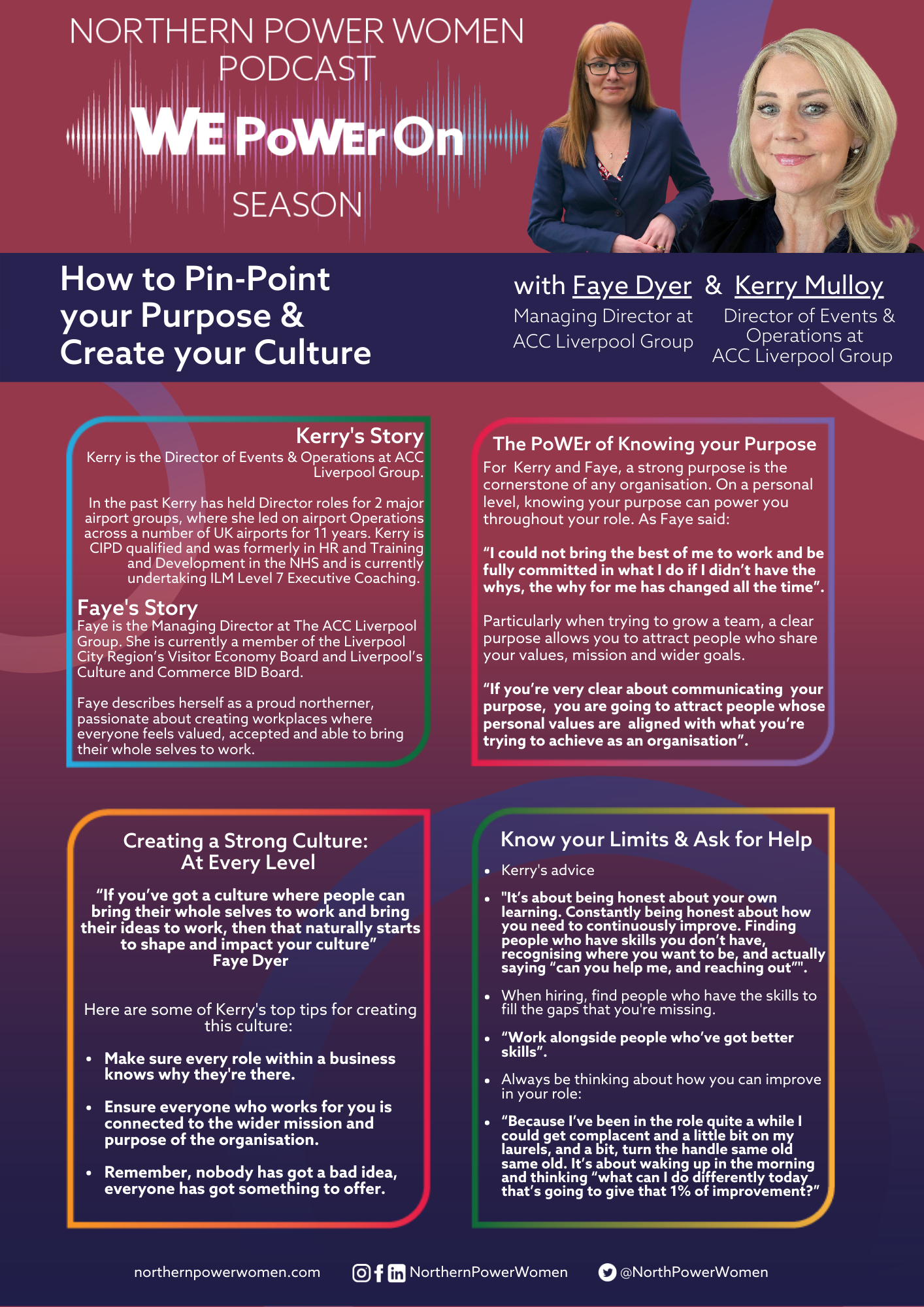
Faye Dyer and Kerry Mulloy
[00:00:00] Northern Power Women podcast, for your career and your life, no matter what business you're in.
[00:00:26] Simone Roche: Hello, welcome to episode eight of our We Power On season of the Northern Power Women podcast. I'm your host, Simone Roche and every week I am joined by someone from our Northern Power Women community, who we can all learn from.
[00:00:41] But this week it's like a two for one, not just one, but two amazing, amazing Northern Power Women from the Northwest on the Northeast who are passionate about the hospitality industry and are doing everything they can to build forward better. First up is Kerry Malloy, Director of events and operations for the ACC [00:01:00] Liverpool group, which includes M and S bank, ACC Liverpool conference center, Exhibition center, Pullman Liverpool hotel, and also owners of Ticket Quarter, which is a regional ticketing business. And prior to joining the ACC Liverpool in 2012, Kerry had held director roles for two major airport groups. They need you right now, Kerry I'm sure they do, where she led on operations across a number of UK airports for 11 years. Kerry is CIPD qualified and was formally in HR and training and development in the NHS and is currently undertaking the Institute of leadership and Management level seven Executive Coaching. Wow. And that's just the first one of our guests today. And joining her is our new Powerlister Faye Dyer Managing Director at the ACC Liverpool group.
[00:01:43] Faye brings absolutely tons of experience in insight into the events and hospitality industry, having held senior positions in the sector for over 10 years, she's currently a member of the Liverpool City Regions Visceral Economy Board and Liverpool's Culture and Commerce Bid Board. Faye is also a [00:02:00] chartered accountant. That's where we first met working out sums for working out how I could make Northern Power Women bigger. Having spent a decade working for KPMG before moving into the industry, Faye describes herself as a proud, northerner passionate about creating workplaces, where everyone feels accepted and able to bring their whole selves to work.
[00:02:19] Faye moved into the events industry as not only is it sector where you get to create meaningful connections and magical moments, but the positive ripple effect of their work has on the visitor economy, wider economy and the communities they serve is vast and for her it's meaningful work. And I love how Faye before you, for this you said you couldn't do your role without the support of Kerry.. And I think there's so many great messages we're going to talk about
today, but that's, if we get any time after reading all your intros, so I'm so delighted to welcome you both here today, because you're all about lifting each other up. Welcome, Kerry and Faye.
[00:02:55] Kerry and Faye: Thank you. Thank you.
[00:02:58] Simone Roche: And I love this as an industry that I'm [00:03:00] so passionate about, and I always think of this is it's what makes me, you know, sort of part of who I am. I love that meaningful connections, bringing people together, creating those magical moments. You wanted to work in the sector because of those reasons and bringing that joy to many didn't you Faye how, how important is for you to have a purpose in your work?
[00:03:18] Faye: It's absolutely vital to make them all. And I think, you know, I could not bring the best of me work before being committed in what I was going to do. If I wasn't connected with what the why is. And I guess know if I'm, if I'm honest, like many people, the why for me is changed all the time. So I guess, you know, when I first came into the world of work, why was very much around just that feeling that I had done a great job. You know, the I'd made somebody else happy. The why was almost because somebody asked me to and I could and then I guess, you know, as I've got more mature and I've got more experience in the world of work and I've, I've learned more about different industries, I've become a bit more specific about how I want to spend my time and what why's I want to align myself to, [00:04:00] because it's about, you know, what I value and about, you know, what motivates me.
[00:04:04] I guess the event industry for me, it works twofolds know, I am a very firm believer that life is about a collection of moments and experiences and hence to work in an industry where our role is to help create, facilitate and maximize those is just, is wonderful because you know that at the end of the day for me is what life is all about.
[00:04:25] But also I guess the why in, in events, I'm in hospitality. It's that ripple effect. And you know, it, it truly is meaningful work because if we do a great job here as a team, then that means we are creating employment in the wider visitor economy, it means we are attracting you with investment to the city region. And really importantly, we are influencing the lives of our communities. And I think, you know, what could be more enriching from a wide perspective than that. So it's yeah, really, really passionate about the industry but it's taken me a little while as well to find that and realise , you [00:05:00] know, who I am.
[00:05:01] Simone Roche: And I think that's really important. It really comes across that strong purpose that you have. So on. What, what does that purpose, what's the impact of that on workplace culture?
[00:05:10] Faye: Yes. Great question. So I think it's, if you're clear about what your purpose you were very clearly communicating what your purpose is then for me, you are going to align people whose again, personal values are very much aligned to what you're trying to achieve as an organization and if you've got a culture that is open, that is where people can bring their whole selves to work, and we can bring ideas to work. Then I think that naturally starts to shape and impact your culture because you're attracting people that aligned to your purpose and you'll let them them naturally shift and shape. I also think that if you are going to be successful as an organization and living your purpose, then you absolutely have to have a conscience that's aligned to that.
[00:05:50] If you want people to be fully engaged at work, and you want to make sure that people can deliver the best that the two are good to be aligned. So it does have, I guess, a really strong [00:06:00] impact on workplace culture. It also, I think means that you've got that really, really strong one teeny ethos because everybody understands what you are, all trying to go in the same direction to achieve. And everybody understands crucially how the role that they're playing fits into that. And they can understand and respect everybody elses roles and understand, you know, where they fit into the bigger piece. So I think, you know, that common sense of purpose team is usually important from a culture perspective.
[00:06:27] Simone Roche: And that comes with that whole bring in whole self to work as well. And that, I think what you're talking about here is that it's your leadership style as well. I think one of the, I think we, I think you were part of when we did one of our power circles, we talked about leadership and one of the things is about listening. It's about that listening and clarity. I think that's so important and I'm going to come over to Kerry. You've worked at very high levels in HR and in executive coaching too, how does this workplace culture that we're talking about and phase talking about impact, not just on the staff wellbeing, but also on [00:07:00] the overall success of a business.
[00:07:01] Kerry: I think Faye summarized quite a number of key points. It's about having a purpose and an alignment. And if you're very junior in an organization, there may seem like management speak words, but it's making sure that every role is in the business they've got a sense of why they are there, and not the big why that we'll talk about the Simon Sinek why, it's about do they
understand how they can contribute, how their behavior links into the overall one team ethos, how people can actually make a difference?
[00:07:30] We do a staff survey every year. And we ask staff, do they contribute? Do they feel they make a difference to the business? We're in the business of creating moments and experiences and events where we used to call ourselves ourselves, shed renters. We're not. We create experiences for clients across the Northwest, the UK, Europe. We are here to create those moments. When you talk about that as our purpose to contribute to the economy of the city region [00:08:00] to actually make Liverpool a destination, a memorable destination. If you talk to staff about that, whether they are an account's clock or they're a senior manager, they all should get why we're here and Faye and myself, we are really working hard to make sure that since the pandemic that we can create a new culture for the business. That actually means that everyone who works for us is connected to why we're here and to have that passion about Liverpool and have that passion about the city region. And it's about saying you work in one of the most iconic venues in Liverpool. You actually contribute to experiences that make Liverpool memorable for the right reasons. You are contributing to Liverpool being one of the most fantastic cities in Europe. And don't forget that even your small job, whatever you do, whether it's an Account's Clerk or it's somebody who moves furniture, every single part of what you do contributes. That culture then translates into how they deliver their day, day to day work. And the clients feel it. And if the clients feel it, they come [00:09:00] back and they have that sense that we are actually genuine and it's authenticity, and it is, it's an, it's a journey. And we've spent a long time doing this since, you know, when Faye joined the company.
[00:09:11] And since Faye's become the Managing Director, we're changing the way that we operate. And it's absolutely authentic. It's not words on a page. It translates to how leadership, how we treat each other, how we speak to each other, how we behave, how we include we listen and we ask questions, nobody's got a bad idea and everyone's got something to offer.
[00:09:29] Simone Roche: I think that's your one team approach, isn't it. And what's coming across to me in this is it's like, it literally goes through you like a stick of rock, you know, it's like, it's in your, you know, it's totally in your DNA. You know, you talked about, really enabling people to have the pride. You are part of something that is absolutely phenomenal.
[00:09:49] And the thing that I wrote down at the start, you show, you know, you, you're magic makers, you talked about magic moments, but every single person within that team, and for someone who has worked a long time in the
events [00:10:00] and connecting business, I think that I think of my first day at G race course. So when I left the Navy and, and I remember standing in the room and it was almost like who lives in a house like this?
[00:10:09] And then you cut it, trying to paint that picture. Every single part of your team is doing that. I know Faye you know, we talk about leadership, you know, Kerry's just talked about that, alluded to that, and I know you are really keen to point out and you were in advance of this, that without Kerry's support, your role would be much tougher. Talk to me about that because I know this is your very much for spotlight in others. I know that.
[00:10:33] Faye: With absolute pleasure. I moved into the current role about a year ago. Following internal promotion .During this last year you know, we've gone through so many things through transformation about culture, you know, recovering from a pandemic. We have repositioned social value at the heart of the business, we've launched a new strategic plan for the company and genuine, you know, without the support and contribution of Kerry, none of that would have been possible. I think sometimes when you talk about leadership, we have a habit of [00:11:00] thinking about I or about an individual rather than a group.
[00:11:03] And I think, you know, regardless of what a formal structure might be on paper, you know, Kerry is my partner, she's my peer. And it's about, you know, having that, that trust, that understanding as a team that allows us then to achieve more, because we've got that, that breadth across. And I think, you know, for me as well, but this is, you know, my first MD role. So I am certainly not the finished article. Now I am still learning, you know, I make mistakes and having someone that has been a critical friend, a chief supporter, you know, a confidence builder, a sort of trusted, confident has really helped accelerate my confidence, I guess, in my ability, in the role. And it's made sure that you know, when things do go wrong and they do some times, and you learn from your mistakes, but I've had some on the long side of me, that's been able to give me a bit of a pep talk, pick me up , help me move on and it's helped to keep the business moving at pace rather than [00:12:00] potentially being a bit of a derailer or me going down a rabbit hole or losing confidence over something.
[00:12:05] Sometimes it can just be the simplest of things that are such a big gesture. So I talked about strategic plan and when we launched that a few weeks ago, I think quite looking at guessing I am a confident person. I'm quite a confident, and I'm not had many moments sort of imposter syndrome. But when I got up to present to the group, it was a scripted piece and I don't do script very well as Kerry knows, I'm an off the hook person but it was scripted. And I had one of those moments where I thought don't know what I'm doing, I've not
learned a script, I can't read it, I can't see. I had to mentally talk to myself and say, because I felt that fight or flight syndrome. And I actually had to speak to myself in my head and say, 'keep going, keep going, keep going' because I felt like I could just walked away. Kerry wasn't very well that day. So usually she would have been up from shoulder to shoulder with me presenting and she wasn't able to do that, but she was absolutely there on the front row, catching my eyes going. I've got you, nodding away, [00:13:00] smiling away when everyone else in the audience was some people in the team were a bit 'what's Faye doing here.'
[00:13:06] Simone Roche: And I think there's some, some really strong things here. You've talked really passionately about culture and team ,leadership and you know, what you're talking about here is that, you know, is having that, that person or having that group of people or having that wing person, cheerleader, whatever it is that peer group around you.
[00:13:24] But there's something here really jumping out to me around that, you know, women supporting women. And I, I know Faye way back in I think it was 2017 when we were we had just had our awards and we were at the Hilton and you were like, you can come to Manchester Central at the time. And I'm like, that's scary. There's no way I can do that. I can't afford it. I can't do that. And you, you gave me the time and the belief to make me believe I could, even though it was terrifying and scary. So, you know, it's those moments of supporting each other are so, you know massively important and, and Kerry you know, why is it so important this [00:14:00] advocating for other women and, and who supported you in your early career?
[00:14:04] We know obviously you and Faye are absolutely the dream team, but why is it so important?
[00:14:09] Kerry: I think. If I, if I was to, to, to call advocacy championing and supporting and encouraging, I've had that all the way from the start of my career and I was lucky enough to join the NHS. And back in the day, when I joined the NHS, it was full of very senior women.
[00:14:25] It's a predominantly female orientated organization. And HR was back in the day, often at senior level full of men for some strange reason. But I was fortunate enough to work for two very amazing HR directors who were female. And I learnt a lot from them as strong role models. Sadly I moved into aviation, there was no females. And so what I did, I reached out to women who were friends or colleagues in the, in the outside world to find people who I could find as role models, looking at people who had integrity, women who
don't feel after emulate men, [00:15:00] women who feel that they work hard. They are true. They are authentic. You don't have to be a version of a man. You don't have to be aggressive. You can actually be a very gentle. And if you like, be honest and authentic to actually get on. And I think it's about hard work and about being it's about being honest about your own learning, constantly learning that you need to continuously improve. Being the best version and actually find in people who don't have, who have skills you don't have. Recognize the way you want to be and actually saying to people, can you help me, reaching out? It's not an easy thing, but you've just got to say working alongside people can be difficult, but spot what they can offer you, what you can learn from them and find people who compliment your CV because you don't know it they do so work alongside people who've got better skills.
[00:15:50] Simone Roche: And I think there's something really about that asking for help. I think sometimes we'll hold ourselves back or all of these relationships, even if we ask for help, we offer help. All these relationships [00:16:00] are two-way streets, aren't they, you know, coaches and those that are coaching mentors, and those they are mentoring. Both always benefits. You must have both seen that.
[00:16:08] Faye: Yeah, absolutely. I think it's, it is two way street, but it's about having the agility in that relationship as well. Isn't it? And recognizing that often, it's not about necessarily, you know, coach and coachee. So often it's, it's, it is just about partnership and the same way that you have in your personal life.
[00:16:24] Being agile enough to recognize what somebody needs when, and being vulnerable and honest enough actually to say, this is me, I'm self-aware, these are my potential detractors. This is actually what I would really like from you. And I think it's, you know, all good relationships, has got to be built on that trust and has got to be built in that honesty.
[00:16:44] And, you know, I think it's also about one of the things that having Kerry on board has really helped me with this, that having someone that, you know, in a really safe way pushes you to be and do better and not in a way that you ever feel threatened [00:17:00] or that it starts to knock your confidence, but always in a way that is bringing out the best version of yourself.
[00:17:06] And I think, you know, that is incredibly powerful. And if, if people can find themselves not just a personal board where it's great and fantastic to have a mentor and to have a coach, but sometimes it's just that the ally, that partner as well, that is going to help bring out the best in you. And keep you pushing forward with that, I think is absolutely valuable.
[00:17:27] Kerry: I, I echo everything that Faye said, and, and, and some additions is that we've got a really strong, talented team here at ACC Liverpool. And I've been fortunate to work here a long time. The team that we've got now are the best in the business. They are superb. And as leaders we're instilling in them, hopefully some really strong leadership qualities, but equally we can do a 360. We can get back from theM how we can improve. So, because we've got such talent and these are people that are homegrown and they've come up through the ranks, they know their business [00:18:00] inside out, but they also know us and they can check in with us and say, can we look at this? Or your style about that. So mentor and a mentee ism, it goes both ways.
[00:18:10] And we can actually say, as leaders Faye and I that we've got that emotional intelligence and that humility to be able to set our team, what do we need to improve on? How do we do better? How can we give you what you need? What development are you seeking from us? Because, because I've been in the role quite a while, I could get complacent and a little bit on my laurels or just think, turn the handle, same old, same old.
[00:18:32] And I think it's about on a morning waking up and saying, what can I do differently to be a bit different today? That's going to give that 1% of improvement. If that hasn't worked, why not dig deep, reflect and be able to be all adult enough to say the problem isn't them. The problem could be me. So as a leader, having that ability to say I'm big enough and old enough to be able to have those harsh conversations with myself to say that isn't the team, [00:19:00] that could be me and having that leadership strength to say, if we want to be better, Mentor and mentee in is absolutely imperative it's a great facility. If you can get it, if you can't afford it and you haven't got access, find it from within your peers and find it for within your team because it's there. If you've built the relationships and relationships is what it's all about.
[00:19:20] Simone Roche: And we would obviously advocate reasonably set our PoWEr Collective, or was to almost enable those conversations to start. Please do get involved , wearepower.net. But, and that's, that's free. There's no barrier to entry because I want to make sure there's always someone for someone. So listen, I cannot thank you enough. I really feel like I've been joined by the dynamic duo today of Faye and Kerry. I can see even capes on now sweeping around the ACC. You brought your humility, your integrity, your honesty into today's conversation. You are indeed magic makers, magic makers in your industry, really advocating for, you know, in this amazing, amazing hospitality and events industry. You're not, you're not [00:20:00] shed sellers. You are clearly exactly creating their collections.
[00:20:03] So Faye, Kerry, thank you so much for joining me today. I have absolutely loved having this conversation with amazing leaders from an industry that I massively passionate about. Thank you so much for joining me and thank you so much all of you for being here today and thank you for tuning in. If you love our episodes, of course, you do let us know by rating reviewing, subscribing to the podcast, let your friends know, let your mentees know or reach out to on socials @ northpowerwomen and on Twitter and Northern Power Women on our other social media. Please do sign up to our Power Platform. It is free and it's a place where you can start conversations, ask for help or pass on your skills and knowledge. Join us next Monday when I'll be joined by another wonderful role model from the Northern Power Women community. My name's Simone Roche and you've been listening to the Northern Power Women Podcast. A What Goes On Media production.