



My wish or my dream would be that everywhere in Europe or in the world, but let's stay with Europe for now. It can be a reasonable choice for a young person to decide that they want to work in youth work and it's not going to require them to sacrifice their future.
Hello everyone. And welcome to under 30, a podcast brought to you by the youth partnership between the European Commission and the council of Europe. I'm Ismael Paez Civico Civico and together with Marietta Balazs , we'll be hosting this episode. I hope you enjoy.
Welcome to the under 30 broadcast series of the youth partnership. Today's episode is a preview of one of our upcoming publications. Thinking together and leveling up, I thinking and action kit for the continuous development improvement and strengthening of the youth work field, which will be published. So it's part of our insights series and it's the first one, the focus on youth work.
It summarizes the results of a large scale research project and presents it in the morning gauging format and language today we have with us Ajsa and Bastian the two authors of the thinking kit. Ajsa, Bastian, could you please say a few things about you.
Thank you Marietta. So my name is Ajsa and I'm a youth worker, uh, and actually youth worker coming from a context where youth work is still really at the very early stages of being recognized, uh, while it is being practiced for quite some time. So in that sense, I was happy to be able to contribute to writing this Thinking and Action Kit that would help in different contexts. Uh, all of us will actually support youth work and development further.
Yeah. Hello, I'm Bastian. I'm a facilitator of learning and all kinds of different contexts. I grew up in the environment of the European youth centers in Strasburg and Budapest, where I learned my craft, I would say, uh, but now I work in all kinds of places and I think I came into this project. More as someone who's had some experience in writing. Who's had some experience in explaining stuff to people and who has a bigger, or a bit more of a distant view, a little bit farther away from it.
And who can, uh, it's not so much in the field, but looks at it from the outside.
It is very important to keep a few things in mind before we dive into the content of the Thinking Kit. Youth Work development is a continuum without a final endpoint, we can always improve it. There is also diversity among different countries and different regions. For example, there might be different definitions or qualifications for youth workers. Therefore the thinking kit is not a step-by-step guide. It aims to support you finding the best path forward in your own country.
In the thinking kit we talk a lot about your own context, this means your particular organization, your geographic location, the reality in which you work, the thinking kit is a reality check, it's a journey or checkpoint to bring forward. The European Youth Work environment
okay. Perfect. So thank you very much, Marietta for that short introduction of what is actually the thinking and action kit. And now I do have another question more towards our guests. So towards Ajsa and Bastian specifically, and what exactly is a thinking and action kit, but more from your perspective, a less theoretical perspective, what do you wish to achieve with it?
And what exactly is its purpose button, please, if you might want to start with that question and then we can give the, give the word to Ajsa.
So when we were. Thinking about how we will approach this work. We didn't want to do a toolkit. We didn't want to give a set of instructions that was okay, do this first and then do that and then do that. And then you'll be successful because the contexts across Europe are just so incredibly different and the starting points are so different. And also. The things that would work in each context, us so completely different.
And so what we wanted to provide was a practical publication or a practical set of ideas that get people to think more questions than answers really, but that all a geared towards action. So that it's not just saying with all, let's think about interesting things, even though that's it. Thing to do in your free time, but if you want to change something, if you want to make things better than the thinking needs to be geared towards action.
And so we wanted to give, uh, a tool that allows people to think deeply and think together and have meaningful conversations with the stakeholders that need to be around the table, but that are all geared towards improving the environment for youth workers all across Europe.
I think that is a, that's very interesting what you said, because of course youth work is not just there to give you answers , it's mainly there to give you the framework and the tools to actually get the, get the answers to the questions you're asking yourself. So even the approach itself is kind of interesting when you say that we're not there to give the answers we're there to ask the questions.
I want everyone to think critically on what actually is the best outcome or the best solutions to the problems that we have at hand, especially when it comes to. a diverse continent as is Europe and every country has their own realities to deal with. Um, Ajsa please.
Yeah, I completely agree that that was, that was our, our approach. Maybe I can add just the one little, little thing in adding to this thinking and action, which actually then became the title of the, of the kid. Um, we were looking, well, actually prepared. Ourselves and everyone who would be the future user of the, uh, kit, to start thinking and then to enter into action, because even to reflect, you know, you, you need to have a certain perspective on what's the situation.
You need to have a certain understanding of what's happening in your own context, but then also, uh, what we found helpful from different experiences. Both as educators and youth workers is that it helps to know also the examples of how other people or in other contexts things can be done.
Or it helps also to understand, to a simple story of how that affects me, or, you know, anyone, someone who is in the youth work field or, or, uh, in this particular, in this particular case who is a youth worker and these kinds of. Improvements in that, in the field.
And that's, that's why, you know, in order to get to the reflection questions, to the thinking part, and then it will be really the best equipped to take some action and to, uh, actually work on improving the, uh, the youth work environment. In your own context. We also provided a bit of a, let's say, translation of what has been. Collected in an impressive knowledge book that Marietta was talking about summarizing it to the very core of the findings.
And one was the, exactly the diversity of experiences across Europe, and then also what works. And we are really hoping that this will help also to inspire. To an extent to inspire also people who are thinking, okay, now we are stuck with all, you know, what else can we do? How can we move things forward?
But those examples can actually inspire the little stories that we share them and actually show why is it important and how important it is that there are better conditions for youth work in every context in Europe.
For when it comes to, I mean, to the context of course, of, of youth, we we're speaking a lot about differences in different countries or in different actual realities, how youth work goes from one place to another. So if I understood correctly, is this a specific framework only for the European continent? Cause, cause you just said the world and of course when it comes to the world and itself, what do exactly mean by that?
Uh, because Europe is very different from the rest of the countries around the world. So can, this may be thinking kit. From South Africa, for example, from Columbia, get the thinking and say, okay, I can actually replicate some of these things, uh, in Europe. Do, do you want to Europe to actually become like a pioneer in making an example of what an actual structural framework for youth work can be, uh, around the world.
Two sides to that. To be answered to that question. Uh, one is primarily the thinking and action kit is for European context. And, you know, once you get to it, you can see that there is all this element of how can youth work at your context local national regional can be supported by certain developments or European level or resources developed at european level. However, with that said, I think, you know, contexts in within Europe are already so diverse.
And the questions that we were asking, and we're really trying to be as inclusive as possible so that no one, basically really, even, I would say maybe Bastian can also jump in, but even anywhere in the world who say, well, this doesn't have anything to do with me. Okay. This question is good question to start thinking about what we can do. And I think that's the, that's the value of the thinking and action or such. So, right. Answer, provide a solution if you want in particular context.
And of course it helps with the European level. So the resources and factors that are supporting towards you youth work and its recognition and its role for young people in society,
And you Bastian do you think that Europe, I mean, I'll ask you the same question. Maybe you have a different, a different perspective because we do know that Europe has been leading in some things, for example, the green transition, do you think can be the same thing with youth work in itself? And getting a general framework. Like you've been developing here asking the right questions in order to hopefully get the right answers. Do you think other countries maybe or continents.
As a matter of fact, can take that same approach.
The entire story of humanity is, uh, going elsewhere, looking what works there and then transplanting it to some degree into one's own context and see if it flourishes there. I mean, the. Potatoes from Peru uh, nourished the Irish and Polish and everyone in Europe and chilies from Mexico are part and parcel of the Indian cuisine and et cetera, et cetera. So I would hope that people from across the world can look at this and not say, oh, this is how you do it.
Because that's not how this works, but they can, uh, that anybody who works with young people anywhere could look at this and say, okay, what could be my version of this? And what way could I be inspired to take a perspective on my context, look at the different stakeholders. In my context, look at the resources that I have available to me that other people might not have. Uh, but what do I have look around, uh, and really see. What might flourish here? What might work here?
What kind of relationship between stakeholders is possible here and what is not possible here? And in what ways can I kind of create an ecosystem of a connection and of ambition and of, um, vision that can. Allow the young people that live here, have the resources and have the access and have a path into their future that is worth working for
what do you think? What can be the main impact of the thinking kit in Europe? Let's imagine we have already published the thinking kit, people start to use it and we can notice some changes. What do you hope to be the main impact of this publication on the life of a youth worker who works on grassroots level somewhere in Europe.
I think our hope or my hope when, when we were working and discussing definitely initiates first of all thinking and, uh, saying, understanding the context, but then also initiates the changes and changes, hopefully, either in direction with improvement of conditions of youth work. Uh, we have seen, uh, in the, in the, in the knowledgeable how, uh, what, what the research has captured, how different situation it is from context to context. And our, our idea was.
Each one can improve, you know, even in the, in the, let's say the most developed and supportive environment for youth work there are still uh, things that could be improved. And, uh, uh, in the let's say, least developed more. Those, the context where youth work is only at the early stages of being recognized, or even be back this sense, there is a horizon that you can see that. This is still a starting point from which we can take things forward.
And when we were working on this we were thinking Not only about youth workers as initiators of change. And I think that's important too. Our idea is that actually anyone in the, in the field could recognize themselves as somebody who can initiate this thinking and then action taking to change things. So it can be equally a youth worker who recognize themselves in the situation as much as educators, youth workers.
To do something with their curriculums or work from that point on onwards, it can be a policymaker. It can be a decision-maker looking at, you know, legislation surrounding the surrounding the youth work. It can be an employer, anyone in the civil sector or in the local authorities or in the you know again, very different from, from country to country.
But every single actor we hope they'll recognize themselves as somebody who could be that hero offer youth work development, let's say would be that person of initiating the spark of change or improvement of, you know, putting things in motion toward reaching the better conditions.
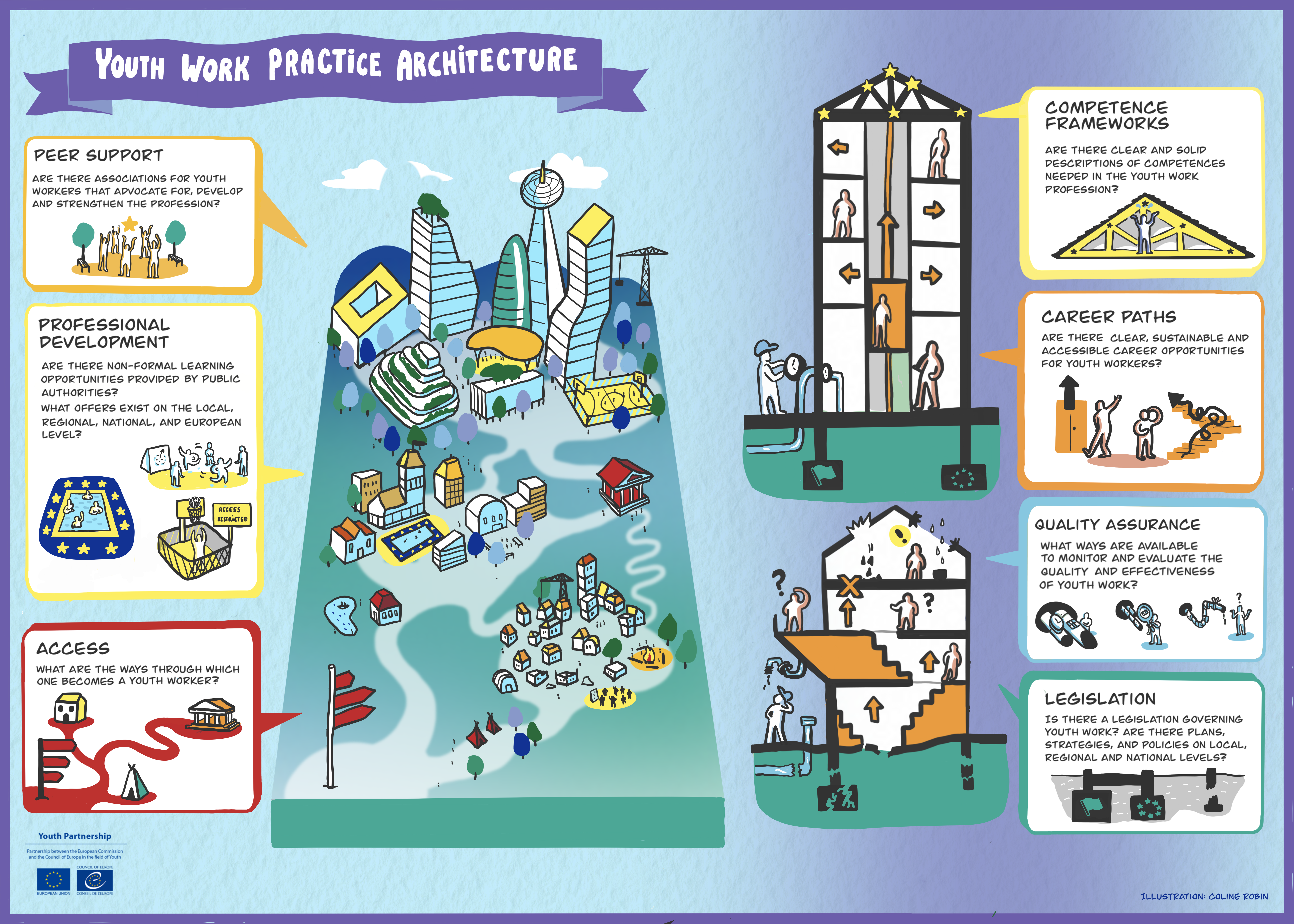
So I want to, I actually relay now a question, uh, more towards Bastian because we are speaking about the disparities between the countries and that's one of the gaps that actually needed bridging on how we can actually find an architectural framework if you will, to put everything together. But we need to go of course, from a high resolution point of view, when it comes to very specific points and what actually happens. To a low resolution point of view.
So go permit, uh, open up the scope towards the whole of Europe. Bastian what do you think may be the main pillars of that scope would be something that maybe everyone has in common, uh, are not focusing so much on the, uh, well on the specificities of each country or each reality. How would you be able to describe a bit how we can find a common ground and what will be the main things that maybe everyone needs to adopt?
That's a tricky question because the high risk solution is very fuzzy and there is really such a diversity of youth worker realities. There are places in Europe where it is a very feasible career and there is a structure around it. You can study it. There are employment possibilities, there are career paths you can grow in it. And then there are other areas where. It is a hobby. Uh, and then people exploit themselves essentially to do what they love, but they live in very precarious situations.
And there's a huge degree of inequality when it comes to this. And so we see quite a lot of youth workers that are. Either going into these precarious situations and having very unstable lives around that, going from project grant to project grant and seeing how they can make a living from it or how they can keep surviving from it and who at some point move somewhere else, maybe where they can actually make a living and make it a profession and not just a glorified hobby.
And so I think it's very difficult to say what is needed everywhere. I think what is. Needed everywhere is, uh, a dissatisfaction with the status quo and a belief that more is possible. But what is also needed, I think, is that from what ever vantage point you have, whether or not you're a practitioner or a politician or a professor who trains youth workers. Is that it can start with you. It doesn't have to start with someone else. You don't have to wait for someone else.
It can always start with you. Which to me is a very empowering perspective. It also is an uncompromising perspective because then it means that if you want change, you actually have to do something and you can't wait for someone else for the European union. To give a framework or for the council of Europe to give some solutions to it, but it actually has to start with you because no one knows your context as good as you do.
No one can find a solution that works for your context, as good as you can in dialogue with the other stakeholders. And I think that for me is the, is the main message here is that it has to start local or regional and it needs. All those factors, it needs policy. It needs pressure from practice that they need the policy. It needs also then an opening in academia to actually take youth work serious and provide actual educational pathways to become a youth worker maybe. And it needs all of this.
And I hope also what this thinking could then provide when people go in and they read examples from other countries. It might instill healthy sort of competition. You're not, not, not every development is done for the altruistic reasons. That would be great. If the development would be motivated from that, sometimes it's just, you don't want to be out done by your neighbor.
And if from that motivation, Possibilities for youth workers to do their work meaningfully without constant fear of precariarity then so maybe it, but at least, uh, we have development in the right direction.
I like that idea of a healthy competition that actually does help cause some countries within, within Europe, uh, replicate some things I've already been working.
We'll speak about a few examples a bit later on, but I have a question, uh, towards Ajsa because Bastian, you actually brought up policy and what politicians may be can do to actually facilitate uh, these processes, but more importantly, my question as a well, as a youth worker would be, how can we make sure that actually politicians don't dictate what youth workers do when maybe them themselves don't actually know what's
going on at the local level, uh, how we can have that, that right balance between. What's the role of the youth worker specifically to actually create the viable framework in their own reality and how politicians can just leave a good platform for them to act upon and not necessarily impose ideas that might think that might be beneficial. But in the end don't end up working. What do you think might be the role of politicians in that case? Ajsa?
I think it's really important here to understand that what we are talking about and what is being presented in the thinking and action kit or youth work is not about the content of youth work as such. It is really around about everything that surrounds and provides conditions for me to actually do the policy youth work meaningfully make a change in the life of a young person. What is it?
That youth work is actually there for, and I think in that sense, politicians absolutely have a role to play and politicians, decision makers, policy makers, all of those. What creating conditions surrounding how youth work where, could it be practiced, with whom, under which conditions , would it be paid or not how sustainable that would be the, you know, really have the role to answer to those questions, to their whole problems of the society or not.
And in that sense, I think what we were also trying to do for this kit is not to say that one of the actors. has bigger responsibility than the other, not to say that one needs to lead and the others will consult or advice, but rather than actually in the, you will see in, in, in the questions, one of the first things that we are asking people to think about is who else is around you.
Which of the actors, which are the profiles of people with power in the, in, in, in different ways, power to influence the change that you want to see happening. And in that sense, I think if youth worker are initiating. Yeah, certain change.
I mean, through them, it definitely needs to come this connecting with the political level and policy level so that the change could be more sustainable if it starts from the, from the political level, from, from the other side again, you know, it never works. And this is, I mean from more fields than, than, than one and youth work as well. So it's an exception. It never works.
If you are just introducing solutions without actually involving the people to whom they are going to actually address with they're going to change that reality. So I'm hoping that we do put it, with our thinking and action kit it will be very clear that what we are proposing, even though they are asking questions that we are proposing, that it's a consensus building work around what needs to change positively to improve the situation.
So that actually the youth work, ideally youth work how we see it as a meaningful practice contributing to the, to the young people, into the societies is being practiced in a way that, uh, that is optimal in, in certain politics. And that's, and that's what, uh, I would say that I think that's the most important part. We were stressing until now how, you know, the change can start from you and, you know, I can be the one. But I can be the one to initiate it. And this is important element.
I don't need to be a superhero and kind of do everything on my own and actually like that it doesn't really work, but we are actually talking about initiating starting the process and involving all the other actors, all the other stakeholders. So that together you can both think about the change that needs to happen or the concrete step that needs to happen and then actually make it, make it happen.
Yeah, I think what it really needs, it is a collaborative, confident, humility on all sides, right. You need, uh, in order to really develop youth work infrastructure and. Practice architecture. So practice environments, you need every actor to, to come to the table, being really confident in how they can contribute and being really humble about where they need someone else. Right.
You need policymakers who know like, yes, I know how to write good policy, but I really don't know how the practice looks like. And you need youth workers who come to the table and said, I really don't know how to work this policy stuff. But I really know the young people that I work with. And if both can come together with confidence in what they know and humility around what they don't know, that's a pretty good starting point. I see.
I really like how you both are presented the co-creation let's say of these frameworks, because usually it's either one way or the other it's either top-down or bottom-up usually, and then we never speak about what things can I actually do to complement your work and what can you do to complement my work?
And I think this collaboration indeed, between decision makers and NGOs or, let's say international networks of youth workers, actually a big actor in Europe, uh, in itself is, um, it's basically the best way to go. And I think there's actual thinking kit and action kit gives the resources to not only decision makers, also youth workers, uh, and everyone in the field to say, okay. What do I need? What do I lack in and where can actually be of service?
Because again, we can't change the world on our own. We actually do need help from other people and we need to collaborate together. And I think that's the whole basis of youth work is teamwork. Essentially. We're not alone, uh, in the, in the journey in some way. I would like to, uh, to, to ask a little closing question, let's say, um, what do you actually hope that youth work will, will be like in five years? Let's say, how would you see it? What do you think now?
The adaptability we need to do, especially maybe COVID for example, we are seeing some complicated situations of youth like around Europe. Um, what are the actions you wish that young people actually do take all decision makers take in order to improve youth work around Europe and the framework in essence, that you've been describing all throughout the episode and in the thinking and action kit.
It's a very difficult question. I'm thinking now is five years, uh, kind of too ambitious. For what I'm hoping. But I, I would start with what I'm looking for already for some time. And I hope the thinking and action kit can contribute to that because of this initiating of changes. That that is somewhere in its purpose. I would, I would hope for consensus that youth work is a practice that is.
Beneficial to young people and that access for youth work is really clear and, uh, enabled for every young person across, uh, different European contexts. And as I was saying also even for five years, maybe to be, to be, to be realistic and look at Europe. And I think everything that needs to happen around around that is, you know, this is the aim.
Uh, would really come to, uh, come to place easily in a way, you know, if you are, if there is really no doubt about the benefits of youth work from young people and society, uh, I think it will be much easier for all actors that we were describing and talking about to divert resources over that, and actually come, come up with particular solutions for different contexts to make it happen.
I again, we don't want to prescribe solutions and there are no clear solutions that could work, uh, everywhere. You, you have very different, different situations, but I think you need to have always this kind of horizon or kind of vision in mind. So why would we need to improve anything in the youth work field? You know, if this, if there is a clear answer to that question, then everything else I would say would come to play.
I'm hoping in the next, you know, as soon as the figure of thinking and action kit is published and in years following that people feel more and more come to this question, you know, why? And then I think concrete steps to actually make it work.
I think for me, my, my wish or my dream would be that everywhere in Europe or in the world, but let's stay with Europe, for now, uh, that. It can be a reasonable choice for a young person to decide that they want to work in youth work and it's not going to require them to sacrifice their future. It doesn't require them to, uh, make really, really tough choices, but there is an infrastructure to become edgy that there is a support.
Around, um, there, there's a way to make this your life to make this your work. And that there is an appreciation from society that this is crucial work, that this isn't, this isn't hobby stuff. This isn't free time activities. This isn't a luxury. This is actually foundational for a society. And I think in the, in the context of COVID, what we've seen is that the.
The caring professions are the ones that are really foundational and really fundamental when it comes to, uh, uh, functioning of society. They've been labeled essential workers, but I would just call them the foundations of any community. The foundations of any society are the ones who care and nourish and nurture the wellbeing of the community and youth workers are such people.
And I think if they be, um, if we can work towards a recognition of the importance of this work and the, um, the recognition that comes with that is then that there is actually career pathways and there is actually a way to. Make this, your work, raise a family on the salary that you are receiving from it. And, uh, and do this as your life's work, then that would be, uh, uh, a Europe I would be proud to be a citizen of, I think,
and on those lovely ending notes, we have reached an end to our episode. Remember that you can access this publication and many others on our website and also don't forget to follow us on Instagram at EUCoEyouth to stay up to date with all our future content. Thank you very much and see you next time.