


¶ Intro / Opening
BBC Sounds. Music, radio, podcasts.
¶ Welcome to Nile Rodgers' Cultural Life
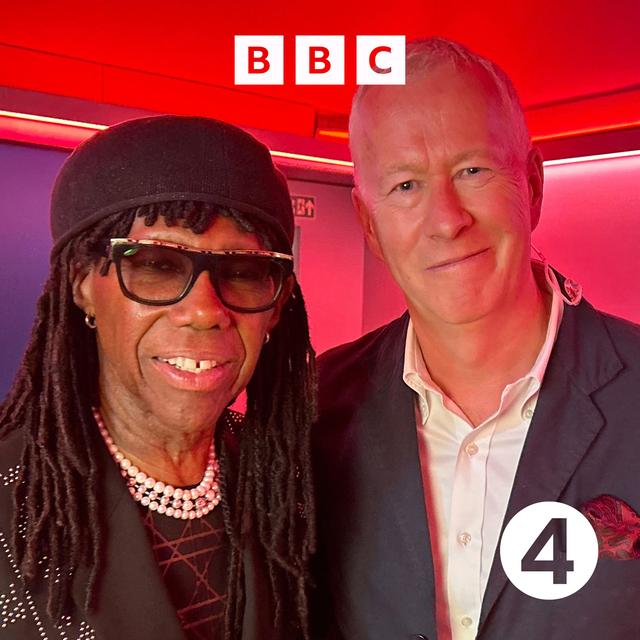
Welcome to This Cultural Life, the series in which the world's leading artistic figures reveal the most important influences and experiences that inspired their own creativity. I'm John Wilson, and my guest in this episode is one of the most successful and influential figures. figures in popular music of all time. He is singer-songwriter, producer and arranger Nile Rogers.
Over a 50-year career with his bands Sheik and Sister Sledge, and collaborations with Diana Ross, David Bowie, Madonna, right up to Daft Punk and Beyonce in recent years, he's created hit after hit. Nara Rogers, welcome to this cultural life. Thank you very much. You are joining us today in the midst of a global tour. Two days ago you're in South Korea. Two days time you're in South Carolina. You must be caught in the midst of uh time zone limbo. When do you sleep? It is the strangest feeling.
My body clock is completely fooled. It I have no idea what time it is when I awaken. I I look at my watch and I go, is this Wednesday or is this 투데이 Anyway. Well it's gr it's great to have you here, whatever time it is in your head.
¶ The Hitmaker: My Iconic Guitar
On this cultural life I ask my guests to choose the most uh important influences and experiences that have informed their own creativity. It's not on the list that you sent us, but surely there is a case to be made. For this Fender Straticaster guitar that you brought with you today and I guess a guitar which goes everywhere with you. This is the guitar you call the hitmaker. Yes. Yes it is indeed. I it's funny that name I don't even know how it happened.
I think that Bernard or Bob Clear Mountain or somebody else named it that. I was doing so many records, so many sessions. early on in my career, it was just sort of like hit after hit after hit. And then I was picking up a guitar and uh I believe somebody just said, No, no, why don't you just grab the hit maker? And I got this one. And you talk about Bernard Edwards, who we'll talk about later in the programme, your musical partner
with whom you formed Chic. When did you first buy the guitar? How long have you had it? So I got this in nineteen seventy three. My band was a group called New York City. We had a hit record called I'm Doing Fine Now Dit Without You B. Anyway, what happened was we were playing at a nightclub in Miami and the opening act would just plug into our gear and do their sh set and then you know and then we come and do our set.
And our set, we not only did original songs from our first album, but a few cover songs. And I noticed when they were playing the cover songs Theirs sounded better, said Yeah. And what's to do with the guitar sound? It sure did. And then Bernard looked at me and said, I keep telling you to get a strap. That's why. Listen to how that sounds. That sounds like the record.
Because at that point you were playing a what, a hollow body guitar that had a thicker sound. Yeah. So j so why has this guitar served you so well? Why is this guitar so associated with the Nile Rogers sound? Just give us a you know it's a cut, isn't it? Probably because typically on old records there were two or three guitar players. So one person would be holding down the Any other person behold in now?
Something like that. But it was that kind of thing. You know, you would have some mu some other guy You put the three parts together and wow you have magic. So as a covers band, I'm the only guitar player. So Bernard was saying you could play all three parts at the same time and I'm like going, Yeah, but it's gonna sound wacky. He said, Not on a strat.
Anyway, when I got a strat and played those cover songs all by myself, he was right. He ts he taught me to chuck. So instead of going So you're paying the sixteenth nose, eh? Right, right. But more importantly, I was judiciously muting with my right hand. So you just didn't get a So I'd comp and I'd start to feel uh uh uh rhythm. So uh if a song was a big song and it had a lick, I could play the lick.
Play the chord and also give the vibe. And that's what Bernard taught me. So next thing you know, I just went into the bathroom. I practiced for a few weeks. And I emerged, not Rogers. So that's fifty over fifty years ago that you bought this guitar. The world changed in a way because that is Instantly identifiable as a Nile Rogers sound, which we have heard on the Sheik Records, on the Sister Sledge records, we hear it on David Bowie, we've heard it on everything up to Daft Punk.
That is an instrument, surely, which more than any other single instrument i in the history of popular music is responsible for. More hits, I would have thought. Yeah. I mean it has a has a single instrument ever been so influential? I don't think so because Even when you think in terms of other guitarists that are famous, you know, Hendrix or BB's Lucille or Eric Clapton's Blackie or Brownie, whatever the hell they call it But they had many guitars, or Yeah, a lot of guitars, right?
You've only had really the Yeah, I got like three or four, but the one I choose to play is this. Do you play it every day? No, I wish I did. I mean if I could make the living that I make without having to do shows and records and stuff like that and I could just stay at home and play guitar, I'd stay at home and play guitar. Has it become like a like a talisman? Do you think it has it become a lucky guitar? I don't think it's a talisman.
I think of it as a workhorse. I don't think that it has magical powers or anything like that. What it does, it allows me a certain comfort factor that I know that if I start with this Um It it's got a mellow vibe, but it still cuts through and it makes the band feel
¶ Bohemian Childhood in Greenwich Village
Let's take you right back to the beginning now. You're born in New York City in nineteen fifty two. Your mother Beverly was just fourteen years old when she had you. What are your earliest memories growing up in Greenwich Village? music. Like swashbuckler type music. In your head. In my head. At what at what age? Uh I was five and change and I was doing um very adventurous
type swashbuckler like, you know, dun dun dun dun dun dun dun boom. In the seven season I'm like a pirate or something. And You were scoring your own life. scoring my own writing. And I do that to this very, very day. My road manager will tell you that every morning I wake up and I go,
Well, the song that's in my head today is this and I can't get it out of my head next thing why'd you do that? Now it's in my head. Um it's just how I'm programmed as a child because I had a very lonely childhood. I imagined scenarios and typically it was swash booklets because the first book I ever read was Treasure Island.
Was it about escape as well? Because you say you had a a lonely childhood. Yes. Your mother very young, only 14 years older than you. You had stepfather, Bobby, who was white, a beatneck. I mean very much a jazz man drug user as well. Yeah, my stepfather came from a family of habadashers and he was quite sophisticated. My mom, very fashionable, smart. left school at fourteen years old. What was home life like?
Home life was wonderful. But the problem was is that I didn't have enough of it because my parents were both heroin addicts. and they were quite nomadic. You you see when you're a kid and you don't quite understand mm heroin addiction, you don't know that it's a sort of triphasic process. The getting high part is the end of the deal. The first thing they gotta do is figure out how okay where do we get the money? After we get the money, where do we get the drugs?
Then we gotta get the drugs home and cook them up and then do them. So every day was an adventure in my parents' life and in my life I was just getting up and going to school Were you aware of what they were doing? Were you aware that they were? I didn't know that it was drug addiction. I saw it. They didn't hide it or anything like that. I I saw it. But I didn't know that you had to pay for it. Like I would watch them cook it sometimes, which looked a little bizarre to me.
But you're a child. So it's not you it's just what you see. Of course later in life you started using drugs heavily yourself. But not heroin. Never Heron. You different. But from what I understand you nearly overdosed several times. You put your s life in serious danger. What effects? Do you think that upbringing that you had, being surrounded by drugs as a child, do you think that fed into your understanding of narcotics later in life or had any kind of influence on
Somebody could hypothesize that, but I think that it was just the culture. I think that and in fact growing up in the sixties and being around hippies and look, the drugs that I did my parents would never touch, just like the drugs that they did, I would never touch. I started out as a glue sniffer and it was all the rage. It was the thing. When I mention that now, people look at me like, What are you talking about? Glue sniffing. I mean when I was a kid, that was the thing.
How important was music at home? Music was incredibly important. The arts of all sorts, every manner, uh dance, theater, music, painting, sculpture. Were you taken to the theatre or museums by your All the time. My parents were so culturally literate. Because my dad was a sort of top of the line habitasher, he they made fine clothing. So A lot of the the jazz musicians would come over and buy my dad's stuff at a discount.
Now, I'm very young, so I don't know if my dad was stealing the clothes and selling them at a discount so he could pay for his drug habit. I don't know. Now that I'm an adult, that sorta makes sense. But I couldn't swear to him. I remember reading years ago in your uh memoir that people like Lenny Bruce, the comedian, or colonious monk jazz pickers were hanging out in your apartment all the time. All the time. Well and that was there they were there because for the clothes or the drugs?
I can't Because in Lenny Bruce's case, I mean it could have been either. You can't tell. How do you how do you know? What am I, seven years old? Uh monk. Um are you here for blow or uh heroin or a fur coat? I don't know. And they're having a good time. And they're talking about Truffaut films, and they're talking about Hitchcock and playing chess with me, and they're playing Go With Me. It's it's an exciting, wonderful cultural. It was rich.
¶ Early Musical Journey & Mentorship
Your biological father was also was a musician, I think. Yes. He was a percussionist. Well terrific musician. Did he have an influence directly at the time? How much time did you spend with him as a child? Yeah, so I didn't spend a huge amount of time with him, but the time that we did spend together was always, once again, about music and art. Always. The Greenwich Village had a lot of cultural music shops. So uh you would go into one sort of uh specialized in Indian ethnic instruments.
So we'd stop in there and my father would get on the tabla and start doing something. did you first start playing music yourself? And and was it your father who was encouraging you? My father w yes, absolutely, my biological father, indeed. We started playing percussion together. However, the standardized curriculum in America demanded that we learn classical instruments.
So I started playing the flute as well as playing percussion with my father Do you remember the first time you picked up a guitar? Yeah, sure. I uh my grandfather, who was from Macon, Georgia, played country kind of music and he had a guitar hanging up on the wall and whenever he wasn't around I would sneak the guitar off the wall and play it. But did it come naturally straight away? Were you you know, were you a natural born guitar player, do you think?
No, I I was not natural at all. I looked at the guitar the same way I looked at the violin or the cello. So I had it tuned improperly and I believed that I could just buy a book of etudes and figure out how to play the guitar. I did, but I had to learn how to tune the damn thing first. So because of all the classical training, I didn't know anything about the guitar being its own unique instrument that was tuned differently than a violin or a viola or a cello.
So you were following the charts and it was sounding terrible. It's totally t like the most wacky thing in the world. So I thought that I just didn't have enough control. So I was playing a Beatles song, The Day in the Life, from the book, and I just kept struggling and struggling and just didn't sound right. And one day one of my mom's boyfriends came in and said, Whoa, what do you got that thing tuned like? And retuned the guitar and I was looking at the exact same book and I played the chord.
That was incredible. It suddenly made sense. It made more sense than everything. Your next choice for this cultural life, Niall. An inspirational figure is your jazz guitar teacher, Ted Dunbar. Yeah. Um, who was he and why was he so important to you? Ted Dunbar was a teacher at Billy Taylor's Jazz Mobile. He taught us uh the techniques of jazz. He was a taskmaster. Had it not been for Ted, I would not be talking to you because what he taught me was
So the the natural let's call them gifts. I don't know what they were, but the natural parts of my personality, my musical personality, Ted was able to make me understand that you could fuse those talents together and be a composer and an arranger. And when I was younger, those words were huge and a ranger.
You mean like like Count Basie? You you you mean like Wayne Shorter? You mean you mean like Oliver Nelson? Like an arranger? Like I could do that? And he said, Yeah, you because you naturally love harmony. And I was like, man, uh you mean I could take th this part of the orchestra and mix it with that part of the orchestra and he was like, Yeah, and man, you you naturally want to do that.
He foresaw that because that's what of course what you are. You're a great songwriter, you're one of those great guitarists. But you are a producer and band leader, arranger. You're bringing all these elements together all the time and that's that's what you've done. I write for a ensembles That's that's what I do. I write for a group of people and it doesn't make any difference how big the group is. The bigger the better, frankly frankly.
¶ Becoming a Professional Musician
It was around this time I think when you were working with studying with Ted Dunbar that there was an open audition for Sesame Street, the live show of Sesame Street and you went along And you got the role. You got the parts, so you were playing guitar with the Sesame Street band. Yeah. And that was touring the country then. That was during the world. Was that the start of becoming a working musician? That was really the the the beginning where I first got A paycheck.
with uh taxes deducted and everything it was amazing. I'll never forget it. My girlfriend went, I can't believe you and I said, What? She said, Your first paycheck, do you go out and buy a pair of snakeskin shoes? And I went, Yeah, this is totally cool. I can't believe it. We gotta pay rent. And you go out and buy Python platforms. And I was like going, Yeah, this is cool. I got a check coming next week too, and I'll pay the rent with that.
Apart from a paycheck at the end of the week and allowing you to buy ostentatious clothes, what did being in that Sesame Street band teach you? everything because I was playing the parts of Toots Thielman, one of the greatest guitar players that's ever walked this earth. And that's how I got the job because they couldn't believe that this little skinny kid off the street could just walk in there and look at that chart and go, Huh, this is nothing. This is easy as pie.
Oh so you were reading off the charts. You were sitting down, no prep, it was just sitting in every Yep, that was it was basically what they would call a jury exam, so to speak. And there was there was a time actually I know it was a touring band, but there was a I know there was a time also that you spent in the Apollo in Harlem where the where the Sesame Street band was kinda rooted. Who were you backing there? Who were the who were the stars on stage? So I I have played in my lifetime this is
It's just extraordinary to me. One day I'm gonna sit down on my write every single name. But I have played with everybody from screaming Jay Hawkins and Luther Vandross and Betty Wright to Aretha Franklin. The roster was so big and this was instrumental in my development because I had to learn how to interpret. All of this different styles of R and B, be it blues, be it Chicago blues, Delta Blues, straight up RB. You learnt your chops, sir. That was it. That was the ground need.
¶ Chic, Bernard Edwards & Songwriting Secrets
Your next choice for this cultural life, a hugely significant choice, is your musical partner, Bernard Edwards. Yeah. Who you formed Chic with in 1977. I know you've been playing together for You became musical partners of course and producers with Sister Sledge, Diana Ross, and you had so many hits. As songwriters, how did it happen between you and Bernard? What was what was the
Secret of the songwriting. And and explain something that you've talked about deep hidden meaning that you need to bury in a letter. Right. So this is before Bernard and I became partners. We were spiritual kind of partners. We weren't business partners because there was no business ex except for fifteen dollars. We can do fi split fifteen bucks.
But we were partners. Like the first night we met I said to him, I never want to do a show without you and he said, Funny, I was thinking the same thing about you. So we did that for a year or so. Everything was going great, but Bernard was not a composer. He was an arranger, he was a band leader, but he was not a composer. So I wrote all the songs for uh this group called the Big And we were more or less a fusion.
We couldn't get a deal, but every record label loved our music. We couldn't understand why we couldn't get a deal. Just somehow it didn't work out. Anyway, I come to England on our final New York City tour and I get stranded because somebody snatches my suitcase. And it was a holiday like Thanksgiving and the American embassy was closed for two or three days.
And it was funny in the old days they used to say, uh, what do you call a musician without a girlfriend? Homeless. I actually happen to have a girlfriend. So I stayed with her over the weekend waiting for the embassy to open. in London. Right. And she got the day off and she says, Hey Can we go see my favorite band? I said, Of course. You're the boss. Let's go. And we went to see this group called Roxy Music. And that was the beginning of sheep.
I saw Roxy music. I saw this group wearing couture clothing and having these two girls dancing around looking cool and I was like, wow, this is like culturally way different than what I've seen in R and B. even though Brian Ferry is very R and B influenced. So in fact, he was just doing a twist on like I can Tina Turner or whatever, except with Couture clothing because He wanted to be an English gentleman because he was like from Newcastle or something.
something. Yeah, he was. But you're saying that idea of presenting yourself is about the clothing, it's about the brand image. Right. And that's what you took. You formed chic around that idea. Yeah, I I I called Bernard, I said, I've never seen anything like this because In nineteen seventy three, if you go back and look at R and B bands, be it the Jackson Five or the Ohio players or the the Commodores, they all were dressed in uniforms. They all look alike and it all matches. And then I went
to the record shop in Camden. Camden was the spot. I didn't know Camden was that cool. And I went there and I said, Whoa, this three Roxy music albums? And they had like models and Playboy bunnies on the cover. I was like, this is a thing. This is something extraordinary. And just tell us about DHM, deep hidden. So what happened was because I came from a very political, culturally rich
background that was very left wing, you know, and I knew that Bernard was from the South and h he was very different. Bernard was very smart, but he didn't have the Social awareness. Yeah. You know, he came from a place where if a white person were walking down the street towards him, he was obliged to walk out in the street.
I was like, What? My stepfather's wife. If I walked out in the street he'd be walking by himself. So yeah, I used to make fun of that. But I also respected the fact that you know, I grew up around listening to people like Malcolm X and powerful speakers uh political activists that it wasn't my responsibility to radicalize Bernard. That's not what our partnership was. Our partnership was making music together to make people feel good.
So what we said was, look, Bernard, since I'm the main songwriter I will never cross a line. So even if I do, it can be interpreted two ways. So I could commit intellectually to something that sounds pretty corny, but because I know that spiritually for me it means a little more than that, I'm okay with it sounding corny. And let's go back to Ted Dunbar, my jazz teacher. He had said to me one day, I was doing a a gig, a pickup gig, and on the list was this song called Sugar Sugar.
And and he could tell that I was really upset about the gig that I had to play that night. Now, musicians that are doing pickup gigs don't get upset. We yeah, come on, we're getting paid to play music? This is heaven. So he says, What's wrong, young blood? And I said, Well, I gotta do this song called Sugar Sugar tonight. Honey to oh sugar sugar to you are my candy girl and you got me a He says, yeah, but what's wrong? And I said, That those are the lyrics that I gotta sing tonight? And he says
But I don't understand what your problem is. He says, Nah, do you know that sugar sugar's been number one for like, I don't know, three, four weeks now? And I said, Yeah, but what has that got to do with it? He said, Well, wait a minute. And he grabbed me by the back of the head and he looked me right in my eyes and he says,
Don't you understand that any song that's in the top forty is a great composition? I said, How could you call Sugar Sugar a great composition? He says because it speaks to the souls of a million strangers. And I actually started crying and I said, Why?
He just described an artist to me. I wasn't an artist until he described that, because I wanted to speak to the souls of a million strangers and I thought all I really wanted to do was speak to the souls of some really cool people sitting around a jazz club going, Oh wow man, you're the coolest guy in the world That's not really what I wanted So in that moment you embraced popular music and you could see that being you could still be an artist and still have massive hit records.
As long as the deep hidden meaning meant something to me as an artist, I could easily do something that to you may sound a completely lush.
¶ Navigating the Disco Backlash
How did it feel, given that also that Sheik were pioneers of disco? At a time when the Bee Gees were soundtracking Saturday Night Fever, that very soon after that, you saw on television people piling disco records in a stadium, I think, in Chicago, and destroying them. and celebrating the death of disco. This was the disco backlash. Did you did you foresee it? Did you understand it? And how did you feel when it happened?
The weird thing for us is that we were in London on an airplane we were f reading the newspaper flying back home, going like, Wow, what's this? Because remember, we had just had two number one if you want to call them disco records, that same year. It was nineteen seventy nine. Le Freque went number one three times, the exact same song. That Huge. The Beatles have never done that. It was huge. Number one, the exact same song. And then we put out Good Times.
So we're on an airplane and all these people were talking about how disco sucks and we're going, wow, if that sucks, I want to keep sucking. That's awesome. So to us, it was like a joke. You're not bothered about. At the time it seemed silly, nothing that would last. We were shocked. at the overreaching impact that it had. We were shocked that people who had just made millions and millions of dollars off of us. I mean imagine we're the same guys who wrote We Are Family Yeah.
He's the greatest dancer. Good times. I'm com I mean, all these cool songs like one after the next. Yeah. It it we never had a single that was not a hit, not one. So we couldn't understand how people who loved us all of a sudden Treated us like we had some scarlet letter on our big d D disco guys. Were you saying the people that were supporting you, record company people, the people in the industry? Would not So they as soon as the backlash happened. Yeah. All I have to say to you is that
You know, it's easy to mention Le Freak and Good Times and all that. Buy a Chic album. Sheik is not a disco band. Sheik had a couple of songs that got played in discos. We were jazz R and B guys that learned how to write some
¶ The Art of Crafting Pop Hits
But you had so many hit singles in a very short space of time. Did that feel like it was coming easily? That was you know, was it a magic moment when, you know, everything you touched turned together? Well because because of what you mentioned, the deep hidden meaning. Like the you know, the very first pop song I ever wrote, when I say pop, meaning that I consciously said
I am no longer trying to be the smartest guy in the room. I am no longer trying to be something other than a person who could speak to a million strangers. Bernard had a normal job at the post office. I had no job, but I did have a girlfriend, so I did have a home. And she was at work, Bernard was at work. I sat down and I wrote. Really cool jazz chord changes, I wrote.
¶ Bernard Edwards' Enduring Legacy
You worked with Bernard for over twenty years, you had huge success, but he died tragically young. Yeah. the age of forty three and it was just hours after you performed on stage in Tokyo in Japan. I think he had pneumonia when he went on stage and he died he died just hours after you came off stage. I mean it must be so still so painful, Nile, but what do you remember of that night? You know, it was so unnecessary.
N I'll never forget the doctor saying, Look, you need to go to the hospital, you need to go home and Bernard's words to the doctor were You think I came all the way over here to let my boy down? I was like, Well, you're not letting me down. You can you know. Mm. So he just said, No, just give me a B twelve shot or something like that. Like, B twelve shot, you got pneumonia. You give the the B twelve shot is not gonna fix pneumonia. So the d the doctor diagnosed it as new.
The doctor certainly knew it was bad because the doctor said just based on his vital signs and the fever that he was running, the last thing he needed to do was two ninety minute shows, but he insisted. And uh Um he got he got through the show though. He got through the show, but He passed out and I thought to myself God, he's such a damn great musician.'Cause when he passed out, it was almost like he was doing a breakdown in Let's Dance. The base was dropping it.
Yeah, and I was like, what didn't I think of that? So the bass dropped out and l while we were doing Let's Dance, Simon LeBon was singing and it was so clever. It was like, Wow, that that was amazing to have it go If you say run, I'll run with you with no bass. It sounded incredible. And then all of a sudden the bass came back in a minute or two later and it came in in the right spot.
And I thought, wow, that was great. Now of course I had no idea that he passed out. Of course I had no idea that they revived him or anything of the sort.'Cause I'm working the audience, right? It's my show. So I'm out there working the audience. So that was the closing number for the first half of the show. And then he played the rest of the show basically sitting down. We gotta bring it down, he can't talk to me. Thank you. Yeah, I'm a little sick tonight. I got the Tokyo flu.
Yeah. Yeah. But are we still here? This is my dearest friend in the world. Been together since we're about 17 years old. And we're well into our forties now. So we've been together a long time and I love him dearly. 한글자막 by 한글자막 by 한효정 Mr. Now. And we got through the show. And um And then finally we walk back to our hotel rooms and I asked him if he wants me to get him anything to eat because it's late night and it's Japan. We're having a great night.
And I say, you know, do you want me to bring you back anything? And his final words to me were, No, I'll be okay. I just need to rest. That's it. Last words I was heard from him. I just need to rest. And um the next morning, a few hours later, he won't answer his alarm. I get housekeeping to open his door and I find him lying on the couch. Television still going. His face is still propped in his hand, and I notice that his feet
The blood like had pooled. It looked like the water li Yeah, the blood had pooled. It looked like the water lying on a boat. And it was like, you know, like. light up here and dark down there and I was like But my brain didn't want to e accept what my heart knew or let's turn that around. My heart didn't want to accept what my brain knew. And um So I did everything I could do to keep from confirming that he was dead.
So I s kept screaming his name and shouting Bernard get up, get up, get up, get up, come on, we gotta go, you're gonna miss the airplane. Come on, get up screaming louder and louder, figuring that he's gonna say all right already. Um and then finally I took these two fingers and I put it on his cheek and it was the same temperature as the glass table.
And at that point I was aware that he was gone. And I broke down. I started crying like a baby. I was out of control. And um Up until then Bernard had always been the adult in our relationship. and I was always the fun kid, writing the music, doing this, uh writing songs, doing silly stuff, uh, staying up all night. Bernard had a wife and kids. I was a bachelor partying
doing drugs, doing anything I wanted to do. And when Bernard passed away I felt that, wow, thank God I've been sober for about a year and a half now because now I have to step up and be the adult. It's a huge personal loss for you. It's a huge artistic loss. for the world. But in a way you've you've kept
Bernard's name alive in the years since, you know, you paid tribute to him and his music and your partnership on the stage shows that you still do. What what do you think about that, do you think? And and what you've done in the years? Oh I think that he would think it was amazing because if you look at our contract, the chic contract that if one of the members passes away, the other member has to keep it going. Or you know what I mean? It's like even doing drugs and doing whatever he was doing
We played great together. Bernard and I uh on our worst days together sounded sweet.
¶ Chic's Lasting Influence & Passion
The chic sound, which you pioneered with Bernard Edwards over 50 years ago, is still being referenced today. Does that surprise you? It surprises me because all I wanted and this is the truth, I just wanted one hit record. When I wrote Everybody Dance, I couldn't believe that it was a hit record. But that's all I wanted was everybody dance to do clopping. I would have been fine. I was like, Okay, we're done.
If you go to a sheet concert right now and you see what the crowd reaction is when everybody dance comes in, my heart soars. Do you hear the influence listening to the radio and hearing contemporary pop songs and thinking there's a bit of meat there's a bit of Of course, of course. Come on, there's a ton of'em now. I'm not uh bothered or anything. I'm excited. I am proud.
Look, my music is based on me hearing other people's music. Right. I forget the great classical composer who said that good composers borrow, but great composers steal. That's what we do. We listen to other people's music. We get inspired and go, wow, if I could only do this, if I could only you know what, if the bridge only went like that, if the middle eight you know, that's what we do.
And at seventy two years old, you're still playing. I mean this week alone you're on a on three continents of the world, you know, playing four or five gigs, including one tonight. I know you gotta rush off to a sound check. What drives you on creatively? Bye. Love playing live. Т there's just nothing
Nothing as satisfying as playing live except for composing. It's about what my guitar teacher told me playing To the souls of a million strangers, playing music for people that I will never ever meet. Nile, thank you so much indeed for sharing your cultural life with me. Thank you very much. Cheers. I really appreciate it. Thank you! Thank you.
I do hope you enjoyed my conversation with the great Niall Rogers, who's just one of many musical stars we've had on the show. Paul McCartney, Nick Cave, Lily Allen, Sting, and Boy George. You can listen to every episode and subscribe to this cultural life on B. Or wherever you get your podcasts internationally. Thank you very much for joining us on this. Cafe Hope on BBC Radio 4.
By the time I'd finished these 100 meetings, I'd raise£50,000. I'm Rachel Burden, welcoming you into a virtual coffee shop where I chat to people looking to improve the lives of those around them. It's about tackling isolation and loneliness. engaging in conversation with people that you know can make a massive difference. Amazing individuals trying to make the world a better place. It's a real gift. Cafe Hope from BBC Radio 4. Listen now on BBC.