



¶ Introduction
 Matt Abrahams
In today's world, communication is all about juggling multiple priorities. With focus and intention, you can be successful. My name is Matt Abrahams, and I teach Strategic Communication at Stanford Graduate School of Business. Welcome to Think Fast, Talk Smart, the podcast. Today, I am very excited to chat with my colleague and friend, Farnaz Khadem.
Farnaz is the Vice President of University Communications at Stanford, where she oversees the institution's global media relations, digital strategy, and internal communications. Prior to Stanford, Farnaz served as the Vice President of Communication at Caltech. Her background includes public service with the US Department of State as a foreign service officer. Well, welcome, Farnaz. Thanks for being here. I look forward to continuing our coffee chats so everybody can hear.
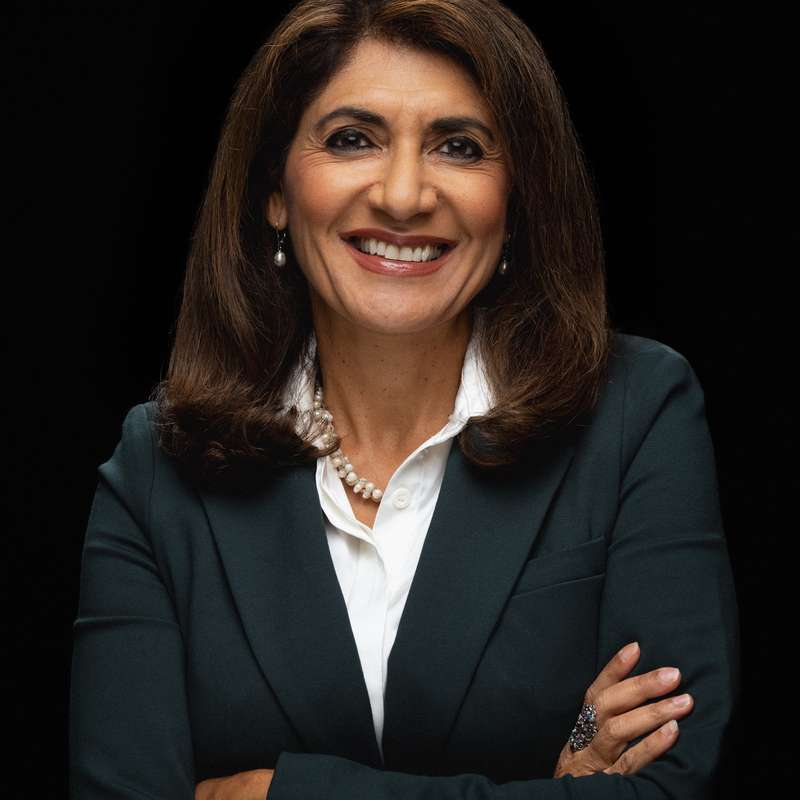 Farnaz Khadem
Yeah. Thanks for having me, Matt. I'm really actually happy to be here. You and I have been talking for a long time about this and having some great conversations, and it's nice to bring it to this forum.
Matt AbrahamsExcellent. I agree. Shall we get started?
Farnaz KhademAbsolutely.
¶ Communication Fundamentals
Matt AbrahamsSo to begin, your team is involved in many types of communication. Do you have some overarching principle that guides how you see effective communication?
Farnaz KhademFirst, let me tell you that as a communicator, I like to think in threes. You think in threes, you talk in threes, you remember it, other people remember it. So I'll tell you the three things. First is just know your goal. Communications is about what is it you're trying to get across. And if you don't know what that goal is as an individual or an organization, you're just, you're not gonna be able to do anything. Second is know your audience.
That's the other thing that people don't always think about is you gotta really be thinking about who you're talking to. And the third is know your data. I think we're gonna probably talk a lot about listening today. So much of communications is about listening and not talking, and data is the way you listen. I mean, when you work in an organization like this, you are constantly having to go back and see what worked and what didn't.
So if you don't know your data, you don't know your audience, you don't know your goal. So it's all kind of a circle. So those are really our overarching principles when we think about this.
Matt AbrahamsAbsolutely. Have to have a clear goal. We talk a lot about goals. The understanding your audience, and I wanna talk about audiences 'cause you have many that you have to serve. And then this notion of reflecting, using data to understand what works, what doesn't work, how do we craft that message, really important. A lot of people just see the goal of communication as getting information out, but it's really how does it land, and you've captured that in those three.
¶ Choosing the Right Channel
You also have to traverse a wide variety of channels, right? Social, there's written, magazines, newspapers. How do you think that landscape is changing, and are there certain messages that are better for certain channels? That seems to be another big variable you have to deal with.
Farnaz KhademIt's such a good question, and it is such a conundrum right now, right? Because the exponential increase of channels is phenomenal. The noise out there, the cacophony, right? People are overwhelmed with information, and so most things don't even get through because there's just too much out there. So I think part of the testing is exactly that. You look back to the audiences, right? We know that some audiences prefer things in short bursts. They want video. They prefer Instagram.
The shorter, the better. We look a lot at, like, national polls, too, or international polls. Like Pew says that half of people right now get their news from social media. I mean, that's phenomenal. So if that's a place where we need to push out more news, we try to do that that way. Longform still has a place, right? Longform writing, stories, they're still really important, but people aren't gonna read 2,000-word stories anymore. Very rarely are they gonna do that.
So one of the things we do as a team is we sit down and let's say we have a story, we actually go through that exact process. We say, "Okay, is this better as a short piece in writing, maybe with an accompanying video, and maybe even with a media pitch?" Like, we have media relations. We have really strong people who talk to journalists. And sometimes people don't need to hear it directly from us. We're actually better off sharing it with the media, who will then share it with the public.
And so we go through that on almost every story.
¶ Building Communication Networks
Matt AbrahamsI think that's a big lesson for people to take away is that it's not just the information, but you really have to think about the channel, and maybe it's a multi-channel approach for the story. And sometimes it might be not your organization, but helping other organizations amplify and send that out. That's useful for people to think about.
One of the other things I'm super impressed with that I think others who aren't in a university setting who have some comms responsibility is you'll pull people together from different areas who all do communication work and have them share best practices, have them learn from each other, really empowering and enabling them, not just through the people process and infrastructure that you talked about, but by actually having them engage with each other to feel supported.
'Cause it can be lonely if you're a single comms person sitting out there, you know, in some corporation. But being connected can be really helpful.
Farnaz KhademWe have so many great people doing communications for organizations around the university, but a lot of them are one-person shops, and so they're, to your point, lonely. They may not have as much knowledge about what's happening. They don't have an ecosystem. They don't have that connection, that connective tissue. And so we thought mentorship is another great way to do that, exactly for the reasons you said.
¶ Coaching Better Communicators
Matt AbrahamsSo related to mentorship, I wanna talk tangentially about a lot of what your team does is equip people to communicate who aren't naturally communicators. I'm thinking of academics or staff people working in a lab. Do you have best practices that you've observed either in the work you've done or your people have done to help somebody who might not be experienced as a communicator, who, for whatever reason, is in a position to communicate?
Maybe they've discovered something new, or they've got some expertise that's being pulled to the fore. How do you help people be better communicators as a coach, as a guide?
Farnaz KhademThis is one of my favorite things to do in communications. You know, I've been doing this work off and on for decades, and one of the best things you can do is help people, because even just a few tips takes people such a long way. One of the misconceptions that I have to tell you about communications is we all think everybody can do it. We all went to school. We can all write. We can all read. We can all speak, and therefore we think communications means just that.
And communications, if you do it well, is an art, and not everybody, to your point, can do that, right? And so we actually do. We offer that kind of training to faculty, to staff, to others, and it's as simple as, I mentioned I started out talking about the rule of three, right? You have three things that you wanna communicate and think about. And you just tell people even something like that, "Come up with your top three things that you wanna say," and that's life-changing for them.
They think about that, they process, and then they are able to more clearly communicate their thoughts. We can help people on camera. We can put them in front of a video camera and then help them see how they come across when they're communicating.
We talk to them about their work and kind of walk them through how to explain that in a way that is understandable because a lot of people are very good at being able to explain their work in the way that they understand it, but not necessarily in the way that other people would understand it. So there's a lot of things that we can do along those lines that we really actually enjoy doing. We think it's a big part of our job.
¶ Crisis Preparation
Matt AbrahamsI love that you gave three examples. And people might not know this, but one of the reasons that the leadership at the business school, but also you in your position, were supportive of this podcast as it started is it, it gave an opportunity for faculty to practice, to get out there, to be sharing their information.
Because part of it, as you said when you talked about recording people, it's one thing to understand how to do it, it's one thing to know your message, it's another thing to get the reps in doing it. And so I think it's great that you help people in all those ways. Uh, in your various roles that you've held, especially here, you've had to deal with public crises. What advice do you have for our listeners who have to deal with challenges, perhaps not on the scale that you have had to?
Farnaz KhademSo it's such an interesting question, Matt. I don't know if I would've started out my career, or even told you a decade ago, that crisis would be one of the things I would do most and I would spend so much time on, or that I would enjoy, because I don't think anybody can say they enjoy a crisis. But in some ways, it's one of the most interesting parts of doing communications for an organization.
So one of the things I've really loved doing the last few years in particular is going out and teaching about how to do crisis. And so maybe some of what I'll share is a little bit of what I say in these courses or talks that I give. You know, Benjamin Franklin said, "By failing to prepare, you prepare to fail." If no one ever takes away anything else having to do with communications, I hope they remember that. The most important thing to do in a crisis is just to have prepared in advance.
So what does that mean? Think about what are your top things that could go wrong in your particular job, in your particular organization. What are the top five scenarios of what kind of crisis you can have? And they're different, right? What could happen at a university could be very different than in a business, or even in someone's personal life. What are the things that could happen? And then you try to plan around those. Do you have the right tools?
If you're in an organization, do you have the right people? Do you know who's supposed to do what? Do you know roles and responsibilities? And so that whole process of actually thinking through what could go wrong and putting in place the tools and resources you need to address it is bar none the most important thing you can do.
¶ Crisis Response
Matt AbrahamsExcellent. So beyond preparation, what are some things you advise, let's say a crisis does erupt and you have to now communicate internally, externally, what do you teach on how to handle that step in the process?
Farnaz KhademI mean, I think there's a lot of different things you have to think about at that point of what do you do. I think one is that it, it really ultimately when you're in a crisis, truth and transparency are paramount. People want to know what is actually happening. And if what is happening is you don't know what is happening, you have to tell people you don't know what is happening. So don't assume you have to know everything before you communicate.
You just have to communicate and tell people what you know. Be truthful, be transparent. Second is in today's world with how fast things are moving, and as we talked about the multiple channels and, for example, how quickly information moves on social, you have to do it early and often. So I think the days where you could wait an hour or two to communicate something, or a day or two in a crisis are long gone. And then you have to do it regularly over and over and over again.
Again, even if you don't know what is happening. Those are, like, two of the main things that I talk about when I talk about how to communicate in a crisis. The thing I always end with to tell people is forgive yourself, because here's what's gonna happen in a crisis. It is going to be the fog of war. No matter how much you have practiced, no matter how much you have prepared, it's not gonna go as you think it will.
The preparation will help you, obviously, because then you are better able to manage those curve balls. You're not spending time on the basics. You're spending time on trying to manage how things are going. But in the end, it's not gonna go exactly as you anticipate. Things are gonna go wrong, and a lot of people beat themselves up for that.
And I think that's the one thing is forgive yourself, go back, do that learning, incorporate those learnings for the next time, and just know that's the way a crisis works.
¶ The Power of Storytelling
Matt AbrahamsI love the idea that you're doing reflection, a postmortem to learn, giving yourself grace to understand that it's not gonna go perfectly, and there might be things that go wrong, but we can learn from it. And yet again, you didn't disappoint. Three T's: truth, transparency, and I'm gonna add timeliness. I'd like to get your insight into what makes for a good story. Now, I know it depends on the audience, but are there certain elements that you like to see in stories?
Is there, for example, it has to have some emotional appeal, or there has to be something vivid? For you, what makes for a good story?
Farnaz KhademSo I love that question because there's so much focus right now in the age of AI on storytelling, right? So you're seeing articles and headlines all the time about what is good storytelling, what is the room for storytelling in the world of artificial intelligence, and so forth. There are many elements, I think, to telling a good story. For me personally, I think the single most important thing is does it create a connection? And ultimately, a connection is usually about something personal.
You can be a great speaker. When I think about TED Talks, what are the ones that really resonate? It's when somebody gets up and they are vulnerable, and they share something about themselves and their background and who they are, and all of a sudden that connection is made, human to human. And that is the essence of a great story. And I think all the other things are really important, and I see it in my own personal life, right?
Anytime I'm talking to someone, whether it's one-on-one or I'm giving a talk or I'm somewhere else, when I share something about my background, how something in my life taught me a lesson that brought me to where I am, I instantly notice a change. And so I think that connection and that personal nature is absolutely core
¶ AI in Communications
Matt AbrahamsAs somebody who has interacted with you and heard the stories you tell, you, you're very good at connecting and use several techniques to do it. You like to use analogies, you like to use descriptive language, and there are a lot of tools that can enable that connection. But I agree, it, it boils down to connection. And you alluded to AI. AI is impacting communication all over the place.
As somebody who runs a communication organization, what is your approach to using AI to help and also being concerned about some of the problems that come with people who use AI in terms of hallucinations and other things? How are you approaching that, and what guidance are you giving your team?
Farnaz KhademYeah. So we spend a lot of time talking about AI. I believe very strongly in moderation in all things, and that carries over for me into the workplace, and AI is a really good example of this. So we're really approaching it in a much more moderated and methodical fashion. Every person in the university communications team at Stanford has to have an AI goal. That was something that I said at the beginning of this year.
But what that means is very different from person to person and from team to team. For some people, that may be my goal is I'm going to take a class and try to understand better how to write prompts. For someone else, it might be more of an incorporation into their daily work. And I largely let the team know. I said, "I want you to do this for you, not so much even for me, for
the institution." I think that having familiarity with these tools is gonna be so important for the next generation of people in communications, and so I think it's incumbent on me to help them learn how to use it. And there are some really great things that we can and are using AI for. It certainly can make a lot of processes easier, whether it be in the writing or editing phase or so forth.
We can use it, and we're thinking about more how to use it for targeting particular audiences, 'cause I think AI can do a lot to help us find the right audiences for our messages. But then to the flip side of what you asked about, there are a lot of problems too that can come with that if people rush to try to do it too much.
So the other thing we did is we worked with actually some great faculty and others around the university, and we created AI guidelines for communicators, and these are now publicly available. And they're just some basic common sense things that try to address the fact of attribution. If you're gonna use AI, don't tell people you've used AI in some process in this.
Two is, you know, understand the hallucinations are real, so make sure you have backed up in terms of fact-checking anything that you have out there. And I think that's gotta be, those two things have to go hand in hand. Explore in moderation. See how it can help you. And on the other side, be careful and make sure you know where the red lines are.
Matt AbrahamsThank you for summarizing that for us. The key takeaway I have from what you said is just because it's there doesn't mean you need to use it, doesn't mean you need to use it in a specific way. I like that. And I think all of our colleagues across the university who are so instrumental in advancing AI would be very pleased with your answer, so that's great too.
¶ The Final Three Questions
Farnaz, I knew this would be a great conversation. We always have great conversations when we grab coffee. I'd like to end by asking you three questions, one I'm gonna create just for you, and two I've been asking everybody for a long time. We started our talk today highlighting listening, reflection. I'd love for you to share a little bit of advice on how you try to listen well and any advice or guidance you give others to improve listening skills.
Farnaz KhademI'm gonna share a story. I had a lot of great experiences when I worked as a US diplomat overseas. I was incredibly privileged to do so. And one of them was to meet some really phenomenal people. And when I was serving in Italy, I had the chance to meet Bill Clinton.
And one of the great things that people will talk about Bill Clinton all the time is that he is a great communicator, but one of the reasons that I thought, and I saw it firsthand, was when I got to meet him, is he makes you feel as if there is no one else except you, like he is truly listening to you. And I met him in a public forum in Florence with 1,000 people around us. But in that 20 seconds, I felt like I was the only person. There was a real connection there.
Not all of us can be Bill Clinton. But I felt very much that taught me something. If your attention is fully on someone, you're not multitasking, you're not looking over to the right, you're not doing something else, but you actually look like you're listening to someone, that can go a long way. And that one very short interaction taught me a lot years ago.
Matt AbrahamsYeah, paying attention and then having the intention to really connect makes a big difference. And regardless of what you think of his politics, he is very well known for that ability to connect and to listen. Question two, who is a communicator that you admire, and why?
Farnaz KhademSee, I thought that question might come 'cause I'm a longtime listener to your podcast. And I'm gonna be a little contrarian, and I'll tell you why I think one of the things that we've talked about here, communications has so many different facets, right? You gotta be a good listener, you gotta be able to be clear, you gotta be passionate about your topic. Different people have different strengths, and it's hard for me to think about one person who has all of that.
So we just talked about Bill Clinton and his ability to listen and connect. If you look at someone, let's say like an Oprah Winfrey, she's fabulous at warmth, and that is a really important part of connection. I spent many years doing technical or science communications, but when I look at somebody like a Neil deGrasse Tyson or a Bill Nye, their ability to simplify is their strength.
So it feels to me like you can take little pieces and parts of everybody out there, like the things that really matter to you, and say, "I want a little bit of this and a little bit of that and a little bit of that," and so no one person has that. I love a little piece of all of them.
Matt AbrahamsSo I will accept your heresy, because what you just shared in your response is the purpose of this question. It's really to look behind what makes for good communicators, and you did a nice job of delineating it. But I'm gonna give you an opportunity in our final question to give three key ingredients for a successful communication recipe. What are the most essential from your perspective?
Farnaz KhademThank you for asking in threes. The three things that I think are very much a reflection of some of the things we've already talked about, right? One is know your goal and your audience. You gotta know what you're trying to communicate and who you're trying to communicate to. Two, we just finished talking about it, listening. Are you a good listener? Do you do active listening?
Have you spent your time actually thinking about what the other person has said as opposed to trying to be the one to think ahead to what you're going to say? On the third point, I'm gonna diverge a little bit. I'm gonna say if you're an individual, you're doing it as a person versus as someone representing an organization. As a person, I think people hear this, but they do not always appreciate just how much nonverbal communication matters, right?
So how much your eye contact, your smile, your body language, your gestures make a difference. And so be thoughtful and be intentional about that. In an organization, if you're representing an organization for good communications, I had a great boss once who said, "Farnaz, a big part of your job is to educate your bosses. You think people know the same things you do. They don't know the same
things you do." So effective communication is to make sure that those who are decision makers around you are educated. They know what you know, and that will lead to good communications outcomes for an organization.
Matt AbrahamsWow. Okay. Lots there. So goal-based, focusing on your audience, listening, reflecting, absolutely key. We've heard some of that before. The importance of nonverbals. It's not just the message, but how the message comes across. And then your job is to make sure that those you're speaking to, be they your bosses, your peers, have the information they need to be successful.
So the goal of communication is to educate, which certainly doesn't surprise me given the role that you have as head of comms at a university. Farnaz, this was fantastic. Lots of key takeaways from lots of different areas of communication, from how we can be better ourselves, how we can better our organizations, how we can handle crises, how we can deal with AI. Thank you so much for your insight, and thanks for joining.
Farnaz KhademThank you for having me. That was a lot of fun, Matt.
¶ Conclusion
Matt AbrahamsThank you for joining us for another episode of Think Fast, Talk Smart, the podcast. To learn more about communication leadership and crisis management, please listen to episode 22 with David Demarest. This episode was produced by Katherine Reed, Ryan Campos, and me, Matt Abrahams. Our music is from Floyd Wonder, with thanks to Podium Podcast Company. Please find us on YouTube and wherever you get your podcasts. Be sure to subscribe and rate us. Also follow us on LinkedIn, TikTok, and Instagram.
And check out fastersmarter.io for deep dive videos, English language learning content, and our newsletter. Please consider joining our Think Fast, Talk Smart Learning Community at fastersmarter.io/learning. You'll find video lessons, learning quests, discussion boards, my AI coach, and book club opportunities. Again, that's fastersmarter.io/learning to become part of our Think Fast, Talk Smart Learning Community