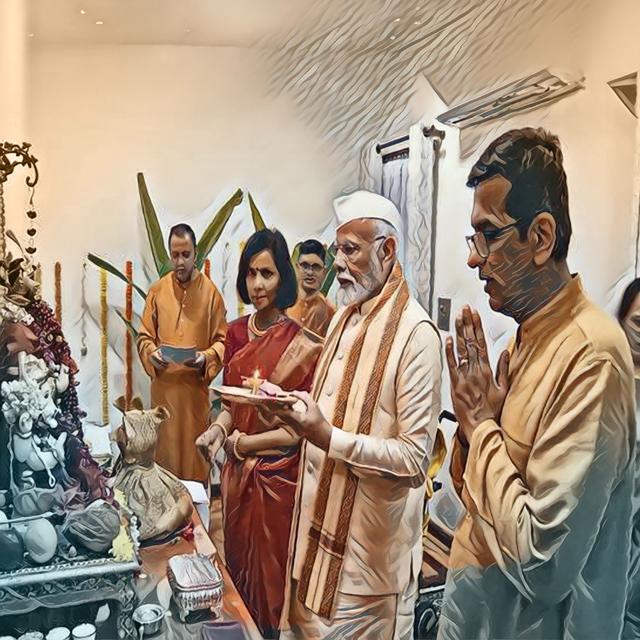



From India's largest newsroom, I'm Arun George, and this is The Times of India. Podcast on the. 11th of September, Prime Minister Narendra Modi turned up at the Delhi residence of the Chief Justice of India DY Chandrachoor. The reason was to participate in the Ganesh Utsav celebrations taking place at the Chief
Justice's home. Videos showed the Prime Minister and the Chief Justice and his wife participating in a ceremony in which the Prime Minister wore a Gandhi cap, most commonly associated with Ganesh devotees in Maharashtra. There was number audio to the video feed released in the public domain, and all that could be heard through the video is the tinkling of a bell during the puja. Criticism for the event came from various opposition parties as well as senior advocates of the Supreme Court.
The. Issue is not individual. The issue is what impact such a clip has on the minds of people.
Just a little over a week after this incident, the Supreme Court led by the Chief Justice had to come into the government's delay in appointing judges to the high courts of various states as well as the Supreme Court. The Supreme Court has also intervened and paused what has been called bulldozer justice in multiple states where a person accused of a crime has seen their home demolished for alleged violations.
In today's episode, we're in conversation with political scientist Suhas Pal Shekhar about various aspects of the courts dealing with the government and the message something like the Prime Minister turning up at the CJ's house sends. Professor Palshikar, who is the Co director of electoral think tank Lokniti analyzes these
issues and more. In conversation with my colleague Alka Dukar and me, we're talking about the Ganesh Utsav visit of the Prime Minister, the ties between the judiciary and the government and much more. The judiciary has been doing a balancing act with the executive for a while now, especially in terms of appointment of judges to higher judiciary. Could the PM's visit to the Chief Justice whom be viewed as just another such event to keep
the peace? Let's first address the first part of your question about the balancing act. You know, the judiciary always has to do this balancing act because it is always positioned as an adversary of the executive, as a protector of the Constitution. The judiciary is a protector of citizens rights. The judiciary is protector of norms.
The judiciary is protector of its own independence and therefore it has to constantly do a balancing act in the sense that it has to give a space to the executive and the legislature and at the same time constantly watch whether they are overstepping in appointments. In India, at least currently, the Supreme Court and its collegium have vast powers in principle in India.
Through historical processes and judicial decisions, the Supreme Court has finally in the last quarter of a century, taken over the powers of appointing judges to the High Courts and the Supreme Court itself. On the ground that consultation, which is the word used in the Constitution, means that the advice given by the judiciary shall be binding on the
executive. Which then means that once the judiciary has given the list of judges to the government, the government has to appoint them there. The balancing act so far has been rather awkward because on a number of occasions the government has simply refused to appoint the judges recommended by the courts on some ground or the other and sometimes not giving any grounds and not
taking any action at all. Supreme Court has again and again warned the government that it has to act on the lists that are recommended by the collegium. The latest as we speak has been a case where the Supreme Court has finally asked the government to give a specific presentation of what happened to each of the recommendation of the collegium. Quickly then the government started appointing a few judges
to the high courts. So here I think the Supreme Court needed to be more assertive as far as the current position between the executive and the judiciary is concerned. The third part of your question is rather comical event of the Prime Minister of the country suddenly going to the residence of the Chief Justice of India to join him in the worshipping of Lord Ganesh on the occasion of Ganesh festival which is a most popular festival in Maharashtra. Particularly.
We don't know what happened. There has been no official explanation either by the Office of the Chief Justice or the Prime Minister whether specifically the Chief Justice invited the Prime Minister to attend the puja during Ganesh festival at his residence. If that is the case, that would probably a very serious blow to judicial independence.
If on the other hand, the Prime Minister had an evinced interest in joining the Chief Justice during the puja, as I said, it would be a comical situation because then one is imposing oneself on the Chief Justice and in that situation we don't know how the Chief Justice could have handled this situation. To make matters worse, the Prime Minister went, as always, with a camera crew and therefore a private event.
It could have been a private event and we could have discussed it separately whether for even a private event, Prime Minister should go to the residence of the Chief Justice. But at least it could have been a private, quiet event.
Instead of that, it became a national spectacle and that's why it is extremely awkward but at the same time objectionable that the two should be seen as joining in a prayer at the residence of the Chief Justice. Then the previous examples were cited where previously Prime Minister had met the Chief Justice of India in one of such events. Our public sphere is full of What about tree these days.
So let us say that if that time we were discussing it, we could have discussed the merits of those issues. But as far as I know, the events that were dugout of past meetings of such dignitaries during festivities where public meetings, public festivals, a party is thrown by the dignitary and then other dignitaries join where it is not a tete, It is not a face to face meeting just between the Prime Minister and the Chief Justice nor at the residence.
So there is a difference. But I would say yes, in public life, such dignitaries, president, Prime Minister, chiefs of army staff, do mingle with each other formally, which is way different from a Prime Minister individually going to a chief Justice's residence. And when there are no other dignitaries present, that makes poor show of our institutions. And the Prime Minister also presented an obvious nod to Maharashtra elections with his dressing for the occasion.
How much does such iconography, the visit to the CJI and the outfit really help politically? The Prime Minister has a very smart sense of dress, so obviously he would go to a Marathi Chief Justice for a so-called Marathi festival, giving an indication that he understands the Marathi ways of how to present oneself before the deity at the time of the
festival. The Prime Minister always does it and whatever benefit he accrues from it, he always does it. This time around I don't think it would matter much for the simple reason that this is a routine, in a sense spectacle that the Prime Minister, in his dress or headgear or language, would try to address a particular constituency which is going to elections. The trouble, however, is that this happened in September.
Elections in Maharashtra are yet to be declared and therefore by that time this particular presentation by the Prime Minister would probably have been forgotten. So I don't see any great political conspiracy behind it. I don't see that this is something where the Chief Justice has compromised his independence completely. What I am saying is that it is poor show as far as institutional pride and boundary lines are concerned. You say that it doesn't impact politically, it shows the
institutions in a bad light. Then what is the purpose of such an event at all then? If you ask me why the Prime Minister might have gone there and we don't know the purposes and intentions, and therefore rather than why he might have gone, I would say what would be the effect? And the effect I think is that it generally shows judiciary in bad light and thus in the long run delegitimizes the institution. That is the effect. The Prime Minister might have gone just casually.
The Prime Minister might have gone because the deity at the Chief Justice's house must be particularly kind hearted and therefore the Prime Minister wanted that deity's blazing. You know, in Pune, where I stay, there are Ganesh deities which are seen particularly very benevolent. So you go and pray them. So that may be the story, I don't know. I have no personal knowledge about the kind heartedness of the Ganesh deity at the Chief Justice's house. So I wouldn't go into
intentions. But I would definitely say this, that this is bad, not because the Prime Minister would have asked the Chief Justice to do something, not because the Chief Justice would really buckle in, but simply because it shows that the judiciary can be taken for a ride. Judges are not above sort of a pedestal. That is the signal that this particular event gives. And after this visit when Prime Minister visited Maharashtra there he attacked Congress saying Congress is against
Ganesh pooja. Usamaibi Ganesh aajbi samaj ko baatne satta ke bhuke logo ko Ganesh. That is how public discourse is shaping these days, that you say one thing and then you impute something else to others so that the entire public discussion discourse is vitiated.
So that's bound to happen. And that's why I thought that if this could have been avoided by the Chief Justice of India, perhaps that could have been great because you don't know the consequences of this rather than that is best avoided. Aloofness is much better than judges being too vocal and public celebrities. Judges shouldn't be public celebrities. Judges shouldn't be giving paid talks, for example, while they are sitting on the bench. Judges should be simply giving rulings.
What does all of this say about the judiciary at this time when you also have things like the government easing the entry of government employees into the RSS? How do you view all these events at the same time? Let's say, first, political inclinations, that is to say, not necessarily partisan, but political ideological inclinations among judges are bound to be there.
And it's a very complex task for any appointing authority to determine whether a person should be appointed as a judge or not simply on the basis of his or her ideological inclination. The assumption is that even if you have a certain ideological viewpoints, you operate within the constitutional framework and #2 that the Constitution does not preclude various ideologies. It doesn't sort of throw away
various ideologies. And therefore it's alright if you have a communist ideology as in the case of Justice VK Krishna here earlier. But at the same time, the trouble is that when there are very sensitive political cases in terms of like the cases that were allegedly discussed at the VHP event about mosques which are contested, whether they are
temples or mosques. Given the history of the Ram Janmabhoomi and the Ayodhya controversy, you will find that again it is very difficult for judges to get involved or not get involved in such ideological events. At an extreme, one could therefore say that the best thing for judges would be not get involved in politics after retirement. And politics here means in public affairs at all, at all. And that doesn't happen.
I think we have come to a stage where rather than leaving things to the discretion and good wishes of the office holders, we need to search clearly have a norm that after retirement, no public engagement full stop. Once that happens, this possibility might get reduced to some extent. But even then, if I have a certain ideological inclination, I get entrance into the judiciary and then sit on certain benches that are discussing politically sensitive
cases. It becomes a very difficult moral issue, both for the public as well As for the judge. How to keep aside his or her ideological inclinations and consider what the Constitution expects in this particular case? This argument that the executive and judiciary must be separated has been violated multiple times, most recently with a serving Calcutta judge retiring to contest on a BJP ticket. What are the political benefits of keeping one's party doors
open to judges? You know, for any political party, for any political dispensation, if dignitaries join it, it sort of adds to its legitimacy. And particularly in the instance you cite in West Bengal where the BJP is an opposition, when a High Court judge quits and joins or retires and joins, it means a lot as far as messages to the public are concerned that here is a High Court judge who joins an opposition party in that particular state.
That is why in fact, there has always been a discussion about what is technically known as the cooling of period, that if you are holding an important office, then there should be a gap, an interval before you join any political party or join active
politics. Unfortunately, in India, there is no strict norm about it nor is there any rule or legislation prohibiting it. It again makes a very poor show of our institution when judges overnight join a political party except political offices offered by a ruling party like an earlier Chief Justice of India becoming a Rajya Sabha member. These are all bad practices in any case.
The Supreme Court has struck down, temporarily, the bulldozer justice model that multiple chief ministers have been touting as a success. How do you view this verdict, which now seeks to put in place guidelines for such actions? Generally, yes. Good. After all that the judiciary stepped in, yes. But a the judiciary need not have to be called into stepping in the 1st place because this is blatantly illegal. That if I am an accused, I am innocent till proven guilty in
the 1st place. But even if I am proven guilty, my family need not be penalized for that and therefore this barbaric idea of using bulldozers against families of so-called accused, mafia culprits, terrorists, whoever is anti democratic. It shouldn't have happened and if it happened, the governments themselves should have controlled and self regulated. Now the Supreme Court has stepped in. But look, the Supreme Court, and that goes to your first question of balancing act.
The Supreme Court sort of trades very carefully. It criticizes the bulldozer kind of practices, but it says that temporarily don't do it till we draw guidelines. Now you know what will happen to guidelines. It is not the job of the judiciary to give guidelines to the executive. So obviously in those guidelines it would be implied that the government should finally
prepare guidelines. And you know, what happened to the instructions of appointment of election commissioners, how the government overcame that and had its own way. So this entire thing may be good in bad times, but basically too little, too late, or we don't know whether even there is anything little because we don't know the guidelines yet. So it's only a temporary respite.
The Supreme Court, if it wanted to really establish rule of law, should have simply said that in any condition, this kind of use of bulldozers against persons unrelated to the crime or perpetrated crime is illegal. Don't do it. Blanket No. That has not been done. The RSS has been in the news since the election results due to statements made by the leaders, which is seen as directed at the Prime Minister. We ask Professor Palshekar how
he viewed these statements. Given the consecutive statements made by the RSS chief and senior RSS leaders in recent past, do you believe that the rift between the Bharatiya Janata Party and the RSS is widening or is it merely a show for the public? No, I don't think it is a show for the public. I think there is a serious difference between the two, and that is bound to be there for a
variety of reasons. Historically, when the current Prime Minister was chief minister of Gujarat and even earlier when he was not chief minister of Gujarat, he had a very tenuous relationship with the RSS organization. It is only for mutual convenience and particularly the RSS convenience that the RSS piggybacked on Prime Minister Narendra Modi when he rose to prominence.
Because the RSS must have thought that here is a golden opportunity for them to extend their cultural reach across the country with the popularity of Prime Minister Narendra Modi. So they did it. The second reason why there is a kind of tension between the two is the personality of the Prime Minister himself. The RSS, whether you like it or not, doesn't believe in competition from other leaders.
Its faith is that its own leadership is autonomous and self-sufficient and therefore a leader of the party which they see as their extension cannot be above the RSS and RSS leadership. Whereas the personality of the Prime Minister Narendra Modi is such that he cannot be subservient or second to any other leader within their organization now, particularly when he has a certified popularity through 3 elections so far. And that is where I think these clashes are occurring.
I don't think these clashes are necessarily ideological though, because the RSS doesn't bother much about economic policies. Though they have their own take on economic policies. They are always willing to compromise on that so long as their cultural policies are acceptable to the existing government, which they are as far as the current existing national or All India government is concerned.
So I don't think it has more too much to do with ideological differences, but personality clashes, clashes of organizational style and historical clash between Mr. Modi and the RSS. When the government lifted the ban for its employee to join the Rashiya Swamsakhsanga, you have said that with this decision, formalization of the idea of the Hindu state has been taken one step further. Would you please describe it and the risk or like effects of it?
See, there had been a ban on membership of RSS if you are a civil servant. Whether that ban was effective or not, whether it made any difference or not, can always be debated. But that ban meant that RSS is having a certain ideological position which is in contravention to the ethics of a public servant, namely that she should be serving the entire public body of citizens
irrespective of their religions. A religious organization which clearly says that it is a religious organization, how can you be a member of that organization and then serve the entire public? That contradiction is there now that ban has been lifted. With the lifting of that ban, we now accept that even if you are a member of a Hindutva organization, you can still continue to be a civil servant.
In a sense, this connects to the discussion of judges having Hindutva inclination as well, and both questions come together as a major challenge. I think that over the last few years we are gradually moving to a de facto Hindu state. It is not a legal Hindu state yet and probably that's the only difference so far between a formerly religion based state and India. It's still not there.
But otherwise, the entire symbolism from the consecration of the Ayodhya temple by the Prime Minister himself to this small thing of lifting the ban on RSS membership as far as civil servants are concerned, are all steps, small steps, sometimes big steps that allow Hindutva elements to capture the Indian state and Hindutva also to become the main ideological identity of the country. That has now been allowed.
And that is what I meant when I said that a small step further in making India a de facto Hindutva state. Then the argument is what's wrong in it. If this is the de facto Don Hindutva ideology and constitutional values, how it is clashing this identity to the constitutional values of India? It clashes fundamentally because the Constitution in in the sense presupposes equality of all citizens, equal treatment of all citizens irrespective of their
religions. Whereas Hindutva as an ideology in many of their writings but more in their practice believe in Hindus having a preeminent position in a Hindu majority Indian society. And that is the difference between the Constitution and the idea of Hindutva. Citizenship is irrespective of Oregon without regard to religion in the Constitution. The Hindutva ideology may say that we have no objection to that but there should also be a preeminence of Hindus and Hindutva ideas in this Indian
society generally. What I then distinguish is the constitutional framework is broadly pluralist, secular, based on diversity, whereas Hindutu idea has a narrow understanding of pluralism. They would say yes, pluralism is there in Hindu religion but that's not the point. It has a limited idea of citizenship also and therefore the clash is at the fundamental or foundational values of the
constitution. To be blunt and provocative, I would therefore say that to be a proponent of Hindutva is in direct contrast or in direct negation of upholding the Constitution. If you uphold the Constitution, you can't uphold Hindutva. If you uphold Hindutva, you can't be upholding the Constitution.
When there is a political ideology that cuts at the roots of the Constitution, you have to then clearly say that this is outside of the Constitution, and something that is outside of the Constitution is very difficult to reconcile with the Constitution. Today's episode was produced by Jayraj Singh and Sahil Gupta. For a daily spotlight on people, ideas and stories that matter, subscribe to us where available on the Times of India website, Spotify, Apple, Amazon or
wherever else you get your podcast. For any new steps of feedback, mail me at Arun George at timesgroup com.