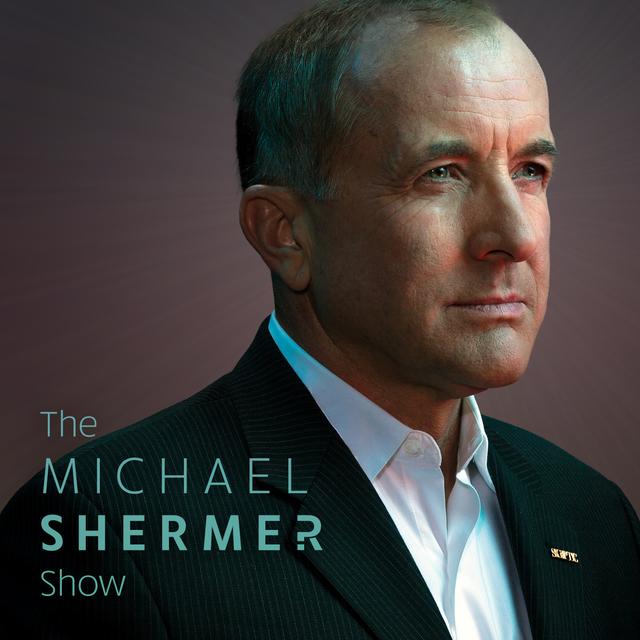
The Michael Shermer Show is a series of long-form conversations between Dr. Michael Shermer and leading scientists, philosophers, historians, scholars, writers and thinkers about the most important issues of our time.
Last refreshed: ⓘ
Follow this podcast in the Metacast mobile app to refresh it and see new episodes.
Don't just listen to podcasts. Learn from them with transcripts, summaries, and chapters for every episode. Skim, search, and bookmark insights. Learn more
For many decision scientists, their starting point—drawn from economics—is a quantitative formula called Rational Choice Theory, allowing people to calculate and choose the best options. The problem is that this framework assumes an overly simplistic picture of the world, in which different types of values can be quantified and compared, leading to the "most rational" choice. Behavioral economics acknowledges that irrationality is common but still accepts the underlying belief from economics of ...
Why do we crave revenge? And why can't we stop? In this episode, James Kimmel explains the neuroscience behind one of our most destructive urges. Drawing from his new book, The Science of Revenge: Understanding the World's Deadliest Addiction , Kimmel reveals how revenge activates the same brain circuits as drugs like cocaine—and why even imagining payback can feel euphoric. If you've ever fantasized about revenge (and who hasn't?), whether in politics or personal relationships, this episode off...
What really defines a cult—and why do smart, well-intentioned people get caught up in them? In this episode, Michael Shermer sits down with cult intervention specialist Ashlen Hilliard to explore the psychology of high-control groups and the people drawn into them. Her work has been featured in prominent media outlets like Hulu, NewsNation, HuffPost, and BET+. In 2022, Ashlen founded People Leave Cults, offering intervention and recovery resources for survivors and concerned loved ones. As one o...
Michael Shermer sits down with economist and Franklin descendant Dr. Mark Skousen to explore the wit, wisdom, and modern relevance of Benjamin Franklin, the man who bridged science, politics, and philosophy like no other. Shermer and Skousen discuss Franklin's contributions to science, moral philosophy, economics, and religious thought, while asking: What would Franklin make of today's America—its economy, politics, and culture? Mark Skousen holds the Doti-Spogli Chair of Free Enterprise at Chap...
The COVID-19 pandemic was a devastating global event, killing more than seven million people, straining the fabric of societies, and shaking the foundations of the world economy. And yet, as horrifying as the experience was, COVID-19 was not "The Big One" — the dreaded pandemic that haunts the nightmares of epidemiologists and public health officials everywhere. That far deadlier outbreak is still ahead of us, and it will reshape life across the planet unless we're ready for it. In this episode,...
Common knowledge is necessary for coordination, for making arbitrary but complementary choices like driving on the right, using paper currency, and coalescing behind a political leader or movement. It's also necessary for social coordination. Humans have a sixth sense for common knowledge, and we create it with signals like laughter, tears, blushing, eye contact, and blunt speech. But people also go to great lengths to avoid common knowledge—to ensure that even if everyone knows something, they ...
Jim Lampley's story is a 50-year travelog of an unlikely career that catalogs the evolution of sports television—from his emergence as the first sideline reporter, through hosting and covering 14 Olympics, to working with all major sports networks. In this episode, Lampley reflects on his experiences in boxing, the evolution of the sport, and the genius of athletes like Muhammad Ali and George Foreman. The conversation also explores the unpredictability of life and how chance events shape our pa...
In this solo commentary, Michael Shermer reflects on the assassination of Charlie Kirk and places it in the larger context of political violence, the psychology of radicalization, the dangers of false beliefs, and the role of free speech in intellectual discourse.
Science writer Nicholas Wade explains how human nature continues to shape—and sometimes destabilize—modern civilization, and argues that ignoring the effects of human nature on politics is one of society's greatest mistakes. Drawing on anthropology, evolutionary biology, and history, Wade shows how deep-rooted traits not only shape the outcomes of certain political beliefs and systems, but also affect how people form families, religion, and social order. Nicholas Wade has worked at Nature and Sc...
Parenting today often feels like an uphill battle, with technology invading every corner of our kids' lives. From the rise of social media addiction to the growing mental health crisis among children and teens, parents are grappling with how they can create a healthy, balanced relationship with technology for their kids. Drawing on her decades as a psychologist studying the impact of technology and mental health, Jean Twenge offers evidence-based advice for raising independent and well-rounded c...
In this episode of The Michael Shermer Show , Michael Shermer interviews Alan Stern, a prominent planetary scientist and astronaut. Stern discusses his recent suborbital flight, the differences between government and private space initiatives, and the scientific implications of UFO sightings. He also shares insights about the evolution and future of space exploration, including details about the rarely talked about upcoming termination of dozens of already paid-for NASA missions. Alan Stern is a...
In a radical new story about the birth of our species, evolutionary biologist Madeleine Beekman argues that it was not hunting, fighting, or tool-making that forced early humans to speak, but the inescapable need to care for our children. Beekman reveals the "happy accidents" hidden in our molecular biology—DNA, chromosomes, and proteins—that led to one of the most fateful events in the history of life on Earth: our giving birth to babies earlier in their development than our hominid cousins the...
Economist Dean Spears explains the forces driving global population change, from past fears of overpopulation to today's concerns about declining birth rates. He contrasts the perspectives of biologists and economists on population growth and highlights the role of human ideas and innovation in sustaining progress. Spears also discusses misconceptions about zero-sum economics, the links between population, health, and economic well-being, and the rise of anti-natalism. The conversation covers po...
Because brainwashing affects both the world and our observation of the world, we often don't recognize it while it's happening―unless we know where to look. As Rebecca Lemov writes in her new book The Instability of Truth , "Brainwashing erases itself." What we call brainwashing is more common than we think; it is not so much what happens to other people as what can happen to anyone. In her work, Lemov exposes the myriad ways our minds can be controlled against our will, from the brainwashing te...
In an era of globalized education, where ideals of freedom and inquiry should thrive, an alarming trend has emerged: foreign authoritarian regimes influencing American academia. In her new book Authoritarians in the Academy , Sarah McLaughlin reveals how higher education institutions—long considered bastions of free thought—are compromising their values for financial gain and international partnerships. Her investigation uncovers the subtle yet sweeping influence of authoritarian governments, ex...
In this conversation, Michael Shermer and Dr. Eric Topol discuss the realties of aging, with particular focus on the role of AI in enhancing patient care and disease prevention, the importance of lifestyle factors, and the limitations of genetic testing in predicting health outcomes. Topol also explains the dangers of ultra-processed foods, their link to inflammation, and the role of GLP-1 drugs in promoting healthier eating habits. The conversation also covers diet, particularly the differences...
Isabelle Boemeke explains how nuclear energy is our best option for ensuring the future of the planet—it can power cities, desalinate water, create carbon-free fertilizer, and heat homes, all with the smallest environmental footprint of any energy source. She also discusses common objections to nuclear energy, including safety concerns and waste management, the potential of microreactors, and the importance of nuclear energy in space exploration. Isabelle Boemeke is a nuclear electricity educato...
In his new book Coming Clean , Eric Heinze rejects the idea that we should be less woke. In fact, we need more wokeness, but of a new kind. Yes, we must teach about classism, racism, colonialism, patriarchy, and other gross injustices, but we must also educate the public about the left's own support for regimes that damaged and destroyed millions of lives for over a century—Stalin in the Soviet Union, Mao Zedong in China, Pol Pot in Cambodia, or the Kim dynasty in North Korea. Criticisms of West...
Traditional religion in the United States has suffered huge losses in recent decades. The number of Americans identifying as "not religious" has increased remarkably. Religious affiliation, service attendance, and belief in God have declined. More and more people claim to be "spiritual but not religious." Religious organizations have been reeling from revelations of sexual and financial scandals and cover-ups. Public trust in "organized religion" has declined significantly. Crucially, these reli...
In this episode, Michael Shermer speaks with historian Sophia Rosenfeld about how modern notions of personal choice—from Amazon shopping to Tinder swipes—emerged from centuries of cultural, religious, political, and economic transformation. Was there ever a time when choice wasn't synonymous with freedom? Why were early ideas of "common sense" and "free will" so limited? And what happens when choice itself becomes overwhelming? From Enlightenment ideals to the sexual revolution and the abortion ...
What can a lifetime of scientific discovery teach us about the universe—and ourselves? In this wide-ranging conversation, Michael Shermer sits down with Lord Martin Rees, renowned cosmologist, astrophysicist, and former Astronomer Royal, to reflect on the forces that shape scientific success, from personal luck to cultural context. Rees shares insights on the mysteries of cosmology, the search for extraterrestrial life, and the paradoxes that still puzzle humanity. Rees also shares intimate refl...
When you are faced with a decision, do you consider the best outcome, or do you consider your deepest values about which actions are appropriate? Steven Sloman contrasts these two primary strategies for making decisions: consequentialism or prioritizing one's sacred values. He argues that, while both modes of decision making are necessary tools for a good decision maker, people err by deploying sacred values more often than they should, especially when it comes to sociopolitical issues. As a res...
Michael Shermer in conversation with Debra Soh at FreedomFest 2025 in Palm Springs, CA. Video courtesy of FreedomFest. Additional FreedomFest videos can be viewed on CiVL.
Douglas Murray discusses his book "On Democracies and Death Cults," sharing insights from reporting in Israel, Gaza, and Lebanon after October 7th. He examines the perplexing support for Hamas, its death cult ideology, and the threat posed by Iran's nuclear ambitions. The conversation also covers the complexities of criticizing Israel, the two-state solution's viability, and touched upon Western political and economic views and immigration.
Philosopher Michael Patrick Lynch joins Michael Shermer to discuss his book, "On Truth in Politics: Why Democracy Demands It." They explore whether truth can coexist with politics, distinguishing between empirical and normative judgments, and analyzing how facts become politicized. The conversation covers historical perspectives, thought experiments, and the importance of maintaining epistemic infrastructure for a functioning democracy amidst challenges like misinformation and loss of faith in reason.
A debate on the mind, soul, consciousness, and the afterlife. Michael Egnor, MD, is Professor of Neurosurgery and Pediatrics at the Renaissance School of Medicine at Stony Brook University. He received his medical degree from the College of Physicians and Surgeons at Columbia University and trained in neurosurgery at the University of Miami. He has been on faculty at Stony Brook since 1991. He is the neurosurgery residency director and has served as the director of pediatric neurosurgery and as ...
When award-winning science writer Amy Alkon was blindsided by her first hot flash, it kicked off a cascade of symptoms—drenching night sweats, insomnia, and a rage she couldn't explain. But what shocked her more was how little real science her doctor had to offer. In this episode, Alkon shares what she uncovered in her deep dive into the research on menopause and perimenopause—the critical yet often neglected years leading up to menopause when millions of women are misdiagnosed, dismissed, or si...
What began as a call for justice has, in many cases, become an engine of conformity. In this searching conversation, Andrew Doyle (author, satirist, and cultural critic) joins Michael Shermer to unpack the trajectory of the woke movement: from its roots in anti-bigotry and awareness to its current entanglement with censorship, identitarian dogma, and ideological rigidity. Drawing on his new book, The End of Woke Doyle traces the intellectual history of contemporary activism, explores the authori...
Since the dawn of the Industrial Revolution, capitalism has unleashed unimaginable growth in opportunity and prosperity. And yet, at key points in American history, economic disruption has led to a greater role for government, ostensibly to protect against capitalism's excesses. Today, government regulates, mandates, subsidizes and controls a growing share of the American economy. Today on the show, retired U.S. Senator Phil Gramm, one of America's premier public policy advocates, and noted econ...
By most popular accounts, the universe started with a bang some 13.8 billion years ago. But what happened before the Big Bang? And how do we know it happened at all? Cosmologist Niayesh Afshordi and science communicator Phil Halper offer a tour of the peculiar possibilities: bouncing and cyclic universes, time loops, creations from nothing, multiverses, black hole births, string theories, and holograms. Incorporating insights from Afshordi's cutting-edge research and Halper's original interviews...