


¶ Introduction to AI's Future
Hello and welcome to the final episode in our AI. Sponsored by Nona. Centre of Gravity for A. R. I'm a professor and An organization. Ethically to make education and how your organisation can develop an AI strategy and roadmap and how your educators can take advantage of our expert AI CPD. Now today we're talking about the future horizon of artificial intelligence.
And by that we mean what exists beyond just the here and now in AI. ChatGPT and many of the other generative AI systems that we've been using for the last year or more are relatively new. But actually, generative AI has been around for several years. So with all the hype and headlines, these new tools have sparked. What are we going to do to prepare society for the next big thing?
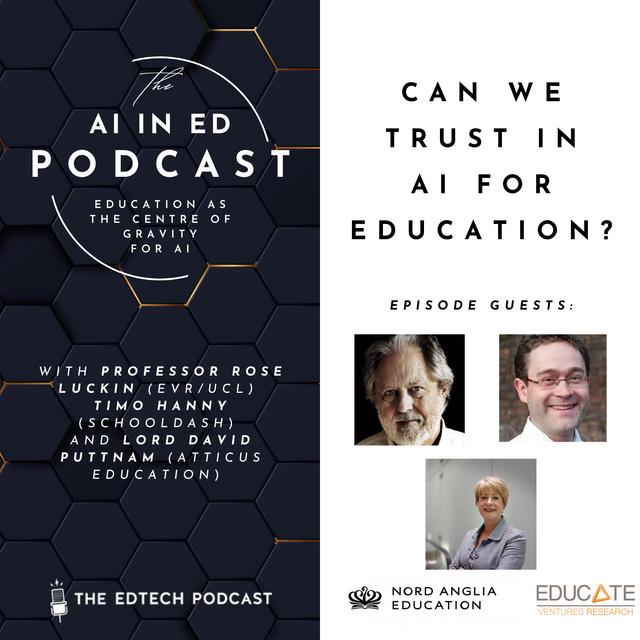
How do we build better, articulate clearer, and apply what we've learnt from things like generative AI and other emerging technologies so that we help one another understand enough not to fear each new leap? in their sophistication. Now with me in our lovely PUD studio today, I'm very lucky to have two wonderful guests who are going to join me in this discussion. Lord David Putnam, film producer and chair of Atticus Education, and Timo Haney, founder of SchoolDash.
And I'd like to get down to a first question that I think a lot of people in many areas of work, but particularly in education, are interested to know. And that is What's actually happening when it comes to the use of AI? If we want to take stock and pause and think about what we've seen happening and then consider the potential.
for good and for bad in the future use of tools, both generative AI and other forms of AI. What do you think the future holds for us? David, I'd love to come to you first.
¶ Building Trust in AI
Very interesting question. The short answer to me for me is All builds around the fact that whether we can create an environment of trust within which AI operates, if we fail to. then I think AI could turn into a destructive, uh potentially destructive technology in the same way that social media has managed to turn around and bite us in the arse, you know?
So I think it developing trust in the technology is going to be the first thing. Developing trust in technology requires trust developing trust in the people who are responsible for it or who are operating, as it were, behind and in front of the scenes. So the issue of trust to me becomes more and more foundational every single year. And I think that nowhere does it apply more in than in the development of AI. And again, within that, nowhere more than development of AI within education.
That's so true. I think trust is a core issue and I like the way that you've talked in terms of trust in the technology and trust in the people behind the development of the technology. And your comparison with social media is very apt. I I really worry about that. I don't think we did a good job with social media and we've seen the damage that's been caused. So, how can we practically build that trust? to try and prevent
the negative impacts that we've seen with social media. I mean we have the new AI act. from the European Commission. But practically, what can all of us do, do you think, that would help that conversation? Is it about understanding more about AI and trying to hold to account some of these big tech companies? Or or or what do you think we might do? Okay, I mean, very simply, really the only answer, Rose, is to
hugely accelerate what we should have done a decade ago, which was develop digital understanding among yo young people. You know, I've I've been uh because you know, that from the age of seven or eight, Kids should be treated, you know, should be taught and treated as grown-ups in terms of the developing digital environment.
Uh so we failed. We did fail. And I think if we don't learn the lessons in social media, we're bonkers. But we failed. So now what we're gonna do is accelerate what we should have done a decade ago. It can be done, but it needs to be done very quickly now and very seriously.
I couldn't agree with you more and I think it is vital and I worry that I'm not seeing enough of that happening and also not enough helping teachers to understand these technologies because they are working with young people and need to be a big part. o of that conversation about developing those digital skills within young people. So I think you are absolutely right and it's something that we need to try and make happen.
I think it's very easy to say, oh, regulation's the most important thing. We need to get the regulation right. But actually regulation without education is not what we need. We need both regulation and education.
Because this is I I know it's not the sound well very odd, it makes me sound odd. In two thousand and three I was part of a group that took through Parliament exactly the regulation we required, which was a requirement for digital literacy to be soup to be supervised and in and and as it were put together by Ofcom. It never, 2003, which about 20 years ago, nothing happened. Ofcom found a way of sliding around those responsibilities and they didn't evolve anywhere.
So what we need is a bit like the post office uh scandal, to be honest. We actually need someone to press the button and say, what on earth were our brains? Where were we? Why didn't we do this? How do we now how do we now deal with it in the same way that Richie Sun is trying to deal with the post office scandal right now? Yeah, isn't it awful that terrible things have to happen before we get to that stage?
Timo, over to you. So same question to you really. You know, how do we tackle the future usage of these tools, particularly in education?
¶ Understanding AI Beyond ChatGPT
So I think, you know, I'd certainly echo a lot of what David said. I think, you know, one thing is just is is to foster this understanding of AI. David David mentioned this. I think it's really important. So a couple of I think really important things there. One is AI is not just Chat GPT, right? So we need to be very clear about what we're talking about when we talk about AI. Chat GPT is not
the only large language model. Large language models aren't the only form of generative AI. Generative AI is not the only form of machine learning and machine learning is not the only form of AI, at least in my definition of it. So I think we need to be very careful to to understand what we're talking about, appreciating the breadth of what we're talking about.
I think the other thing, particularly for the relatively uninitiated when it comes to the technology itself and how it works, is this isn't magic, right? I think and I think it can be Can work to the advantage, or at least the self-perceived advantage, of technologists and particularly technology companies, to try and present it as if it's something magical.
Doing it really well is hard. So technically the people that do it well are very impressive people, very clever people. Um but understanding how it works in principle is actually not that difficult and no one should lead you to believe otherwise. I think another aspect of, you know, ending up in a good place rather than a bad place is
this sort of healthy skepticism about it. Um it's here. I don't think we can we could uninvent it even if we wanted to. And I think it can genuinely be a massive force for good, not least in education.
Um, we have to be skeptical. And just reflecting on on what you and David were discussing, you know, a couple of minutes ago with with regards to social media, I remember so I'm a recovering techno optimist. You know, I remember being at the Web 2.0 conference summit in San Francisco, it must have been at the end of two thousand and seven because it was the morning after Barack Obama had just been elected.
And the sense of, you know, like palpable optimism in the room. This is post dot com bubble, you know, there were a lot of people in the room who made a lot of money out of uh the web and technology. And, you know, a Democrat and an African American taboo had just been elected to the White House. And there was just this unbridled optimism that the world's gonna be a better place now, you know, un unbridled knowledge.
we're gonna have you know increased empathy and better communication and of course fast forward to twenty twenty four and we find we're not in that world. And and if I think about another event I was at recently. Roses were there too, which was the AI and Education Summit that we held in London a few weeks ago in November as a satellite event, a fringe event, for the AI Safety Summit at Bletchley Park.
There was a great deal of skepticism in the room there, healthy skepticism. So not, you know, we should stop all of this and, you know, we shouldn't have anything to do with AI. Everyone was there to talk about AI in education. But there was a great deal of skepticism.
around, you know, this could be bad as well as good. And we really have to be very intentional about making sure that we we know we we dial up the good and and we reduce the bad. And that's not something that's going to necessarily be self evident. from the get go. So as we choose a particular path, it won't necessarily be
obvious to everyone, you know, is this the right path to go down? So we I think we we have to adopt what I think of as a sort of mind the scientific mindset, which is sceptical, it's always sort of slightly self doubting, you know, always open to persuasion that we shouldn't be doing what we're doing, we should be doing it in a different way. Because
You know, technology amplifies. It doesn't, you know, and it amplifies the good and the bad. And we need to make sure that we we amplify the good. There's lots of other more specific things one could say about education, but I think in terms of general stance,
encouraging that understanding, not encouraging the sort of magical thinking about AI, and taking this sort of sceptical approach rather than unbridled techno optimist approach that people like me are s are slightly prone to, I think is the sort of a healthy start. That makes perfect sense. I really like what you said there about understanding how it works. is not that hard.
And I think that's true and it speaks to what David was saying about needing this literacy, needing people we could do all digital literacy, AI literacy, data literacy, we need all of those rolled together. And I know over the years I've had many conversations with colleagues in computer science.
where I've been saying, look, you know, if you want the general public to understand AI, you have to do it in a non-technical sense. And often they say, no, no, no, everybody's got to learn to program, everybody's got to learn to code. And it's like, no.
You'll put people off if you insist that everybody has to do that. Some people like doing that and that's fine, but we have to find ways of communicating and helping people to understand this that are suitable for everybody. So hearing you say, you know, it's not that hard. is great. And I and I agree with you. I think the basics are possible to be put across in a non technical sense. And it's really important that that we do that as far as we can.
I think the balance between optimism and scepticism is really difficult too. I know that when Sir Anthony Selden, Priya Lakhani, and myself launched the Institute for Ethical Artificial Intelligence in Education back in 2018, so pre-the-launch of ChatGPT and all the other generative AI systems that we've been experiencing for the last year. One of the motivations was that we felt it would be unethical.
if we didn't find a way to ensure everybody could benefit from these technologies. And nothing that I've seen that's happened since 2018 makes me feel any differently about that, other than I think it's harder. to do now because I think You know, we're seeing So much influence for large technology companies in Silicon Valley that are driving what's happening. And I worry, therefore.
that what David alerted us to at the start in the comparison to what happened with social media, we're probably more at risk of that now than I thought we were, say, two years ago.
¶ Education's Proactive Role in AI
Which makes me feel there's an greater urgency. to this educating people, this digital AI data literacy. Yeah, I just wanna, I mean, echo that and say that I think a an important part of making that happen is um the education sector itself taking the initiative. I think I think by default the initiative falls to
technology companies and particularly big technology companies. You know, I have a lot of respect for them. Some of my best friends work at those companies. I've done a lot of interacting with them. So I'm not here to diss them, but I don't think it's healthy that they set the pace, set the running, set the priorities.
they should be servants of the education system and what we're trying to achieve. So we need to avoid, for example, solutionism where, you know, they've got a large language model they want to sell and that they're the question on their mind is how can we use it? The question in our mind should be, you know, we've got students to teach and how do we want to do that, right? And how can we, you know, what are the tools that can make that
more effective. So I do think it's really important that the education sector takes the initiative and sets the agenda for itself rather than defaulting to big tech companies. Or even government. I think government clearly has a role to play in this, but educators themselves need to take the initiative. And that can happen at every level. You know, that that's everything from the you know, the teacher in the classroom kind of, you know, experimenting with with new approaches to
bigger organizations, multi-academy trusts, you know, unions, um, right up to and including government departments, right? But I do think it's incredibly important that we don't think of this as a sort of a wave we're riding or a storm that's battering us, something that's being done to us. It's something where we all have agency individually and collectively. And I think the education sector needs to form that.
kind of that sense of purpose around what's happening here. Nothing is inevitable and everything is up for grabs. And you know, educators need to recognize that and act on that basis. I couldn't agree with you more. But I do think a lot of educators don't feel confident enough.
don't feel they understand. I know that when we were speaking to Andreas Schleicher last week, and that episode of the podcast will be available as well, he was stressing the importance of teachers feeling able to experiment. feeling that it's okay for them to try out these tools, even if they might not get it right first time, to have that space to learn and to learn together. So I think that teacher education piece is vital.
David, back to you. How do you feel? You're a teacher. You teach a lot, I know. How do you feel as an educator that you can best get up to speed with AI and of course you are up to speed with it more than a lot of people.
¶ Practical AI Use for Educators
Well, I think there's two things. One is a reflection on on one experience I'm having, but on the on the ground, in terms of what I do, we, for example, are beginning to seriously take advantage of uh instant translation. So whereas I could only really teach and and'cause I teach in Singapore, I would teach a quite a mixed class online, uh not online, I mean virtually.
uh and I know that there were people in this in within that class looking quite quizzical. We can now do it literally with with Chinese coming up as an alternative as an alternative language, simultaneously. I the only test is every now and then I try and try a joke out and see make sure they do laugh. I know, okay, it's it's clearly working. But I had a very interesting experience test here. I'll send it to you actually, Rose.
I took a tiny ninety second clip from a movie I team that I liked a lot. Just making an important point I tried to get across to some would-be filmmakers. But she spoke so quickly that I could see that certainly a lot of the students wouldn't grasp it. So I asked Alison, what's me here? I said, look, let's subtitle it. Now in the past, we could subtitle it, we'd but we do it physically.
She did it with voice voice IP. It was perfect, absolutely perfect. It took it took about 45, took as long as the video clip went to subtitle it in in English. So this these developments are certainly making my job that much more interesting, maybe making me more accessible in an interesting in an interesting way.
The the tech I've got, the Cisco tech I've got is ex is extraordinary. I don't think I'm not sure it could be really improved upon in terms of quality, but voice, I think voice to video is really interesting and offers all sorts of opportunities. But uh we're only beginning to play with at the moment. I personally use voice to text more than any other form of IP. I think it's something that we just take for granted and it's just a brilliant form of AI.
It really is. So I certainly use that form of AI much more than any other. And that reminds me of what you were saying, Timo, at the start. AI is not just Chat GPT. Large language models are more than AI is more than large language models, or you know, machine learning is not all of AI. You know, things like speech to text, incredibly useful. It's not generative AI. It it it it's a translation, you know, and it's been around for ages.
People will be using it. I bet many people who are listening dictate notes on their phone. There's lots of ways in which we use these forms of AI. And even with these modern generative AI tools, they're often using other forms of AI as well, not just. the generative AI. So it's really interesting to hear you say that. And I love the fact, David, that you're saying it makes me more accessible as an educator. So that's a that's a great way of looking at it.
But it makes me wonder whether we actually could usefully break down the different forms of AI as we're trying to engage teachers and learners to understand it and look at the different types of things these sorts of tools use. And do it of course in a non technical way. David. Uh I agree with Andreas that we need room to experiment. One of the reasons you and I think work at Nord Anglia, to be absolutely honest, is we it we have this extraordinary opportunity to experiment.
And not just experiment in the UK, but experiment across a wide range of cultures. Now last uh I got an invitation last week to order the first um Apple optical. So I'm I'm I don't think I can afford it anyway, but I'm trying to encourage certainly not Anglia to get a set. So I think for us to be at the cutting edge of finding out what can we do with this in a classroom. Because as a group, in theory, if it's a real breakthrough, it's affordable to us.
certainly in some of the schools. Now that's very unusual. But the great thing we can do at the end is prove what can work. hopefully then r rescale it, change, change the scale of it, and actually influence education far more generally. So I think the the this interesting opportunity to as it were play with toys, get involved with people who are prepared to to experiment.
for you and I to be able to connect them with BAFTA, for example. These opportunities are fantastic, but it takes a bit of courage, that's all. Yes, I think that's a really important point. And the more people who experiment, as long as they share the learning from that experimentation, then everybody can benefit. So That absolutely makes perfect sense to me.
I wanted to first of all double down on what you were talking about so David's really interesting experiments and uses of technology what you were mentioning that Andreas was talking about in the previous podcast around this license to experiment, right? Which we don't typically have in particular in the formal education.
Ex certainly here in England, where I'm sitting, um, uh you know, really quite highly regimented and quite highly controlled, then people don't have a lot of latitude, not to mention time and money, to be able to experiment, let alone to be able to tr experiment with things that ultimately don't work, which
¶ Systemic Learning and Sharing
you know, if something's if everything works, it's not experimentation, right? So so we do need to have that. We need to have a system, an education system that itself can learn, that can adapt, right? So not just one that can teach. Like we have an education system that teaches, not an education system that learns.
on its own behalf. And I think we really need to adapt that. And I do, you know, I've spoken in recent months with people in government who I think do get this, right? Whether it will happen or not is a slightly different issue. But I think people do really
Get it. And I really like what you said, you know, Rose, about, you know, recognizing all these different use cases. Like in a way, we shouldn't get too hung up about what AI exactly and what exact definition of AI. Is what I'm using really AI? If you're using machines, if you're using computers to make decisions, to help you make decisions, to help to support your work, it's it counts, right? This is about how we use m you know machines to do what we do more effectively.
And I think, you know, there's lots of things that that get overlooked. You know, so what I mean, one of my favorite examples is predictive analytics, right? Which is um it's certainly comes within the remit of what we're talking about here, I think, right? And and for what it's worth, we'll often use machine learning type approaches. as you know,'cause you you're involved in doing some of this stuff, right?
that could be completely transformative to education, right? So it's not just what happens at the coal phase, in the classroom, in the lecture theatre, where the educator is engaging with the student or even the students engaging with the technology directly. It's also about what happens sort of behind the scenes. You know, how do educational organizations um prioritize their attention and their interventions, for example? And, you know, data analytics, I mean.
is full of its own risks, its own types of risks as well, but also could be incredibly empowering and help level the playing field if employed in the right way. I also just wanted to give a quick shout out for
the fact that we shouldn't only be thinking about the way that education is delivered, we should be thinking about the content of education as well. Right. So we need to learn new skills. And I know you're very big on this, Rose, and and very articulate on it. But we need to learn new skills, right? Critical thinking skills, you know? These
this kind of scepticism that we were talking about at the beginning, right? You know, these are these are learned skills. They're not just necessarily things that come naturally. And then they're all the more necessary because of because of the rise of these um uh AI and and uh associated technologies. But they also we can use those technologies in order to help develop those skills and teach those skills. So it w it cuts both ways. The other thing I would just say um finally is
I think it's um you were talking about the importance of sharing experiences. I think that's like that's critical, right? Take I know I'm a scientist by training, a neuroscientist by training, and I'm very taken by the observation that alchemy became chemistry when people started sharing their results, right? You know, so so uh, you know, long a lot I'd far from the first person to point that out. But I think, you know, we will we need to move from AI alchemy in education and elsewhere.
to actual kind of AI science, right? Which is how do we know what works? We know what works largely, not because we've tried everything specifically ourselves, but because other people have tried it and they've shared those results. So I think looking out for people
that are doing it and whether that's people in the same institution you meet in the staff room or whatever over coffee or that's people who are part of wider organisations or networks or they're just people out there you know like people like Ethan Mollick at Wharton.
the Wharton Business School. You know, he he's an educator at a business school who makes liberal use of AI, he's got lots of interesting ideas about it and and posts, you know, lots of information about his experiences and what works and doesn't work. And there's lots of other people. Tyler Cowan's done a lot of good stuff about that.
Uh there are people here in the UK, Conrad Wolfram, you know, um, Tom Chatfield, uh, an amazing lady called Rose Luckin as well, actually, I believe. So so I think, you know, there are these sort of people out there hear it hear it doing great stuff and sharing the results of their work. I think paying attention to them and the other people closer within your personal network is included incredibly valuable, but also be generous in sharing your own experiences.
however small or large, however trivial they may seem, if we if we all share those experiences, then I think we create a kind of system that can adapt and embrace this stuff in a really positive way. I agree completely, Timo. That's music to my ears. And I want to come to David to talk a little bit about something you've raised about the importance of the content of education and educating people.
so that they can live fruitfully and and safely in an AI-rich world. But before I do that, I just want to pick up on this point of of sharing, because it seems to me there is A lack of real evidence and data about whether or not all of these AI applications that are being used. much more frequently within education are actually achieving something beneficial. I mean, we hope they are, and they set out to do that. But where's the evidence base?
we don't see it. So sharing what you're doing, developing different use cases. Like you, I I'm a I'm a big advocate for purpose driven selection of AI. What is it that I want to achieve and how can AI help me? Rather than thinking about what type of AI it's, you know, what do I want to be able to do that AI might be able to help me do? Okay.
What what kind of AI can I use for that? How do I use it? Who can help me with that? And then sharing what we're doing so that we can all learn from each other. I think it's so important. And I also, of course, love your analogy to alchemy becoming chemistry and we do need AI to be much more scientific, or our use of AI needs to be more scientific. But David, I want to come back to you and particularly pick up on this point that Timo's raised about needing to change what
we educate people about in order to prepare them. You know, these higher order thinking skills, critical thinking skills. And again, Nord Anglia are doing some really interesting work with metacognition in this respect. So I'd love to hear your thoughts on the importance of those really sophisticated human thinking skills and the way in which as educators we can help develop these within young people so that they're better equipped to deal with a world that will inevitably be full of AI.
¶ Rethinking Education Content
Well the weird thing here again go looking back Rose, 20 years ago, and I was lucky enough to just kind of hang on to the coattails. Uh, working with Ken Robinson and Stephen Heppel and others, we were asking the same question. And in truth, nothing's really happened since that weren't at core exactly the questions they were asking and the challenges they were, as it were, setting the world of education. And we both know kind of the limit fairly limited reward since then.
So I've got one suggestion on the sharing and sharing and and stimulating thing. This may sound really weird and I don't want it to sound like I'm trivialising the issue. I hope it won't. So I came out of advertising. I had the extraordinary piece of love. At age twenty, twenty-one, I joined an ad agency and what was happening was the ec the economy of the n of the nation, 1962, was kind of sluggish.
And the only area of disposable income was among young people. So young people, the first time, 62, 63, 64, could buy things. Whereas their parents, believe it or not, was much more disposable. So what happened was I and a small group of other people, many of whom you know, uh were given the chance at an ad and ad agency. To experiment. I mean, we were encouraged, we were probably over slightly overplayed, even. But myself, Alan Parker, Charles Sarchi, Ridley Scott worked together.
So this is about environments. We were created and environments created within which we both competed and did, I think, very good work. And it's not an exaggeration to say that by 1966 we had changed avatar. Literally. Now why did that happen? Because at the same time in 62, there was a creation of a thing called the Design and Art Directors Club of Great Britain. Uh team may know it, uh D and A D. And DNA D
by luck, took our stuff in sixty three, sixty four, six and we were winning every award imaginable. I mean just we were cleaning up. So what happened was all the other creatives in London Well, we'll have more of this, we'll do it aside. So actually everything changed because we were allowed thinking but the window of it, as it were, to of the the window to appear, at least to have some of the output.
Now that's why I've always believed in Oscars. This year there's an amazing film called Poor Things. I don't know if you've seen it. If Poor Things wins the Oscar, it will change a lot of cinema. Because you're gonna have a every good filmmaker saying, oh hang on, I want some of that. Because it's a very daring film. It uses technology brilliantly. It's a remarkable film. And it may well win. So you need these exemplars and then you need the platform.
This is my point, DNA D, Oscar's path or whatever it, the platform on which the rest of the world says, whoa, I've got to climb on board that train. That's the train I'm going to be on. Because if I make down that train, I'm going to do better work. I'm going to love what I do. I'm going to meet really interesting people.
And that really is honestly what happened. And I'd say if if it sounds a little trivial, I do apologize, but that happened. And that's what needs to happen within, I think, the educational landscape. I don't think that sounds trivial at all. And I I I really hear what you're saying. We do need to help people feel.
That experimentation is value to create that environment. I remember a few years ago, I was very privileged to be involved in something called the topole review of the national health system with respect to robotics, AI, and genomics. And I remember when I joined the group, I felt I had nothing to offer. I didn't, I wasn't a medic, you know, I felt out of place.
But I was encouraged to go along to the first meeting and then decide. And I loved it, of course. It was wonderful being in a room with amazing experts. But I hope people listening who might have been part of that re review would recognise what I describe as being we started in a space where we were being told by the technologists how the technology was going to develop.
And we ended in a space which was much more about how the people were going to use the technology and therefore as a result of their use, how the technology would actually end up being used. It's different, isn't it? What technology is capable of doing and what people will actually want to use it to do. The part of the project that I was working on, which was very much about building capacity within the workforce.
¶ Fostering a Learning Culture
we very much concluded that the best thing that could be done was to build a culture of learning. to build that culture where people just accepted that they were learners all of the time. And of course that requires a certain amount of experimentation. So I hear what you're saying and I absolutely agree with it. What I think is additional in what you're saying is that reward, that celebration.
So it's not just that you're encouraged to experiment and to share, but you're rewarded for really good work in that space and you're given a platform to talk about it. I think that's so important. Yep, it is the platform.
Couldn't agree more. And and I think well first of all I I would have loved to been a fly on the wall when when David was working Charles Sarchi and Ridley Scott and all the other people that you mentioned. That was just that's uh that's incredible. Okay, so that's uh that was that was my big learning from today. But um
Yeah, no, I completely agree. And I think, you know, this does, you know, um, you know, was reflected in in what I was trying to say about, you know, making sure that the system as a whole can learn and that, you know, educators, you know, we all need to kind of
adopt a degree of humility. Like we all have a lot to learn. We're on this joint voyage of discovery. No one knows where we're going to end up. No one knows the correct path. And we need to have a certain degree of humility in that, which means that educators, perhaps educators who feel like they've mastered their subject matter, their their domain, they're they're there to you know convey that information to others.
You know, we need to adopt this mindset that says, actually in this new world, there's a whole load of stuff we don't know. And and we shouldn't feel bad about that because nobody does, right? But so there should neither be imposter syndrome where we think, Oh
it's all the techies that understand it, nor should there be this sort of, you know, overbearing sort of self-confidence that feels like, well, you know, I'm I'm a professor or I'm an experienced teacher or whatever, and therefore I know what I should be doing. I think, you know, we all need to learn how to make the most of these tools. And and I think there, you know, there is still a huge amount to be gained from it. You know, one of the one of the things that um
that education has been trying to do really since it's probably since formal education was invented is to provide higher degrees of differentiation in the classroom and the lecture theatre, right? And and that goes not just for I speak as a non-educator, so with all due humility. That goes not only for
for teaching, but also for assessment, right? So our you know, our assessment tests and our teaching styles are sort of one size fits all. And that's a huge problem, I think, with the current education system. And it's sort of one that we've accepted and almost it's almost become invisible to us, I think, very large largely, except for people who who sort of um whose job it is to think about these things.
Because we take it for granted, right? But it doesn't need to be the case that everyone sits the same test and therefore it's o the test is only good for m measuring people in the middle and can't discern the people at the lower and upper end um at all adequately.
Neither it should be the case that even if you've got a classroom of twenty five, thirty more students or whatever, or a lecture theatre full of a hundred students, that you can't differentiate and provide a different experience with different levels of support for each of them. There are ways of using technology to do that.
But it's not like that's a solved problem. The technology tools are there and we need the ability to be able to experiment with that and and to get scientific about it, not just anecdotal about it, to your earlier point, Rose. And I and I guess I just
wanted to also say that m I think that's most likely to start emerging and actually very soon because I'm aware of some initiatives in higher education rather than in K twelve education. I think there are also differences between countries. So in many ways the US is ahead of the curve. certainly conveyed to the UK. But I think also different sectors will adopt different things at different paces and can learn from one another.
There's certainly moves afoot here in the UK in higher education to create to create sort of organisations and teams that can take the existing technology and can purposely with a particular pedagogical kind of aim. can apply it, can can adapt it, can um measure its effectiveness, can iterate. And it's the kind of stuff obviously that you're involved in as well, Rose. So I don't wanna I don't wanna I don't wanna lecture you about this, but it it seems to me that that is happening and and that
uh that actually one part of the education system can learn for the other. So so for example, for people in schools, I would I would um particularly encourage encourage them to keep an eye on the higher ed sector and other other areas of education as being areas where we might see
sort of accelerated development of some of this and and lessons that can be learned and and applied in those those other phases of education too. We've at last found an area team where and I don't wholly agree. Ah for me, the place to go is the higher end of primary.
¶ AI Adoption: Primary vs. Higher Ed
force change at the higher end of primary because we've always known that kids often slip back in the first year of secondary, right? What will become evident is that that's not acceptable. Is that that that it becomes that will move from being weird and unfortunate to being ridiculous, I think, quite quickly. So I would actually apply it a huge effort to nine, 10, 11 year olds. The second two years of primary is where I go, without any doubt at all.
I I I would love that to happen. So I hope you're right, David. I I think um and I and I'm really only speaking to the sort of organisational autonomy that universities have over over and above schools. So but I hope you're right. So let's see. Time will tell. I hope so too, because I've always believed that the ages of eight to ten are particularly fertile. Systemically
It's easier to engage children because they're not studying for exams yet. They haven't become part of that secondary system. They're still creative, they're still open, but they're advanced enough developmentally. To be starting to be self aware. There's a lot of excitement there. So I certainly hope you're right, David, because I I think that's really exciting. Timo.
¶ Underinvestment in UK Education
Yeah, I mean one other one of the reason why I'm slightly pessimistic about schools, I mean, relatively speaking, um, is that I I as you know, Rose, I spend my life kind of analysing school data. And so one of the striking things when you look at school data, and I'm talking about particularly this data for schools in England, is a couple of things. So one is spending on technology learning resources
Is flat or declining over many years, right? Certainly declining in real terms, but at best flat in sort of nominal terms, at least over the last. Five, six, seven, eight years. with some sort of blips up and down during the pandemic when they suddenly had to buy some computers and uh and provide uh iPads to their to their students and so forth.
So it's interesting, it reminds me of the the the quote from Robert Solo, the the Nobel Prize winning economist, which is here, you can see computers everywhere except in the productivity stats. And I hear about ed tech everywhere. But it's nowhere visible in in any of the
school spending um uh data, which worries me. And the other one actually that that worries me is that uptake of of GCSE computer science is in decline, right? It's low and falling. Um, which is just like it seems to me like we're having this discussion and th those You know, so I I live in these two worlds where I look at the data and I see schools are spending basically no money on technology, certainly not going up.
and fewer and fewer kids are taking GCSE computer science. And then we're talking about like this world where everyone needs to understand and use the technology. And those seem incongruous to me. I hope that some that, you know, people with the ability to change things, perhaps in policy circles, for example, will take up, you know, sit up and take note of those things. Because I think
That doesn't bode well for um schools uh being effective in this domain. Um but you know, we shall see. I'm I'm I'm all for them getting better at it. Do those d does that map across into Europe? I mean, I'm obviously interested in Ireland, uh but uh is that a UK? uh centric uh experience, the low spend and um low take up? Or is it uh uh generally a European issue?
So I don't know because I haven't looked at other countries in Europe, I'm afraid, but um I I don't know. Uh it's it's it's certainly true in in England at the moment. It's not even I mean I think it is a UK wide thing, but it's um we have the best data for England and that's the one we've looked at the most.
Well there's a good question, but I don't have a good answer, I'm afraid. As Rose would tell you, we both do a lot a lot of work in Singapore. It is not true in Singapore. Yeah. Yeah, no, for sure it's not it's not universally true around the world. That's definitely true. Yeah. And I think that that's really interesting, that differentiation, because countries like Singapore who've really grasped the nettle are going to blossom even more because they're going to be ahead of the curve.
And actually Timo, you've raised something interesting and and we're starting to run out of time, but I I would just like to ask you. What's the data like on the amount of money that's spent on C P D? Is that Yeah, that's uh that's a similar story. So so if you want if you like the very, very simple story of
schools in England, which is the what we've looked at with almost obsessive detail. So that's what I can speak to the most is that the the proportion of spend so the the spending sort of the the the the overall spend has been constrained, especially once you take into account inflation, the proportion of spend on staff costs, so simply it's on staff employment cost, basically, uh has been going up as a proportion.
So it's sort of up that the sort of seventy five, eighty percent of budget for state schools in England now, that sort of level. And as a result of which you see other lines being squeezed. So you see things like professional development of staff. So that is a staff cost, but it's not a, you know, it's a sort of nominally optional, at least in any given year it's optional. And then longer term it becomes a problem.
Site, you know, site maintenance, those kinds of things. So we've had a big problem with rack concrete here in the UK. That's uh part of a symptom of a longer term squeeze on on school maintenance. And things like spending on learning resources. So all of those things are sort of strictly optional in the short term, but become bigger problems in the medium and long term. That's a long term kind of trend in terms of
It staff costs going up as a proportion because because um school funding hasn't kept up with salary increases and salary increases also haven't kept up with inflation, but that's a different story, and other budget lines getting squeezed as a result. So it is
It is a consequence of this and and you know, um, and I think it's we're storing up problems for the future. I mean, you I don't want the the sort of the the technology equivalent of the rat con concrete scare in the UK where you know basically
school buildings are falling down for those who haven't been following that story or for those outside the UK, school buildings you know have been falling down because of long term neglect effectively. And you wouldn't want something to happen in the sort of technology sphere through long term underinvestment. I mean that would just be
You know, it'd be criminal because because Education not only stands to benefit from this AI, education is also the vital means by which we can sort of protect against the wor the worst downside risks of AI, right? As we were sort of coming back to what some of the things we were discussing at the beginning. So it's both an opportunity, but it's a threat if we don't make a good job of it. And that's so interesting is at the moment in time when we should be increasing
the amount of training that we do and the technology that we're using, we see precisely the opposite happening in terms of the data for the UK, which I think is really worrying. And as David, you've pointed out, there are other countries who are not. um looking at it in that way. And they will of course prosper as a result.
¶ Final Advice for AI Engagement
Now sadly we're running out of time, but I would like to ask both of you to finish up by giving our audience. Your best piece of advice for the future. So we know AI is here to stay. It's not going away. It's developing rapidly. It's hard for people to keep up. If you were to give our audience one piece of practical advice. What would it be? David, I'm going to come to you first.
absorb all the information you possibly can and make some make some judgments. I mean it's worth just me mentioning because I'm doing it at the moment. Uh the chairing this, the examiner board for um and for Anthony on AI. where what I'm what's coming back is more concern about protecting the existing business model than about finding out what AI could do to revolutionize the exam process.
Now, if that's if that if I'm right, that could hold us back five years. Yes. So what one piece of advice that starting with examinations themselves, look at what AI could do. I couldn't agree with you more. And I think that speaks to Timo's earlier point about humility. I think we need some humility amongst those in charge of the examination system to realise that actually
We do need to change. I was going to use exactly that word. Humility in government. Humility amongst um the movers and shakers, for example, in exam. Humility is a really important word in all of this. I agree completely. Humility and trust are the two words that absolutely come through the conversation today. Timo, over to you. What would you be Yeah, great, that's hard that's a hard one to follow, but I would say get stuck in, right? So
Everyone can dabble with this technology. You don't have to be a programmer. Everyone can sort of fire up Chat GPT or everyone can try out these things. There's all sorts of I mean, the the the thing that we've been through recently in the last few months, the last year or so, has not actually been so much the development of the technology itself, that's been a big part of it. It's been suddenly the explosion of access to it, right? So
suddenly, you know, everyone has access to these tools and can play around with them. So do it, you know, and that might be just dabbling and trying it for your own edification and amusement. Um, it might be to try and use in your work in some way. But get stuck in. You can do that at any level, right? Any level of understanding, any level of time commitment, any level of expense from starting from essentially zero. I would also just add to that briefly.
Don't think of any of these things as human. I think it's really important that we don't anthropomorphise them too much. We are inclined to do that with everything. Like we see faces in the moon and in pieces of toast and all of that kind of I'm as a ex neuroscientist, I'm very acutely aware of this, right? So
And these things are almost designed to kid us that they they're human and they're not. I think AI in some ways should stand for alien intelligence. We're still trying to work out, which is why we're often surprised by either how good they are or how stupid they are in different contexts, right? They're not human and we shouldn't think of them as human. They are machines and they don't quite work like the way we work.
And we're still trying to work out, we're still trying to probe those intelligences. And you can be part of that, but don't anthropomorphize them, don't think of them as human. And and finally, I would just say like reach out, contact people, you know? So so there's a wide world out there of people who are fascinated by this stuff, who w love to talk about it.
You know, I love to talk with educators who have experience in the classroom. I have more experience working with the technology and with the data. You know, reach out to me if you want, Timo at school dash dot com, right? We can, you know, people can help connect you with other people with with with like interest or with complementary understanding.
And um, you know, there's a big world out there and it's a collective endeavor and we all need to be part of it. So j just get stuck in, I would say. I think that's brilliant. It is a collective endeavor. And if we are all humble about the way we engage with it and we're all up for learning, I think that will make a huge difference.
I also want to echo what David was saying about those in charge of assessment and examinations. They really do need to realise that things have got to change. And a bit of humility there would go a long way. Thank you both for joining me. That's been a brilliant conversation. I know that our listeners are going to get a huge amount from that. So thank you so much for joining me.
Thank you so much to Nord Anglia Education for sponsoring this series on the EdTech podcast. It's been an absolute privilege to have their support in bringing these vital discussions to the public. I sincerely hope wherever you're listening you found our discussion informative and practical. ac mae'n cael ei gweithio gyda'i gweithio gyda'i gweithio gyda'i gweithio gyda'i gweithio gyda'i gweithio gyda'i gweithio gyda'i gweithio.
If you want more information on the series and our wonderful guests, visit the EdTech Podcast website at theedtechpodcast.com and connect with us via social media. To see how Educate Ventures research. or you website educate them. Join the conversation. And finally thank you once again to Nord Anglia Education for their unwavering support. You can discover how live at one of their schools around the world. to the artificial intelligence. Our data driven future series of the Ed Tech.
Performed in collaboration with the Ed Tech Programming Professor Rose Luckin. Have a great week wherever you are and listen out for our upcoming day.