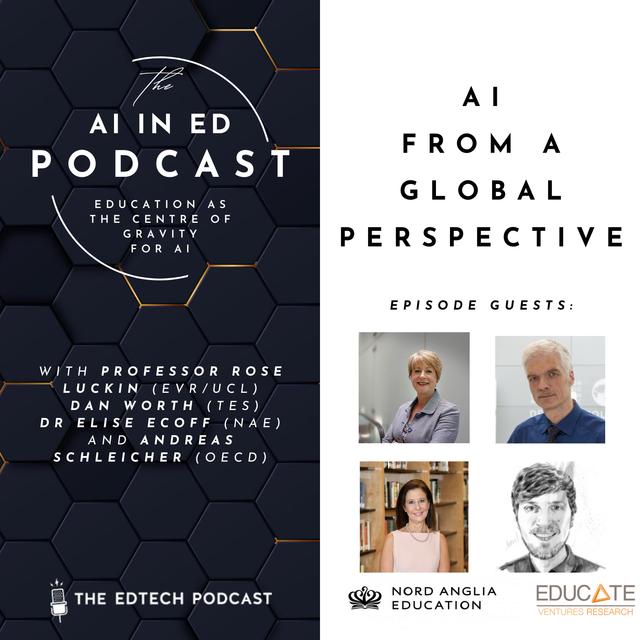



¶ Global AI Education Perspective
Welcome to the AI in education. where we're looking at how we ensure that education remains the center of the earth. My name is Rose Luckin, I'm your host and I'm the professor. An organization that uses AI Visit educate. How can your organisation develop its AI plans strategy and how your educators can take advantage of our expert artificial intelligence, continuing professional development and training support.
In today's episode, we're going to head out a little beyond the UK and the English speaking world to get a global perspective on AI and ask how educationalists and developers around the world build and engage with AI. And yes, we're examining how their practice with AI might change the way we engage with AI. But we're also asking why they might be doing things differently and if that changes the way that we in the UK, America, Europe interact with them and indeed interact with AI.
So I am really thrilled to have with me in the Zoom studio today to talk about a topic that is very close to my heart. I believe for many years, in fact many of the 30 years that I've been working in AI and education, that AI ought to be a really good force for good, for increased equality, diversity. I'm not sure it's rolling out that way. So I'm really interested to hear what people have to say and get the discussion going about the kind of global perspective.
In the studio with me here today, I have Dr. Andreas Sleiger, who is the Director for the Directorate of Education and Skills at the OECD. Dr. Ali Zikhoff, who's Chief Education Officer for Nord Anglia Education, and Dan Worth, who's senior editor, the Times Educational Supplement. So let's launch into our questions. as quickly as we can.
¶ International AI Implementation Strategies
Particularly given the wealth of international experience in the room, I'd really like to start with quite a straightforward question. Would you be able to tell our listeners what you know about how countries outside the UK have implemented AI technologies in their educational ecosystems?
And if as part of that you can say something about regulation or government guides or training programs that have been part of that rollout, that would be great. But we're really interested to know what is happening across the world when it comes to AI.
And Andreas, I want to start with you because you've been involved in so many initiatives around the world to improve equity and the quality of education. And I know that you are personally very interested in AI in education. You and I have had many questions on this topic.
¶ Shanghai Calligraphy and Korean Tutors
So I'd love to get your view about what you're seeing happening in different parts of the world. Yeah, thank you. Well, you know, I think this AI is the great uh uh promise and actually it came home to me in Two thousand eighteen actually, well before the pandemic, when I was in a classroom in in Shanghai, looking at how primary grade kids were learning
calligraphy. And that's, you know, one of the biggest headaches of Chinese teachers, because we in Europe struggle with thirty characters and they have to learn four thousand. So it's a just a massive kind of volume of tasks. And it's not just a technique, it's an art in the students where, you know, drawing the characters on the tables.
In their tables they had integrated scanners and on that table they had their mobile phone that was giving them real time feedback on the quality of the drawing, you know, based on pattern recognition, AI algorithms that, you know, put all of this data across the province together. And teachers at the front could see how different students learn differently, you know, where they got stuck, where they got, you know, moved forward, where they get bored, where they
get excited and they could actually engage with students and put, you know, interesting student solutions up for the whole class and and things like this. This was for me my my real first encounter for AI at the system level. Uh in uh October this year, I was in in Korea and I saw where students through their digital textbooks now have digital tutors.
You know, you don't have to raise your hand in the classroom. You can actually, you know, just ask your tutor who actually has been following you in your learning experiences and who gives you your personalized homework at the end of the day. So actually.
¶ Patchy Implementation and Inequality
Uh there are some some some really interesting examples. At the very same time, you know, when you look at this on a global scale, our surveys show Implementation is really very patchy. You know, I think uh you can say, well, you know, AI can address the question of inequality by, you know, personalizing learning and adapting learning and so on. We also see, you know, a lot of amplification of of inequality through those kinds of techniques.
Uh we see that you know from twenty-nine OECD countries that we surveyed, uh just half of them had a unique student identifier, which is sort of the most basic ingredient you need to have an AI system. operating. So I think we have still interoperability is is a huge challenge. You know, we have fantastic, you know, uh computer solutions. We just don't have the data systems, the the approaches, the regulatory frameworks to reconcile, you know.
privacy with data flows and things like this. So yeah, I I I must say, you know, given what is technologically possible, I would say implementation is still very, very patchy. And you know, you ask yourself, you we raised uh the question rose, you know, is it a force for good? You know.
Uh, I don't think the jury is out yet. You know, I think what you can see is that AI is not a magic power. It's a great amplifier and accelerator. It's amplifying good pedagogical practice and good ideas in the same way it can, you know, amplify poor practice and and bad practice. It can, you know, super empower teachers. I think the example from Shanghai is an example, but it can also
disempower them by making learning more scripted, more, you know, st and and things like this. So I must say actually Our latest Digital Education Outlook that we published in December last year It's quite disillusioning, you know, when you compare, you know, what's possible and what is happening. There are few countries where you can say, Well look, you know, they're on their strain, they get it right, but I wouldn't say that about the majority of the OECD countries.
And the point that you make about the amplification of good and bad, I think is really Also a very powerful point and something that I think it's hard for organisations to get to grips with. And so Elise, I'm going to come to you next because you know you are heading up an education team at North Anglia or the is it eighty four schools or have there been more added since I was last eighty seven schools. Eighty seven schools, so a lot of schools in that group. And
You yourself are very evidence-based, you know, have a research-based approach, and I know that your team is very strong on that. And the schools provide high quality education around the world. But what are you seeing across the different schools about the way
¶ Nord Anglia's Durable Skills Approach
they're approaching this and the context within which they have to work being different too. Yeah, well, I you know, I find it really interesting. You know, we we don't try to have cookie cutter schools. So every one of our schools has had a little different approach. And you would find that I think in in schools all over the world, those that are sort of jumping in and those that are more hesitant and cautious.
What I think it's given us an opportunity to do is really kind of take a step back and say, so what is the future of education or school? What's the purpose of school? When we had our senior leadership conference last fall. with all our heads of school, we were able to really talk about what does that mean and where does AI fit into that.
So, you know, not just philosophical conversations, but really practical conversations around what do students need to know and be able to do? And conversely, then how do we, how do we support teachers to be able to do that? which is, you know, which goes, which is critical, goes hand in hand. I think one of the things we've been really focused on though, as as And the last thing. probably four years is really on durable human skills, the skills that
are never going to be replaced by artificial intelligence, but certainly doesn't mean we're burying our head in the sand. But for us that research piece around metacognition and skills. As you know, Rose, we're working with 27 of our schools.
to really look at how we evidence that growth in our students. And we think that work is going to be really incredibly important as we as we start to look at what AI is really capable of and the kinds of things that it um that it can and will do for students. We're also spending a lot of time on process versus product. You know, when when chat GPT came out, you heard this.
collective sigh, oh my gosh, you know, we have to ban it. It's going to cause all kinds of, you know, academic dishonesty, which in many cases, we we saw evidence of that around the globe, not necessarily in our schools, but we heard cases of it. So really looking at If if education is about a process, then how does it help the process? How does it help the teacher in the process?
How does it help the student? And we've seen lots of experimentation in our schools that have been really interesting, you know, um comparing, you know, AI generated writing to authentic student writing or looking at research that you can do through and where the limits are in what what a large language model might have versus what you do yourself. So
Um, while the jury's still out, we're really trying to look at those pieces of evidence. And I think finally it's it's spurred on our digital lab that we're working on, which is really more around there are so many products that have emerged. Right. How does a teacher, a school understand where there are products that add value? So we have an emerging digital lab where we're going to do some user cases with just a few teachers in a few schools. And if we see that
they feel like it's you know it's really supporting student growth, then we'll share that and share those best practices. So that's kind of the way we see kind of it working and unfolding for us. Thanks Elise. That's really interesting. And I want to come back on the piece about teachers and empowering teachers and and those use cases. But before that I want to talk a little bit more about what you were saying about focusing on durable human skills.
Because I think that picks up on something Dan I noticed that you'd recently reported on a letter that had been written to the UK Education Secretary by international school leaders about the current curriculum being too focused on exam prep and outdated requirements.
for higher education, neglecting the broader development of student skills in this area. So I'd love to get your perspective on that particular aspect of this. You know, we hear a lot about AI, but actually Human intelligence is really important and making sure that our students are very well equipped. for that world that isn't evitably going to be full of AI.
¶ Preparing Students for an AI Future
Yes, and and that is that conference was very interesting because AI was a big topic of conversation in regard to how do we prepare for this and how do we you know, if you can if you get th something to write things for you.
Wh where's the need to learn? But of course we all know it's not going to be like that, but it's it's a tool that's going to emerge and you know pupils need to be ready for it. You know, educators need to be ready to know how it's going to be used, how it could be used, the issues it might cause.
You can't, you know, put your head in the sand and pretend this thing is is not out there or or say we're not gonna have anything to do with it because it it is gonna exist. It is it exists now, it's the speed of development is rapid.
Um, you know, your pupils will be going home and using it. There was a report today on the BBC about people using chat you know, AI chatbots for, you know, for therapy and things like that. And that's on one hand you could say that's great'cause it opens up that world. On the other hand
what are those chatbots saying back to these people, including young people, you know, and we we've covered that on test before. And so I think there's a lot there where, you know, nation states are trying to think about AI and how they use it in all domains, including education.
There's also the element of schools themselves recognizing this is a big trend and just trying to get ahead of it, do what they can, kind of what Tuelise was talking about. And I spoke to many other school leaders who are sort of doing similar work, thinking about how they can use it.
Just recently there was another COVID report out looking at their sort of member schools and you know how they're approaching AI. And there were some really interesting stats in that about, you know, I think um 36% of their schools have provided training to staff on AI use. um, forty, forty-four percent are planning to do so with their pupils and a quarter are already teaching students how to use AI responsibly and uh appropriately. And I think to me that really gets to the heart of that is
as much as there's things nation states can do here and set up policies, schools as always sort of innovate and look forward and and adapt. And they know they've got to do that with AI. And so I think And then you you bring that into that kind of future skills of of the the world, you know, and what you're gonna the world you're gonna go into. And if AI exists, if Microsoft's putting a button for it on their new keyboards for their computers, you know.
Yeah, pu people needs to know what that button means and that's AI. And when they open it up, they can use it in a positive way or understand it because it's part of the modern workforce. And of course that's a bit of a generalization. There'll be other industries where AI might not. touch fee is but fundamentally if you can go in and go, yeah, I know how to use this, I can use it to my advantage, I can reduce my workload.
that's something that you of course we should want to teach them about as much as we teach about anything else. So I think but that's a big thing. You know, I'm not I know that's a massive workload thing again, nothing for teachers to teach. You know, not easy. I'm not saying it's simple, but
you know, it's out there. And and I think one thing my final point on this that I someone said to me at a conference that I w that really struck me was that people talk a lot about AI taking jobs and that kind of threat. And I think it's somewhat overblown and it it generates a good headline. But you know, a lot of technologies have come along and been incorporated into jobs rather than just replacing them. Not to say that won't happen necessarily, they are, but this person said,
AI might not take your job, but someone who knows how to use AI might take your job. And that really struck me as like, yes, that's why it's important schools are incorporating AI into their own operations.
workload benefits and so forth, streamlining processes, data analysis, all that good stuff, but also thinking about how they teach AI and and and you know make sure that's part of the skills they teach young people, not just an assessment head down, let's get three A's because might not prepare you. for the modern world in a way that they should be being prepared.
¶ Teacher Empowerment and Safeguarding
Thank you, Dan. That's music to my ears because I couldn't agree more. We really do need to make sure that we prepare young people for a very different world to the one that we might have anticipated even five or six years ago. And I therefore want to come back to Elise on the point you were saying about teachers, because I think this piece about teacher empowerment is really important.
I had the pleasure of going to various different countries at the end of last year and everywhere I go, um, I ask the same set of questions about how ready my audience feels for AI. And the shape of the results has always been the same. The numbers are slightly different. But The places where people are concerned are as in using the technology in the high-stakes environment of the classroom. They're happy to try it.
for for their own prep, but they're nervous about using it in the high-stakes environment of the classroom. And secondly, safeguarding. Everywhere I've been, the biggest area of concern is safeguarding. People generally respond saying they appreciate and feel they have some understanding of the challenges and risks of AI, but they are really concerned about safeguarding. So we just want to come to you first, Denise, and then I'm going to come to you, Andreas, after that.
Just to get your perspective on that situation and how best do you think we can support educators so that they can do much as Dan was saying, make sure their students are well prepared, both in terms of the Durable. human skills, as you put it, which I really like that phrase, but also being able to use AI, both the teachers and the students.
¶ Supporting Teacher AI Experimentation
Well, first of all, I think um schools and school systems need to create environments where teachers feel comfortable with, you know, supported experimentation. Because if it is a gotcha, then you know, teachers are going to be less likely to want to try something. You know, we've seen lots of success in coaching models and models where, you know, those who are quickest to gravitate towards experimentation are able to do that and then support others in that.
But I think a lot of it goes back to what Dan was talking about in those sort of general basic, we would have called it digital citizenship, you know, back in the day, but it's really a whole suite of digital literacy and data ethics. um and the ethics of and I think that has to start with teachers. You know, teachers need to understand that so that they can help their students with that because inevitably somebody will misstep.
And so we need to understand and unpick that that whole big piece around ethics in artificial intelligence and how we can help teachers to become more comfortable just as human beings first. You know, it's one thing to have Spotify know your preferences, but it's another thing when you're worried about student information, right? So I think there's there's a piece around that. We, you know, we're very fortunate in we have a professional learning.
platform. And so we're able to put articles out, we're able to put professional learning out, start conversations with teachers, whether that's regionally or across the globe, to kind of have those conversations. But I do think it's first setting the stage. having environments that are trusting and hospitable, and then understanding that it is a bell curve. So teachers are going to need that same differentiated instruction that we expect them to give to our students.
That makes sense and I'm guessing, but please correct me if I'm wrong that that looks quite different in different parts of the world. You know, you have schools in lots of different regions and I guess for some experimentation perhaps comes more naturally than others. Yep, exactly. When we first saw, you know, Chat GPT, we had some schools that said, Are we going to have a policy so we can start experimenting? And schools that were so far down the road already.
Because their students were and they were just keeping up with their students, right? Because students are always. No matter where they are in the world, if there's a you know, they are they're for the most part fearless about jumping in and trying something. So we have to be able to support teachers wherever they are.
their own beliefs and value systems, uh, where they're working, and there's just being able to really, you know, because they all want to come to work to do a good job. And that means as we talk about preparing students for the future, it's going to include understanding about and being an a savvy consumer of artificial intelligence and other emerging technologies. Absolutely. That makes so much sense. And I I like Dan, your
your quote about your job won't be taken by AI necessarily, but it might be taken by somebody who knows how to use the AI. You know, I think it's really important. But Andreas, I want to come back to you because, you know, what are you seeing in terms of that teacher piece? and and different perspectives across the globe because I think it's really interesting, both in terms of teachers understanding themselves about AI and being able to use it, but also helping their students to understand it.
¶ Reimagining Teachers as AI Designers
Yeah, you know, I think the only reason why we should fear Chat GPT is because education has done so much to degrade human capacities to what, you know, Chat GPT is good at. And I think that's true for students, it's true for teachers. You know, at the student level, you know, one of the most depressing findings from our survey on uh social emotional skills was that fifteen year olds reported generally lower levels of creativity than ten year olds.
If I would tell you, you know, your 15 year olds do worse in mathematics than your 10 year olds, you would do something about it. And you would actually say, well, this is not possible. But we have that compliance driven, you know, uh culture in education that drives out, you know, some of those Capacities that actually you need most in the world of AI. The fact that only half of our student population.
You know, and it's actually not a very difficult thing to learn. It's just that our culture of education teaches people to believe what's in the textbook rather than questioning the wisdom of our times. You know, we teach even science like religion. You know, we make you believe in some scientific theory, then to make exercises to and at the end we test whether you remember the answers rather than asking you the questions.
And I think, you know, what we see among students is exactly what we see among teachers. If you as a teacher, you know, are only a great instructor, well, you know, AI is gonna replace you, you know. And this is, I think, the point that Dan was making, you know, someone who uses AI is gonna actually take that job over. But you know, look at this the other way around. AI.
can super empower you. It can make you a great coach, a great mentor, a great facilitator, a great designer of really innovative learning environments. And I do think, you know, if you ask teachers Why did you become a teacher? Why did you choose that job? Most people actually in our Stala survey say, you know, I became a teacher because I really want to accompany young people on on the way.
And and the industrial work organization that we have in our schools has exactly driven out that possibility. They put you in a classroom to teach one hour of mathematics after the other, which you know AI is gonna become a lot better than than than people.
And they don't give you that time to spend, you know, time with students to understand who they are, who they want to become, you know, accompany them. They don't give you time to walk with your colleagues to, you know, use technology. You know, one of the things that
I think you can take away from this. It's not about training teachers. It's about really enabling them to become designers of, you know, effective learning, innovative learning environments, to learn together with their colleagues where you do not involve Teaches in the design of technological solutions, they're not going to help you with implementation. You know, and that's really we have made students
consumers of prefabricated content. We have made teachers users of AI technology. And you know, you if you don't understand an algorithm, you're gonna be the slave of that algorithm tomorrow. And I think that's what we're seeing. So I I I don't think, you know, it's about teacher training. It's really about creating a work organization and environment where teachers become more the architects, the designers, the
uh inventors. And in some education systems, that is already happening where you know you have crowd curated, crowdsourced solutions, where you have good research groups among teachers. You know, you go to Estonia in Europe, that's actually an amazing place where you can actually see some of that happening. But uh
Once again, unfortunately it's not the overall trend. And uh I think it was done earlier. You know, I agree with him that you need that kind of frontline focus of teachers, but you also need a systemic architecture. You need that ecosystem. You know, when we invented cars, we soon after invented seatbelts and roadsides to make sure the cars work for us and not against us. And I don't think we have really seriously started that walk in the field of AI, at least not, you know, involving teachers.
¶ Building Collaborative Education Ecosystems
That resonates a lot with with my own perspective. And I think you're so right about the fact that. And Elise reflected this too. It's about creating environments in which teachers can learn together, can experiment, can research together. can have a community of learning. But that's often really difficult to do in practice in certain parts of the world because the ex the culture doesn't necessarily exist for that kind of an approach.
And and I can understand what you're saying about needing to build that systemic ecosystem. That certainly makes sense. And we can look to countries you've identified Estonia for examples of good practice, but what Can we do to help organizations create those environments? and that systemic ecosystem in practical terms, what practical steps would you say would be the top ones you'd identify as as needing to happen sooner rather than later?
Yeah, I don't think it's so difficult. You know, compare what we do with school teachers with what we do with university professors. You know, why do university professors engage research, write papers, all of that? Not because they get extra pay for that, but because, you know, they get recognized for their good ideas, they get opportunities to go to conferences, to work with colleagues, to learn from colleagues. I think, you know,
We have a good example in the academic field where actually knowledge creation, co-creation, review good practice is actually very well established. But in in education, in school education, we have these siloed vertical structures where we have a very atomistic culture.
You know, good ideas do not travel, good ideas are not shared. We could change this. You know, we could, you know, what we do in, you know, in the academic sector, we could do that in school, build teachers into the system of knowledge creation. And uh I also think, you know, the the medical sector is a or you know, my my own background is science. You know, as a scientist, you have a great idea. Tomorrow everybody in the world is gonna know about it because
you know, science has a common language, a common kind of culture of knowledge mobilization. Those tools are not so difficult to bring into education. We just do not have that that culture. We s still think, you know, It's an industrial kind of way of knowledge transmission as opposed to, you know, a system that, you know, reinvents and reimagines itself. So I I actually think
It doesn't take more money. It doesn't take it's a it's it's it's a kind of work organization that is really the key to that.
¶ Overcoming Barriers to AI Integration
That's interesting and that's very encouraging as well, that you think it certainly can be done. And at least what you were describing in terms of the lab sounds like an interesting way forward in terms of creating the right kind of environment. And within that, I'm asking you this question, but I get it's it's it's quite obvious the answer, of course, you'll agree that celebrating teachers who do a great job with the experimentation is is part of that.
But in practical terms for you as a leader, eighty-seven schools. What do you see as the key challenges to creating that right culture, that right context for this experimentation and celebration of teachers who really engage with that?
Well, I mean, I agree with Andreas. I think it we probably make it more complicated than it has to be. But I would say, you know, in in terms of the lab, I think one of the things that we're hoping is Teachers will have a place where that great idea can then percolate. and expand out to other people. So while it's a construct
And we want it to become natural across everything we do. It's one way of being able to really do that, put put a little resource behind it because teachers don't necessarily have the ability to do that themselves and then have those conversations and and develop that. But you know, in in terms of the barriers, I think, you know, we always say
universities, what they're looking for, the the process when you get to, you know, secondary school. And, you know, Andreas was talking about how 15 year olds don't see themselves as creative as as 10 year olds. Well, why is that? I think a lot of that is how we influence universities to look at that whole student differently so that that siloed sort of I teach subjects and not students.
you know, has more of a chance to kind of be m you know moved moved away and and we can start looking at things differently. And that's why for us thinking about transferable skills is so important because content
um, can be Googled. It can certainly be, you know, there there's less of a need to, there always has been, to memorize or to, or to just be able to spew facts. It's what you're able to do with it. And that takes cross you know, cross-functional teams and collaboration and project-based learning and all of the things that
take time. And so getting back to sort of AI, this is where there's magic in the kinds of things it might be able to do to save teachers time so they can do what they do really well. My first or second year of teaching, I had 33 students in a public school in South Florida with six different reading groups. So basically reading took me all day because that's how many different
Levels of reading I had in the class. So I had to listen to the, you know, I had to plan for six different lessons, I had to be able to teach. listen to students read. This was their formative years. There's so many ways in which we're starting to see AI be able to help a teacher to do some of those management things, to be able to help differentiate content. To be there for a student to even to hear and to read to. So if we can start to really leverage where the technology really supports.
um some of those tasks, it will give teachers more time for collaboration, idea generation, the kinds of things that they're good at and that they want to be able to do. We need to be able to unleash and empower them. And there's a lot that we can learn from what what we're starting to see in AI. The evidence isn't isn't clear yet, but you can certainly see those green shoots around how that can really free teachers up.
¶ Empowering Educators for AI Development
That's a brilliant reflection, Elise, that early teaching experience. And you can just think of so many ways where AI could really help with that. And I love that phrase, unleash and empower teachers.
And that's when I want to come back to you, Dan, now. But I actually want to change direction slightly, sticking with teachers and in particular empowering educators, because One of the reasons I feel so passionately that we need to help educators as educational leaders get to grips with AI and feel much more confident about their understanding and use of AI is because I want them to have a louder voice.
in the discussions about what AI is developed, what kinds of guidance is there, what kind of regulation in place, and basically try and move the power balance a little bit away from the big tech companies. to the humans who really need to have much more say in the kinds of technologies that are developed for use in education.
¶ AI for Teacher Workload Reduction
I think the idea of I mean Elisa's point there about workload is really important, isn't it? Because you know, we know there's a I mean, I'm talking about the UK here at least, we know there's a recruitment and retention crisis and workload is a massive issue. And if this tool comes along that could reduce that workload pressure because it can
generate resources for you, it could generate lesson plans. Now I'm not gonna I'm not saying that because I'm just think that is what it should be used for. But it as if it could just serve as a prompt to a teacher just to get you know, if you're really struggling on that Sunday night to think of something, it's like you put something in, it's like that's a good idea. I could adapt that and work it with my class, you know.
Or indeed, and and this is where we're talking a lot here about the classroom, but you think on the sort of the admin side, you know if you've got to write a letter to a parent about a behaviour issue, for some teachers that must be very difficult because that's not that's, you know, not your skill set necessarily. You're you're great in the classroom, but writing that letter and you've got to get the wording just right.
Well again you go to chat GPT or something, you ask it to do a 400-word letter, it needs to cover these three points.
it gives you a template. You're not gonna just copy and paste it. I wouldn't have thought so. You're gonna adapt it, frame it, tweak that. But it's giving you that starting point. And we all know it's on this it's easier to edit than than stare at the blank page, right? And These little things, if you can incorporate that into your workflow in a in a kind of natural way and it just helps you when you need it.
That to me could be a massive tool. And that's where I think it'd be interesting, you know, Elise, you're talking about your lab environment. It'd be interesting to know as much.
do teachers start putting forward like, Hey, I use it for this and it's a back end process. It's an it's a workload thing, not a a lesson plan or kind of something to they do with their pupils necessarily, but also it's a you know, we I use this and I've I've saved so much time and that time I use, I can now spend more time planning an excellent lesson or or really, you know, thinking of homework that's really going to stretch the the top achievers in my class, whatever it might be.
That I think is really interesting and and and something that where AI understandably the focus goes a lot to the classroom and that kind of impact in the classroom, but actually can have a lot of impact potentially on on the the other side of of workload that that um teachers have to deal with as well.
Because all these tools have been developed by big tech companies, there's almost a kind of and then will be adapted by sort of the the second tier of players who are gonna like develop presumably education focused AI tools. I think it's hard for I don't quite know how a teacher would sort of
necessarily direct that. But I suppose if they're the ones shouting about what they are doing with AI in this kind of slightly nascent era of AI and can and can adapt tools and make them work and say, This is what we're doing with it and, you know, other people see that and say that's well, that's a good idea. We could develop that into a company and maybe teachers are the ones who form those start ups, I don't know.
if if teachers are the ones developing the stuff from the ground up or using it now in their terms to make it work for them, then maybe that's a way that things could develop that become, you know, genuinely, genuinely useful to teachers versus being another piece of software that the school buys, says you've got to start using, doesn't really help you, becomes a bit of a
a time drain and and the whole thing just becomes, you know, no help to anyone and and all that promise is is gone away. But, you know, that that's a big topic and and one that, you know, I know you're not suggesting I should have the answer, but I think it
it we're gonna see how that plays out in in the years to come with AI and and it's still fairly nascent and I was a technology journalist before education, so I've seen tech hype come along and what usually happens is it the hype goes up and then it kinda kinda plateaus into the the reality and then it hits this kind of useful point where actually people start using it as much as they need to. And I think we're kind of probably still going up that hype curve.
But we'll kinda hit reality soon, um and then we'll he we'll reach sort of normality, which will be good. I like this suggestion that one way to give teachers more of a voice is to be more celebratory, more public about what they're doing, to make sure the way that they're using AI is out there in the world, because then That's there for the tech companies to see as well as for other teachers to see. I think, you know, for many years I've believed that.
in order to get better technology, whether AI or not, teachers need to have much more of a voice in what's developed. But it's actually incredibly difficult to achieve that. Because Yeah, there are some great startups founded by teachers, that's absolutely true. But in the main, teachers aren't tech developers, so it's actually really hard to do that.
And Elise, you and I know, um, and it's in a publication called Lesson Twenty-One, that actually having teachers using technology that's not fully fledged, that's still under development, can be really difficult and very very challenging for them in that high-states classroom environment. So I I think your suggestion, Dan, if I've understood you correctly, of really kind of getting the news out there about the way teachers are using and adapting these tools is a nice way forward.
I mean I think that is important. And again, like, you know, Lise, if that's kind of what you're doing, your lab thing and sharing that. And again, you know, as a plug, if I may, Tez Magazine, you know, if you're a school leader out there listening to this and you've got teachers using AI in an interesting way and you think
And again, Andreas Andreas was talking about it's like let's share that, let's make sure people don't have to sort of reinvent the wheel over and over again. But if you've got if you're a school doing something interesting with AI and you've drastically cut workloads or you've found a way to improve parental engagement by using it to hone your comms or set, you know, fascinating lessons.
Then then let's share it, then tell us about it, and we can put it out on Tez magazine, on the website, you know, share it around the world on social media, you know, because I think yes, you know, we need to do that. And there's probably loads of people doing stuff that wouldn't even think to put their head up and say, Oh, actually I'm doing this interesting project over here because
I don't know, not everyone's not everyone's a self promoter, right? And and thankfully so, but actually sometimes there's a time when you should. chat about what you're doing and and you know and celebrate it. And actually if it helps another teacher down the road or or a on the other side of the world also improve their workload, you know, or or boost their lessons or, you know, help a pupil see a new way of solving a problem, then let's let's share it and and celebrate it. Yeah.
¶ Nord Anglia's Digital Lab Initiatives
That's a great invitation to to all our listeners. There you go. If you are doing something with AI, let Dan know. Let us know. It'd be really interesting to hear. At least I am going to come back to you before I go to Andres. Yeah, you know, with your approach, I guess there's a real opportunity for that kind of making public what's going on, sharing the experimentation that that that your teachers are doing.
Yeah, I think, I think what Dan said is really true. Teachers are are often won't raise their hand to say, look, I'm doing something great. But if you ask them to just help somebody else with something, then you all of a sudden that emerges. Yeah, I mean our our goal and you know we have a network of where we're able to share best practices, we have affinity groups.
We have early childhood educators working together, IB educators, arts educators. And so that happens, but you you still have to continue to sort of fan the flames a little bit because it doesn't always happen organically. People are busy in their classrooms. And it happens sometimes at the local level, but then we're sort of um bringing that up.
so that our entire network can benefit. But we also want to share that and amplify that with other educators because we feel that responsibility um and that kinship with educators everywhere. So You know, as we set up this lab, we're setting up a website so we can just share with people what we've learned. You know, like I said, a lot of it is going to be user test cases where we're really interested in professional learning and we found a tool that will allow teachers to just
record themselves teaching a lesson and they can watch it back for their own reflection, but they can also get 15 or so different AI-generated reports, which will help them, which might see things about their classroom that they wouldn't see themselves, all for their own personal growth. You know, would teachers be interested in that? Would teachers be interested in that in one country versus another, one school environment versus another?
So um we're looking forward to being able to kind of do that and then share that information. That's a great example. And I'm sure there'll be lots of people who would be interested in knowing and how that progresses.
¶ Teachers as Architects of Learning Systems
Andreas, I I want to come to you again because I'd love to know your views about that this. this piece around teacher empowerment and the way that the AI that's being used in education is being developed and how we can ensure that the kinds of applications that are being developed by companies large and small are the sorts of things that our education systems need.
Yeah, you know, I just think maybe we should start out from the recognition that teachers are the experts on student learning and they should be sort of the the brain of of those developments. And you said earlier, you know Teachers are not tech developers, and you know, why not? You know, why don't we create more fluidity across occupational sectors? We have this idea that you know teaching is a closed sector public profession, you become a teacher and you teach.
Uh no, maybe you know you're very good in technology development. Let's create the space for teachers actually to engage with that and and and collectively. And and so on. So I do think we need a lot more fluidity in those kinds of occupational profiles where where there is more space for teachers to take an active role in and I would say not just technology, but the design of the instructional system. You know, all of that really and and you know, if you are
uh a medical doctor, you naturally contribute to the professional practice and uh and and the wisdom. And there is no Ministry of Health that tells you what to do and w how to work, but actually, you know, there are professional standards and norms that are created, re-imagined by the professional, inspired by new technologies. I think we can learn a lot from that in the field of education. And that brings me also, you know, Dan made that point about teachers workload, you know. I don't actually
by that naturally, you know, there's actually very little evidence that teachers are busier than other people. That's what we often hear, but actually when you look at the data It's not so obvious. I I think the problem and the teacher recruitment crisis is
Also not necessarily just about, you know, teaching financially not being attractive. I think the issue is that teaching has become intellectually so inattractive. By actually reducing the work of teachers you know, to people who just, you know, replicate walk rather than design work. So I actually think a lot of the answer lies in creating more space for people to be imaginative, be creative, and to be
recognized for this. And again, you know, not recognized because someone says you are the teacher of the year, but actually recognized by your peers for actually the impact you have on the system. You know, what about school leaders? asking their teachers not just, you know, how well did you teach the kids in your class? But actually
What difference did you make to your colleagues? What difference did you make to the instructional systems, to the development of new technologies? I do think, you know, we would actually create a very, very different profile of teaching. Why do I say this? Because you know you look to countries like Estonia or Finland, they don't pay their teachers really well. But they have nine, ten applicants for every teaching post because you know it is such an amazing uh work environment. Or Singapore.
You know, it it's it's not uh primarily about money, it's a lot about the kind of opportunities that we create for people to make a difference in their system. That's what inspires people. You know, can I can I actually make a difference? to other people to the system to the students as opposed can i just you know be a little wheel and a big machine That's such an important point, isn't it? The opportunity to make a difference.
that fulfillment in the role that that that you're taking part in. And as you said, you know, why do teachers want to become teachers? Because they want to make a difference. So helping them to do that is surely what our systems need to do. I'm also reminded of some very early research I was involved in many years ago around communities of practice of teachers. And actually some of the things that made the biggest difference.
Two the ways in which those communities did or didn't flourish was really simple things like teachers being given time and it being recognized. that it was valid time for them to become part of this community of practice and being made to feel good about being it. It was those things that really were factors that made a huge difference to the success. So it's not that difficult, it's not that complex, and yet somehow we often Don't do it!
And systems are generated in ways where I think you're right. In the UK, you know, the conversations I have with many teachers is I think they do feel frustrated. at their inability to do what it is they set out to do when they became a teacher. You know, they desperately want to do a good job. I don't know any teacher who doesn't want to do a good job. They all want to do good jobs, but it's often very hard for them to do that.
And so I think you know any steps we can make, and particularly with AI, not I don't just mean in terms of where the AI can help them, but I mean in terms of them being part of that conversation and their engagement with that conversation around AI being given space and time and recognition. within the system and within their organisation.
So that is fascinating. I think we are sadly coming to be out of time, but I'm going to come round to each of you and ask you if there's any point that you would really like to make that you haven't had a chance to make. But I'm also going to ask you to leave the audience with your optimistic thoughts. about the way in which the use of AI across the world in education could be a very beneficial thing for us as humans, could help us to be more human intelligent.
But also the areas where you feel we have to be a little bit careful in order to achieve that optimistic outcome. So I'm gonna come and start with you, Dan.
¶ AI as a Tool for Human Connection
Well I think the idea and it reminded me actually your question there reminded me of the other thing I was going to mention, which is something that Andreas touched on, which is When y whenever you speak to anyone about school in their life, they all remember a teacher, right? A great teacher predominantly who who inspired them. And it usually comes because they connected with them with them on a personal level. There's something they great lessons and
They the lessons were memorable and they seemed to understand them as young people and they inspired them. And I think that will never go away. You know, the pandemic showed us that when you're at home on a screen engaging education, it just doesn't have that. doesn't have that, right? You need to be in a room, you need to be inspired, you need a great teacher. So that's never gonna go away. And AI won't to to me, my opinion, AI will never replace it. You'll never not want that human connection.
Where AI can be the positive, though, is where I personally I think as a sort of someone who's been in technology before and is sort of optimistic about technology and what it can do for us. um without ever seeing it as a panagea, is that it it will help you sort of do things more quickly or or new ways of doing things or help inspire an idea or, you know, in the classroom to get pupils to use it as a prompt for a lesson in the same way that any other new thing comes along.
And is used in that way. And it won't become this kind of the top tier thing that that supersedes everything else. It we will just find its place in the ecosystem. like every other technology. Um personally I never subscribed to this idea that there's one sort of super technology that's gonna come along and change everything. We've heard that before and you know you know, mobile phones were one thing and of course they've changed the world.
But they've also slotted into the world and other things still exist in other ways. And so AI will change things, of course, but it won't sort of upend the status quo. entirely. I suppose though, that's sort of my positive take is that it will find its place and teachers will adapt to it and pupils will adapt to it and it will kind of settle without ever you know, nothing ever stays the same forever, but it will sort of settle.
But I suppose that does also require that the governments have to set up the parameters for its use. We have to decide how we're going to use it around assessment, around examinations, around homework policies, you know, br not Rydyn ni'n mynd i'n mynd i'n mynd i'n mynd i'n mynd i'n mynd i'n mynd i'n mynd i'n mynd i'n mynd i'n mynd i'n mynd
assume it will sort itself out and that will require, you know, hard work and detailed policy papers and nations to get together and agree things and and and schools then have to put those policies in place. And that will take time. But I think as long as we do that work, we can harness the the benefits it offers.
And and, you know, an education and the fundamental human connection that's at the heart of education, that everyone remembers that great teacher will will still be there. And it might be that that kind of oh, that's how we used AI and we did this with it and will be as exciting as what people remember from the past when it was oh we put on a play at Christmas and it was really fun. You know, I mean
Again, I'm generalising in some of those anecdotes there, but I think that that's my view on it. That human connection is just so important. I completely agree. I don't see AI taking over.
¶ AI as Catalyst for Human Skills
the roles of teachers, that human connection is fundamental, but they can certain AI can certainly be helpful, at least. Now I'm going to put you on the spot. Something optimistic, but where do we need to be cautious in order to achieve that optimistic vision?
So I'm always optist optimistic about education. I think it's the greatest field. I wouldn't do anything else. And I think we're all privileged to work in it. And I see that everywhere I go at schools all over the world. Um, I think what Is the most optimistic thing is that AI and the the what it provides for us really allows us to see.
our humanity and the things about people and our brains that are very, very different from AI. And it allows us to focus on skills and not content. And maybe we can really start to shift the conversations.
f at the university levels and around what's important and how we measure and the things that get students into universities. I think there's a whole lot of things that are continuing to shift as as we think about it. And AI in some ways is a catalyst for that because we really get to think about what really matters most.
and the kinds of young people we want to send off into the world and what will make them thrive no matter what after university. And I think that's not so much about AI, it's about there'll be something else. After the chat GPTs of the world, there will be another emergent technology at some point that will have disruptive powers. And so I think for me, what we need to think about is, yep, we need to, we need to navigate this.
But really underpinning that is what are we doing to make sure that no matter what that piece of technology or that innovation that's coming along that might disrupt some things that we do, are we really preparing people to be able to navigate that whatever it is? Because we won't be able to teach for every piece of technology while it's still, you know, while it's changing, every facet of it.
So we really have to be thinking about those the the flexibility, agility, critical thinking, all the things that um are exciting about education and what we want um for our teachers to empower them and to give authentic voice to our students. And I guess my caution is Let's approach it from a position of, I just read a great article on kindness and not so much.
around the idea that everybody is going to try and use it to get away with something. I think there's, I think we don't want to go too far in either direction, right? So eyes wide open, but incredibly optimistic.
¶ Agency and Purpose in the AI World
That's great optimism. Thank you, Elise. And Andreas, finally to you. What's your thinking on this subject? You know, I'm I'm I'm very optimistic that AI is as a tool is gonna make learning more interesting, more engaging, more personalized, more adaptive, more fun. Yeah, I I do think, you know, AI will transform the way we learn with the way we teach it, all of that.
Where I am more skeptical and more concerned is actually learning for the AI world because I don't think there's any automaticity in this and you know, will we, you know, make learners passive consumers or develop that agency, that co agency, that collective agency to actually that empowerment of learners actually to to make a difference in this world.
uh will we address, you know, questions around identity and belonging? You know, who am I? Why am I here in this world? And I I I I think there is you know, a risk that education uh through AI will become more instrumental. You know, we we use it as a as a tool and uh to to develop, you know, to prepare people for
something as opposed to to give them that that agency, that identity, that that purpose, that passion, actually to make a difference. And that, you know, I think some made that point as well. We need to always remember that that education is not a transactional business, but a social, a relational experience. And I think AI, you know, can, you know, super empower that and it will. But uh I I think we must never forget that.
That is a brilliant place to stop. Thank you all. Great to hear such optimism and also such very astute thinking and observation about what's happening at the moment in the world of AI. I'm sure our listeners will find this episode extremely interesting. I wouldn't be surprised if it isn't one of our most popular episodes because I think it's been a really rich and Very, very interesting discussion. So thank you all so much.
coming along but also for giving so much thought to your contributions to the podcast. Many thanks to my wonderful guests on the podcast today. I very much appreciate having each of you on to contribute. Thank you also to Nord Angela Education. You found our discussion today. If you want more information on the series and our wonderful guests, visit the EdTech Podcast website, theedtechpodcast.com. And connect with us via social media.
To see how the Artisans of AI expert team at EBR can help Go to educateventures.com. or join the conversation on LinkedIn. You've been listening to the AI in Ed, our data-driven future series performed in collaboration with the EdTech Podcast, presented by me, Professor Rose Lycan.