




¶ Defining the Elusive Celts
Hidden Celtic is a magic bag into which anything may be put and out of which almost anything may come. Anything is possible in the fabulous Celtic twilight. Not so much a twilight of the gods as of the reason. JR R. Tolkien Hello and welcome back. Last time we talked about the problem which J.R.R. Tolkien so eloquently presented in his commentary on the difficulty on nailing down the Celtic people.
¶ The Classical View of Celts
In this episode, we attempt to answer the question Who are the Celts through two different lenses language through the linguistic study of modern Celtic languages, and material culture, through the archaeological records. Both these areas, however, extrapolate their classification as Celtic from the descriptions of classical historians from the late sixth century BCE to the first century CE.
The first known use of this classification derives from the Greek geographer Ecateus of Maletus in around five hundred seventeen BC, who was attempting to describe the peoples who bordered the Greek colony of Messalia, modern day Marseille. And then later mentioned again by Herodotus of Helicarnassus, inhabiting an area around the Danube. In Greek, the word is keltoi, but the etymology of the word itself is not entirely clear.
It could mean the tall ones, or it may have initially been the name of a single Latin tribe known to the Greeks, and later became synonymous with all Latin tribes. Through similarities the Greeks noticed in language and material culture. However, we are not certain of anything, as the Greeks did also refer to anyone who didn't live in Apolis, city state.
and speak Greek as barbarians, which itself has an etymology rooted in what the Greeks thought non-Greek sounded like, that being barbar barbarian.
¶ Unpacking La Tène Culture
From there we have a loose continuity, as the word Celt is used by the Greeks and Romans. fairly consistently to describe what we now classify as Latin culture. So we tend to work forwards and backwards from there, though the Romans also use the word Gaul interchangeably to describe Celts who occupied modern day France. We will explore the period covering the written record in much more detail when we arrive at that point in our narrative.
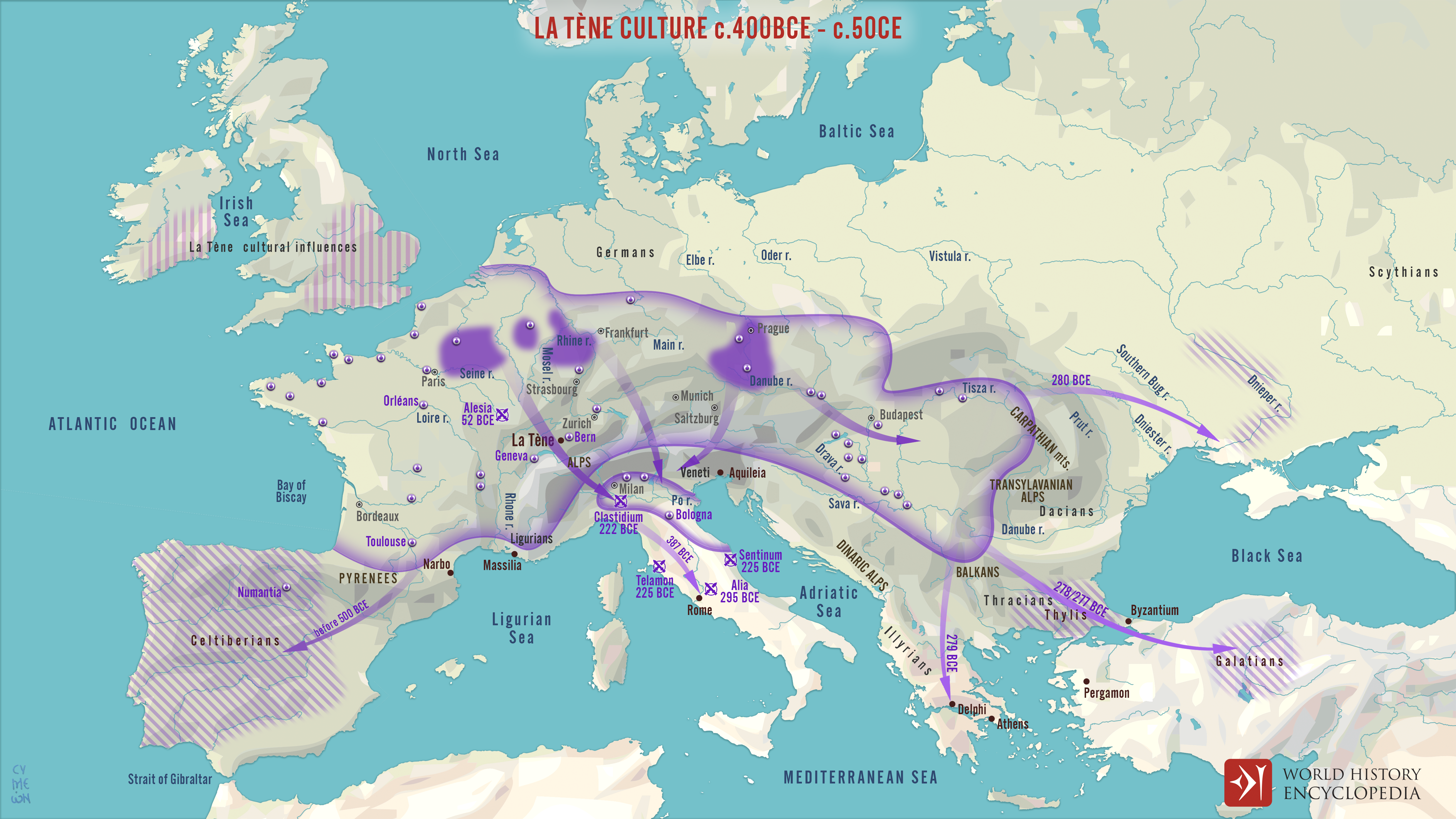
But it is important to note from now on when I refer to Celtic culture, the core of this is the Iron Age Latin tribes, who the Greeks and the Romans refer to in the classical period. For this episode, I would advise looking at a map of Central Europe, as I will use modern place names for references, and I will also post links in the episode description to maps and further information.
I will be relying extensively on maps throughout the series, um, once I can figure out a good way to uh make them accessible for the listeners. But for now, a general idea of s the main place names and topography of Central Europe and some of Western Europe will suffice. Most archaeologists, linguists, and historians are happy enough to classify Latin culture to be the first firmly Celtic material culture.
However, though I've said the name on the podcast, I've never really explained myself. It is at this point I'd like to point out that there are a number of visual references for today's episodes, and likely many episodes going forward as well. First appearing in the fifth century BCE, Latin culture, named after the discovery in the modern region of that name in Switzerland,
is the term used to describe a material culture which was present from Borges in the west to Bohemia in the east, and a large stretch of south central Germany in between. The site for this culture, was on the northern side of Lake Nachatel in Switzerland. It was here in eighteen fifty seven that a rich horde of artifacts was first discovered by Swiss archaeologist Hansel Kot.
Now traditionally, it was assumed that the Proto Celtic and then Celtic language must have developed in this region, that the material culture of the Latter Celts developed. From this, later discoveries were classified as Latin by the commonality in art style, burial practices, etc, which were also attested to in the latter written record.
I plan to do a full episode on Latin culture, but for now I want you to keep in mind that classic Iron Age Celtic style. The kind of ge Celts you see the Romans fighting in the Gallic Wars and Gold Torks, helmets, with powerful animal imagery like boars and raptors, anthropomorphic sword designs, and motifs of single combat and images of great nobles on chariots.
Some links to examples of these will be in the podcast description, um in case you're not familiar with the kind of style that I'm talking about. Just know that many of these motifs did not necessarily exist during the same time period, but are helpful images to keep in mind for a general picture.
¶ Hallstatt: Celtic Ancestor Culture
Okay, so now we have a brief and vague definition Celtoi equals Latin, which colloquially means Celt. How did a culture originating in Switzerland find its way to Britain and Portugal and become so culturally dominant to the point that the Greeks, Romans, and Phoenicians recognize them as Celticized? Within a few hundred years, not only that, but also seeming to totally dominate Central Europe culturally and linguistically.
The short answer? It probably didn't. Or at least the spread didn't start with Latin. It is important at this point to mention the role of Hallstatt culture in the story before moving forward. Halstad, or Salt Place, in German, named for the town in modern Austria in which it was discovered, is believed to be the direct cultural ancestor. and possibly the linguistic predecessor of Latin culture.
Again, Halstat will receive its own episode, if not multiple episodes in the chronology, but for now we need a basic understanding before we move any further. Halstart refers to a late Bronze Aid culture which thrived in Central Europe between fourteen hundred and four hundred fifty BC. We are specifically interested in Halstatt D culture, which is a later form of the culture in the Late Bronze Age and Early Iron Age, and most scholars believe they spoke Celtic, or at least Proto-Celtic.
¶ Traditional Spread Theories
By the late sixth century, these connections extended throughout much of Central Europe, and its influence even expanded into the Mediterranean by the Etruscans, in northern Italy, and the previously mentioned Greeks of Massale. It is believed that the Latin culture developed out of Halstatt D culture, and it is notable that Halstadt finds dry up around four hundred fifty, where Latin takes its place.
Haustat influence on this era is so great in Europe it is often called the Halstat period. Now on to how it spread like wildfire. Now please note, before we go any further forward, the remainder of what I discussed in this podcast is highly contested in academic circles. And I'm only here to give an overview. So traditionally, Halstat D spread its culture and language through extensive trading and a highly competitive hierarchical society, as we've already mentioned.
Which resulted in the spread of the Celtic language and culture through much of Central Europe, either through migration or through or trading of material goods to France, Belgium, Austria, South Central Germany, and Czechia by around the sixth century BC. There is even evidence of Halstat spread reaching north central Spain and Portugal by this period, also forming the beginnings of the Celtiberians, a topic for its own epoch. There is also taxonomic evidence.
Which is the evidence of place names? of Celtic language at least having an influence on south eastern England around this time, as well as influence from Britain, reaching the Continental Channel coastline, as many tribes in England and northern France appear to share names.
So according to traditional theory, the Halstatt raid, trade and migration began the influence of Celtic language groups into modern Celtic areas, that being the areas where modern Celtic languages are still spoken along the Atlantic coastline. that being the British Isles, Brittany, and Northwestern Spain. Hallstatt society grew extremely wealthy, as evidenced by burials such as the Horkdorf Prince in southern Germany, for example, with grave goods to rival any Egyptian pharaoh.
This wealth and trading influence was accumulated through the products they mined, these being salt, tin, and copper, which were all extremely valuable commodities at this time. Salt was used to preserve food, so as you can imagine, it was extremely valuable in a world before refrigeration, and of course copper, mixed with tin, equals bronze. which gives its name to one of the ages in which Hallstatt thrived, and being used extensively still in the early and even late Iron Age.
We are fairly confident that this society spoke a Celtic or at least a proto Celtic language. And Halstatt cultural influence is indeed vast, as we find Halstadt burials in Britain, Spain, and even Croatia. However, that does not necessarily make these cultures Hausstatt, and that does not necessarily mean they speak Celtic in these areas. It is extremely difficult.
To know what what language, a purely archaeological culture, without any written evidence, Spoke, which is a problem we will return to. shortly. However, if Hallstadt culture spread as widely as it did, and its language spread with it, then it would be much easier for the latter Latin tribes to spread their own culture through linguistic and trading connections.
established in the Hallstatt world. By four fifty BC we enter the Latin period, and over the next hundred years we begin to see Celtic migration into what is termed classical civilization. And with that, Brittenekai.
¶ Migration and Written Records
But it is with these written accounts we begin to see the originators of much of the migratory Celts theory. The famous Roman historian Livy recounts overpopulation in what the Romans termed Gaul, that being France, Belgium, and Luxembourg, as well as some of Western Germany and northern Italy. as being the primary cause of this migration. And indeed, the archaeological evidence does bear this out. So we cannot completely discount the classical historians.
And it does seem likely that migrations did play some part, if not a large part, in the spread of the of Celtic language and culture. And that is the gist of the theory of Celtic origins which was believed for much of the twentieth and early twenty first.
¶ Bronze Age Maritime Trade
Century. Okay, so I know that was a lot of information. I'm trying to condense it into a pretty short period of time. All these topics will be covered in far more detail as we go forward. But to recap, Celtic is Latin culture. The ten culture comes from Haustad D. Haustad spoke Celtic, or at least Proto. Halstadt spread its influence throughout the continent.
prior to migrations by Latin tribes. And by the time these tribes enter the written record, we have a firmly Celtic material culture who speak a Celtic language. If you want a modern example of how this works Many American cultural items and products have had a much easier time spreading to the English-speaking world than other areas of the world because they already share a common language and some common cultural origin.
Or if you want an example that's purely cultural and not linguistic, you can look at the spread of the American culture into much of Western Europe, which is non-example. And this example I feel demonstrates the next problem. If in a thousand years they're doing archaeological digs in America, Europe and China They would probably come up with a similar map to the kind of one you will find online for Hallstatt cultural burial.
You will find a heavy concentration of American goods in America with variations depending on the state and location in the country, and you'll find random outliers all over the world. You'll also find burials in England. Central Europe that look similar, but how would you be able to tell from the goods, without any written record, that people in Britain speak English, but people in Central Europe do not as a primary language?
Then of course you would have your outliers, like McDonald's and Coke in China. Now, this example is not perfect because we live in a highly globalized society, but archaeologists like Barry Cunliffe proposed that the society in the Late Bronze Age was far more interconnected and sophisticated in this part of the world than we traditionally think. Many people commonly understand that the Mediterranean world was highly connected, but increasingly we're seeing evidence that
The sophistication extended to Europe. Tin, for example, was a very finite commodity in the Mediterranean. only being some mines in Anatolia and Cyprus. The vast majority of the tin produced for the Bronze Age world was produced in Cornwall. Now here begs the question. How to get all that tin to Egypt. The Hittites in in modern Turkey, or the Mycenaeans in Greek. It seems highly likely that you would need to develop trade networks.
And of course, during this time maritime travel was far less sophisticated. There was a definite need to hug coastlines. There was no open ocean travelling as far as we can tell. So you would need a reliable network of ports to get you down a coast. For example, we mentioned tin being so important in the Bronze Age world. You're going to have to get it to the Mediterranean somehow, and overland routes are dangerous and unreliable.
not to mention very long. So if you needed to get that tin for Cornwall, you'd have to have a port in Brittany, port in Galetia. And then finally making it through the Pillars of Hercules.
¶ Linguistic Evolution and Survival
or the modern day name, Straits of Gibraltar. So it certainly seems like there would be high demand for this trade route, not to mention the fact that Scotland, Ireland, and Wales all have gold deposits, which is always a valid material. And the second part of that tin equation is copper. There are copper mines in the Lake District, Wales, Cornwall again, and even in southern Portugal, near Lisbon.
Now, if you have a map in front of you, you may notice that all those areas that I just mentioned are areas in proximity to where modern Celtic languages have survived and been revived. Coincidence? Maybe. Maybe it's just because it's the fringes of the Western Empire where the Celts were driven out. Or maybe it's because the Celtic language survived here because it was already the most linguistically Celtic part.
of the Celtic world, which arose from the need to have a short wa hand way of communicating along this vast coastline. Second part of the equation I have not mentioned is that Celtic languages, both the P and Q groups, are from the Indo-European language family. And the cultures that existed along this coast and in Central Europe were all believed to be Indo-European ancestors, or at least spoke an Indo-European language.
Now, if they developed their own languages prior to this trading network, they would be able to use their common linguistic ancestor to develop a new language or attempt to revive an old one such as modern Celtic language speakers have. We will go into far more detail about the origins of these people, Indo Europeans, into Urnfield culture, into Hallstatt, and then finally to Latin culture. As I've said, I plan to finish off the first series just as the written record starts.
So the next stage of this development is that the trading connections along the Med the Atlantic coast. deteriorate due to the Bronze Age collapse at the start of the early Iron Age? and at this same time, Halstack culture in Central Europe is thriving and growing in influence. They develop links further inland, which makes its way to the Atlantic coast. and the Celtic speaking also become the material Celtic.
¶ Challenges and Future Exploration
However, though there is some archaeology to back this up, there are problems with this theory. The first problem I have is that it is politically very easy to back. All the modern Celtic nations will be keen to point to their own nations as the origin of this culture which now defines them. The second one, which is far more important and far less personal, is that the genetic evidence does not bear this out thus far.
And the archaeological evidence isn't conclusive enough to draw any definitive conclusion. So where does that lead? Wow. That means that we can start to look at the chronology and dive into some of these issues in more detail as we go along, and you will be able to draw your own conclusions. However, as I stated earlier, this is fiercely academically debated.
People spend their whole lives and careers on this and thus far there seems to be no straightforward answers. And in history there rarely are straightforward. I also plan to do episodes further down the line on Celtic languages. But to be honest, at the moment I'm understudied and underqualified and I have far, far more reading to do on Celtic languages. So for now we're going to go back to Indo-European migrations, up to urn field culture, and I'm hoping to do that in a single episode.
Then we're probably going to do a multi-part series on the Hallstatt culture and certainly a single episode dedicated to Hallstatt D, as this is where we start to see similarities. and common themes which means that archaeologists can define that culture as Celtic.
Then we'll do a large episode, again, maybe multiple parts, on Latin culture. We might split these up into categories, uh, such as language, warfare, society and religion, as we have much more written evidence on this era to corroborate the archaeological record. Then that brings us to the start of the written record and the voyages of Pythias the Greek. At that point, I plan to stop, see where we are with the podcast.
And then either I will delve in to the story of the Celts, that is, the chronological story in the written record, mainly dealing with their impact on Greco Roman civilization, Or and series of episodes which plan which will tr attempt to ground the listenership and myself firmly in the Celtic world before we charge forward with their chronology, an attempt To get rid of that Greco Roman bias and give us the story from the Celts' perspective, which after all, is the point of this whole project.
So as much feedback as you're willing to give me will be extremely helpful. as if I feel there is enough interest and direction for the podcast, I will invest in website hosting, etcetera, so that I can give a far more filled out view of the Celts going forward. But at the moment, this is just a hobby. And I do have two young children at home. Now it's time for the homework. Yes, homework. If you like narrative history podcasting, I encourage you to check out Mike Duncan's The History of Rome.
Specifically the era of history which deals with the Romans and the Celts. And although I certainly feel that getting a proper grounded understanding of the Greeks and the Romans helps us understand where their biases come from precisely, and overview will do just fine. I would start with the sack of Rome. The episode number is ten Barbarians at the gate.
And it is a short episode. Mike Duncan's early episodes are short, his later ones are far longer, but you don't have to worry about them, because the Celts are only dealt with from episode ten until episode forty one, which is in a series of parts, which deals with the Gallic War and of course the end of Celtic dominance in Europe. The other podcast I would listen to is the Hellenistic Age Podcast.
as he does an excellent summary of the Hellenistic world starting before this with a prelude on the Greeks all the way up to episode 20 which hits the Celtic invasion of Greece. But I would encourage you to listen to these podcasts for the first wee while As I'm not planning on delving into the Phoenicians, the Greeks and the Romans. There are plenty other places that have done this.
far better and it's not the point of this podcast. But a background in these people will be extremely helpful by the time we hit series two. But you've got plenty time, because it's taken me forever to produce these. If I'm on schedule, I will see you in two weeks as we look at in