


The CIO is a person who uses it to facilitate and enable company so that it becomes more competitive and it becomes more profitable. If you only just do the jump or supporting the business, then strictly speaking you maybe call CIO, but you're not serious. Hey everyone.
My name is Henry Surya Barragan. And you're listening to the tekhelet Juno, the show will be bringing you the greatest technical leaders practitioners and thought leaders in the industry to discuss about their Journey ideas and practices that we all can learn and apply to build a highly performing technical team and to make an impact in your personal work. So let's dive into our Journal. Hello, everyone.
Welcome to a new episode of the tekhelet journal podcast, excited to be back here again to share. With all of you, my conversation with another great technical leader in the industry. Thanks for tuning in, and spending your time with me today, listening to this
episode. If you're new to the podcast, know that package, you know, is available for you to subscribe or major podcast apps, such as Spotify, Apple podcast, Google podcasts, YouTube, and many others also do check out and follow technology on our social media channels on LinkedIn. Twitter and Instagram everyday, I post nuggets of wisdom from the latest podcast episode and I share them on those channels to give us some inspiration and motivation for us to get better
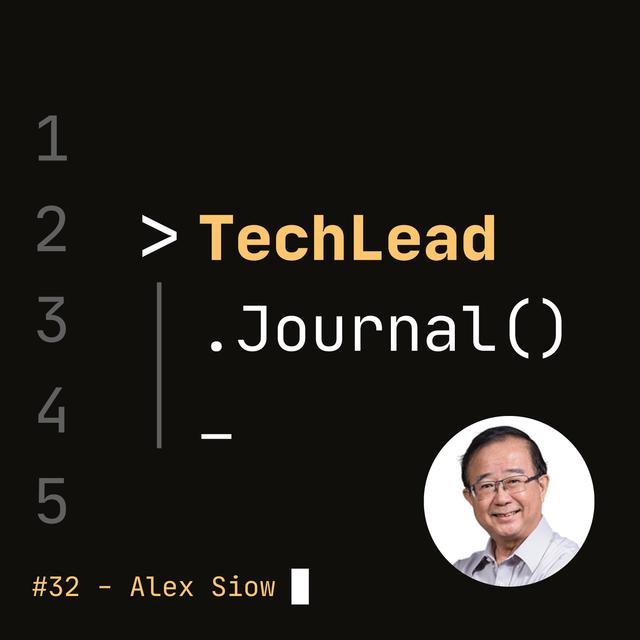
each day. And if you'd like to make some contribution to the show and support the creation of this podcast, please consider joining as a patron by visiting technology node. F / Patron, I highly appreciate any kind of support and your contribution would help me to add sustainably producing this show ever. Week, for today's episode. I'm very happy to share my conversation with Professor. Alex show.
Alex is currently a professor in the school of computing at the National University of Singapore, nus and also the director of any us has advanced Computing for executives with a career that spans over four decades. Alex, Theo is well known as Singapore's first CIO in the
1990s. He recently published a book titled leading with It lessons from Singapore's, first CIO, which is written for the next generation of cios, ctOS and other Executives who were closely with technology and the book offers practical tips, case, studies and his personal insights that shed light on the central. Competencies required for cios in this episode.
Professor. Alex shared with me, his insights on the important role of a CIO what he thinks the traits of a good CI, o-- r-- How is the I/O manages his time priority risk and governance? Professor Alex, also shared with me his inspiring leadership philosophy that are highly appreciated. By many people who work under
him in his career. He also explain to me the concept of servant leadership the true essence of it and what it means to become a servant, leader towards the end, Professor Alex shared his views on the future of technology and also remote working. Professor Alex is a very fun character and I really enjoyed this conversation with him and I hope you will enjoy this episode as well.
And if you like it, consider helping the show by leaving a rating review or comment on your podcast app or social media channel, those reviews and comments are one of the best ways to get these podcasts to reach more listeners and hopefully they can also benefit from the contents in this podcast. So let's get this episode started right after a sponsor message. Are you looking for a new? Cool swag. Technology, you know. Now offers you some swags that
you can purchase online. These tracks are printed on demand based on your preference and will be delivered safely to you all over the world where shipping is available. Check out all the cool tracks available by visiting technology, know that deaf / shop, and don't forget to break yourself. Once you receive any of those tracks. Hey everyone, welcome back to another episode of the tech lead, you know. No. Today, I'm very very excited to have someone from Singapore. A professor.
His name is called Professor Alex show. He's well-known in the industry here in Singapore, freshly. Well, known as the first Singapore CIO. I saw his book in a bookstore lately and invited him to have a jet in this podcast. He willingly agree. So hopefully, Professor X will be able to share a lot of business. So welcome to the show problem. Hello. I'm glad to be here.
So Professor, for those people who don't know you, maybe, Would you like to introduce yourself and be telling about your career Journey, your highlights and turning points Henry. I started as a civil engineer because I went for studies in Germany, on the Singapore, government scholarship. So, I pursued civil engineering, upon return, and finishing. All my national service obligation. I started work as a structural engineer in the Housing and
Development board. So, I was actually a structural engineer for about 10 years design. Being supervising construction and also involved in construction technology projects during the ten years. I also involve in some computerization projects, after 10 years. That's a structural engineer.
The management of hdb was looking for somebody to run the IT department because the position was vacant and there was a search or suitable person sort of the global search, but finally, they narrow down to me, which is very strange because I was also not It person I was and user i t. So the CEO offer me the job to be the head of it for in 1989. I went over to the IT department and did some understudy. Before I assume the hate a few months later.
One year later. I think there was a renaming of all the various management Personnel in hdb, and my boss asked me what you want to call yourself. So I said, I want to be the Chief Information officer. My boss was very good. Good said, okay. If you think you like the title, you just call your Chief
Information officer at a time. Of course, see, I will type bill was not known in Singapore. So this is why I became the first Singapore CI who the first person to carry the title that maybe people who is doing a CIO job, but they didn't carry the title. And so that's the beginning of my It Journey, and they lasted all the way until now. So, ten years as a software engineer 13 years as a CIO of hdb, after which, I actually, Sighing from the Civil Service
and join stop. So when a way to start up I told the see you then that I've been 13 years as CIO. So don't let me be the CIO here. Yeah, and you say okay everything but the CIO so I started off working as strategic relations and my liaison with the government in the CEOs office after two years of that. I was told to go and become the head of empty. Price sales to take over the sales to corporate customer. Of course. Just like it's a story repeated itself.
It was not Our, IT person became CIO and now I have no idea. Why sales and I became head of sales, the corporate sales. And I did that for three years. And then the CEO say, yeah, I promise you, you won't be CI ho, but I have to break my promise because there is a big project which was undertaking there is the revamping of the business. Just the composer's big CRM system, the city couldn't find anybody suitable to be the CIO. And we have one here in the back yard.
So he said, okay, you go in take over as a CIO, which I reluctantly did. So am I then became CIO for three years insta? Have to implement the business support system there after I change a portfolio to be introducing Enterprise risk management to stop. So I was hit Enterprise risk management. I sort of retired from starhub after two years. And are you going to join Accenture as a Management Consultant serving the health and public sector?
So it was a managing director of health and public sector in Accenture for two years. I didn't really quite like the job because you know has always been on the buyer side. And now I'm sellers like although yes, it's not how I was doing the selling but that was with a big team of people here. I have to do personal sales. So I said no not my cup of tea and decided to join the Steve. So professor and I've been there for the last six years in any. Where's the National University
of Singapore? I joined the school of computing in a department information system, which incidentally, the school Computing is ranked number four in the world. Yesterday. I received the ranking. So prestigious. Do you know when I joined them? So then I also been asked to take care of the Executive Education Center for the school of computing. So I teach and then I run the Executive Education Center. So thanks for sharing your story problem. I think it's really, really interesting.
Like the situation where you are being asked to do a role, which you not so-called expert in and you're willing to take the challenge and succeed after that. That's really amazing. So I saw your book in the bookstore lately. So what made you write a book in the early days? When I first became the CIO, there were lots of people who don't know. What is a serial in fact, Half or three-quarters Singapore have no idea what the CIO so they thought I'm in charge of
customer service. I'm the information officer. So reporter from Straits, times approach, me and say, since you're the CIO of Singapore, first one, why don't you write a column in the streets times to explain? What is the job of a serial? So we started to call them in the supplement of The Straits times called the computer times, which of course, now is no more available at that time.
It was quite Popular, is the supplement that comes up weekly on Wednesday. So I was asked to do this column called the cio's desktop. I didn't know what I was in for because I agreed to write, I wrote the first article and was published and was very popular. That's according to the report and she told me we were doing the fortnightly. So there is something which I expect to have to write every Fortnight I did. So and I wrote almost 40 articles over a period of two years.
Fortnightly. I'll be seeing lots of articles about the top of this yo-yo. The challenges are met and things I have to deal with. So all those articles were published and I did nothing about the hole somewhere in archive. If you go in the National Library of type, or down there, when covid-19 hit us, one of my associate in the u.s. Executive Education. She asked me since you wrote so many of those articles. Why don't we just consolidate into a book? So that was the start of the The idea.
So we went to the National Archives, you know, I have to go to the library of type 2 going just for the Articles. Then we realize that you put them all together. You will not form a book because newspaper articles are short and sharp. Even if it's a one full-page newspaper. The supplement is half the size of the normal paper, so it is not a lot. So we try to put them all together and say no you cannot form a book. We have to write more.
We have to put in one meets and we have to put in more case studies. Actions. The aim was actually the used it to educate future cios and also budding cios in the region. Not only in Singapore to have a textbook that can be also used because the whole region is now developing and everybody seen the power of Information Technology, especially during the covid-19 crisis people realized without it a lot of company. Ready cannot survive and so the whole region suddenly woke up,
so it's A matter of timing. If I have published my book much earlier two years earlier or three years earlier. It will not be so popular as now because suddenly a lot of SME. A lot of people realize I T so important and so timing, when we publish this book, The Publisher was very excited. Actually. We wanted it to be a single pole publication and available to the region. They say, no, no. No, I think the whole world needs to read this book. So he was actually now open.
Available in the whole world. So yeah, thanks for sharing your experience and expertise for me in the book. A. I rarely find a book about CIO definitely. So my first question then because you have assumed this role for quite a number of years. So what exactly the role of the CIO actually? Okay, let me explain before I assume the title CIO not just because I wanted the title
cereal. When I took on the, IT job, as head of IT told to see you all who actually took a gamble on me. Yeah, actually. He selected me. So I said, okay. I have your back team. I want to change things. Firstly. I'm not a dirty person. I come from the user side. So I understand hdb business. So I want to be involved in the business and I would like to thank apply it to the business in a way. Without knowing that, it's a CIO was job. I did the CIA job. So without knowing, what is
actually the CIO job. I took on the title or the CIO. And then I started the difference is, of course. Is not pretty, perhaps a tacky, can also hold us here or job, but his main job is not technical. His main job is to support the business. Exactly. At a time in 1990, is the time when the it moved from the back office to the front of the business around the world. Actually, not only in Singapore.
So, that's where the IT person. Now come up and say, we're no longer just doing the number crunching or the systems development at the background. We are coming here to support and enable the business. So, So to answer your question, the CIO is a person who uses it to facilitate and enable company so that it becomes more competitive and it becomes more profitable. If you only just do the job of supporting the business, then strictly speaking, you, maybe
call CIO, but you're not cereal. So these days the title CIO itself. I think it's a little bit convoluted. You can see so many other variants of the title like CTO Chief technology officer. I'll maybe Chief digital officer and maybe so many others. So in your opinion are they just different sort of names or are there clearly specific differences between these title? Actually, each mean a different thing in the past. There were people in charge of the data.
Somebody is in sort of infrastructure and technology, and hardware, and software somebody who is in charge of the architecture, but there was the CIO and top and all these people are the managers under him. So because I T has become so pervasive. So important to organization is no longer possible for CIO himself to manage each of these portfolio in detail, he can but that means you will have so much time to learn support of this thing.
Therefore, the whole world now has the evolution of the portfolio of the stereo. Now, you have one person who is Chief security information, security, one person in charge of data Chief data officer, then you have the chip. Keep that for each of, these actually falls into the portfolio, which are used to carry. So I have all this person, which means, it's just that we give them a bigger title and make them do more work. Actually all for the good of the organization.
However, there is a difference. But see I once it you some organization has a CTO and the CIO reporter. CTU some organization. Have the CTO that reporters here. You what is the different? The CTO is charge of the Technology, its Chief technology officer. So depending on that organization, which is more important to them the information systems or the technology that for you. See if the wastage is on technology than the CTO is the higher ranking on the information.
Officer will be the one in charge of using it to provide information to the organization. So you mentioned a couple of times a cios job is actually to support the business. Maybe you. Liber8 little bit. What do you mean by support? Do you like provide? For example, your case last time is help this customer service or running, just mainframes and servers, and things like that. So what exactly do you mean by supporting the business?
Are you supporting the business? Firstly, you have to understand? What is the business decision? What is the mission, and what are the core values of the organization? Whether the it is organized in such a way to enable each of these core value to be realized. And Each of the objective organization to be executed. So that's how we support the business. We think in terms of the business of the company instead of what the users need in, the past is always the user or customer.
So we have to make a user happy when I became the CEO. I said, no our customer our hdvs. Customer only one customer the whole organization. Only one set of custom hood. So common set of customer. We work together with the end user as business partners. And Other, we will serve the customers. This is a change of mindset, very important chairman. So, because the IT people, you know, technical people, they like to be the back talking to machine. They don't like to talk to people.
So I have to Crystal around and said. Now if the user have no idea what to do to serve the customer better, we come up with ideas and that's how we bring it to the front. However, of course, we always must recognize that the user, the business heads. You are the one responsible for the business. So although we can offer them ideas. Please, do not take away the credit from them, give them the Dual credit because ultimately the risk is run by them. The reason of serving the customer.
We only enabled them to do it better. So I know that it is probably a little bit of challenging situation to describe the many few things that our CIO needs to do well, but if you can look into maybe your experience or the best cios available out there, what are the good? Of a good CI, maybe execution prioritization and things like that, but maybe if you can summarize and share with us, what do you think are the good traits? The most important skills that CIO has to have is actually
project management. Today. We talked about project program and portfolio. Right? Actually. The CIO is the chief portfolio manager of all the information systems in the organization. The most important trick you has is project management because you have to execute everything. According to budget, according to share, you is one of the most
important thing. The other thing is, of course, he must be able to speak the business language because if you want to go and talk to the business people, you can't show them all your Technical jargons and order. They don't understand what you're talking about. For example, or we want to introduce our PA. What is that? Now? We're into the fourth Industrial Revolution to understand all these. So we have to cut the Techno speak and speak confidently to the end user.
Another important thing is, we have to earn our right at the table. That means I told the CEO. I want to be part of the management team and it is the management meets. I want to be there too. So then you have to earn your right to be at the table. So I told my staff that first we have to do our things right to earn our speaking, right? If you don't even do our own bread and butter, keep the lights on operation. Well, then people will not trust what we say.
We don't have the speaking right to say That we want to implement this system. That system you can even do anything, right? How can you tell us you want to do this system or the system and want to spend, how much money and all that? So in the initial days when I took over, I already have to get all my operation. Shipshape, get them all back to already and getting the lights on because the most important before we can now talk about
enabling. Another thing, important is know how to keep your promises is very important. Because there was a survey Then I think my one survey organization, one Management Consultant. They say among all the top management position. The CIO has the shortest life span.
Sighs. So you might sometimes we call them career is over CIO is because a lot of us over-promised good customer service means you deliver more than what you promised don't promise so much promise the sky and deliver the Earth. So those I think are the few important things that differentiate a good stereo from a not-so-good cereal, right? I personally think CIO definitely needs to happen execution, but I didn't know that exactly when you mentioned project.
Now, it makes sense like a CIO needs to run multiple streams of work multiple projects, like you mentioned about data, security, infrastructure and things like that. So all this becomes a portfolio on the CIO and they need to be able to manage those things. Very, well. He also mentioned just now that a CIO needs to understand the business Vision, the mission and the values.
So what do you think a CIO needs to do in order to cultivate this mindset across the people within the, it departments in the first place when you want to run? Organization, you know that the CIO achieve results through his people, he may be the smartest guy, but without all his staff to execute his nothing. So for me motivating all the staff is very important. But how do you motivate people? People are motivated when they have a dream when they can identify with you?
So very, very early days in 1991. I started to say in order for our staff not to resign and every time you have a turnover, a big problem. Um for us because they are highly skilled people, you have to train them in order. So for them to stay on with us, then they must share the same dream as or so. We have to come up with it Vision.
I think we are one of the first organization in Singapore to come up with tenure it Planet. But of course that time was 1991. So it was supposed to be up to the year 2000. The so you call it Vision 2000. We Gather people together or it people and then came up and plan. What would be like Eli? Year, 2000. How would HD be utilized by T to serve the customers by the year 2000? So we have things like web page before internet was even invented really talk about using.
Electronic means to talk to people and communicate with them. So with the vision, the staff get very excited to say, these are all the things that coming along. If they stay on with organization, they will get to play with all this technology. So we actually put a technology roadmap as well into the vision 2000. We also can Up with it, training strategy for the organization, because you can do all the magic, all the beautiful system. But the people do not know how
to use. So for me, I said we have to train the users, so that the users need all this system. Then we are creating demand for ourselves because I was trained as a sales assistant, why I was able to do sales, because even in HD be as simple as doing something. So, in order for people to want to continue to ask us to do system, Have to educate them. But that's a two-edged sword.
You train harder and user very well, you know, the demand very high on us. And then if we are slow, they will start doing system themselves and then we create this problem or Shadow ID when end-user start doing system for themselves. You always have to weigh the pros and cons of whatever you do. There is one of the important trait obviously, are you, because everything that we do in ite carries risk and risk, management is a very important trick.
Because everything that we do is risky because let's say you decide to invest in a system and the system actually is going on end-of-life and we do not do the proper due, diligence and research, and then we're going to do and then we can trouble. So, one question I have when you explain about this, I mean these days technology moves very fast setting like a ten years Vision, probably, it's a little bit hard especially with all the new advancement in technology. Sometimes within one year.
You can see Totally different Technologies coming and also about the talents because there are so many technology-enabled companies. These days people have more options. They are willing to jump from one company to the others. I think this might be a challenge, but what's your view about all these? So how to make it relevant with the current pace of technology and talents that are available out there in the first place technology today, move very fast in the early days.
I was able to do it, then your vision because technology was from that fast. But today you've I say do it. Thank you planning. Probably we can take the Gartner hype cycle. We know all the Technologies coming up but you actually compare all the technology hype cycle of a gardener. You see that a lot of Technologies added every year, as you said, very correctly. So many things are coming along so fast, how can our plan be anything meaningful? However, not so meaningful plan
is better than no plan. We can put in all these things and say what we want to do and then some All the technology for true, and then disappear. Then we have to adjust the plan. So a technology plan that's relevant to the organization. Must be updated and review annually and always look at the technology and how it can enhance customer service how it can enhance business. When I teach my class to my student, I said, we are the information systems people.
Why do we do information system? Only for one reason to support the company and why does the company going? The business because he wants to make money. So, I asked the student name me, one organization that does not need money. I mean, it's no brainer. Everybody is into a business is to make money whether it's charitable organization or whatever. It is, still need money in order to pay the stakeholders and pay
their people. The beneficiaries that for always, think of all the technology that is going to be beneficial for our customers and that you will receive out quite a lot of them. So some are nice. Someone with nice to play with. But I didn't very useful for us to serve the customer. So, how about the talent management part the retaining of them? Because technology moves so fast options available a lot these
days. So how can you support nurture and make people stay within the it organization in the early days? I could because I give vision and told them, we are the best. We make the organization, the best one time we were really one of the best. It organization in Singapore, people want? To identify with winners, you want to manage a talent?
The talent is also looking for talent talent difficult to keep if you cannot keep them motivated, super excited, but one of the things that's very important is to continuously train and send your people for training, educate them. Keep them updated with technology. A lot of employers have this selfish notion. Why do I spend money to train all these guys? After that? They will quick and then we'll loosen all them. However, I said, You don't change them. You'll lose them.
Give a faster. So either way, that's I mentioned. Just now, everything comes to Greece. So it's a matter of balancing of this. I think it is better to be generous and train your people. So that when they are equipped with the latest skill, they can actually, do not always think that they will leave you. They may even surprise you with new ideas because they are equipped with the latest skills. And competency, they can contribute to new ideas.
The organization that the CIO run is not only the CIO, but everybody else is a talent in the whole organization. Every last member is a talent and everybody can come up with surprising ideas. So, as you mentioned, all these trades challenges the race that CIO needs to Bear. Personally, I wonder a lot. How does a CIO organized his time? Organize his day-to-day activities because that seems to be like, so many things on his plate from the race from security from running.
Things well, from managing new technologies that are up and coming talent management Vision. So yeah, what do you think, like, how the CIO should best organize their day or their activities? Actually, I don't think the CIO has a tougher job than any other person. I think even a person, and a lower level. This, they have to manage many, many things. So, it's a matter of learning to prioritize, prioritize your time, prioritize your focus, while the things that are
important to you. So, Always be mindful of critical things that have to be done in the day, in the week, in a month or in a year for me. That's always a whiteboard. Well, put down all the button projects that I have to focus on. So you don't lose focus. Now, the trouble is in this world those who are capable will get more and more jobs. Unfortunately. That's the way it goes. Because the boss will say, hey, this guy is capable. How many jobs are you doing
already? Can I give you one more? Unfortunately, my life since the days when I was Changing the order. We do know nobody ever asked me you have time to do one more job. They will just say I have this job. Can you do it? So that is up to you to then juggle see which is top priority, even as a structural engineer. I handle many many things at one time just because I am able to complete a lot of tasks at the same time. That's a people who give me more. That's why.
I mean one of the article in a book I will say the answer is yes. What's your question? When people ask me just are you Henry, I mean, you asked me. Can I do a podcast? Yes. A, no, I'm never right. So that is, my character has always been that way. If the reason why you call me is because you have reconsidered very carefully. I want to talk to you. I want to interview you. So when your boss asks you for a job. He already decided you are the best person so don't be so
modest. I think maybe the other guy is better and all that don't actually you are actually making your boss angry. Well, you're trying to tell him that he's stupid to pick you. So for me, it's a pleasure to be trusted with so many tasks. However, the moment you fail in one pass, maybe jeopardize older people have entrusted you. So for me, one, very important principle. Is you must finish. Whatever you started. You must not under deliver. Whatever you promise.
There are some times when you can feel but never tell anyone. I have not tried when I was a Youngster changing. You. There was a CEO that time his philosophy is if he give you a task and you don't even bother to try then you are really worth nothing. If you try and you try and the time you still try and you tell him so I tried three times it cannot be done. Then you say yes, I believe. So. If you have not even tried then you already gave up.
I think then people would not entrust you with anything. So for me, my motto has always been you give me a job I would do. Do, but I would do to the best of my ability. And sometimes I do feel, but not, for lack of trying. You just shows that this thing cannot be done. That's all. So, as you mentioned out these, of course, these days, I mean, especially if you are worried about all these four, quadrants
about importance and urgency. So, I feel also these days, there are so many things take an example of Cyber attack. Sometimes, it could just happen that it becomes an urgency certainly. So as you try to prioritize all this party, actually keep the balance between solving the Maybe you know like modernization of Technology cyber security and things like that.
First is the important things, the things that you plan to do in the future, the priority of things changes every day, if we think for a moment that Lester this property today, we just go a business as usual. You'll be the same. No, always be prepared with this emergency myself in hdb. I started this thing called the business continuity management at a time. I don't think there were any organization taking of touch this turkey.
Continuity thought of concept. If we have a business continuity mindset, the business must go on. So how do we make business go on, if that's something that's going to cause a disruption to business that thing must be tackle first. So the priority of doing things is, how important is this thing to the business? A Cyber attack that will disrupt the normal operation of business. You have to be tackle first.
It's not called firefighting. It's just that you have this preparedness, emergency preparedness, and we What to do. So actually, we work out before you even and disaster. Happened hook up the procedures. So, that, when something happened, which is executed, there are other things that were in the priority, then we have to adjust. That's why I said, the project management is very important. All right. So one of the so-called challenges, well, you mentioned it, briefly just now is about
managing governance, right? Things like Shadow. It suddenly coming up from different, departments within organization. So, how does the CIO manage this? Audience compliance within the whole company in the first place. There's a misconception that the CIO is in charge of it governance. Well, he is not, you'll be surprised to hear that. So the person who is in charge hikes, you got - mr. CEO. Okay, let's it is his organization.
And if you ask the CIO to be the head of IT governance, then he will prioritize according to his agenda. So everything as I said, must be according to the Yours agenda. So what we did in IIT, government's is the governors of ite. Mr. CEO plus all the business head and facilitated by the CO2 Co Secretary of this committee because everybody is part of this governance team. They all know they are part of it, you come up with a high tea prioritization and the plan and all that.
They all have agreed to it. So when they want to do something on their own, and they see that all righty. He's not responding the sorry, we have to do our own it, called Shadow ID, then they will know, because they end up our governance. Why we cannot do the system for them. It is because other things are more urgent, according to the CEOs are gender.
But however, some of these blisters department, they do really need the system and some of these are Standalone system, which they can easily do by themselves. And so I said that tremendous organization become advanced in the it knowledge. You cannot stop people from wanting to do their So what we do is we do a federation approach. So we get every user Department to have an IT organization. A small one.
It is not a full-time job, but it's a group of people who is actually it support officer in each of the user department and we control them, we have a monthly meeting with all these photos and then we will ask them what all the needs for things you want to do. So we know what they are all doing. We also tell them that you want to do something. We won't stop you, but please tell us. And then we will help you to
Outsource some of these jobs. If you have the budget for it, we will help you also, but it department will always have a liaison officer looking after. Because ultimately, if anything goes wrong, the CIO is responsible. Whether it is user-led or whatever. So I always tell my people, it does not matter whether the user developing or is outsourced or whatever. Finally, it has a problem. They will look for the CIO.
So since we are going to be responsible, my solving What's happening as you mention about Outsourcing? So one question that pop up in my mind because these days, people say every company now is a technology company and that's why they need to be enabled about technology. They probably need to master technology.
What is the balance here? Because traditionally many many companies before Outsource a lot of it capabilities to that party and thus the Consulting companies, but now because of the disruption from the startups, the fintech and things like that, people start to realize that actually it support. Don't. So they need to build capability within the company itself. So, what's your view on this? So I have always been mindful that the law of companies will come to my CEO and say, why
don't y'all saw these? And actually, we can see below caused by me, taking over some of this. So, Outsourcing is not a bad thing. If you read properly, that means you must know what you can also see. And what you can also see, Outsourcing to a third party partner. You are not transferring your responsibility. You only transferring the look to them, the responsibilities to
rice with it department. So things like help desk, you can Outsource it support, you can actually our source, you can even Outsource the infrastructure person. However, you have to retain the architect. You cannot say. I also have to take control because then the vendor knows more about your architecture. Then you yourself security. I don't know Source because it's to dedicate to important, strategic planning.
I don't know Source. Most of the vendor will come and ask me. Me, can you share with us your strategic plan? That will ask them? Why should I share with you? My strategic plan is your job to find out what is my strategy. Strategic plan is a core competence that the IT department should not Outsource that means before we consider whether we need external help to
the body. We should have inventory of all the things that in call to us. And what are the things, which are non core and can be outsourced. You're right about a lot of company realized we offer so many of these. In the now, we don't have the skills. In fact, nobody in Singapore, wants to do programming, you know, supporting on to be managers. I want to be a project manager and will be managing director, whatever.
So, for many years. We also saw rinse off to foreigners to do the programming process in order. Then how do you get the Singaporean back to do all this programming low-level work? The important thing is to tell everybody, there's nothing called low level in it. That's no low level work. Everybody is so important. Opponent, if we ask you to programming, we want us to do programming forever. So we need to have the job rotation scheme. We have to rotate people, so
that everybody have a chance. So you don't put one person in such a system maintenance and that he's down there for 20 years or system meetings. Then after that, your outsourced after that. Nobody can know how to maintain. So by having a rotation scheme for everybody, and also saying that no job is low level everybody is important. So everybody have to eat quickly. The skills from low level to high level. I think that's one way that we can overcome this.
We still can Outsource if it's because of costs, but how people still have the knowledge because we have gone through the ranks as you mention about. This thing a billion traditional way of thinking they want to be managers. But a lately I also discussed with a few of my guest, there seems to be a lot of lack of skills in terms of becoming a good. It technical leadership, which also brought me into the starting this part. Cast, I'm wondering because you are now teaching in a university
as a professor. So what are some of your core things? When you teach them before they start their professional Journey. Are you talking about technical skills or it's more on the technical leadership because core technical skills. I'm sure there are plenty of resources that you can just browse and Google and read. But leadership, I think is still something that is quite rare. Especially good one.
Good technically this, what is your approach when you teach the students in your Visit the I teach strategy and I teach governance and I teach managing our emerging technology leadership of all this. It people is ability to understand the domain. So if you cannot translate your system to a solution for the company, then why were you doing is no? Use, I'll give you an example.
A lot of company are grappling with how much data data overload, which is one of the chapter, which I wrote here. What is data, will it because indiscriminate collection of data? Every system collect data in the old days organization, have this application Centric approach to data you have application first, then you collect the data. Then after we try to harmonize the data, the data warehouse data link, what we're going to do all the data to be a leader,
in this new era are. Now we have to teach the organization to think of the data they need before you do the application system. So the application system is just a conduit of collecting data, but what do you need the data for? So how do you know what data you need? Then? You have to put yourself in the shoes of the customer, the customer doing business with you and you doing business with a
customer. What are the information that you require when you do transaction with the customer and that forms the basis of your data requirement from there, then you build application system to collect this. Then the other way. It was actually, the always when you have so many application system than you have data disparity and lots of data problem. Now. Now if you duel data-centric, you only collect the data you require.
And of course, under the current privacy laws, even more important don't just collect data for the sake of collecting data think carefully, what other data you require. So at least your destiny data, litigation or that we can contain because they know exactly what they do. We have totally makes sense. Thanks for sharing that as I read the first few chapters of your book. One thing that strikes me a lot of people when they wrote in the preface or the Accolades in your book.
One thing that stood out from all these people is that they mention your leadership. Few people actually wrote nice things in the book, for people who are interested. You can read the book. Of course. What is your philosophy for leadership? Actually? Why you made all these people appreciate and honor your leadership? You may not know that I actually serve in leadership position in
the community. So I was president of the computer Society. President of the it management association was the first president of the project management Institute. Singapore, chapter and I am currently is a card security. I live in Singapore, chapter chairman. I was a grassroot leader. I was a military commander. I was a battalion Commander. So for me why I'm always chosen to be a leader, not because I'm
very outstanding. I think it's more because I deliver, so when I take on a leadership position, firstly, it's not because I want to be cleaned with the Emperor or whatever I go down there, say, okay, now, how can I serve you? I think that impressed us a lot of people, that's why I wrote about servant leadership. So when you become a leader, first thing to do is as a leader, my job is not here to
enjoy the fruits of leadership. I want to serve the people to make my leadership both work and leave a mark for people to remember me. You can be the president of something, and after you gone and people forgot that you were the president. I mean, how sad it is. So leave a mark, even writing a book is leaving a mark my legacy. Or people remember what things I have done? Try to mention about seven leadership. I know you mentioned about the key question, how I can serve you better.
But what is the actual essence of this servant leadership servant leadership is firstly, you put yourself in the shoes of the people that you serve. I'm looking at this either what I want from the leader. Same as what we want from our CEOs. When we join a company. I'm sure when you join a company, you want to see you to come up with some fantastic thing and then we will all Prosper together. So He servant leadership is first, the people part of my organization?
I exist because of the people, if nobody is in my organization, then what am I leader of leaders on our team? So I'm leader because all these people are here to support me. And so I support them to come up with program to benefit them. So it's a commonwealth doubting that is servant leadership. That means really at the same time deliver benefits to all them. So proof as we go into this, current situation due to the covid-19 from home remote work
and things like that. Also, disruption happening almost all the time. You can see a lot of Technologies like deep fakes and so many other technologies that are harmful. What do you think in your view? Because you have gone through long years of professional Journey, being in the CIO, at the top level of the technology, and information systems looking forward.
What do you think are some of the Futures that we can foresee in terms of work, probably in terms of technology, or in terms of Business that are enabled by technology in the first place. Is the sisters that do not Embrace technology. The great disadvantage, however, business that Embrace technology also in danger because the more you computerized, the more openings you have to the world. The world also have openings to get you. So it's always a two agents for.
So as you progress up the technology that you have to beat up your security knowledge, I think are no choice. All the people have To be educated to be responsible user of Technology. When you join organization, your organization asks you to sign a thing called acceptable, use policy. We all sign without even reading it. And then later when you get in trouble, then you raise hopes I signed this.
So not only you ask the people to sign, you actually have to provide them, some sort of training and put them actually. Do you understand when you are in this organization, use this technology. Therefore, you actually have to be responsible for the consequences. You don't usually D of the information because as companies become more advanced, they become very competitive. Information is very important. Data is the most valuable asset now in organization. So we have to keep it just like
money. It's even more valuable than money. The future is, of course, with the industry 4.0 coming up. We know that cyber physical teams is for the Timbers of reality. That means we might be working with robots. And now this is natural for human being too. I feel that we are not as good as the robots because after all robots, they don't sleep. They work 24 hours continuously. They don't fall sick. We are vulnerable, but the
robots are not, however robots. Also in a sense vulnerable to mistakes that we made in programming them. Ultimately robots will have to adhere to some illusion created by the creators of the robot. We need not have to feel any inferiority. Just have to remember that. These are all tools that we have to work with for the Relation to be Advanced. If we say, we are fearful adorable. So we don't want to remember robot, the, how can the company compete?
So the thing is that we must be able to be confident, that these are tools that are able to help us and we have to know how to manage all these tools today. All the computers are more advanced than our brain. So, are we afraid of them? No, we are not because we get used to them. We use them, just like, autonomous vehicles, that's coming up and all that. I mean, don't be afraid that. We loose our skills because down machine had taken over now.
And then we must continue to exercise some our knowledge. So men cannot suddenly because of the advance of machine learning and all that Sundays. I was brain stopped working because the machine are taking over. So we can go and relax the human. Brain is definitely even more powerful than all this Machinery. It's just that they were faster. Naturally. We can look so fast, but imagination. We still have people able to dream dreams and It a lot of Technology.
You put all the machine learning and learned and learned. Yes. They can do things better better better than that, more precise, but the machine hasn't learned how to imagine very thoughtful and insightful definitely. So how about the remote work? The working from home, all of a
sudden because of the covid. Now, every employees, for example, now, flexible, in terms of working, in the office or office remote, sometimes and there are companies who are actually hiring people from the remote countries. So as a CIO Joe, Job. This, of course, introduced the risk, but the data leakage security issues and things like that. What is your view on this? Because I'm sure, but I'm pretty confident. In fact, that companies will start rolling out more flexible
policy going forward. I think, as I mentioned very early in our discussion, everything carries risk, there are lots of good points about remote working. For example, your company Google, right? They can now employ people from all over every corner of the world and don't have to Like them into a certain place for them to work. Now, companies have access to a greater pool of talent, great pool of talent. It's just that the risk of cyber incidents and all that had
always been there, just that. Now it becomes more apparent to all these people who can profit from Lex attitude of workers, but rest assured in my career so long. If there is a need, something will be invented. So don't be afraid that will be a new tools available to help. Us to secure and make sure that we are secure and I trust that the invention of the human in tentativeness.
So Allah start off saying, I don't know what to do things already invented or inventor, as you know, the human being never stop amazing people. You just like the keyboard is so small, just a few notes. It can produce millions of songs and new songs are being invented still. So the human mind, the creativity is not something that can be limited. It's Limitless. So, profit has been a pleasant conversation.
I think, due to the time we have to end but before that, I would like to ask one more question, which I usually ask for all my guests, which is about three, technical leadership, wisdom that you would like to share with all the audience here. Okay. I thought about it. What thing will Define capable of clu differentiates you from other people? Number one is to realize that he have to look through people. Nobody is so smart that he doesn't need anybody else to support him.
So the CIA will achieve results through his people. Secondly, is that no matter how smart he is. You may be the top student anywhere. There's always somebody smarter in this world. So recognize that you always have to continually learn even though you may be one of the best or later one of the best. That's always something that was surprised.
You continue to learn and third one is, we have to be very good Risk. Managers because everything that we do carries risk, you don't want to have any mistakes or problem, then don't do anything. You're afraid of. Don't do anything. Then you don't do anything then. How can you be a successful leader? So, all leaders, very good leaders. They all have to take risks and sometime, you may not work to yourself up, do it again. Do it another way.
Don't do the same thing because you'll be crazy. Do another way and always be ready to tell your supporter. Your sponsor about the Reese, how you mitigate the risks, the whole world progresses because people take risk. Wow. Yeah, that's pretty good to sum up this conversation. So Pro for people who would like to connect with you more or maybe learn more from you when they can find you maybe online or somewhere online but linking. So anybody can request to be friend.
They can post questions to me. If they are longer conversation. I will give them my email in the link in the whole world. Can find me on linking available to answer any questions. Yeah. Thanks again. Pro for this Pleasant conversation, and I'm In the future, we will need more capable trust a ball and able leadership from cios like you. So again, thank you for this conversation. It's been a pleasure. Thank you. And we interesting conversation.
Thank you for listening to this episode and for staying right till the end. If you highly enjoyed, please share it with your friends and colleagues who you think would also benefit from listening to this episode. And if you're new to the podcast, make sure to subscribe. And leave me your valuable review and feedback. It really, really helps me a lot in order to grow these podcasts better. You can also find the full show notes of this conversation on the episode page at technology.
Know the death website, including the full transcript interesting quotes and links to the resources and mentions from the conversation. And lastly make sure to subscribe to the show's mailing list on technology on all the deaf to get notified for any future episodes. Stay tuned for the next. Technique Journal episode. And until then. Goodbye.