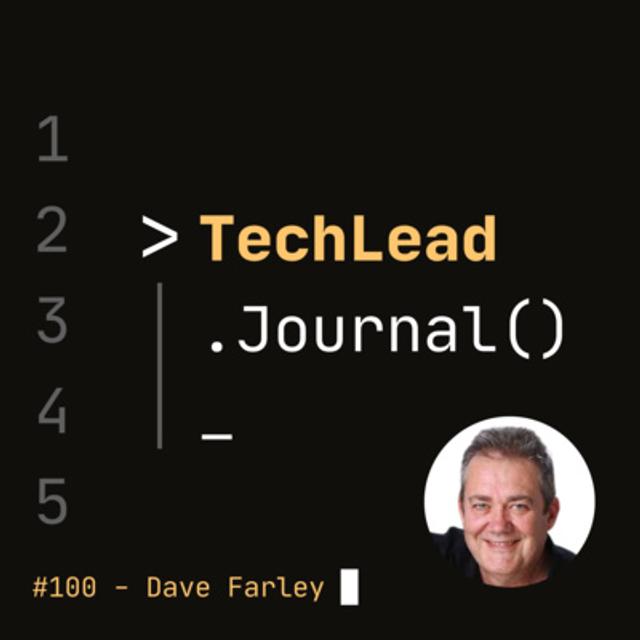



Thank you for listening and supporting the tekhelet journal podcast. It is my ultimate pleasure to serve you in the past two years. I hope the podcast serves you well and gives a lot of insights that you can apply in your work and Life as we are going to celebrate the 100th episode. I would appreciate if you can drop a few words in our survey related to your experience with the podcast.
And if you record your story or message in an audio format, we may feature you in the podcast special episode. The survey is open for both. Both listeners and guess. I'm looking forward to hearing your message. Soon, drop me the message on technology, know the dev slash celebrate Dash 100, here's the link one more time, technology? Know the Beth's, let's celebrate bash, 100, what engineering
means? You know, the disciplines is the most effective efficient way of doing work of high quality. And so, if software engineering, doesn't allow us to build back to software faster, it isn't software engineering.
Hey everyone. My name is Henry Surya, we Robin. And you're listening to the technology, you know, podcast the show where I'll be bringing you the greatest technical leaders practitioners and thought leaders in the industry to discuss about their Journey ideas and practices that we all can learn and apply to build a highly performing technical team and to make an impact in your personal work. So let's dive into our Journal.
Hello to all of you, my friends and listeners, welcome to this special episode of the technology on our podcast, the show where you can learn about technical leadership and Excellence from my conversations with great thought, leaders in the tech industry and this is the episode number 100. Oh my God, I can't believe that. I finally reach this special milestone in the beginning. When I started my journey creating this podcast, I made a pledge to myself that I would
reach 100 episodes. And here we are two years later from my very first episode. I'm really proud to have reached this Milestone and I could not have done it without the support from each of you, who listen to the episodes week in week out. And also a special thanks to all the guests, who appeared on the show and for sharing your expertise and wisdom. I really, really appreciate your trust collaboration and for your willingness to share back to the community.
And personally, I have grown a lot. In the past two years by serving, all these great contents. And I really hope that all of you enjoy and grow yourself as well. And by the way, if this is your first time, listening to tackle e-journal, make sure you subscribe. And follow the show on your favorite podcast app and the social media on LinkedIn, Twitter and Instagram.
And for any of you who wants to contribute back to the creation of this podcast, support my journey by subscribing as a patron, at technology node Dev slash pay. Patron for today's special episode, I am super excited to share my conversation with another great thought leader in the software industry, since I read his groundbreaking book, continuous delivery, and applied. Many of the principles and techniques mentioned in the
book. I have benefited a lot in my professional career and still continue to Advocate its best practices wherever I can. The book itself, one the joke award in 2011 and has been continuously impacting the industries. Instant even until now. And so, as many of you would have already guessed by. Now, my guest, for today's special episode is Dave Folly apart from co-authoring, continuous delivery book, these
days. Dave, also runs a highly successful and popular continuous delivery YouTube channel on software engineering topics, which I also watch and learn from it. A lot in this episode, we discussed Dave's latest book, modern software engineering, Dave started, It by explaining his view on Modern software engineering and why it emphasizes on practices for
building better software faster. Dave describe the foundations of the software engineering discipline and he explained the core competencies, we need to succeed in modern software. Engineering by becoming experts at both learning and managing complexity. They've also explained the importance of understanding technology, fundamentals, improving software, readability, and handling software.
Cassidy by managing concurrency, and coupling towards the N Dave also share some of the tools in the modern software engineering tool kit that, of course, include continuous delivery. I really enjoyed my conversation with Dave learning the fundamentals of modern software engineering. And importantly, the practices that we can use for optimizing learning and managing complexity.
If you also enjoy listening to this episode, please share it with your friends and colleagues, who you think may also benefit fit from listening to this episode. It is my ultimate mission to spread this podcast to more people. And I need your help to support me towards fulfilling my mission.
Before we continue the conversation, let's hear some words from our sponsor definitey is the top International software development conference, with an emphasis on coding architecture and Tech leadership skills.
The lineup for this year is truly stellar and features many Legends in software development names, such as Robert Uncle Bob Martin, Kennebec Scott Hanselman, thank a subramanyam Carolyn honey, Alan Halep, Mary, poppendieck, and many other prominent names, including some of those who have also appeared in this podcast before the conference takes place online. So you can enjoy it from the comfort of your couch. We spoke to the definitey organizers, and I'm happy to
share that technology. You know, has got the 10% discount code for you, enter the promo code, awsm underscore tlj. When you purchase the ticket on definite e.com, here's the promo code. One more time awsm underscore, tlj. Depending on the time when you purchase a ticket early price is still available. See you there. Today's episode is proudly sponsored by skills matter. The global community and events platform. With more than 100,000 software
professionals here members. Can organize their learning experiences around the technology topics. They care about. At most you get on-demand access to their latest content thought, leadership insights, as well as the exciting schedule of tech events running across all time
zones. So whether devops our data science is your bus or you are fan of functional programming or all things Cloud, you can make real connections with people who share your interests head on over to skills method or calm to become part of the tech community that matters most to you. It's free to join and you will find it easy. Keep up with the latest tech Trends. Hello everyone. Welcome back to another new episode of the technology on our
podcast today, I'm very excited. So I got the chance to meet someone who I follow a lot by reading his book, following his blocks. And also recently his YouTube channel, his name is David Farley. Also more widely known as de Farley. I mean just to share. And when I read The Continuous delivery book, this was like many years back. I find that book is one of the Cornerstone of my career. Trying to implement those practices like delivery pipe
lines, continuous integration. I really find the book is something that is really critical for my journey so I really thank you for that for writing the book and as a next artwork as well I always love to see all the other workers as an author because they write a very insightful book based on experience. Thank you so much for spending your time today. Dave looking forward for this conversation It's a pleasure. Thank you very much for asking me and I'm pleased that you enjoyed my book.
So in the beginning, maybe if you can share a little bit of background about yourself, maybe telling us your career Journey that maybe people haven't heard about any highlights or turning points, should I do? So, as you can probably tell by looking at me, I've had quite a long career, I'd be doing software developed for a very long time and Correll.
I started off probably at the start of what was then called the microcomputer Revolution. So the Mooshroom kind of Lady computers to computers that were more accessible based on Silicon integrated circuits that were starting to become cheap. So I had the advantage of kind of the first computers being fairly simple and be kind of growing up with them over time, which is pretty nice. Really, I've done quite a lot of
different things. I spent the early part of my career with Hardware manufacturers, I worked for computer manufacturers and writing operating systems and device drivers and those kinds of things. And then later, I got interested, I don't know by
accident. I didn't but in kind of distributed systems starting to build for those days larger scale distributed systems, I think I ever shared for kind of become part of the team that invented the concept of microservices a long time before they actually cook off. So we kind of emailed them and then they went away again. We did some really interesting stuff for a research company. Building software with these very Loosely coupled. We called the collaborative business objects.
It's still the most interesting software in the sense that you could introduce two pieces of Independently developed software, and they could do useful work together, which are not seen, anything do that, quite, as well. It was a fascinating project to work. On one of the seminal moments, for me was, as you mentioned Working For Thought Works, weren't you thought works, and I'd already be doing informally some agile.
Things I'd be doing a little bit extreme programming projects before that but thought Works kind of turn the volume up on that show me and we started doing what we thought at the time. And I think the one most people credit to Sweet are working on some of the Big East agile projects that had been done up to that point. And so we must are pushing the boundaries and finding difficult, things difficult problems. We've had you, apply extreme programming.
When you got 200 programmers, we started addressing that kind of thing. And I think that was one of the things that sort of gave birth to the concepts that have steered my career. Since in terms of continuous delivery and talk to you more engineering, kind of approach to thinking about solving, these kind of problems.
The latter part of my career. I've spent nearly all of my career building real software for people one way or Nova about six years ago, my friends and family convinced me that I ought to start my own business because I was always a bit nervous of doing that kind of thing. And so I started a consultancy these days. My job really is a software consultant advising organizations all over the world. Usually big organizations on how to do a better job of software development and not to mention
also producing YouTube content. It gasps you seem to be very, yeah, even of churning out contents every week. Sorry to Oh it's you. That was some accidents as well as you can probably tell. I'm not some weird plants are career hoop. That was an accident forced on us by the tender me. I was very busy with consultancy. The pandemic happened and that stopped and my wife and I were looking around saying, what are
we gonna do? We especially go to Brazil next week, you know, probably gonna be there. And so we started YouTube channel, partly just as a means of keeping us sane and having something to do, and it's being extraordinarily more successful than we ever anticipated or hope which is Not. I can also see the plaque behind you, so I think that, yeah, I know like after you reach some hundred thousand subscribers or something like that. Right. That's right.
So we got that earlier this year, we just passed a hundred twenty thousand subscribers we rapidly approaching or we just crossed the 5 million views Ma. So it's quite a big Channel, know for a technical Channel. We release a video every week on Wednesday and we get tens of thousands of years. Every week we usually would get that quarter million views a
month. That's quite a lot of people coming along with the journey and at least listening to these ideas even if they don't always agree with them, which is good because we're back at the debates and it's not just about the number of viewers, but I think the quality of the content at these pretty rare still, I rarely find YouTube videos that covers all this technical contents, that is deep and also
based on real experience. So, thank you so much for producing that and I hope that it will continue to grow. But today, I think we will discuss mainly from your latest book, which is titled modern software engineering. The first thing that comes Two minor for me. When I look at the title, why do you call it modern software engineering? Is there the always of software engineering and there's a new modern way of software
engineering? Yeah, it was a total movie stuck in my mind for a long time while I was writing the book and to be honest I was somewhat nervous. Like the reason that I call it modern Subterranean rather than just software engineering and I was nervous. Oblique lightly is kind of the
same. I think, you know industry, we kind of weirdly devalued, what we think of as engineering I It's very common to think for people to say, software development isn't engineering and a lot of it isn't nothing. That's fair. And lot of it isn't engineering, but in other disciplines engineering, doesn't mean heavyweight bureaucracy, which I think is what it tends to mean to us. What engineering means in other disciplines is the most effective efficient way of doing
work of high quality. And so, if software engineering, doesn't allow us to build better software faster, it isn't software engineering. So modern software engineering, I think he's different to what we're before we tried to implement engineering approaches before and they were nearly all works. Narrowly focused on some particular set of tools or diagramming techniques or something like that and bureaucratic in heavyweight. And that's not what I mean at all.
So, I mean almost entirely the opposite of that. So what I was interested in part of my background and interests, my hobbies is that I'm very interested. Science. I think that a reasonable definition of engineering, is as a practical implementation of science. You apply scientific style reasoning, which is Humanity's best approach to learning to solving practical problems. And I think that's a reasonable
kind of colloquial. Definition of engineering, I was always interested in those kinds of ideas. What are the ID that we could point to and whatever your technology, whatever? The problem, you're solving, whatever organization that your work? If you applied these principles, you'd have a better chance of success. And I thought I'd spotted some of those things over time, and then related to continuous delivery, which was my previous book that I worked on with Jay.
So humble and so on, but also somewhat separately. But slightly different angle. It's kind of all fog. They intersect and they're very reinforcing at one another but they're not the same idea. So what were the principles that would allow us to do a better job? And I thought that was what I was trying to explore and that's what Titles meant to try and convey the subtitle of the book itself is doing what works to build better software faster.
And in your book, I also find it quite insightful. Is that you mentioned that if our software development practices do not allow us to build better software faster, we should really change them because they are not enduring. So please tell us more about this concept. Why do you think so like why we should focus on building better software faster? The simple answer is, why would anybody want to build worse software slower? I keep this the combination in part.
This is my kind of again colloquial take on the Dora metrics, the metrics that come out of the state of debauch report that give Alice a predictive model. If you work in these kinds of ways and do these kinds of things, you increase your chances of success and they are based on the stability metrics, what's the quality of our
software? When we eat You suckering to production, how often does he break and when it breaks, how long does it take us to recover from the breakage and fruitful, what's the efficiency with which we can deliver software of that quality? So that's the fast apart. So working quickly, one of the findings from the door and metrics which is important, I think, is that there is no trade-off between speed and quality.
One of the traditional assumptions is that if you want to build high-quality things, you need to go slowly what Madonna reports Set is know, if you'd go slowly, you build lower-quality things. And that's what the statistics say. That's what a sociological approach to measuring the performance of subdued. Lot of teams finds the more barriers you put into being able to release change quickly, the worse the output.
So we want to be able to move quickly, we want to be able to go faster and we want to be able to build better software, and that means that we need to be able to focusing on be able to learn find out where mistakes are correct and really quickly and efficient. And that color is, one of the way. Which is closing with continuous delivery. Can you still use a fantastic way of being able to build better software fast from my
career itself? I can tell that so many experience from my view is that we build software faster in the beginning. But since that, after a long period of time, or maybe few months, it starts to get slower and slower and maybe many people have left. They don't know about the context that domain problems. So I think maybe some of the tools that we will discuss today can help people to really build better software faster like continuously. So, You have a definition about
software engineering, right? If I can read here, is that the application of empirical scientific approach, which you mentioned in the beginning, just now to finding efficient economic Solutions. So, the economic Solutions here is also quite interesting to practical problems in software. I know that you will cover in the book that some of these
keywords are really important. Maybe if you can discuss slightly some of these terms, why do you think it's important to Define software engineering using this way? So, I was trying to get the simplest minimal description of what I was thinking. In terms of engineering. I was quite pleased with that description that you just read out because it's fairly lean. It's fairly concise, but I think he doesn't miss anything important.
So applying the reasoning, the rational approach of science, I think that one of the fundamental Nature's of science is that the difference is between science and almost. Everything else is that we start out assuming that we're probably wrong and that's a very healthy thing to do. In engineering and in software development at all. So we're going to apply scientific style of being in a lightweight, not overburdening, not bureaucratic way.
But we're going to be informed by that kind of thing. We're requiring. That solving practical problems. We're not doing theoretical researcher. Proving the quarks are the basis of particles or anything. We're building things. And so we've got to be practical and pragmatic. So the empiricism of engineering just trying stuff out, ultimately, he's a big part of it as well. The economic power is Again,
part of engineering. If we are physicists, we can imagine building machines at a black hole, thinking about that practically economically in energy terms. We're not ready to do that kind of thing for us Engineers, we are building things, and so there are always economically strength at some level. That's about the amount of time and effort and money that they spent, but also economic constraints in the sense of the performance of our delivery
system and the performance. It's about software. The carbon footprint of the software that we create, that kind of thing. He's an interesting question for you need. So right. So I wanted to get that in there as well. So I think all of these different parts of the definition, kind of lead us in this direction of trying to organize our thinking in a more rational way and apply it to solving problems, and are of value to people in some way.
That's what I was trying to reach full with the definition. Thanks for that explanation about the software engineering. So I think for us, we need to probably redefine some of our understandings of engineering is not just writing code that works and deployed. I think that's a really good point. One of the things that are
obsessed with at the moment. He's watching SpaceX built a space Rockets to go to Mars. That's engineering Live on YouTube, you can kind of watch it happening in the real world that's not theoretical. They're evaluating their ideas, their blowing spaceships off are learning from that.
They're making progress. Final step and of the old of these things, kind of coming to an engineering approach to solving problems and thinking about the ways in which stuff can go wrong in all of the time, looking at how to be proved and refine our designs and our Solutions, so that they'll better fit, the problem that we're trying to try to solve. For us to follow this definition of stuff, engineering you mentioned there are two things that we have to be expert at.
So one is actually to become expert at learning. This comes back. Probably to the scientific approach that you mentioned. If s is experts at managing complexity, maybe we can cover one by one. Let's start with experts at learning. So you mentioned there are a few key things like five things that we need to be able to practice in our software engineering or software development day to day. So what are those five things? Yes. So experts at learning, let's
just say why that's important. First of all, it's to do with this kind of scientific engineering philosophy of assuming that we probably run, we not going to start out with perfect vision. We're not going to be able to predict the business context, the technical context, the socio-technical context of how we organize ourselves to what, we don't know, the results, and you've those things at some level, we're going to get all of those things wrong.
And so we want the ability to make progress while we don't know at the start of a project when we don't have all of the answers yet. Therefore we want to optimize to be able to learn Microsoft did some research into their own ideas and found that two-thirds of their ideas produces zero or negative value for the company. So you'd like to be able to learn which with a bad ideas early on, if you wanted to be efficient. So we want to optimize for be able to learn all sorts of things.
What the problem is that we're really trying to solve what our users really need to be able to solve that problem. What a technical solution, Speech. Does it really work? Is it releasable? Is it compliant all those things? You will learn ways of doing that and we going to work in order to be able to do that. As you said, there are five principles that underpin our ability to do that.
So, we need to work intuitively. We need to working many small steps so that we have many opportunities to kind of look at what it is that we doing and refine it. Oh, that didn't work. Let's not do that anymore. That kind of thing. We need to take feedback seriously. We need to understand what information. Animation.
We need to gather in order to be able to determine whether our ideas or our Solutions are useful for help whether our problems are landing with our customers, where there are tests are passing or failing, we want to optimize great feedback to do that. We want to also be able to work incrementally, want to be able to build systems or almost evolutionarily, sort of bit by bit knots.
All in one, great, big chunk. So, we want to be able to deal with these things more independently, so that we can kind of carve it out in certain if we working on it. Scale divide the work so that different parts of the organization can work on different parts of the problem. So working incrementally is part of all of that. We want to book. Experimentally. If you want to start being more scientific, be more like
engineers in our approach. Then we should apply a little bit of discipline around the way in which we think about making changes. And the key to that for me is to think experimental e. We want to make little predictions. You want to say? Well this is the problem that We're looking at the moment. We think if we did this thing this would improve that position on this problem. How would we tell? Whether that thing was or wasn't working?
That's the difference between an experiment into that step of predicting, what the outcome is, and then carrying out the tests. So you can think of this as a etched with the product. We think that if we do this thing, it's going to improve the sales or this widget and we'll put it into production, see what happens or you? Could be as a trash. All. I think that the coach should do this thing. If it were to do this thing, this is the assertion that I would be able to make.
Then I write some code to fulfill that assertion, these are ways of it working experimental e and that can. And for me, has become pervasive. That's the way that I now think about and practice nearly all change where I can. So what is it that I'm trying to do? How would I understand the results of this thing? And I'm just thinking in that way, doesn't need to be heavyweight to be really Fast really short, really efficient but it's just a slightly more
disciplined organized. Way of structuring, I think that gives us better results and the last one is the empirical we already talked about. You'd be racism. Engineering is about real-world things. You cannot about some Ivory Tower imagination of a system. It's about the reality of it. So we need to gather feedback
from production. We need to go to understand what's really going on. We need to be able to make practical decisions based on what it is that we find Elon Musk. He's building space. Citing checklist. I'm sure that they're doing very sophisticated, computer, simulation, but at some point, it builds the pads of metal and that they blow it up on a test and see how it works. That's how Engineers think, and
that's how they operate. If you look at the development of any sophisticated engine, think about a layer of plain error. Planes used to be incredibly dangerous things in 2017. The equivalent of two, thirds of the population of the planet flew in commercial airliners and not one person died that wasn't possible in the early version of Severa planes. We had to go through that pain of things breaking and killing people and say, oh well, we
won't do that anymore. Will relearn some eight is about work incrementally and growing and learning based on mistakes that we make fundamentally. And we've got to give ourselves the freedom to be able to operate that way and to make those kinds of mistakes books when they occur to learn from them and to correct that. So I think those five things
it's true. Working feedback, incrementalism experimentation and empiricism are the Cornerstone of our ability, previous species to be up to learn, effectively and efficiently. I can't imagine anything that we could consider to be engineering with that post legs. So the first third of the book is really about exploring. Those ideas in much more detail in looking at each one of those principles and Hunt picking apart and seeing how it fits
with software development. When I read these five key principles, they seem to interrelate with each other. Of course, they support each other and then you become expert at learning. So these days, many people, I think already understand a how they work intuitively. They probably tried to build a shop feedback loop and things like that. Where does that thing go wrong? Why do you think still you still need to reiterate these kind of Concepts because a jolly five understand correctly.
From the beginning, from the get-go is actually to adopt all these kind of things, right? It right. If incremental short feedback loop and there's also an experimentation partway after the spring, maybe iteration that you deploy and learn from the customers.
So, why it seems like these kind of things are still forgotten or maybe misunderstood, I've Had The Good Fortune to you during the course of my career to be fairly close to the birth of some influential, Big Ideas, my observation in all of those circumstances. If you talk to the people who came up with the big Ideas after their ideas are successful, they said we didn't meet, man. That's because this kind of this
semantic. Diffusion things people come up with ideas and then other people interpret them differently. And I think that's definitely happened to Agile. I think if you look at the agile, Manifesto, which is the closest thing to a definition of what agile really means, scrubbies near the agile, Manifesto says, what agile is really about. If you look at that that's not going to a day that's still pretty good.
That's a pretty good specification of what goes on the problem with a Maturity as an approach, an armored car carrying a job. A believer that is an important step. But the problem with it is that part of it is about giving people freedom to make their own choices and learn things and that's deeply important. But there are naive ways of taking that and one of the naive interpretations of that is that everybody has a veto on
everything. So, if you're working on a team and your team decides that they're going to be testing development, and one person on the team decides, they don't want to do testing development. Don't they won't do it. They'll Victory. That's not really what agile was the level at which autonomy works. I would say is kind of at the level of the team. So, team agree begin to work this way.
And then you do it, whether you like it or not, you do it up that be, they're part of the team that was doing things that I didn't speak with the right things to do. But we still did it as a team because that's what we'd agreed to do. So, there are some things like
that. There's also the natural resistance of a big organizations to want to change, but I think my purpose, Over the years, I've worked with a lot of different organizations usually bigger organizations but a lot of I think my overall summary if I could love for that it's very unfair to lock the Bots. Get the body Force above them all together. If I was to put words in their mouths, what they all want, is that we'd like to carry our work
new. Tack means we always did before or get different results and that's not gonna happen. So, the trouble with agile ways of working is that they're quite radically challenge to traditional corporate culture. So they're very difficult for big organizations to adopt because it means breaking down barriers in organizations
without sounding too immodest. I think the continuous delivery is currently state-of-the-art software developed eat what most of the best companies in the world at software development to do and it works, you got data that says that it works often in certain measures orders of magnitude better than other words of doing. And I think the one of the advantages of continuous delivery is, it's just a little
bit. Prescriptive it still gives people the freedom to innovate but it's fairly hard line on some things. So part of the definition I use these. If you can't produce something releasable every day, it's not good. English delivery that's pretty hard.
Why? That's a pretty definite State that's more definite and say as important as it is but people over process which the agile Manifesto says he's a really important idea but it's a bit vague compared to produce software of the releasable software. Every day. That's a pretty hard line statement, a little bit more constraint, a little bit more specificity in what we should be doing.
I think sometimes freeze us and helps us to be more Innovative to be more creative in some of the things that you do. I think a continuous delivery of the second generation agile, discipline. I think the second generation a job approaches are more effective than the first generation wants. So are continuously abuse. Also second generation extreme programming for me was the best agile. This Knights of the first generation, but continuous delivery adds a little bit more
stuff around. Extreme programming takes a little bit further, but both of those are engineering approaches. And that's the other thing. That is a failure of agile, agile, got sober T to become a project management approach rather than an engineering discipline. Ultimately, we're building software. So we got to be able to create
things. However, good, you're planning, he security doting, the stuff, it's not working at So I kind of like the our definition of continuous Delirious like a second generation of a gel or maybe experience. Because some of these practices is like, a rigorous process. You have Department pipelines, running tests as driven development, and all that, I think they're kind of, like, just people guidance are so, what practices that they need to follow. You mention that if you cannot
really software every day. So it's a really high bar, especially for people who started with a good idea in mine, and it seems like very far-fetched, very high and Big Ideas. How can people do this while at the same time? I think one of the discussion point in the book you mentioned about cause of change. So if you're doing traditional software development, maybe it gets faster in the beginning, but over the time it gets slower. But we're using this modern
software engineering approach. You can actually make the flat course of change to the software developers. So tell us more how we can actually aspire to reach that level where over the time. Basically any changes you make to the software is kind of like flat. It's not like a steep curve going upwards. I think actually that brings in the kind of the second section of the book. Which is what I call managing complexity, the techniques of managing complexity are really
about addressing that problem. So I think that one of the most important qualifying characteristic of what, we would think of as quality in software, is our ability to change it. So sure it has to do the job that it was designed and intended. Rory, if performance is an issue, we like fast enough at all those kinds of benefits. But fundamentally it's living in this world where we don't know all of the answers on day one. We can't perfectly predict the future and the business Direction.
Then inevitably, we must be able to change minds and change our software. The business Direction might change. That solution might not be good enough in some way or another or we spot a new idea. That's much better than the one you had in the first person we want to follow that. All of these are reasons to change our software. So I think that one of the Of the cornerstones of high quality is our ability to make those changes quickly fishing, the easily flattening that cost of
change curve. As you mentioned for that, we need to be able to work a little bit defensively, the way in which we approach designer software. So it's reinforced by the practices of learn, if we're building our software so that we can iterate quickly on it and we can gather good feedback from it and we can carry a little experiment to change to it as a licking experiment of some form that reinforces this ability. Then we need to build software,
that's modular that's cohesive. The bits that are separate should be separate in the software, the bits that are closely related should be close together in the summer. We want it to had good separation of concern, each piece of that software to be focused on doing one part of the job. And then when we need to change their mind on that part of the job, we can just work in that
part software. We want our software to lines of abstraction wanted to hide information, between one part, At the software in another so we can make change in one place. So that worry too much about our other places work. Having a coupling between the software is a problem and abstraction will give us that. And that is of the last point, which is to manage the coupling effectively, but with at registrants attendance, eat more in the direction bluescope.
So, we'd like, at the pieces of our software, not to care too much about the detail of all the pieces, if we build software that looks like there, then it is much easier to change if you want to build software like that. Then one of the It makes the beginning news that massively amplifier is all of those five properties test-driven development, prefers software, that's modular.
Cohesive separation of concerned abstract and Loosely coupled, it's much easier to write tests, urine, tests or software, that looks like that if you have those properties in the code. So, we got this nice feedback loop, this nice reinforcing process. We want these properties as Hallmarks and quality in our code. And we have these techniques that tend to make us put these properties in. The code that's kind of what I mean by engineering. It's not an automatic recipe.
It's not going to automatically generate great software, you still need to be good, you still need to be intelligent, still be to be thoughtful. But when you are good intelligent and thoughtful and use these techniques, it guarantees you a higher probability of a better outcome. It's not going to make sure that you're going to be successful.
But you've got a higher probability, you will be if you work those ways but big what the data says and what I'm trying to do Book. So when you mention all these five key principles, cohesion modularity, loose coupling suppression of concern, looking back in the University, we kinda like, thought about this maybe in programming 101 or things like that, but it's kind of funny. Like, why do we need to keep on repeating these sort of fundamental basic Styles in software engineering, probably
or computer science? You mentioned the industry currently has a tendency to focus a lot more about tools Technologies Frameworks or languages rather than actually emphasizing a lot of fine. So tell us how do we get wrong here? So many people talking about Technologies like Cloud, kubernetes mobile, whatever that is, but why people the emphasize on design? It's a good question and I wish I knew the real answer I can give you my opinions as to some of the Rings.
I think three degrees, inevitable software development is a career appeals to certain kinds of people. Those of us that it does appeal to our interesting, how computers work in the tools. I'm as likely as anybody else to have a bigger wrist debate about the merits of different programming languages in a pub with anybody else. But ultimately doesn't really matter. Very much collapsed language where I thought that I'd kind of consciously Works to use every last part of the language with
see many years ago. There's not many parts to sing so you can see on the bearer of small brand. But as part of the book, I tried to count up language like used in professional settings over the course of my career. I reckon I'll probably Programmed commercial software, one way or another in about 20 different languages. So very ephemeral over the course of 40 years. That's one language every couple of years. So you might be more stable than me. You might be looking at that more.
I've certainly done more stuff in Java than I have here prologue. But it is interesting thinking about the wet job works. If currencies in syntax in Java and python a lot because that, you talked about nothing but fundamentally when I stop and think about it doesn't have any impact. From the way that I design software area, it has some new arts in terms of whether I medium Attic in the language that I'm using or not.
But fundamentally the way that I organized and carve up the problems that are trying to solve with software hasn't changed very much for decades in some ways we find around the edges. The way that I think about is I think a little bit better now but the same things that were important doing things in C or even an assembler are still importance during the in python or JavaScript so F sharp or
whatever else. Those Fundamentals, don't change modularity, Max's whatever the technology that you're using to buy Cody's at the same separation. Concerns the same. As you said, we learned about these things in University and then we discard the nurse at age. Why do this with Helm charts? That stuff? Doesn't really better as a result what we tend to do. So we look at something like kubernetes, kubernetes is a fantastic tool.
If you're Google scale, doing all of these different Services. That's fantastic. I see teams. All of the time that rebuilding Forgive me some very simple little application. That's probably a single process running somewhere and they start off by deploying you with kubernetes you going. Why does kubernetes helpful, this simple, little problem and is that work? So thinking, in terms of what the problem is, that we need to solve applying things like modularity.
Cohesion, separation of concerns tells us how to solve it and then we figure out the tools to use to apply to maximize our ability to build multiple software, Oh, that's so easy with good separation concern. That's the goal. The technology is just, the means like a carpenter being obsessed with the nails that they use and the Hammers rather than what it is that they're building. We need to focus on what it is that we're building.
Not the nails and the hammer thanks for giving your insights, like you mentioned, any good programmers, doesn't matter what language maybe they can learn new language or even use old language. They can still produce software that resembles all these five key elements. Verity separation of concerns and things like that, the importance of managing complexity at resonate with this
as well. Because the more you have growing complexity codebase the cost of maintaining that software is really huge and we are probably wouldn't be able to make change as easy as maybe the first time it was written in the last few episodes of the podcast. I've talked with some of the guests about managing code, complexity, readability, and all that. I think this kind of ties back to all these principles of
design. So why do you think it's very important to have code that is manageable in terms of complexity and also readable you mentioned is about communication, but this is counter-intuitive to people because people think writing surface is to make the program work or to solve a business problem here, and that's certainly true, but it's never one up.
So this sustaining, our ability to solve those problems, he is in everybody's interest, it's in the interest of the organisations that employers as well. Run. And I think that's one of the mistakes that as software developers on teams.
We tend to be too short term in I think and we tend to optimize of next week rather than next month if you optimize for next month that some different things it's a bit like deciding that the time that you spent putting Petrol in your car or charging your electric car or is a waste of time. And so you're going to do with that and very quickly, you're going to run out of gas and you let your car will come grinding to a halt. If you do that thing, there are
sir. Certain things that you need to do in order to maintain your ability to make progress in software terms. That's precisely what you said at the start, which is the big problem of building complex software is that over time it gets harder and harder to change it. That's because we didn't do a good enough job of managing the complexity as we added new
things. So focusing all of the time on managing the complexity flattens that cost of change curve retains at Freedom, to change our minds and to do new things and new features. Modify the features that are
already there more easily. It might be difficult work sometimes but we still have the ability to do that then if we build some big complicated coupled ball of mud that we're afraid to touch so managing the complexities about trying to organize our thinking universities that compartmentalize the problem it's a bit like writing a book. If I wrote a book that was just one long sentence it might have all of the same words in it but it'd be much much harder to read
than if I break. Get down into sentences and paragraphs and chapters and sections and label that gives us markers of where we are. We can jump to a play a different part in the book. And look at only that part in the book, I'm going to refer back to those are book level tools for managing complexity ideas like modularity. Cohesion, separation of concerns abstraction and coupling. Our software levels are quite ideas for managing complexity to
be fair. I apply these not just to software, but to Information Systems in general the way Open eyes, my hard disk, he's kind of simpler returns of modularity, and cohesion and trying to break things into pieces, and keep things that are related close together and things that are unrelated to our part of my dish, because it makes it easier
for me to navigate the system. So, I think these ideas are foundational principles that we should apply to basically everywhere I'd be talking to some people building packaged software and low coat software this. Treatable still apply. There are be talking to people to do machine learning these principles, still apply it. I think those are the kinds of things that we would expect if we were to identify genuinely important principles for an
engineering discipline. That was related to software. Yeah. I like the way that these five key principles can be actually taken not just from low-level coat but actually do something bigger like machine learning and sometimes getting this distributed systems and other you cover about why microservice exist, what microservice exists is partly also by adopting all these key principles, there are two things. When we build a complex may be distributed. Stubbs right?
You mentioned that two things that probably is root cause of more complexities about concurrency. And coupling sometimes these are unconscious though, when we build software we don't think about multi cam current process at one go. And also coupling, it could be dependency coupling, coupling between classes or even competing with other services. Maybe if you can touch on these two primary cause of complexity in the modern software.
Yeah, we pleasure. I think those two things, it independently but certainly can bind our kind of are equivalent to come Quantum physics. They're incredibly complicated and we are always just moments away from which is interesting. As soon as you create a branch in your version control system or spawn a new thread, you've just jumped into that world of complexity of concurrency and coupling between those
concurrent systems. And it's always comes at a much bigger cause they're not doing and it's go back to it analogy of writing a book if you and I are collaborating. Writing a book then we could divide up the work and you write one chapter and I write another or if we working on the same piece of text you could do so that we could send this changes between each other and all that kind of stuff.
Or we could put it on google doc and we could work on it could currently we could see our changes that last one is a much better way of working and much more efficient way of will, because we can see what's going on and we get that fast feedback, we can learn really quickly. Oh, you're working on that part Henry's, working on that part. I'll avoid that for now while he's working on, whatever it is. So we get much better feedback those way.
So thinking about those kinds of ideas and how the information works is important in the latter part of my career, when I was Building Systems, right? Talking buildings, I was involved in building what we think was probably the world's highest performance Financial exchange and that was fascinating. We had to do some not necessarily me but the team as a whole had to do some really very clever be things in terms of deep concurrency and man.
Shooting the flow of information to have to get the levels of performance of your base to achieve. We were looking at the specific architecture of Intel processors and designing software that would take advantage of that to maximize the throughput of our Co that's very difficult stuff and it's the same difficult stuff that we have. As soon as we spawn a new thread, that needs to join up with another trade, the cost, we did some benchmarking kind of
things to look at this. If you just increment the number and you say, oh, I mean creating this. It's a very large value so I'll speed it up by making it to do in parallel if you just do that. Then the cost of the most efficient work of synchronizing the results back so that you get a valid result at the end is 300 times slower than just doing on a single thread. So there are naive ways of optimizing things and there are clever ways of optimizing fixed
parallelism. He's very valuable for certain kinds of problems and very stupid or other kinds of problems one. The places where this surface is high enough, recognizable places information control. If you have a relatively coupled system and you divide that system up into a bunch of microservices, each living in a separate repository but you don't trust them enough to melt and release them independently. So you've got to test them all together before you're safe to release.
That's one of the more inefficient ways of organizing. Their if you put them all into one big repository, there are different kinds of optimizations that you can do then if they're inseparable. Because the trees you are adding a bunch of overhead to your ability to go in and change coding different repos, all of the time.
So it slows you down. There are lots of advantages to microservices that they will give you but this is a problem of concurrency and coupling between the these I think the concurrency and coupling is the hardest part of software computer science. Really everything else is relatively straightforward in comparison to those two things.
So being defensive about concurrency and coupling is a very Strategy, a couple of my friends are considered to be world-class experts include current system. Their advice is always dumped a currency unless you must, they are the world's experts they say, don't do it unless you must. So I think that being defensive about those sorts of things and managing those things.
And one of the things that we do that alma mater, we built our very high performance exchange was that we are conceptually isolated concurrency, so that didn't happen. Where we were doing the business logic. So the business Logic for our system is very, very high throughput, very widely used hundreds of thousands of users.
All the business logic was process on a single thread for each piece of business lunch, but we did smark things in being able to bring the information to the point at which those single threads could process, the logic. So we externalize separated the concerns. I've been able to do that. So, I think there are smart ways of doing this in organizing, these kind of things, but I think concurrence in coupling are the enemy. You should be doing everything else to kind of God.
A Celtics, those things that's hard to be engineering discipline part in managing complexity, thanks for sharing this insights. I'm always amazed when in your book you mention about lmax. This is like a very high state of the art kind of system. Some of the principles also that you mention is it's not really just optimizing for Speed paralyzing and all that your could must be readable.
But when you isolate the concurrency such that, you can still make changes and still the system is performing. It's not like optimizing syntax or lines of code or try to make assembly code better. Absolutely, 100%. One of the things that we looked at measure L Max was the readable code, is nearly always more efficient, not because it's not that, it's an overhead into because if the code is readable you're going to be striving to make it simple.
So it's expressive and clear what's going on and compilers, love that shit. If the code is readable to us then it's readable to compiler. Therefore the compiler could go to town and optimize it more effective but more than that if it's read. Abel. It's going to be simpler and so there are fewer places there for nasty problems, too high. If you think about what high performance software really is, it's about delivering the most impact for the fewest instruction.
So that's kind of definition of what we would think of. And so designing, for Simplicity is really what we want. Simplicity is really what gives us the readability. Readability is a fantastic tool that will drive us in the correct direction. You've got to do other things so I could formats as well. But readability, I think is one of the most profoundly important tools. For all of those disputes of managing complexity.
He makes that go more modular more cohesive, we'd better separation of concerns more lasting those things. Make our code more readable. We can build a little sentences up as we create our cone, but even a non-technical program, I would be able to understand what was going on if you get the names, right? So I think you're right that readability is profoundly important. One of the real import Tools in our toolbox. And also on decoupling, right? The other source of complexity.
So you mentioned just now if you write microservice but you cannot independently release it or independently test it, this is also some pitfalls that people do they write microservice but before release they need to coordinate multiple Services working together and do the regression. So I learned from somewhere as well, that coupling is one of the killer of age Unity. So if you cannot manage complexity, basically, you cannot have this agility. Thanks for emphasizing this concept.
So maybe if we Sometimes to cover the tools, the tools that you mentioned can be the modern software engineering tools. What are those actually tell you mentioned about tdd continuous delivery? Maybe, there are some other things that we haven't learned from this conversation so far. Yeah. So there are a few other ideas. One of them is again, going back to related to the door report if we optimize our development approach to be able to work in
smaller steps. So get faster feedback on our changes, we get to add more definitive position we can make
A small change. Look at the effect of that change and understand it. Technically, I think one of the reasons why that is important is because that's one way of limiting the variables, if we can make a small change and evaluate that change essentially in its own context without worrying about the whole, the rest of the system that's going to give us a clearer picture of when the Chinese good old not as long as that system is modular and Loosely coupled and all of
those other things. So That's a good way of working in continuously returns speed is probably one of the most profound tools that I use in trying to help big organizations to transition to working with continuous delivery. You just start saying. Okay, so where are you now? You're releasing once a year. So let's try Andre. What would it take for us to releasing once every six months?
Let's do that. Then every three months, then every month, then every two weeks, then every week, and just keep finding what the problems are that get in the way you use the speed of Feedback release ability to drive down and remove work and complexity from the development process until you can release every day. That's in great way of doing
things. It's a great way of thinking about and structuring and exercising changing the way that people in organizations worth deployability is another of these fantastic tools and talking about micro service means kind of points to that. Very clear if we want to be able to take an engineering stats, they're really what we'd like to be able to do is to be as Trinity of as we possibly can about our evaluation of our software before release.
So I'd like to evaluate my software and have as much confidence as I can achieve before. I release it not just put any old rubbish into production and red fruits fall over. I'd like to be able to evaluate it in as close to the circumstance and says I can imagine for it to be Deployable. There are two strategies as far as I can. See that make sense to be able to do that. Both of them are driven by the deployability for supper. Anyway, which is why I could
deploy guns is a useful tool. So one of them is that we could just decide that we're going to treat our whole system, as one thing will evaluate it all together. If all of our tests pass, you'll say, yes, it's good. And we'll put into production, or we could decompose it into many indications of Parts. Evaluate these parts and say, this part is good and now that go to production. The second one only works as long as those things are
independent. Deployable if at the end of my deployment pipeline, Say this part is good but now I'm going to test it with all of these other parts before I release it then the real pipeline. He's that second one where I'll be evaluating everything together to be able to do continuously. You have to be able to do that once today and there's a lot of complexity now because I've got all these separate, Repose and separate deployment pipelines.
And lots of in efficiencies, with that way of working, microservices are independently Deployable. So I think you can use the deployability in the system as a tool. So we can say, we want to release change into production. What side? Humans have deployment. What is this thing that I can evaluate to the point where I'm happy for it to go into production without doing any more work?
What's that unit? That tells me the scope of your valuation of my deployment Pipeline and probably the scope W, goes into my repository. That's a useful at all the different phenotypic statement on how you structure your code in repositories and things like that scoping evaluation needs. They deploy or unit. All of these things, test-driven development Speed release. Ability.
All of these things are tools that we can use to amplify our ability to learn and our abilities as complexity of the systems that you build. So they kind of come together and that way of working. Amplifies, those software engineering properties, that we're striving to achieve. I like the way you mention about the scope of the pipeline. So in your book, you mentioned that. If your pipeline says it's good, then it's good to go. There's nothing else that you should wait, no approval.
No coordination with other teams. I think that's also another key. Insights from me, when I read the book is because sometimes when we have a pipeline, okay? All test, run successful and all that, but we still wait the approval of waiting other system to release verse or something like that. But the concept of good pipeline is that when it's good, you just release it, there's nothing else that you should react. So that's one of those semantics diffusions that we were talking about earlier.
I am the person that came up with the idea of the deployment pipeline. So that's absolutely what I bet. He sees Deployable at the end of the pipeline, I tend to work in more complicated Industries. These Lisa regulated Industries building medical devices or finite systems or Machinery. The challenge there is, oh yes. But we got to get this sign of buying supplies. Know you can automate that as well as a slur made a change to the model 3 production line.
This is a chase the factory. They upgrade the charging for the modern three come from 200 kilowatts to 250 kilowatts that was a software change which reconfigured the factory to build cars differently and it took Took three hours. Wow, so they put this upgrade change in, he went through their deployment Pipeline and then the fatuous produces that you first about Pre-K, SpaceX are changing software on their Rockets, 43 minutes before the rocket launches.
Wow. So you can do this, you can do Mission even very difficult circumstances, but it does take a different mindset. What I'm thinking was an engineering mindset to do. So, I'll suffer developers who listen here. If you think doings Liberty is hard for your software, think about SpaceX and Tesla and how they can do it with class Factory and Rockets. So I think we can all aspire to become much better, and try to
build better software faster. So they've thank you so much for sharing your insights all these conversations. I think it's really great. But unfortunately, due to time, we have to wrap up pretty soon. But I would like to ask you one last question before I let you go. So, this is something what I call tree. Technical leadership, wisdom, something like advice from you to all of us here. This Learners to learn from your journey or experience or from your past projects.
So what will be, Dave's, three technical leadership, is them? It's a good question. I think. My first one, I think the industry as a whole would be significantly better. If we all started out, assuming the are own ideas were wrong, rather than assuming that they were, right? So going thinking, this is been to be rung, but I wonder how it's wrong. A kick. That's an engineering mindset.
That sets us up for Control the ways in which our engineering mindset is wrong, thinking about the ways in which our software on our system isn't working practices can go wrong. I think that's a much better way of organizing thing.
If I could flip a switch and change the way that software developed worked, I would make it so that everybody from now on that learned how to program, did it in the context of test-driven development first, their first day of writing their first program, they started with a test.
That's the Way that I would teach test programming, because I think that if we learned people like that, there'd be none of these arguments about whether it was Bachelor, not because we know that it is. So I think that's the next one. The last one is I feel privileged to found a career that I have reveled. I have stained consistently even on the difficult days, even when I'm struggling, I loved what I've done for a living. It's fantastic.
I think that we should sometimes stop and think about that. And think about The value that we bring to the world, we are the engines of change in our society more than almost any
other group of people. That means that we have the privilege of being in that position to do amazing things, like pools, and social media, Rigby internet, and all of that kind of stuff, which is fantastic on many fronts, but it's also means we have a responsibility to do that in a thoughtful way and worry about some of the implications of some
of these things. So I would also Also ask people to be a little thoughtful about the context in which they work his place, and that's not somebody else's responsibility. The Volvo emissions Scandal. A few years ago, showed that saying that my boss told me to do, this is not an excuse, the person who did it, still went to jail. So we should be taking responsibility for our own working, speak about to see the social context to understand the check. Well, that's really beautiful.
I was guessing that you probably will say something about continously. Rebut that Lee is something else though Dave, I'm sure that people know where to look for you, but for completeness sake, if people want to connect with you and continue this conversation where they can find you online, you can get me at Twitter, my Twitter handle is
apps. They slowly 77, go to YouTube and search for continuous delivery and you will find my Chapel. There's some good stuff there, even though I say so much, that my books are available through the use of sources, you can buy all of my books on Amazon, one of them at least on leap. So, take a look for those, as well. Have a blog site as well date following. So in preparation of this composition, I must say that your book is really insightful,
and thank you for writing that. I find it really good. If we all Engineers wants to upskill and maybe go back to the basics a little bit so thinking about learning and also managing complexity. So, thank you so much today for your time today. It was a pleasure.
Thank you so much fun. It's not choking Thank you for listening to this episode and for staying, right until the end if you highly enjoyed it. I would appreciate if you share it with your friends and colleagues who you think would also benefit from listening to this episode. And if you're new to the podcast, make sure to subscribe and leave me your valuable review and feedback. It helps me a lot. In order to grow this podcast
better. You can also find the full show notes of this conversation on the episode page, at Tech Legion o.f website, including the full transcript enter, In quotes and links to the resources mentioned, from the conversation. And lastly, make sure to subscribe to the shows mailing list on pack leader dot f to get notified for any future episodes. Stay tuned for the next technology. No episode. And until then goodbye.