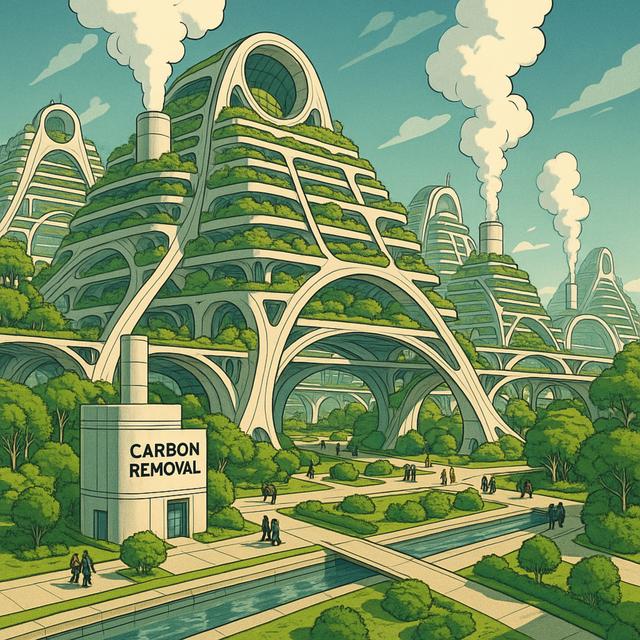



Hey everyone, thank you for listening. This is Ross Kenny, and I'm your host. I have two sponsors that I'd like to tell you about today. They're both organizations doing valuable work within Carbon Removal. One of them is a new sponsor of the show and the other one has been with us from the start, so I'm going to start with a new one. I'm going to give them a chance to go first. It's Climify. Personally, I think they produce some of the best content within Carbon Removal.
Their reports are top tier. I always look forward to reading them. I've learned a lot from them. There's one in particular that I like that I referenced in a blog post I wrote a while back called Bridging the Cdr Financing Gap. The comprehensive guide. Just really powerful, great work. If you're looking for good Intel on carbon removal, check out the Clima Fire reports. They're really good. There are lots of intermediaries
within carbon removal. If someone wants to buy carbon removals, many people will heed the call and try to sell them some. Climify is a group that I see almost more as a white glove service. They're quite selective in what they choose to do. The way that they put it is that they empower companies to develop and manage robust, high quality, durable Cdr portfolios that's built upon market intelligence. They have a proprietary rating system.
You may have heard that they just gave Deep Sky in Canada a very high rating. They're involved in the procurement themselves of facilitating, sourcing and managing RFPs for companies. So if you're looking to run a carbon removal RFPA request for proposal. So you could have. Carbon removal companies coming to you with proposals for what they might be able to do.
Climify as a group that can very much help you with that, perform the due diligence, structure the portfolios, negotiating, executing transactions, that's all something that they can help you with. And then also just managing the portfolio of making sure that the projects are monitored, warehoused appropriately and then when the time comes,
retired. Climify's project database covers about 95% of all the durable Cdr projects globally, but out of the 500 plus projects reviewed by Climify, only 15% meet their standards for delivery and integrity that they look for. And eventually only 5% of those projects are included in client portfolios.
If you're looking to buy some carbon removals, if you want to run an RFP, follow the link in the show notes to learn more about Climify. And of course, I'm also very happy that Arbonics is sponsoring the show again. Arbonics connects European land owners to corporate credit buyers in order to remove CO2 and protect biodiversity. They're very data-driven. They're trying to turn degraded and abandoned land in Europe, in the Baltic States back into
biodiverse force. That's a really impactful good thing to be doing for its own sake. Outside of carbon removal, it's a good thing to do but is also very much focused on how much carbon can be sequestered while also pointing us towards the importance of Co benefits and ecosystem services. I think sometimes carbon removed people forget about. We're pretty focused on the PPM, but the other stuff is really important too. They're doing fascinating work on the data layer side.
I'm not sure if you've seen the digital twinning of forestry, but they're making it. It's exactly what it sounds like. Our Bonics is on the cutting edge, trying to make forestry work for carbon removals and turn your back into that beautifully forested continent that it once was. So if that interests you, the link is in the show notes to go check out Our Bionics. Also, Lizette Louie, one of the founders and COO of our Bionics, was on the podcast earlier this year.
Go check that out because we dig into a lot of the role of temporary removals within carbon removal. It's a fascinating big topic and Lizette brings her a game to it, so I hope you enjoy. Link to both sponsors are in the show notes. If you'd like to be a sponsor of the show too and hear more about what that might look like, you can e-mail me. The e-mail is in the show notes.
And then also, if you're podcasting and you want to use Riverside for recording or D Script for editing and transcription services, I have affiliate links in the notes too, and that also helps drive the show's financial solvency. So thanks so much for listening. Here is the intro to your show. Hello and thank you for listening to the Reverse in Climate Change podcast. I'm Ross Kenyon. I'm a carbon remover, simple as that. Been involved in carbon removal for the better part of a decade.
I'm really happy to present this show today. It's with my friend Christian Gavers. Danut Christiana tapped me on the shoulder when City Cdr initiative was something that he was just starting to think about. It really captured my attention. As you can tell on the show, I'm really passionate about the kinds of questions that his work involves. At a superficial level, the city Cdr initiative is an attempt to embed carbon removal in municipalities and sub national
political units. A lot of people think about climate policies happening at the national level and international level, but below that it's more symbolic or not really that interesting to a lot of people in some cases. But I think actually that is not correct. And I think the kinds of political questions it asks are very important and fundamental. They are questions around what is the correct size of entity to undertake climate action.
And I think a lot of the momentum is to scale that up as high as possible. We want climate policy that one cannot defect from, and the assumption is that having that at the highest level makes that more possible. But I'm also. A strong believer in this idea of subsidiarity, that organization should rise to the appropriate level of centralization and scale, but no greater than that. And there's a lot we can do that
is sub national. There are things that States and cities and counties and other units can do that are useful experiments for figuring out what kinds of policy even works at a much smaller scale before we choose a much riskier and higher level of complexity organization like a national or international level. And as we get into in the show, all politics is local and someone has to live. With carbon removal infrastructure.
And that could be anything from improving soil health and having more carbon in the soil and healthier soil slowing down water runoff and increasing the resiliency for communities in the face of floods. Or it could literally be pipelines carrying compressed CO2 to classics wells, and a lot in between that cities are going to interact with carbon removal. And being able to find ways to do that in a way that is acceptable and maybe even better than acceptable to residents is
work very much worth doing. And given that larger scale political units are in a time of crisis, I think it's fair to say geopolitics is something everyone is pretty much talking about. There's trade war, there might be greater conflict, and I hope not. If that does happen, I think it's going to throw a lot of climate work into question. It's one of the narratives that I actually don't like so much about the reshoring trade war discussion and how it might impact climate change.
Because if there is war, especially at the level that reshoring might be useful for, it will be the most disruptive set of policies possible for avoiding catastrophic climate change. Great power conflict and war would be an immense wrong turn. Looked at only from the perspective of climate change, nothing good is happening for climate during a time of great power war.
Short of that, though, while larger political units are thinking about trade policy and strategic advantage and various theaters of war and conflict, there is a lot of opportunity for smaller political units to step up to make sure that carbon removal and other types of climate action can take place at smaller levels. That we can learn from, that we can grow from, and that is incredibly valuable work.
I'm very happy to be involved with the City Cdr initiative as a strategic advisor, working on communications and knitting together the various comms threads of this project. That's been super fun for me. I'm honored to be working on something I find to be so important, and I think Christian is very clever in the way that he's approaching this entire topic area. If you'd like to get more involved, there are links in the show notes to do so.
There's also I Feel Like. The show requires like a link to The Federalist Papers and. We talked a lot about, I mean, you can probably tell if you've read James C Scott, a lot of my my thinking comes through understanding someone like Jane Jacobs and Robert Moses fights over the shape of New York, urban living and things like that. So if you are intrigued by any of these questions, cool.
We would probably be friends in real life because these are fascinating questions for me and the links are in the show notes. Also, if you love this show, please consider becoming a paid subscriber $5.00 a month. It's ad free for all of the programmatic ads that Spotify slips in. There's also bonus content. There won't be bonus content for this show, but a couple of the shows before this have had bonus
content. I try to make sure that the good stuff that doesn't fit into the main show ends up still being able to be listened. To you by paid subscribers. It helps make this show a reasonable, feasible thing for me to continue doing. So thank you for doing that. Short of that, a great rating review on Apple Podcasts and Spotify is also really helpful to me. If you could take a minute right now, open your podcast app, whatever it is, and give me the full rating and review.
If that is an option, that would be terrific. In any case, here is Christian. I hope you enjoy. Christiana, it seems like every couple days I see another announcement of yet another city that has joined the city Cdr initiative. I'm getting fatigued by them. Can you? Can you consolidate all of these Dang announcements? No, just kidding, I love it.
Yeah, totally. No. And I guess maybe the starting board is to acknowledge that we don't have some kind of, you know, organization that we set up and unfold on the way you press the button. No, you know, instead we're on a journey. You know, we're building a plane while flying it. And there's all these new cities and organizations coming on board. And it turns out that, you know, instead of the kind of small plane we thought we were building, it is becoming some massive jumbo jet.
And and that's why, you know, a lot of cities perhaps get a sense of FOMO. That's one thing. But on the other hand, I think the reality is just that cities are looking at the topic of carbon removal, are wondering, you know, how they are going to address their residual emissions or are wondering how they could leverage more climate finance for their, you know, adaptation and reduction efforts where synergies can be realized and so forth.
And so please promise me that you don't chew now, just yet, because there's so much more to come. No, I'm entirely joking, I think people. Who do not? Work on policy. Imagine that interacting with any sort of governmental body takes a very long time, is very conservative, making decisions requires stakeholder approvals that are complex, And yet it seems like you just unlocked a torrent of cities who care about this obscure weird little field of carbon removal.
I didn't even know cities cared about it this much. And you're attracting some serious municipalities here like you're getting Phoenix. You know this thing is not Amsterdam. Just signed up too. Yeah, like bigger ones like Amsterdam, Tito, Ecuador, San Francisco, Baltimore, Zurich, Sydney, Yeah. So, so, so larger municipalities. But, but mind you, you know, the whole idea is that it's a kind of universal initiative. And we believe that every city
has the agency to act. And not just cities, in fact, also, you know, county governments or provincial governments, though the focus is initially on cities. Every city has the agency to act on this, irrespective of their size, geographical locations, legal competencies, fiscal competencies and so forth. It's just a matter of understanding what is your advantage point as a city.
And that may be, you know, that of a city that can be the strategizer, you know, being at the heart of a car removal push or if you just don't have the means, you know, all the, all the way. At the other end, the spectrum, we've identified a role for cities as a as an enabler or as a facilitator or convener. In fact, we called it that, you know, allows the city to pursue Cdr, but by bringing together the relevant players that can actually take the action.
There are various roles in in in between. Why do such, you know, cities sign up? I mean, first and foremost, I think it's important to say that we are not asking them to put down money. We're not asking them to go quickly. That'd be great. But The thing is, you know, most cities are strapped for cash. You know, they don't have a lot
of money. In fact, that is also why they're often overlooked, you know, in, in, in, in, in terms of sort of at times in terms of climate action writ large, but certainly in the case of carbon removal, they have little to spend. But there are other reasons. And then we'll get into that why they are so important.
But for now, we have just created a low bar to entry, which is to say that you know, we need them to support our opportunity baselining phase by actually providing the data to ground truth all of our insights and recommendations that ultimately provides the foundation for setting up the capacity building program and the investment mobilization program. I imagine lay people think about climate policy mostly at the level of international politics.
the United Nations, they're thinking about COP. I don't think people's first association with climate policy are cities. I imagine you would agree with that, but it is something that you would like to change. Am I framing that? OK, Do you like that understanding? Do you think I'm on to something with that? To some extent, but let's, you know, nuance it a little bit, which I should say as a former lobbyist, EU energy and climate policy.
So I've been sort of down the road of hardcore nitty gritty policy making in, you know the well, let's not get too far into this, but the, you know, unseen rooms under the European Commission buildings and stuff. This is not what cities do, right? They don't make that kind of policy. In fact, I think what what cities do is slightly different. They to a large extent they have to fulfill, you know, national level policies or state level policies or all of this tends to sort of cascade down.
Imagine it from the perspective of the Paris Agreement, let's say that's sort of a, you know, piece that has been agreed multilaterally, OK, this is what we need to achieve. You know, these are the targets, the objectives, and subsequently national governments, or in the case of the EU, supranational government, right, develops a set of policies, then national governments develops a set of policies that implements those
supranational policies. The state level governments implement policies that that connect up with those national level policies. And so there's this whole string of policy making along different governance layers. And when it comes to cities, you know, the tools they have at their disposal, first and foremost difference very vastly per per city. You know, some may be able to levy taxes, others not. You know, some may be able to drive building codes and do their own zoning policies,
others not. Some may be able to do zoning for municipalities within the vicinity of their own, you know, municipality because of, you know, whatever kind of set up in a given county, for example. So it is more, and that's what we're trying to identify is, is it's more about sort of what is the, the, the toolkit of a city. And that is different from the tool kit of a national government.
And nobody has ever investigated in depth how the tools and instruments that a city has as its at its disposal, you know, can be leveraged for the purpose of advancing, you know, Cdr. And so that is sort of one side of the the coin of what we're trying to to investigate, You know, what is the capacity to act for cities on something like carbon removal?
There seems to be so much heterogeneity in how these different size political units are nested within each other, especially by country, compared that to the international level where we have converged upon the the state formations shelling point of the nation state. Like the entire world is composed essentially of nation states. There aren't really empires by name anymore as nation states.
But if you have cities and counties and states, but others have provinces, some might skip counties entirely. Some cities may be very autonomous, others might be enacting with their higher body demands of them. Does that not make the work much more complex than than maybe working at the international level? Yes, but we didn't get into this business to do easy stuff. So that's one point and the second is efficient.
I like a good challenge. This is one that's not many people have embarked on in, you know, plus national governments, the international level. We have sufficient folks, you know, focusing on that. And that's critically important.
You know, no city can do truly impactful, meaningful stuff if national governments don't provide the framework to to do that though, you know, I must say, you know, you're in the case of the US, obviously the federal government is sort of stepping back on a lot of this stuff and, and, and state level governments are are trying to sort of in some cases step
forward. And in that context, I believe that there is a very important role for for cities to play as ambassadors of climate action By yeah, by, by, by, by forging your hands, really. And, and, you know, at times in direct opposition to national government's policy. There lies a real opportunity here in the US in the current environment. But, you know, by and large, there is a lot of heterogeneity between cities.
That is true. Yet, if you look at the world, I'd say that after, on average, after national governments, city governments are the most powerful governance layer around that is able to drive truly systemic, you know, policy. Now that may not be the case in the US, you know, but that is the case on average in most countries in the world. Wow, I've never thought about it quite like that.
I suppose even in the US there's cases where someone like the mayor of New York City may be more powerful than certain governors of less prominent states. So like maybe that's the case where that. Happened. Yeah, but they're all, they're probably also other countries in the world though, where maybe Cape Town is more powerful than the province itself or other provinces just by virtue of that alone.
The size of the dominance culturally, economically is, is that kind of what you're describing or is it something else? Yeah. No, no, that's exactly it. And so there is that variety, that is true. But you know, it's a matter of how can we for our purposes, right?
How can we create a type typology of cities that allows us to differentiate them, categorize them in a way that we can provide them with the kind of toolkit, the policy opportunities, the tools, instruments available to them that are tailored to these specific categories of cities. And so we can only do that as we, you know, source for data. This is not some kind of that's of research exercise solely. This has to be fed through real life data and that's what we are
doing. And you know, under the subsequent capacity building phase, there will be a lot of that tailoring according to these categories. So the typology of cities that we're creating. Can you explain what kind of taxonomy you're working with for cities and also which kinds of data are they providing? Yeah. So the data we were asking at the moment we're, you know, I'll be honest, we're the kind of beggars can't be choosers situations, right. And that means, you know, a few things.
But one thing that it means is, is that not all cities have all the data available that we're asking the requirements for a particular city in North America to let's say track greenhouse gas emissions are vastly different from European cities. That's just one take and many cities in the US are not keeping a very details greenhouse gas inventory.
I can tell you that in addition, many cities in countries in the global S are generally not able to source all the data that they may need because of various reasons such as capacity constraints or whatnot. And so the data we are asking is granular but inevitably a little bit patchy when we, you know,
have to work with that. And it straddles everything between questions around governance set up, How are these administrations set up in a way that it's hampers or promotes their capacity to act on carbon removal? Think about this in terms of sort of, are there opportunities for cross departmental task forces to be set up? You know, where is there a first and foremost, is there a
sustainability director or not? You know, is there a, you know, resilience officer or not, you know, and where is this, is this sustainability director embedded? Is there a dedicated sustainability department or is this person embedded in some kind of economic unit or, you know, all of these things matter in terms of a city's capacity to
act. And therefore, in terms of sort of the recommendations that we can give around how to innovate your governance set up in order to be, you know, more, more or able to, to act. Other questions revolve around policy and regulation. You know, how is all of this organized, not just climate policy, but also non climate policy and, and allowing us to understand sort of where Cdr objectives might be embedded in in non climate policies.
And a third set of questions that we're asking is what technical that revolves around the like design features of urban systems and particular urban infrastructure such as your wastewater, you know, processing facility or desalina tion plant. Or you know, the generally you know, how material is sourced for the roads that are being built or the age of your building stock and the
renovation cycles of that. All of which aims to point at real opportunities for integrating, you know, Cdr in a way that is different from what what we have done so far. Namely, not just pureplay stand alone, you know, great shiny, flashy Cdr facilities somewhere in the middle of nowhere.
But you know, Cdr solutions that are integrated in our everyday living environment on the doorstep or front yard of of people and, and, and I believe that, you know, we'll speak a bit about that I think, but, but I believe that is very important because it's so distinct from the way that the Cdr market or space has developed so far in terms of project deployment.
Does interacting with so many different types of polities make you more supportive of the idea that Poly centrism, complexity, diversity of governance models is a good thing? Or do you secretly? Or maybe not so secretly, You're in for legibility, standardization, clear org charts that are the same across cities. There are trade-offs either way you go. What does your heart call out for? Like with such questions, I mean, they are sort of rabbit
holes, right? I mean, we can go quite deep into the trade-offs of fun or, or, or the other, but, but probably the reality is that, you know, it matters less that we standardize the way that such administrations are are are set up then that we standardize the way that they realize impact.
Put it differently, we want to make sure that the way that cities account for negative emissions in the greenhouse gas inventory is standardized across the board, right across all other cities to be able to make it comparable as data force, to be able to feed it directly into national, you know, NDCS in a
standardized way. All of this is important ultimately from a climate science standpoint because otherwise, you know, if it's not comparable data, we cannot properly track the impact on on the climate, which is what we are doing all of this for at the end of the day, right.
But how that action is realized, what kind of setup comes before it, all of that has to be grounded in a local context to make it as powerful as possible, as effective as possible with the right kind of, you know, in the end, social buy in, right? Because because you know, none of this can be some kind of top down effort if we wanted to lead to a kind of exponential scale
that we are after. So I would say, you know, ensure diversity of action, but meanwhile guarantee standardization of, of impact and, and how we read impact. I like that answer. It's difficult in places like the US, where you are now seeing potentially A constitutional crisis around how much federalism we're willing to tolerate. The Trump administration's been very critical, to put it lightly.
Various cities that have sanctuary city policies that do not check immigration status of residents, and I even see rhetoric being used of withholding disaster funding from blue states during times of crisis.
It's unclear to me to what degree States and cities in the US will be able to act divergently from higher national polities like the US federal government, because it's it's also possible that rather than it being a beautiful case of federalism as laboratories of democracy, it opens them up for political retaliation. Do you think there is room for smaller units in the US right now to act decisively or does it open up a lot of risk for city managers?
Wow, this is a big question disguised as perhaps as I was. This is what? The podcast does Christianity you want to. Unit economics. OK, well, let's let, let me go back then to, to sort of my, my earlier days in, in political science then then, you know, I would say off the bat that in this is not any more about the
rule of law, right? This is, this is about something else entirely, as you say, sort of the risk of political retaliation and powers that the federal government has to, you know, to, to to, you know, target smaller entities. We see censorship already. We see that certain cities wouldn't dare to put their head above the parapet. Yeah, of course. And certainly in red states. I approached a lot of cities in red States and the far majority
never bothered to answer. Why is that not because these cities themselves wouldn't really care about the kind of action. You know, many of them may be sort of, let's say blue cities and it sees the red. But I cannot think of it in any other way than than a kind of self censorship, right? Kind of fear. They're they're sort of, you know, forcing in in in in in
into not acting. But I guess you know, what we can say is that, and then I'm taking this from a kind of political activist standpoint, right? You know, all the rights, everything that you think you have today, including as a city government, you know, maybe lost tomorrow if you don't stand up and and actually use those those rights. So we are at risk also city governments and certainly also states in the US of certain rights being, I don't know how you would call it clawed back,
right? It's like the federal system is under threat. And this also relates to city's agency, of course. But if we don't execute the agency, you know it will be as a it, it will die in darkness. And die in darkness. Well, it's just one of the things about the US Constitution that it's fundamentally intention. Very few people have a principled position on something like states rights. It's often invoked instrumentally when it's something that an individual state wants and it's against the
will of the federal government. People tend to favor states rights when they're in power at the federal level. They want to enforce their desires upon all the states. And I feel that on both left and right, I haven't seen a consistent application of do we care about decentralization or our vision of justice being enacted.
And so this states rights versus 14th Amendment fight is sort of a fundamental tension that is irresolvable given that you live in a country that is diverse, that disagrees about some very important basic issues about what it means to be a citizen in the US. So I'm not surprised basically that you couldn't come to a final conclusion and solve America. For us, it's a it's a big
question. Like we looked at Europe like the Napoleonic Code was an attempt to get rid of medieval rules and regulations of weird overlapping polities and just be like, cool, this is the new way we do things. It actually has like, it's the metric system, but for law. And it's very, you know, orderly in America. We we built in tension in a way that does not centralized in a in a neat way. So yeah, we went into political science mode. Exactly.
So it's messy, you know, but messiness allows for ambition, allows for leaders to stand up, forge ahead, pace their own ass. You know, a lot of this is not written and especially not in this time. So, you know, I'm not an American and I certainly don't have to expect to become one any
day, any day soon. But you know, I would, I would say to anyone listening here is that yes, you know, the future is unwritten and when it comes to carbon removal, ever more so I finally, you know, if it's not done here, it will be done elsewhere. It's already being done elsewhere. And not that momentum will continue to grow. And it's generally a good thing,
of course. But I would like to see that a lot of the capital, a lot of the innovation, a lot of the talent is retained here in this country where it's a lot of it
originated. And that can only happen if if we have those, those leaders amongst cities, amongst states, amongst project developers, amongst NGOs, you know, amongst Congress people in Congress, of course, you know, but the more people sell censor themselves, you know, the higher the risk of all of that, that good stuff, just, you know, going elsewhere.
That's. One of the reasons why I was so excited to support the City Cdr initiative is that overall, either way you go, centralization, decentralization, they each have their own pathologies and frustrations like anything on earth essentially does. But I tend to trust the emergent principles of complexity that you know, smaller units can act other people will emulate.
The good stuff tends to filter up 1 hopes, and that's a really powerful thing rather than having to depend upon all important decisions coming from the top down and filtering down that direction. There are you can name examples of the top down approach being like really great for humanity to in certain cases, but overall I tend to prefer that. So I'm very attracted intellectually to what you're trying to build. Yeah, no.
And I fully agree with you. And then and I would like to take it a little bit further, which is to say that, you know, it's not either or often a lot of the, let's say large scale, heavy-handed top down stuff, you know, that we also want in the case of CDI, you know, we want big policy initiatives. You know, we want big, you know, public incentive programs to come on stream, you know, because otherwise we'll never move beyond the innovation phase that that that we are still in.
But none of that will come to fruition in the absence of social legitimacy, in the absence of citizens that are also voters, you know, agreeing that this is a good thing to do. And where can we make the case to citizens, to voters? You know, that Cdr is something that requires such a big policy effort. It's at the city skill. There's no other skill that we can do that truly. You know, it's in the front yards. We need projects, showcase projects in the front yards of
everyday citizens. We need front yard narratives that are deployed within cities. We need people to, to make, to, to feel that it's tangible, to feel that they benefit from it directly, to feel that they can talk about it, you know, in their own words, in a way that connects with them and their
personal needs. You know, we haven't gone there as the Cdr community, but it is, it is the next frontier that's and, and, and we hope that with the city Cdr initiative, you know, we are paving the way for others to follow and follow us as, as we, you know, as we pioneer what I consider to be Cdr, you know, for the purpose of creating a positive living environment. Fantastic segue. I was just about to ask you about that. We have an expression. You probably heard it all
politics is local. You familiar with that? You're trying to make all Cdr is local a thing, it sounds like. What can cities do like Cdr at the city level? I imagine people can infer some of what that means, but there's several things inside of the proposals that we worked on together that I expect are not the first top of mind thing people think of. What actually would it look like for Cdr to be embedded at municipal levels? Yeah, A first we should say something about sort of define
Cdr, right. So, so we are not talking solely about durable or permanent Cdr here.
We are talking about the the full spectrum of Cdr from more temporary solutions that involve often sort of interactions with natural processes to more more durable and permanent forms of of Cdr. Now we are, as I said, on a journey and so we are exploring the full sort of breadth of what I call, you know, urban Cdr pathways, that's to say project value chains that either involve the capturing of CO2 from the atmosphere within the city or the storage within the city or
both taking place within the city. Now what we have seen so far is that there's a wide spectrum of of methods and some you already know, they involve integration if we're talking about more durable city or they involve integration in existing urban systems. So lately a lot of people have been talking about, you know, integrating Cdr solutions in wastewater processing facilities
or plants, right? Can lime wastewater, you know, there, there there are other ways of, of turning sewage sludge into biochar, which can subsequently be, you know, distributed well as one does with biochar anywhere on, on sort of land, but can also be integrated into construction materials which can be subsequently used in building. You know, the building stock in a given city.
There is there, there, there is obviously more innovative deck opportunities like integrating it with the HVAC systems. There are ways of doing enhanced rock watering and, and deploying this on rooftops and, and, and, and, and sort of gravel roads
and, and public lands. There are obviously ways of, let's say enhanced carbonation, let's say of construction and demolition waste, which is subsequently used as aggregates in construction materials, which are used in the built environment, making, you know, ultimately what we're creating. Then a city that is not an emitter.
This is a little bit sort of into the future, but what I hope we would be able to, to create is, is, is carbon sink cities where, you know, they store more CO2 than they emit and are net negative themselves. That, that, that is sort of the, the ambition, that is the, that is the mission and, and that coincides with, with making cities.
And it's another concept, nature positive, like integrating nature blue and, and, and green infrastructure, you know, directly within cities, which has significant carbon removal, you know, benefits and components, of course, as well as integration with adaptation policies and obviously, you know, mental health, you know, priorities, right. So, so the variety or the portfolio let's say of urban Cdr pathways is pretty vast. The opportunity is significant.
Study by the Poster Research Institute in Berlin at the end of last year estimated that at over a giga tons that could be realized, giga tons of removals that could be realized on an annual basis by 2050. And that was just a sort of slim set of of of solutions. So the potential is big and it does mean that we should look at cities not as some kind of, you know, units that are static now, but rather as, and I'm, I'm just kind of familiar with this. I'm not an urbanist or anything,
an urban planner. But you know, this concept of looking at cities as, as organisms, as something that is called the concept of urban metabolism, that, you know, absorb materials and exude materials that absorb that, that emit CO2 and, and evidently you should also absorb CO2, a missing component in the, in the, in the theories of, of
urban metabolism. And so when we think about it in those terms, then the city is not just some kind of static unit, but rather is one that is characterized by transient spaces between the urban environments, the peri urban environment and the rural environment.
These are totally connected, you know, not just in terms of material flows, in terms of emission flows, but also in terms of culture, in terms of politics, in terms of, you know, ultimately, I guess, our capacity to act on something as as challenging as climate change. Beautiful answer. I like that we. Paired so much of this work with resilience, with beauty, with the enhancement of the urban experience too.
It's not just how do we remove carbon, it's about tying in carbon removal to values that people do hold that either makes them more resilient in the face of drought or other environmental risk that they might face. It's about adding shade, it's about making their environment more beautiful, helping with mental health, things like that.
That there is often money and support for that may allow for some amount of double dipping or just something like multiple policies achieved at the same time that had that sort of overlapping goodness to it. I really like that approach. I think that was a very intentional choice by you too. I guess what we were trying to do is realize this impact multiplication, right? So money that can be used to realize multiple urban priorities.
And the way to do that from the perspective of Cdr, what we have found with cities is to present them with the opportunities to integrate Cdr or embed Cdr in non Cdr policies in a way that it enhances their ability to meet the priorities related to that. That policy, whether it is a waste management policy, whether it is a mental health policy, whether it is an urban greening policy, whether it is a, you know, jobs creation policy or whatnot, right.
And that is how we are approaching this and that is what struck A chord with these cities. And, and now we are, you know, on this, this journey of, of discovering as well, not just in the physical opportunities of integrating Cdr in the urban environment, but also, you know, the, the, the, let's say, political opportunities to integrate Cdr in policies that, you know, almost horizontally, right, policies that would not otherwise be used for climate
action. We feel that there lies a huge opportunity, missed opportunity so far that can be replicated at the national level as well. So that connects up with this ideals and cities and laboratories of of democracy to
some extent, right. So experimenting in that sense with with policy and yeah, cities that have so far signed up seem to agree with the idea that it's good to go down this path rather than say we need a stand alone Cdr policy that is separate and requires an additional separate budgets that we just don't have a city government strength I'm. Going to bring it back to political science for a second.
I hope you don't, please. I think one of the the risks here that can take place even at the city level is an over reliance upon central planning and city policy in a way that I think about Canberra, Brasilia, Ankara, he's like essentially planned cities that are not that livable.
They're very legible, they make sense, you can look at them, they're very well planned, but they don't have that human organic livability factor to it. I also think about Robert Moses fighting with Jane Jacobs over the highways in in New York and how that worked. How do we make sure that mentality doesn't come into carbon removal at the city level? Although I, I wonder if you're salivating about that level of power. Would you like to be Robert Moses or Lake or Busey?
But for carbon removal, is that your secret dream? I mean, you know, Bossier is her role that as a hero, right? And in in terms of urban design and architecture, whereas Robert Moses is largely vilified in retrospect as a guy that realized a lot of stuff, but perhaps at the expense of, you know, the ways that politics should be done and, and, you know, rule of law and, and and whatnot. But to answer your question directly, no, we don't.
We, first of all, I don't want to be that person, But secondly, we do not promote the idea of building new cities in the desert in order to be able to make them, you know, net zero or net negative, right? No, no, no, no. It's the whole. It's the whole like it is all the editor of this initiative is about identifying physical opportunities and identifying policy opportunities to integrate Cdr into what already exists today. That is our, our, our, our, our, our light motif, right?
And yeah, sure. You know, build a new city in, in the Arabian desert or, or, or, you know, whatever. I mean, it's great, good, you know, do it, right? But but we have these legacy cities all over the place, everywhere, right? That's what we need to deal with. It's kind of innovative, futuristic places where in the end, you know who truly lives there, right? It's not built for everyday
citizens. We're still building those though, like I see layers kind of smart cities that happen in South Korea. People are trying to do these. We have the the planned community movement in the in the US was a big thing too of like, how do we just before anyone lives here, how do we structure? We can't just have lower Manhattan with its weird little streets.
Thank you, Dutch people again with weird little Dutch streets and lower Manhattan. What if we just grid everything out and planned everything perfectly so that no humans need to think about design ever again or or add their impact at all here? That that that is still, they're still happening. That that way of thinking has not gone away. I know, I know. But you know, I will tell you. I'm still also confused here in DC. You know when I'm looking for a street. Oh my God, am I in Northeast?
Southeast where? Which quadrant? Which quadrant? Then I and I might find myself a few miles away from where I'm supposed to be. Planning that same way too. Come on, you don't get like enormous roundabouts and diagonal streets without some amount of geometric planning far in advance like, you know, because. Totally. We like we need to choose a a place that was. I mean, all those cities exist because they don't want the main commercial powerhouse to also be the capital.
It's just too much power. That's why I like it can't be Istanbul. It's got to be Ankara, a new city. It can't be Sydney or Melbourne. It's got to be Canberra. We just want to make a city out of nothing just so there's no politics. Sacramento instead of instead of San Francisco or Los Angeles team like those are how decisions get made seemingly, but then they often times. They're political decisions, right? They're politically to to to win
sort of political recognition. They're like pride projects in a way, right. Like in a way. Do you see was that as well? It was Washington, George Washington, you know, banding together with Pierre Long for some French architect and saying, hey, I want this grand city, you know, and then this long files like, well, you know, yeah. How about we take Paris as an example? You know, we built this massive avenues from iconic building to iconic building.
Sure, you know and. The housemakers criticized for this, too, for the same reason. Because that was built so the army could crush rebellions that Paris faces back in network times, Yeah. Yeah. These are not city citizens. These are not cities built for citizens, you know, And therefore, if we look at carbon removal, we should do carbon removal ultimately, you know, in a way that works for citizens, not in a way that works against them. Because it will bite us in the
ass. We will not get that social legitimacy, that citizen buy in that we need to be able, at least in democracies right, to be able to drive large scale policy efforts. Speaking of that last point too, I often see environmentally minded people fantasize about how fast Chinese projects get built in the in the absence of secure property rights and democracy.
And you're like, yes, you could move really fast if you don't have to ask for consent for things or or do the difficult democratic work, but do we want that? It does allow for faster climate action, but it also sacrifices many of our other values at the same time. I feel uncomfortable when people are not suitably reflective by my lights with regard to that. Yeah, me too. And it's reminds me a little bit of in a response from one city official that sadly have a turban removal.
I, I, I really do not want some kind of techno utopia from being realized. And and and that is what, you know, city officials in some cases associate carbon removal with. And to be honest, you know, that is what some environmentalists that's, you know, think that that might be the only way, right, Wouldn't sort of disagree with that. That is something we need to create because it would be the only way to stand the climate
change. But obviously, as you said, at the expense of so much more that, you know, makes us, I guess who we are today. That's. True. Well, people want to get involved. Follow your work, support your work. What stage is the City Cdr initiative at right now? Give people something to to hang on to that might be able to to help support this work.
Yeah, of course. So as I said here in the first phase of, of what we see is 3 phases, this is the baseline, the opportunity opportunity baseline phase. And and as of I think in the next month, we'll start releasing a number of let's say assets, city case studies, cross policy fact sheets, number of sort of super tangible. I would see them as tools directed at city officials.
So very practical. The idea is we will launch this, this large report, hopefully at New York City Climate Week, which you know, benefits from the work with now over 15 cities from all around the world and a consortium of partners of over 20 partners leading Cdr players also putting together now a third, let's say, community of project and technology developers with an existing focus on cities to further feed technical insights and, and, and know how into our into our work.
But then after that, you know, we'll work towards COP 30 and hopefully launch this capacity building program by that time. So, you know, in the interim, in the interim, reach out, check, check our LinkedIn, you know, page and reach out if you have certain cities that you think you know could be brought on board. If you know of any funders that
want to chip in helpful as well. And, and otherwise just, you know, follow what we are doing and we'll be releasing lots of interesting stuff in the months to come. And for project developers, you know, there is significant benefit in following what we're doing because down the line we'll be seeking to in this investment mobilization phase to channel capital directly into projects within the cities that are participating in the capacity building program.
So, so yeah, I'm very excited to, to continue down this path, to be on this journey and say join this journey, this exploratory journey as we, yeah, as we, as we, as we pioneer Cdr for a positive living environment and, you know, break new grounds. Thanks for being here, Christian. I've really enjoyed my time working with the city Cdr initiative. I think this is immensely important work, especially right
now. We're federal governments, National governments may be pulling back from climate action, at least in some parts of the world. I also just like the ethos of smaller entities being able to step up. So thank you for providing the, the framework, the legibility, the access so that they're able to do so. I think, I think you're doing some of the most important work out there right now. Thanks, Ross for having me on the show. Really appreciate it. You know, I, I very much value
the kind of how can I put this? We might be doing cutting edge climate action, but you're you're doing cutting edge podcasting here. So, so thanks Ross for for batting the way asking. You all those bizarre questions that no one else has probably asked you. Those are the best conversations. I'm glad you think so. OK.