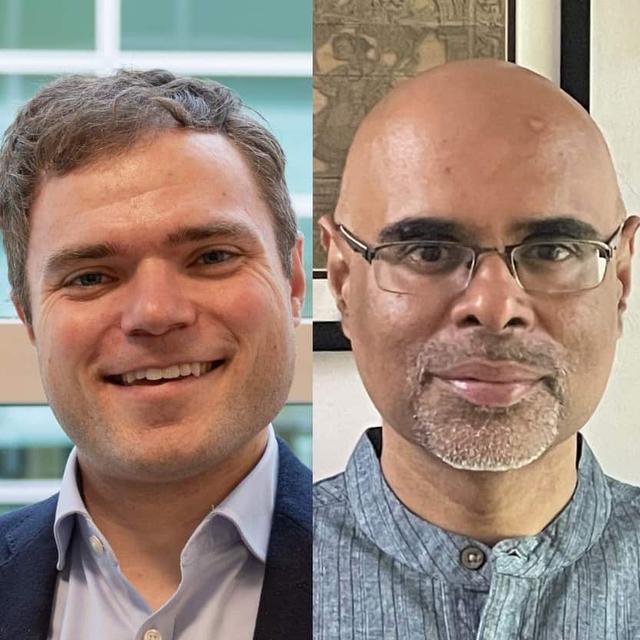



Hello, and welcome to the Physics World Weekly podcast. I'm Hamish Johnston. Coming up in this episode, we meet Daniel Sarno, who is a cofounder and chief technology officer of Sona. Based at The UK's National Physical Laboratory, Sona is developing a new method for determining breast tissue density using ultrasound rather than conventional x-ray based mammography. Sarno explains how this can help improve the early detection of breast cancer.
But first, I'm in conversation with Bhaskaran Muraleed Haran, who is at the Indian Institute of Technology, Bombay. An engineer by training, he has a keen interest in using computational physics to develop new materials and devices for quantum science and technology. I began the interview by asking about how computational science is being used to create new quantum materials. So in order to so the next generation of quantum technologies will feature
what is called quantum hardware. And the quantum hardware is obviously devices. And just like you have the complementary MOS or the CMOS being the building block of the digital technology, you will have building blocks based on quantum devices for the next generation or the upcoming quantum technologies. For example, the, superconducting qubit, that's a device.
So just like in the CMOS era, the the industry relied on device modeling as an important aspect of, you know, giving feedback to experiments. So there's whole there's this whole thing about a feedback between theory and experiment and and as to achieve a synergy between theory and experiment. So that first experiment is understood via theory and then the theory can probably predict something
new. And the experiment can go toward that step and back and forth and, you know, that's how things develop. Another thing is theory is also useful in giving inputs about possibly new materials that can achieve the same functionality. One great example is just before we are in what is called the Beyond Moore era, where devices are shrinking toward the limits and people are looking at alternate technologies. One of the technologies just before all this quantum, revolution started was Spintronics.
Spintronics is the technology or the or what's called the paradigm which tries to use spins or the electron spins as a medium of information. Just like you have the charge, which is basically the charge of the electron, you also each electron comes with a spin. And in high school, you would have studied up spin and down spin. That can be units of information. So one of the things computation did is that they predicted a new material called magnesium oxide,
which can produce a better spintronic device. And lo and behold, that tech the magnesium oxide based, Spintronic devices are getting close to, you know, being in the market or something like that. This is an example where theory can predict a new functionality and eventually lead to new developments. The same goes with probably several nice ideas can come from theory. And computational is the computational
modeling is the next step. Theory is more like at the level where you can come up with neat ideas from physics. Then comes the actual computational modeling where you try to simulate possibly the actual device situation. And that is more hands on towards talking to experimentalists or talking towards technology, etcetera. So another example is back in the ninety's sorry, back in the early two thousand's, people were trying out carbon nanotube transistors as a
possible next generation. And that's when a lot of theorists were working at the level of understanding how carbon nanotubes can behave like transistors, etc. Today, there's a lot of computational theory which working on two d materials. And especially toward transistor technologies, etcetera, on molybdenum disulfide and various other materials. The same way I could say that theory and modeling helps in many ways. One is, of course, there's a lot of work on superconducting qubits.
And then from the superconducting qubits, you need to achieve communications between these qubits. So there's a lot of theory and modeling at that level where you can understand and go towards the various layers that are involved in the quantum technology. You have the building block that is a qubit. Just like the transistor was a building block. Then you have, you put them into circuits and then you make them into a processor.
The same way we are hoping that quantum technology will reach a processor level. And at that level, you have a lot of scope for computational engineers to sort of help and improve the designs and things like that. So can you talk a bit about some of the materials that you're investigating at the moment? What are the hot materials at the moment for, quantum Yeah. Technologies? Yep. So when we talk about quantum technologies, the first building block is a qubit or the quantum bit.
And to realize quantum bit already or the qubit, there are already many platforms. I would just trace back to 1926 for a second. At that point of time, they predicted that a device called the MOSFET or what's called metal oxide semiconductor field effect is possible. But no one took that for serious, no one took that to serious notice. And the bipolar junction transistor was invented in somewhere around 1949. And the inventors were back then asked, what is the application?
Bardeen, Bertain and Shockley. John Bardeen just came up and said, probably it's a good amplifier. It can be used as a hearing aid. Now you can believe it. The transistor changed the world. And I think in nineteen fifties, someone took up the field effect transistor and then rest is history. Whatever the patent was filed in 1924, in nineteen fifties it came up. So here's the deal. Lots of competing technologies or paradigms exist much before the real one takes on and becomes
the true, you know, life changing technology. So at this stage, at the nascent stage, we have several candidates for the qubits. One is a superconducting qubit which is reasonably mature. We are looking into superconducting hybrid systems for that purpose to understand the inner workings of the superconducting qubit device.
And at more exploratory levels or not not so much nascent, but somewhere in between we have the silicon qubits and donor qubits and various types of materials that are surrounding the silicon. The ambition is to integrate silicon into cubits. And so silicon cubits are also quite actively investigated and we are also doing a lot of work on understanding the devices that make these qubits. The third one is for other quantum technologies.
Those are technologies that are not just necessarily qubits but maybe for single photon detection or surrounding various other applications that come under the quantum umbrella. You have a lot of materials like tungsten telluride. So a lot of two d materials are under a lot of investigation for various applications surrounding this whole quantum technology, which we are
also actively looking at. For instance, tungsten telluride is a material that is known to be something called a topological insulator. Now a topological insulator is an interesting material that sort of conducts what is called very pristine edge states that are not or that are that do not have what you call traditional words dissipation. Now dissipation is like think about cars in a traffic and a lot of people around. Your car cannot go smoothly.
But these are materials that can go in such an environment, but on the edges, they conduct so well that it's almost like edges of freeways where you go without scattering with anyone. But the bulk of the material is like a crowded road. So this kind of a new material gives you very interesting properties which can be used for various quantum applications. It can also be used for classical applications. So these are the classes of materials we look at. And the word is a nice
word for these. It's called quantum materials. Now you might ask every material could be quantum. The answer is it's not like that. Quantum materials are special because you can see their if I can we finally use the word, quantumness at longer length scales. For instance, when you measure the resistance of a topological material, it will show you something that's quantized at there's a standard number for that. But yeah. So it will show you a quantized resistance
and things like that. So these are materials that can be used for various surrounding quantum technologies That include, photon detection and materials. They could be also what's called peripheral technologies, the qubit technologies and various things like that. So we are at an exciting phase and world is changing rapidly. There are lots of materials to investigate. And every day there's a new breakthrough and we hope to sort of ride the wave
with our research. Right. And and and what about at the at the device level? What what what sort of devices are you are you interested in studying from a computational point of view at the moment? Yes. Thank you. So the devices I work on are specifically related to two things. One is the qubits stem cells. How how to make better qubits with the existing devices. So in that sense, we look at what is called quantum dot devices.
These devices can host what is called, for instance, silicon qubits or spin qubits. These are one type of qubit. As I said, there are many competing qubit technologies. The other devices we look at are superconducting hybrid systems as I said. One of which is a reasonably mature technology, it's called the transmon qubit, which is based on superconductors. There are other qubits that are also being currently investigated.
And there are many advantages slash disadvantages at at the level of each platform. So one of the things that would come up next is a hybrid quantum system that could actually leverage the advantages of various types of, systems, bring them together for a quantum processing. So in that sense, we are looking at two d materials for qubits. We are looking at spin qubits at silicon
level. We are also looking at superconducting hybrid systems at a broad level for various other competing qubit paradigms. Yeah. I see. And one of the, sort of early applications, I suppose, of quantum computers is doing simulations of materials because, of course, materials are quantum in nature. And it it in some cases, it's easier to do the simulation on a quantum computer, if you had one, than it would be
on a classical computer. Is that something that you're you're actively looking at at the moment, actually using nascent quantum computers to do some of your computational work? Or is that is that something from for the future, with regards to your research? Yes. So thank you for this question. So there are many, let's say there are many aspects to your question. The first part was more to do with simulating materials. Right? So that is often called quantum simulations. That's a word for it.
So you can simulate a hypothetical material. For instance, there is there was there were some materials that people predicted in theory that really don't come as a material. For instance, there's something called the Kita f chain, which is supposed to have what's called a p wave superconductivity. Doesn't exist in nature. Right? There's another chain called some of these materials they are they have something called SSI chain. Many of these materials don't exist in
nature. But you can simulate them using quantum, for instance, quantum computer. Not just a quantum computer but you can simulate them by aligning materials in a row trying to achieve that Hamiltonian. That is called a quantum simulation. However, if you're asking about how we use the quantum computer to do some of our device simulations, the answer is no yet. We do not we do not yet simulate these things. And there are quantum computers I
know. And probably you can fire simulations using Qiskit and other softwares. But those are more about trying out certain quantum algorithms. And some people can, you know, run a search algorithm or one of these famous six algorithms are there, four or five algorithms. You could try out those algorithms on quantum computers. That's what at the back end. So that's probably what I think is there out is out there.
I'm not sure if we have done anything on those fronts because we directly simulate the physics of the devices. So for instance, the main let's say I would call the protagonist of all these stories is the electrons for us. Electrons are the subatomic particles that carry electric current. Right? The reason you have electricity is electrons. The reason you have a computer eventually is electrons.
And, so the quantum devices some of the quantum devices that could form quantum computers or what's called solid state quantum computers would depend on electrons. So we simulate and understand electron motion or electron transport across these devices. And that's precisely what we use mathematical models to simulate. And that at that level, we probably don't need a quantum computer to understand or speed up our algorithms. We'd rather use standard GPU type, you know, speed
ups, which are good enough. Yeah. I see. Okay. And and this year, 2025, is the international year of quantum. And what we're doing here at Physics World is we're asking as many physicists as we can, one question. And that question is, what does quantum physics mean to you? Well, I have been studying quantum in devices since 02/2003. So much before the quantum, technology impeded started. So in that sense, I am an electrical engineer to begin with.
And when I started my PhD, the the corridors of my depart of the region I was working on was always resonating with Hamiltonian, Quantum. And I got used to that. So Quantum means everything to me. And I believe, the quantum revolution, if it happens, can be disruptive. And I'm really hoping that quantum technologies take up. I'm not sure if only computing is the thing. Computing will definitely speed up certain algorithms, no doubt.
But I think surrounding quantum computing is a bunch of quantum enhanced technologies, sensing, as well as, communications and various other aspects of surrounding quantum. I'm sure if all this come together, we should have a great by twenty forties and early twenty fifties, next century. Sorry. The the second half of the century can be, I mean, can be a very disruptive, technology for humankind. So quantum is means everything to me at least. Yeah. Well, that's great. Thanks. Thanks so much for
coming on the podcast. Thank you. It was my pleasure. Thank you. That was Bhaskaran Muralidharan of the Indian Institute of Technology, Bombay. He's on the editorial board of the journal Materials for Quantum Technology. It's published by IOP Publishing, which also brings you Physics World. Now moving on to medical physics. The second segment of this podcast episode features an interview with the medical ultrasound expert, Daniel Sarno, who is based at The UK's National Physical Laboratory.
Here he is in conversation with Physics World's Tammy Freeman. They look at the role that ultrasound can play in diagnosing breast cancer. Mammography is an effective tool for detecting breast cancer, and it's widely used in screening programs. But mammography exposes patients to X-ray radiation, and it doesn't work well in dense tissue, which can hide the presence of a tumor.
Researchers at The UK's National Physical Laboratory have developed an ultrasound based system that can provide safe, low cost breast density assessment, and NPL is now looking to spin out a company, Sona, to bring this technology to market. I'm speaking today with Daniel Sarno, Sona's cofounder and chief technology officer. Welcome to the podcast, Daniel. Hi. Thanks for having me. So can we start by looking at what are the limitations of current mammography based cancer screening?
Screening in general as a, as a tool used by health care systems aims at detecting early signs of cancer in mostly asymptomatic populations. So breast cancer screening, for instance, in The UK, at least is offered for women aged 50 onwards every three years. And the the reason why we do this is that the breast cancer is the most common cause of cancer, in women worldwide. There's over three point three million new cases each year.
And in The UK, there are about fifty seven thousand new cases with increasing rates mainly in younger women. Now the reason why we do screening is that we want to detect breast cancer earlier. If we detect breast cancer earlier, particularly at stage one, so when cancers are localized, survival rates are near a hundred percent is incredibly survivable cancer.
Issue is when cancers are dissected much later in stages four in predominantly stage four where cancers have metastasized and gone to multiple sites, where survival rates then dropped sadly to as low as twenty two percent, in some countries. So screening aims to find cancer earlier when it's more treatable. Treatable. And like I said, for most women, it's offered at either 40 or 50 depending on what country you live in. With the main tool that's used is, mammography.
So mammography is a X-ray based imaging system. Most notably, requires compression of the brass, which is sort of what most people think of when they think of mammography. The issue actually is that different breasts have different compositions. Some women have higher amount of fibro glandular tissue in the breast. Some women have more fatty breast tissue. But mammography performance really depends on breast composition.
Women with the highest density of breast, that's to say, women with mostly fibro glandular tissue, the performance of mammography diminishes drastically. For women with batty breast tissue, mammography the sensitivity of mammography, which is sort of the the metric by which you can assess the performance of this tool, is as high as ninety percent. So most of the cancers that are present in women with the lowest density breast tissue are picked up by mammography.
For women with, highest breast density categories, the performance of mammography drops to as low as 50% sensitivity. That's to say, if a cancer is present, almost half of the time, it will be missed. But the onset con consequence of that being that cancer is picked up later or in a kind of a subsequent screening opportunity. Now this limitation of mammography has been known for a long time, but it mammography still remains the best tool
we have. It's the gold standard tool for breast cancer screening. But there are other tools out there, other modalities for breast cancer screening. Some of them being ultrasound based. There is MRI, which is, obviously, a very costly but effective tool. There's other there's different types of mammography, such as, tomosynthesis, a a a version of mammography that's sort of this pseudo three d imaging,
and contrast enhanced mammography. So there's a plethora of tools beyond mammography that can be, used as screening for women with different breast densities. Okay. So, Sona is developing the ultrasound based approach. So what what are the advantage advantages of ultrasound scans over X-ray imaging? Yeah. So what we're doing at Sona is we're actually providing a tool or developing a tool that can do breast density assessment. So this
is not breast cancer screening. So we're we're not trying to do the job of mammography in trying to detect cancers at the earliest, stages. Instead, we're trying to measure global, metrics of breast composition such that women can be provided with the right forms of breast cancer screening at the right time for them based off their breast composition.
And some of the advantages of, of ultrasound over X-ray imaging is that, of course, the kind of natural one that I think most people would think of is the X-ray imaging is a ionizing based imaging tool. This limits its use both in kind of setting that these, mammogram scans can be provided, but also the frequency with which mammogram imaging can be provided. But ultrasound, in contrast, is a safe tool. It's non ionizing. It's, accessible and portable.
It's actually it's the second most commonly used imaging modality worldwide. So it's very pervasive for that reason. Okay. And can you explain how your system actually uses the ultrasound to measure tissue density? Tissue density, breast density in particular, to repeat, is important for to understand for two reasons. Firstly, breast high breast density actually increases cancer risk. Seventy percent of all cancers are detected in women with dense breasts. Now how pervasive is is breast density?
Well, about half of all women over the age of 40 have dense breasts. It it varies from individual to individual and varies with age, but about half of all women have high breast density. It increases cancer risk, so women with the highest category of breast density can be up to six times more likely to develop breast cancer than women with the lowest category of breast density.
But just to repeat, the the other impacts of high breast density is this this effect that it has in reducing the performance of mammography. So high breast density can mask answers on screening mammograms and reduces performance. Breastness is currently assessed at screen at the screening opportunity using mammogram images. So a mammogram image will be, taken of an individual going through screening. That mammogram image can be used to find any cancers present in the breast tissue.
But, also, the image can be looked at globally by either a clinician or software interpretation to see by either visually by eye or or by using algorithms the ratio of fat to fibroblegial tissue and give a metric for breast density. That's it has proven incredibly useful.
In fact, the US FDA recently changed their reporting guidelines for women across The US to mandate breast density assessment, across all states, such that, you know, it it's it's considered such a an important factor to measure that The US actually have mandated this reporting. So the issue with mammogram based breast density assessment is that it actually is not particularly consistent. Studies have found that breast density assessment done by clinicians
varies depending on which clinician you have. It varies from screening opportunity to screening opportunity. And also breast density assessment with mammography is not accessible. So at the moment, you only find out if you have high breast density at your first screening opportunity. Now coming from the National Physical Laboratory, we see that this is a a measurement challenge.
And being an ultrasound scientist and believing that ultrasound is a particularly useful technology to use, we believe that we can do breast density assessment using ultrasound measurement. Now how it works is we do something known as, global acoustic attenuation measurements of the breast. That's to say, how much does the breast tissue diminish their ultrasound signals as they pass through the breast?
With women with higher breast density having higher acoustic attenuation, properties of the breast tissue compared to women with lower breast density. So our system was developed at the National Physical Laboratory over a number of years. We've developed a new form of ultrasound sensor to measure this property in a quantitative way. And what that actually unlocks is the ability to, a, measure breast density, in a repeatable, consistent way.
But, b, you're actually able to now monitor breast density over time with, so rather than just a a single measurement of breast density, you're now able to do repeat measurements, which have been found to also relate to breast cancer risk. Women who whose breast density does not drop as fast as you might expect in, across the population have actually a higher rate of breast cancer than women who've not.
Okay. So, you could use your system to sort of track the differences in density over time, possibly starting at a younger age for the screening, and then you can interpret those results. And then, if it looks like someone's more at risk, would they then be sent on for mammography screening afterwards? Exactly. Yeah. So we we believe that what's needed for breast cancer screening is early breast cancer risk assessment.
At the moment, we can do breast cancer risk assessment using factors such as history or even genetics. But breast density, because at the moment, it's done with mammogram based, imaging, cannot be done at an earlier age. So with our technology, you could bring breast density assessment before screening such that you can then plan an onward personalized screening program that's fit for the individual rather than just using age based, screening profiles. So, I mean, where would you see these
systems being deployed? Would this be something perhaps that you're just local doctors that it would be just sort of part of a a routine test that women would undergo? Like, whilst they're too young to actually go into the screening program, They they could have this, measurement taken beforehand. Yeah. So the the technology that we're developing is is incredibly accessible. Like I said, it uses ultrasound, so it doesn't require a dedicated facility.
It's aimed to be a desktop sized device, so small. And that opens up the possibility of screening. Of sorry. Breast density assessment being much more accessible than it currently is. So we aim to have these devices in primary care clinics, in, breast cancer screening programs, in remote or low resource areas, and also a part of work workplace and community health initiatives. Okay. So, has the system been tested in patients yet?
It has. The the the the system and technology actually has quite a, long lineage. Originally, as I described, we've developed new sensor technology, a number of years ago, and we've gone We've evolved from early proof of concept sensors through to research platforms and, initially, measurement validation in in acoustic materials and breast phantoms. A couple years ago, we actually did our first in person testing to validate these measurements, in a few people.
At the moment, we're being supported by the government office for technology transfer and also by the UK Innovation and Science Seed Fund. And we're developing a proof of concept prototype that will initially conduct preclinical testing and later further in person testing.
And the aim of this system really is to go from what we've had before, which is a series of research platforms, something that's much closer to a clinical ready device in a, in a configuration where we could do accessible breast density assessment using through transmission ultrasound. Okay. And so this this company, Sonar, is being set up basically to bring this technology to the market. I mean, can you just sort of quickly update on how that's progressing?
How long do you think it might take until the these systems are actually ready for clinical use? Yeah. So we're we're we're we're making some great progress. We understand that it's very challenging to bring medical technology to the market, but we are up for the challenge. This sort of technology, we think, will be able to be deployed in '27 2027 or 2028.
That's what we're we're aiming for, with this year going through a series of preclinical testing and next year into clinical trials and clinical studies where we will compare our ultrasound based method for breast density assessment with, traditional mammogram based methods for breast density assessment. Now, yep, we know there's a lot of work, today to get this to the market,
but, but we're not alone. So we've actually, this year, brought on a great team of experienced entrepreneurs and world leaders in ultrasound innovation and product development, and importantly, breast radiologists as well. Excellent. Right. Well, thanks very much. It sounds like a really promising technology. And thank you for speaking with us today. That was Daniel Sarno of NPL and Sona in conversation with Physics World's Tammy Freeman.
I'm afraid that's all the time we have for this week's podcast. Thanks to Bhaskaran, Muralidharan, Daniel Sarno, and Tammy Freeman for joining me today. And a special thanks to our producer, Fred Isles. We'll be back again next week. See you then.