



¶ Intro / Opening
Welcome to mid Rats with sal from Commander Salamander, an Eagle one from Eagle Speak at Seer Shore. You're home for a discussion of national security issues and all things maritime. And good day everybody. Glad to have you on board. And if you are with us live, i'd like to go ahead and extend the altar call to you. If you feel so inclined, you can head over to the
chat room. That is the great place to be. If you have some observations you want to share during the course of the show, or if you have some questions you would like for us to address our guests, you can go ahead and put it in there. We'll be monitored during the course of the show. We'll be glad
to bring your good ideas into the conversation. And as always, if you've got to leave halfway through the show and you want to catch up on what you missed, or if you don't already, go ahead and go over to iTunes, spreakers, Spotify, wherever you get your podcast to find mid Rats and subscribe. That way, the recording will be ready for you at a time that perhaps works better for you. And today let's just go ahead and dive right in to the show.
It wasn't too long ago that USA decided back in the first Obama administration, that we were going to leave Iraq. But the history had different plans for us, and we shortly found out when the Islamic State and Syria and Iraq made their parents and just seared the international community with a brutality that not unprecedented in the modern era, but at least its public visibility was. And we returned to Iraq and partnered with the Iraqi military and others.
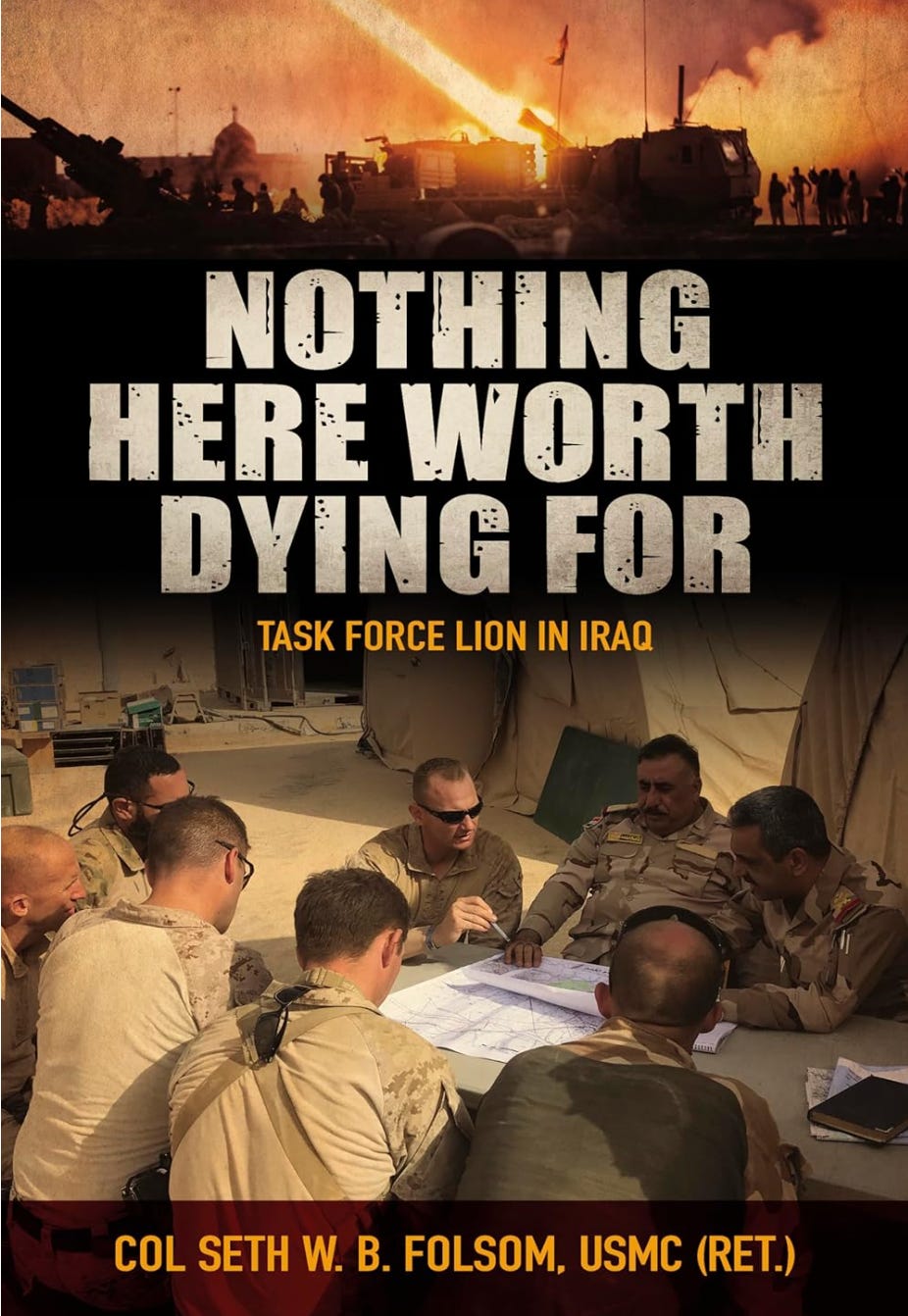
We began the pushback and a struggle against ISIS that is still going on to this day. And there is an undertold part of that story that we've brought on returning guests today to talk about, and that is going to be seth fulsome Colonel United States Marine Corps retired in his latest book, Nothing Here Worth Dying For, Seth Welcome back to Midrats.
Thanks sal guys. I appreciate you having me back. It's great to be here as always.
And it's just a great opportunity to get your book and it's coming out this month and everybody you can find links to it over on the show page and hopefully we'll give a flavor for this story. This is not you Seth. For those that may not be familiar with his work, we have links to that on the show page as well. He tells a very unique story about what we now call the Long War, the Global
¶ The Rise of ISIS and Initial Responses
War on Terrorism, and the pre show we were talking that a lot of what he and his marines and sailors and others he served with have experienced, you can trace a very bright line back to ninety ninety one and this very long ongoing conflict. And for this particular vignette of he and his compatriots experience, you know, Seth for the listener, give him an outline of the time and the place that your book takes place in.
Yeah, thanks sal So. Yeah, the story it really begins back in twenty fourteen, and that you know, the I think from a foreign policy perspective, back then, President Obama's focus was getting out of Afghanistan. You know, we had already essentially shuttered operations in I Rock in twenty eleven and twenty twelve, and we were really focused from my piece of the world, on the Joint Staff, we were
focused on the post twenty four plan for Afghanistan. And so that same year in twenty fourteen was when the Islamic State just really cut through the center of a Rock like a hot knife through butter. And there was an immediate request for support from the Iraqi government because of the speed at which the ISIS forces were advancing, particularly in the north up around Mosul and in western Lam, coming in from the border station at Al Kaim, pushing
all the way to Paditha and elsewhere. And so in this initial push from the DoD to try to support the government of a Rock and the embassy in Baghdad, there was an initial request for forces for a couple of division level advisor teams in addition to the other capabilities that they were ordering up for this effort. And those two advisor teams, the Marine Corps put their hand
in the air and said we'll take those. One was going to be a positioned at the Altacatum Air Base and the other is going to be positioned at Alasade Air Base in western al Ambar. And those two advised and assist teams were they were basically modeled on the old division level transition teams that we had in a Rock when I was there in an eighth Each one of those teams was about twenty six people, and each person on that team was essentially an army of one.
You know, you had one operations advisor, one fire support advisor, one administration advisor, et cetera. And so very quickly into the deployment of these two task forces, task Forced Alacade and Task Force ALT the Cottum, the commanders of those
¶ Building Task Force Lion
two advisor and assist task forces realized that just being just you know, blanket like vanilla advisors what wasn't going to cut it, because the Rackies needed immediate and in most cases enduring access to a whole series of enabling capabilities to be able to get out after the problem with ISIS. They needed real time intelligence all all the different types of IT, GEO, IT, sege EMMIT, human, et cetera.
They needed a significant amount of support in the in the fires range, indirect fire aviation, delivered ordits, et cetera. They also they needed enabling capabilities with with their logistics, planning, and execution. They needed a lot more. Otherwise they were
going to fail. They were going to fail, you know, on top of the failure that they had already had to stop the ISIS invasion, the Marine Corps and the c j T F O I R, the Combined Joint Task Force Operation Inherent Resolved, began bolstering up these two advisor task forces into Advise, Assist and Enable task forces. So they beaked up these these core teams into task force headquarters and then began bolting on all the different
capabilities needed for the Defeat ISIS campaign. So that's where where we were in about twenty seventeen when I came into the picture with First Task Force al Sade that was later in the operation renamed Task Force A Lion.
You are not the first team in country and kind of talk about the teams that preceded you and then how you assembled your own team to go over there.
Yeah, so we were was with the fifth rotation. We call ourselves Rodeo five, and the first couple of rotations were really really ad hoc efforts. They were so again the two task force headquarters sourced out of the Marine Corps, and they were largely sourced out of in fact entirely sourced out of individual augments pulled from across the force. So eventually the Marine Corps settled into one task force headquarters would come from First Marine Expeditionary Force here in Campounton, California.
The other would come from meth In Camp And it would be a process that anybody who's been involved in the joint world understands the process of building a joint manning document and then sourcing it from across the force, and it's a huge pain in the ass. And in
¶ Challenges of Individual Augments
the case of these two task forces, the people that were needed for these positions were not buy and large were not from the gem Pop force. It was the demanning document was filled out with a lot of critical, high demand, low density moss or specialties that the Marines had in things like the intelligence community, the fires community,
the aviation community. And on top of all of it, each one of these task force rotations required a colonel at six as the task force leader or the commander, and so like I said, the first couple of iterations of my task force, in at least one of those situations, the commander was actually pulled out of command to go
lead his task force rotation. By the time I was brought into this in twenty seventeen, the Marine Corps had taken a more deliberate approach in what the manning document for the task force headquarters looked like and how they were filling these positions, but they still hadn't solved the problem of all of these billets are our critical billets with the heigh demand loads. And they also hadn't really solved the problem of how are we going to continue
to source an six to lead this effort? And so really from the get go it was a manpower pain in the ass for the service and for the two meths that were sourcing it because there just were not enough people to go around.
That's part of the story early on that I'm glad that you go through and you talk about, especially in the beginning, because when you look back at what we've seen the last quarter century, I felt included. There are a lot of us who have experienced as being IA's and if those outside of the military are those that you know had never done an IA where they were they were part of a part of a command, they did their interdeployment work up, they worked hand in love
with people, they deployed, and they came back. They're still part of the unit. And that's what people have their mind. But IA's and entities like what became Task Force Lion for you, it's it's I guess one way to look at it, if you're trying to describe it to people who haven't been through it, it is somewhere between the Star Wars CANTEENA and the getting a baseball game up together in the blacklock field with people from your neighborhood
you've never met before. As somebody who was tasked to to lead this, you would think you also would be able to pick your team, But it doesn't work that way outside of Hollywood. Talk for a little bit about and you got some unique characters that you wouldn't expect
¶ Mission Overview and Arrival in Iraq
an infantry colonel would have working directly for them in certain jobs. But as as we've all experienced, you know, regardless where people come from, but the balance of the time, people rise to the occasion. So talk about your core group where they came from that you had to eventually go take into Ambar.
Yeah. Absolutely, And you know, like you said, not all ias are created equal. And and on the low end, if someone gets you know, assigned to being an individual augment, a lot of times it's just them reporting to another headquarters to fill a role, and so it's that person's responsibility to integrate into a pre existing unit in the case of Task Force A Lion, my entire the core of my headquarters, the entire team was all individual augments.
And so what I you know, the the tagline is that it was eighty five different marines and sailors from thirty five different units, spread across southern California, and and and so what what I realized really quickly was that this was this was all of these these marines and sailors coming from all these disparate commands and locations, that they were not coming into a pre existing command that
had its own culture and its own climate. And I realized that for this thing to work, ultimately, we had to create our own our own command, We had to create our own climate, our own culture, and we had to do it quickly because the team formed in February of twenty seventeen, and we were set to deploy at the end of July. So we only had a handful of months to form this team, get to know each other, and get ourselves trained to the degree that we needed
to be to text keep the mission. And so these as these billets began to fill in the first few months of twenty seventeen. Yeah, like you said, I had some interesting characters show up. You know. One of the first was my senior listed advisor, Sergeant Major Leibfried, who he came from First Anglico, an air enabled gunfire leadison company at the meth and he was he was extremely excited. You know, he knew about this mission. He wanted to
be a part of it. He knew what the opportunity it presented, not only with our core team, but also with the multinational team that we would integrate with at Ala Sade. You know, I had my deputy commander. I had. I'd always grown up with the idea of, hey, your deputy commander for a combat mission needs to be combat arms. And so I was thinking, maybe it'll be another grunt like me, or maybe it'll be you know, an aviator, and it wasn't. It was a staff joge advocate who'd
come over from the Greene Logistics Group. And I was thinking, oh my god. You know, I can't believe my deputy is going to be a lawyer, right, But the perspective that he brought, and the background that he brought, and
¶ The Complex Landscape of Iraqi Forces
even his just his his cultural understanding of other cultures, he became force multiplier. You know, other people that popped into the team like operations officer, a major named Aaron Autry, this guy which when you first met him, you would think that he never had anything to say about anything because he just didn't talk. He was a very tight lipped guy. And he had some significant experience as a company commander and a platoon commander in Afghanistan.
And a Rock.
But he was also he was a magtaft planner, and so he had both the operational, the tactical and operational outlook, but he also had a strategic outlook to everything that
he did. And I had people like Lindsey Mathwick who was my task Force logistics officer, and she had been in she'd done multiple tours in A Rock in the early years, and one of those tours she had been in the Lion, this program where they matched up female Marines with infantry units as kind of a predecessor to the old the FET program, the female Engagement Team program in Afghanistan, and so she had real on the ground experience in I ROCK. So this this team was this
really you know, diverse, multi talented team. But again, what we lack was some kind of unifying culture or some kind of unifying element to our team, and so I put an enormous amount of energy into that in the few months that we had together before we deployed, because I knew if we get over there and we don't know who each other, you know, is, and we don't know we don't know what our mission is and why we're doing this, then you know we were going to be sunk from the beginning.
Well, talk about a little bit now about the mission you were given and the situation you wandered into when you when you finally arrived in Iraq.
So you know, I remember, I remember when the task forces were formed in twenty fourteen, and I didn't pay a whole lot of attention to it. Didn't really start paying a lot of attention to it until I started getting brought into the conversation that I might go lead one of these teams. And so as soon as the word came down from on high that I was going to go lead the task force a lion, I reached
¶ The Role of PMF and Tribal Forces
out to the guy who was commanding the Rotation four, who was already in theater. He was an old friend of mine named Fred Frederickson, and we had grown up as lieutenants together. He was one of my closest friends, and so I dialed him up on a VTC one day and said, what the hell is going on? I need you to talk me through this. And what he went on to say was how quickly the campaign was progressing,
particularly in Amboor. Up until that early spring of twenty seventeen, the real focus on the Defeat Isis campaign had been in the north. It had been up around Mosul, commanded out of the base and Erbil and everybody was a laser focused on the battle form Mozuul and what was happening there and how it was going to be another campaign altogether, just to do the post conflict actions in Mozoul.
And so what Fred told me was, Hey, this things are continuing in Mosul, but c J TFOI R is now turning to al Ambar as the deep fight and they're ramping up operations here. And we are, we being Fred's team before me, we are in the process of putting the finishing products on the plan to enable the Rocky Security Forces to retake western Ambar. And what he said really stuck with me, and he said, that's going
to happen on your watch. That's what you need to prepare for your team needs to show up from day one ready to prosecute this plan that my team and the team you know Rotation three before him, had developed
in concert with the Rockies and the coalition. So when we showed up in early August of twenty seventeen, right from the get go, the Army two star General General Pat White, who was the Commander for the Combined Joint Forces of Land Component Command C. J. Flick in I rock He pulled me aside immediately and said, this is happening. It's happening soon, and your task force is going to be the main effort. You're going to be the ones that helped the Rockies get to the finish line at
the Assyrian border in al Came. And so that we had no timeline apart from be ready to do this at any time. The Iraqi government or the Prime Minister, they will all decide immediately when they're ready for this to go, and we have to be ready to go on their call. And the one of the guiding you know sayings that that they had over there was never may never have the Rockies wa wait on us, Never
make the Rockies wait on us. So we had to build multiple plans with branches and sequel and apply the time space considerations so that we were ready to go since the Iraqis work.
¶ Navigating Command Structures and Relationships
And that starts the journey, because it's interesting how you outline the fact that you have different structures and groups you have to learn to negotiate with. You not only have US Marine Corps people, personalities, procedures, admin, chain of commands back home, you also have the US Sentcom and you have coalition forces and you also have the Iraqis
as well. And you come into Ala Sade that like a lot of the infrastructure in Iraq when you were there, and wait, by the time you had returned eight years later, it's a very very different place just from an infrastructure, logistics and support routine as well.
Yeah. Absolutely. You know the Ala Sade that I remember and that a lot of people remembered, which everybody had called Camp Cupcake from the two thousand and eight nine time frame. It was a It was a massive air base in western endbar at everything.
You know.
It had movie theaters, swimming pools, fast food restaurants, salted dancing lessons, you know, you name it. And the Alisade that we landed in in twenty seventeen was nothing like that when when the Coalition pulled out of Alisade around the two thousand and nine or ten time frame, they left it all for the Iraqis as hey, here's our parting gift. You know, here are all these thousands of tea walls and filled HESCO barriers and all these these you know, Southwest Asia SWA huts that they had built.
And it was something that the Rockies, it was a it was a gift that they couldn't afford to maintain. So the majority of the base was completely run down, beaten down by time and weather. And the Iraqis on the base was an Iraqi Air Force unit and the Iraqi seventh Division, and they had pulled back into their own contonements on the northern edge of the base, and it basically left the rest of the base to rot.
And so had we had a better time when I landed there in twenty seventeen, completely because the previous rotations had been executing a simultaneous effort. On one hand, they were working with the ISF and the Coalition to get after the ISIS problem, but they were also rebuilding the infrastructure at Alocade, and along with that what made operations
with the Iraqis. So challenging was when the decision was made that the coalition members like my Task Force were going to be able to go outside the wire with the Iraqis. The lines of communication were incredibly extended throughout western land Bar and so it required a security component.
It was a long resupply line, and so we had to do a lot of coordination not just with the coalition units who would provide a lot of the logistics and sustainment component, but also coordination with the Iraqi government because all of our logistics convoys had to fall under the Prime Minister's basically its contracting program called pm not They wanted the Iraqi industry to be involved in the effort, So almost all of our logistics sustainment convoys across the
battle space were with the Rocky contractors.
Let's uh, let's talk about the force that was opposing you, because I think people may not remember how fast the ISIS went through Iraq and what what what allowed them to do that? And what was your perception of what you had to do to help the Iraqi security forces?
Uh?
Retake big Chuckler country.
Yeah, So you know when I was when I was working with the Iraqis in seventh Division as an advisor back in two thousand and eight, the enemy situation in Ala amber Bar Province was incredibly minimal at hout where I was around our com there was nothing really going on there. There was more turf wars between the Iraqi Army and the Rocky Police than anything. And so, you know, I talked about the enabling capabilities that we brought the
Iraqis in twenty seventeen. We didn't have anything like that with them at my level, or really at the brigade or division level in two thousand and eight because they didn't need it. And what I can only assume is that between you know, the two thousand and nine ten eleven time frame in twenty fourteen where Isis blew through the country, the military just they weren't.
Prepared for it.
I don't know if it was a matter of complacency or disorganization or infighting within the commands, or maybe a combination of all of them. But ultimately, the Iraqi military, which was you know, in parts, it was modeled not from their old system, some of it was modeled on our system. Through all of our advising efforts in the early days of the war, and you know they were they one way that they I think were modeled after US was they had they had a reliance on a
lot of heavy equipment. They had started getting things like in one tanks and they were rolling around the battle space in home v's and they were just a larger, slower military formation than the ISIS formations who were cutting through the country. You know, a couple months ago when we talked about how quickly the Assad regime had fallen in Syria, and I think we talked about, you know, the ability of these militias and forces like to operate.
You know, they were light, they are fast, they are flexible, UH, and they can they could fill the void a lot quicker than large military formations. And so just that I think in general, the unpreparedness on the part of the Iraqis UH perhaps caused them to take their eye off the ball and it opened up a seam for ISIS
to exploit. And then and I think also you can't discount you know, really the sheer terror factor because a lot of I think a lot of what was going on in the Rock in the early days, you know, there was a terror factor, and there was an al Qaeda factor, but Isis hit. I think Isis took it to another level. And they were so brutal and so public about what they were doing, and you know, posting videos and high definition of beheading people. I think it.
I think it really set the rock's back on their ass and they're like, what what in the world are we going to do? And I think that there may have been some degree of paralysis on their part or or if not flat out in denial that their country was being overrun.
It's it's easy, it may be convenient to just to forget how incredibly fast and how incredibly brutal in the modern age they were. And you could see how a country that even on its best best years was fractious that it would it would, it would buckle until it got reinforced, and by the time you got there as a byproduct of that, that chaos is it wasn't just our usual red blue green situation, red blue green, fusia,
white black. There was all sorts of organizations in there, some that were obstensively part of the anti anti isive effort, but we're not our friends. You had the shadow of the Iranian influence, a lot of the she organizations, but she also had tribal forces as well. Talk a little bit about about the the Iraqi forces that y'all were directly supporting, but also how these other I guess we could call them irregular forces as well, that we're part
of the anti Isis effort. Creating a little extra twist and a little challenge for your team.
Yeah, as always, it's complicated, Yeah, but I can try to break it down, you know, as nuts and bolts as I can. So what what my mandate with Task Force Allign was partner with the uniformed Iraqi security forces. And and what that specifically meant was my task force was partnered with the Jazira Operations Command what we called the jay OK and that was a that was a core level Iraqi Army headquarters that was commanded by the man who would become my partner, a guy named Major
General Costum. And within his unit he had the seventh Iraqi Army Division and several other specialty units like his commando battalions and commando brigades. But that was my mission was directly partner with the uniformed Iraqi military. A supporting effort to that was the partnership with the Iraqi tribal militia forces who were buying large these Sunni militia units in alan Bar who were anti ISIS. I don't know that I would go so far as to say that
they were pro us. We never had any issues with them, but they worked directly with and in most cases directly for General cost So they became to a large degree, they became one of his maneuver arms within the Zero Operations Command. And part of it was, you know, the desire on the part of the TMF to back into the cities that essentially belonged to them and where they were from and where Isis had driven them out of, and working with Costum would enable them to do that.
Now they were always strings attached, but that was kind of their ultimate goal. The other part for Kossum and the uniformed Army was they just didn't have enough units to work across a battle space as big as al ambor Is, and so they relied on the TMF to be mobile action arms to operate in a lot of ways that very close to the way that ISIS was operating and definitely similar to the way the PMF the Popular Mobilization Forces operated and so the PMF. That was
the third part of it. They were a series of militias who worked directly for the Prime Minister's office. Most many, or if not most, of them were directly controlled, supported, and or influenced by Iran. So one of the things that was reinforced to me very quickly when we got on the ground was that within the PMF all of these proxy units what we called Shia militia groups or SMDs, All SMGs were part of the PMF, but not all PMF units were SMDs. And we learned quickly that you
conflated the two at your peril. Because the positive thing to say about the PMF, written large, was in those early days of the ISIS blow through in a rock when the Iraqi uniformed army crumbled or vanished or just flat out retreated, the PMF held their ground, and the PMF were the ones who were responsible for really holding back the ISIS forces that were advancing on Baghdad or
Bille and Alasade. And so what that meant was, no matter what happened with the the is F, the Rocky security forces in their campaign to retake al Ambar, no matter what happened, the PMF were going to be a part of it, and no matter what happened once ISIS was defeated, the PMF were going to be an enduring part of the security fabric within a rock and that that was kind of that was a tough pill to swallow for us because we knew that a lot of these mgs, a lot of these Iranian proxies included a
lot of the same guys who were shooting app and blowing up Americans in Iraq in the early years of the war. You know, they they did not like us, and in some cases there were you know, armed standoffs between Coalition members and some of these units. It's something that happened several times. At the Alta Katam Air Base,
where our sister Task Force was located. They had members of Teb hezbolah H, which is a sa militia group, a Runnian proxy based on the Condom Air Base just you know, yards from where the Americans and the Coalition
were with Task Force out Cottum. And so there was a lot of these two groups giving each other the stink eye, and uh, you know, a lot of handwringing about what's going to happen if somebody turns their guns on us, or there's some kind of miscalculation on the ground that leads to a shootout with these guys.
One of the other challenges you've faced, as far as I could tell from the book, was an extremely convoluted chain of command. And uh, you you seem to have a lot of responsibility, but not a whole heck of a lot of authority run through. There were a number of people looking over your shoulder all the time. One of your friends was try to it was offering help, but you're suspicious of the kind of help he was offering.
And and then you had to deal with the h the Iraqi government and uh, the contentious generals fighting for position there too.
Yeah, the our chain of command and you know, more more to the point, our command relationships that were established for us. But when we got over there was if you looked at it on the PowerPoint slide, it looked like a maze.
You know.
We Task Force Alion was under tactical control takon of the of C. J. Flick, the Combined Joint Landforces Component Command in a Rock, the two star Army general who who was leading the ground effort campaign in the Rock. So we were taken to C. J. Flick. We were under operational control of Task Force fifty one to five with in Bahrain, which is a partnered Blue Green naval task force that's responsible for the area that the area
that Fifth Fleet is in charge of, so TACON. We were also under administrative control of our parent command at one meth back in Camp Pendleton, so they were responsible for all the administrative components of looking after us and our requirements of reporting back to them. And then on top of all of that, for all Marine Corps matters in the Sentcom ARIAV operation, we all reported to Marine Force ES Central Command Marcent, So that was just on
the Green side, on the Marine side. Then, like you said, adding on top of that that, we had a partnered relationship with the Zero Operations Command and so it's very difficult for us to make a move without incorporating them
into it, otherwise the partnership, you know, doesn't exist. And then there were also the uh the command relationships that we had with the various Special Operations Forces units that we worked with, and alongside there in Western Endbar there was the overall All Special Operations Joint Task Force or ROCK.
Within them was the Siege of SODIF. Within them was the Special Operations Task Force West, which was based around the Seal Team at Al Saud with US, and it was it was made very clear to us immediately that at no time would any SOFT unit report to Task Force Alliance. They would never be taken to US. At best, there would be a supporting, supported effort for the operations we did, but they they were They had a visceral reaction to any suggestion that we might attach a SOFT
element to the Task Force to work for us. So what that meant practically on the ground during the operations we did with the iraqies was we would work with SOFT to attach teams primarily to the tribal militia forces the TMF, because they had the authority to work with the TMF. My team and I did not. We worked with them indirectly, but we couldn't work with them directly the same way that SOFT did. And so it was this this patchwork to quilt of putting all these pieces
together and just trying to make it work. And it was to say it was challenging is like the understatement of the year. No.
I kind of was getting an eye twitch during that portion because of one of one of my things I have to claim full responsibility and guilt for is back in Afghanistan. I was one of those goobers that had to build that whole matrix about Op Cohn versus opcom who was Takon who is Takm? And we also had the national caveats matrix. It added to that. Yeah, and
¶ Challenges of Coalition Operations
you also had to deal with that. I think for the for the listener who perhaps they've watched Catch twenty two or the original mash movie, I think that's the exaggeration. It's really not an exaggeration. You could really make a dark comedy talking about a couple things. I just give a listener some flesh for is you have this combined situation where you have the Danes and the Norwegians and
eventually the French come out to help you. But you almost had a fanboy capture of the Danes by the US Navy seals, and you also internally, if I got it right, you pretty much kidnapped a young contractor who was the only person in Iraq that could keep your
communications gear up and running. So again, kind of like like Mark identified you, you had a lot of responsibility, but you didn't have much of authority, so you had to work around these these structures that were obsensively there to help you, but it seemed like they were putting rakes in front of you and your team and themselves.
Often. Yeah, it's the truth. And I wouldn't say kidnap. I would say held onto for a little while until we were certain the mission was going to be accomplished. But no, to your point one hundred percent, and that
is that, you know I talked about. I talked about the challenges of the command relationships and how our team was put together, but the authorities piece that you're talking about, it was a significant obstacle to getting things done in country and what that stemmed from was my position as the task force commander. The task force, again, as we talked about, was a cobbled together unit that was not
based under an existing unit flag. So for example, the C. J. Flick Headquarters in Baghdad was built around the first Armored Division headquarters, so the first Armored Division Headquarters flag was in Baghdad, and the commander carried the same command authorities in Baghdad as a CJ. Flick commander as he did back in the States as the first Armored Division commander. I didn't have a flag because I was an IA.
I also was I was initially designated as just an OIC, an officer in charge of the team, until I got to a rock and a couple of people made it clear to me, you are the commander of the task force, and I realized was in that situation a commander is not equivalent to a commanding officer because I had no command authority, no administrative command authority when I was with Task Force a Lion. And when I say none, what I mean is I didn't have I didn't have NJP authority,
I didn't have awarding authority. There were were funding authorities that I didn't have. I had really none of the command authorities that are traditionally associated with someone who is formally selected as a commanding officer. And yet I had all the responsibilities of a commander in theater. I was a battle space owner with the task Force. I was responsible for any civilian casualties that might occur in the
¶ Authority and Responsibility in Combat
course of prosecuting the air strikes and the ground strikes that we were doing. There was a whole line of things that I was responsible for there, but I had nothing on paper really to back it up. And so what it ultimately what it led to was a not small amount of of Mother may I and a lot of asking permission to do things because otherwise I had no authority to do them. And that was it was it was. It was an obstacle that I don't know that I ever really overcame when I was there.
Yeah, it's it's interesting that that I was thinking of logistics. Your your your logistics people must have been crazy. Where's the money coming too? For the contracting stuff? I mean, I know you had a really good logistics supply officer person, you know where we're I think she was she right? Where where was she getting the funds to pay for all this stuff?
¶ Logistical Feats in a War Zone
Well?
The the upside there is that that was money that was set aside in the they called it the T and E program, the Iraqi Training equip Program, and so there was a there was a pool of funds that did everything from providing M sixteen's to the new Iraqi recruits all the way to funding some of the some of the convoy and the movement operations that we did.
But the you know, the caveat was it required her and her team to work with the Prime Minister's office, you know, via the coalition, to say okay, we want to we are planning on moving this many short tons of equipment and ammunition fuel from here to here, and this is what the requirement is. So now we need you to approve it, and we need you to source
the contractors. And so the people that were doing the kind of the the lion's share no pun intended of the initial coordination work was our logistics section and the next level that work was done up in Baghdad.
And the geography of this I've being as somebody that's based out of California looking at from from Assad up to up to come, I'll come, however we pronounce it. It's a distance of about as the hi Mars rocket flies. It's about eighty nautical miles, which is about the same
distance from San Diego to Long Beach. And y'all were not stuck, and one of the challenges for your team stuck not the right word, but you didn't stay just in Ala sad Is as staff Major General Cossam and in his forces were moving up the Euphrates Valley up
towards the Syrian border. H y'all were moving with them, and that I thought was a tremendous story and a great tribute to your logistics team in themselves being able to work up like y'all did the valley so y'all could continue to support and assist the Iraqis is moved up.
Yeah, that you know that that whole process and what our team accomplished, it's something that I'm incredibly proud of and I you know, I will talk to people about that and the opportunity I get because it was it was a logistical feat to get it done.
And it was like by the end of the major operation that we did with the Rockies called the Desert Lion that occurred between September and November of twenty seventeen. By the end of that operation, our marines and sailors and soldiers and everybody else in the task force, they had moved about eleven thousand miles in sustainment convoys going back and forth between Alasade, the different outposts that we established and ultimately to the final outpost at the train
station in al Come. And you know, it's the credit. You know, the credit goes to a lot of people for execution. It was clearly by my ops and logistics teams who were able to plan it and then make it happen. But the credit also has to go to the two previous teams who were there before us, Rotation four with Fred Frederickson and Rotation three with Paul NuGen.
Those two teams were the ones who they built the guts of the plan to get the task force and more importantly, the Iraqis out to the border and that was with that was a lot of late night sessions between them, the Coalition and the Iraqis of mapping out. Hey, this is how far the high Morris window is. This is how far the Canon artillery window is. These are this is what the Golden Hour ring looks like for
METAVAC support throughout this. And so, you know, when we were doing high fives after the operation was over and you know, breaking our arms, patting ourselves on the back, we definitely had to take a pause and realized that none of this could have happened as quickly and as well as it had if we hadn't had the previous teams setting the groundwork and planning this thing for us.
You know, one of the things that I think a lot of people could relate to and I know it wasn't funny at the time, but reading it, I couldn't help but laugh because I think we all similar stories. I also think that you and everybody else from now on knows that a Paladin, she's a wide lady. She
¶ The Complexity of Joint Operations
needs a little more, she needs a little more than everybody thinks she does to move it. Just to give people idea that the resource limitations you have, you know, explain what I was just talking about, Lady Paladin a little bit of wife, but also talk about the fact that you you couldn't take all your assets with you simply from an ownership point of view of the Paladins versus your high mars.
Yeah, exactly. So, uh, you know what you're referencing was in this logistical effort. As we began to frame out and build these outposts that we were going to occupy with the Rockies, we also had to figure out how we were going to jump some of our heavy critical
enabling capabilities forward with us. One of those capabilities was we had a Army artillery unit based aboard Al Saude with us that was under our take on our tactical control, and that unit was Army Paladin howitzers and self propelled howitzers. It's a self propelled howitzer, but you can't self drive it, you know, fifty sixty seventy miles to an outpost. It
has to be put on a tractor trailer. And so as we were prepping to head north for our first operation in our first outpost, my logistics officer came to me in the office one night and said, I got some bad news. And I said, what's up? And she said, the paladins are too wide for the Rocky trucks that got contracted to us. And I was like, what you know? I said, well, how wide's a paladin? And she said it's like ten point six feet And I said, yeah, well, how how wide are the rocky trucks?
And she said not that wide?
And so you know, and it was a great learning experience because, you know, she did know and I didn't know either. I mean I had I had no I had no idea. And one of the things that that keyed for me was the importance of joint operations. That you've got to get out of your comfort zone and realize that if you're a marine, the joint world is not the Marine Corps world. We don't have paladins in the Marine Corps, but the Army does. The Army was
part of the joint force. So it was uh and and you know, in the end it all worked out and she she made it happen by accelerating the contracting process to get the right trucks we needed. But it was one of those moments where you know, our heart almost stopped and uh, we're able to to uh to make it happen. Yeah, well, I'm sorry, what was the second what was the second part of that?
¶ Cultural Differences in Military Operations
You know what?
It fell out of my brain too. You can't you can't remember. Listen your your story about the palains and reminded me of a very desert storm. When they were moving the abram abrams around. They brought all these low boy trucks from the US. So you know, Joe's trucking company in Baton Rouge shows up with this, with this that they could get the abramsons and they could move them through the country. It was it was really impressive.
It wasn't just you know, you don't realize, especially me as a Navy guy, to realize that all that stuff had to be moved, even though it was self propelled, as you just said, it's not good to move them that way. You have to pervoctently plan ahead for this stuff. So I was kind of laughing at that part of
the story too. The other the other thing that I thought was funny too, is you you were given the you had a rival group with rifles with you that but they they were stuck with We were talking about national caveats earlier, and they got stuck and I got to give him a pretty hard time about coming out outside the wire with you.
Yeah, you know, I really felt for them. Uh. The the the British commander, he was a fantastic guy. He had a bunch of great soldiers working for him, and their mission was to provide It was to be a sec for security force for Alasade, and they took their job extremely seriously. I mean, they had a base Defense Operations Center set up, they had some Marines from the Special Purpose MAGTAFF there to augment them, and they took
based security extremely seriously. Because of what had happened in Afghanistan with the airfield attack, that was just one of
the reasons why they took it seriously. They were also just a bunch of professionals and their national caveats prevented them from going outside the wire, and that was a restriction that just absolutely absolutely drove him out of his mind, especially as we were beginning to gear up and we had been given the authority to go outside the wire with the Rockies and escort them in their operation all the way to the border, and you know, with tender
Colonel Bellamy and his Brits, they were going to be left behind. And it was to the point where, I mean, I think for him it was a professional embarrassment and I would ribb him about it, you know, and say, hey, we're going all the way and you know where you're going to be. You're going to be like hanging out in the coof and drinking coffee, and until I ribbed him, until I realized that this is doing more harm than good.
And to his credit, he was so passionate about it that he elevated the issue all the way with his chain of command and it ultimately got briefed by the mod to Parliament, and I think the case that they made was the Coalition is going outside the wire and we look like jackasses not being able to do so.
And Parliament relented a little bit. They gave them a certain radius of several kilometers that they could operate outside the wire, which it didn't completely solve the problem, because the idea of security forces was one of those enablers that we needed at every outpost that we set up and manned, and we also needed it along the way
for route security. But what that restriction on the policy for the Brits did was it it enabled them to serve as the quick response unit or a quick response for UCE, the QRF for Al Sade, operating several kilometers outside the wire, so that if something went down outside the wire during these movements, they could quickly respond to it. And I know it helped them, you know, from from
an emotional perspective, to be able to contribute. But it also freed up more marines, more trigar pollers for us to take forward with us to work the security operations along the different lines of supplying communications and at the outposts. I think well.
And also an interesting side story that kind of weaves this way through a lot of this is just the in spite of all the years that we've worked with the iraqis that there's a huge cultural difference between the two where you talk about we've all worked for them, is you'll work for an American you know, general officer or flag officer who's perfectly comfortable calling an email a midnight thirty and expecting an answer by zero two hundred.
It just it just never ends with these people, Whereas even though they're in their own country, fighting their own you know, San Diego to Long Beach Battle that uh Major General Cassam and his troops, it was almost a nine to five military bankers hours war.
How was that?
A lot of your team had experience in Iraq before, but you know, bridging those two cultural differences that had to have been a challenge.
Yeah, it was a challenge. And you know the the midnight calls thing. I mean, you know one of the things that I talk about in the story is that Costum loved to call in the middle of the night. I mean, I think, I think in general, the guy was just an insomniac and he wanted a lot of reassuring. And after a couple of weeks of this, I finally told my interpreter, look, I can't I already work long hours here, I can't talk to him at midnight every night,
or we're not going to get anything done. This the call is still came, they just weren't quite as as frequent as the head been. But the nine to five aspect, I mean it was a real thing. Not not so much like right at nine, but whenever we were doing the operations from from the outposts during the final clear the Iraqis started moving every day at six. You know, they didn't they didn't start before sunrise came up. They
came when they started moving when sunrise came up. And at the end of the day, as the sun was going down, they went to ground. And so they were basically they were day fighters and no matter where they were in the fight, they would pause what they were doing. And that was you know, we we we knew that, but when we saw an action and experienced it, it was it was difficult for some of us to accept.
You know, for example, during the first major operation that we did during you know, Phase one, and we were at our firebase in Sagra when the Iraqis finally punched into the city of Honor and split the city in half, and we're literally routing the Isis fighters that were embedded in the city. When the sun went down. I mean, it was it was like at the culminating moment of the battle, and we were all in our command post and cheering, and I'm like talking to cost him on
the phone, you know, being his cheerleader. And this was the it was the beginning of the exploitation phase, and they went to ground and like, okay, we're done for the night. And my apso Aaron Autry and I looked at each other and we were like, what the hell, you know, because we knew if we had been out there, if it had been a Marine Corps or an army unit at that culminating moment, we would have begun the exploitation because that was the weakest point that the ISIS
fighters faced. But the Rockies were comfortable with saying, Okay, we're gonna pause here, get some rest, and we'll start all back up again in the morning. So yeah, it involved, you know, taking a step back and saying, I understand that this is not how we would do it, but it's not our fight. It's the Rockies fight, and we're here to backstop them and help them get to the goal line the way that they need to.
¶ Reflections on Purpose and Sacrifice
Yeah, I think it's important to keep the vision concept there, you know, the old the old when you're up to your rear end an alligator's concept. One of the things that throughout the book, I mean, I set your frustration a lot of the time with what was going on. And then towards the end, as you're beginning to get ready to withdraw and you get visits from various high ranking officials, talk about how you got the title for your book.
Yeah, it was what's the line from pulp fiction. I had what alcoholics call a moment of clarity, you know, I was in a this was it was in December of twenty seventeen, and the big operation that we had done with Desert Lion had really culminated in November, and we're we are now in kind of closing actions, but the campaign wasn't over, and there was still a lot of work we'll have to do, and things were bubbling
up with the PMF. We were having problems with them around our base at Alt Come, and like I said, we just we still had a lot of work to do. Operation Desert Line was just the beginning, and I was on a I had hopped on a helicopter with the C. J. Flick, Commander General White, and as we were talking and you know, White and I had a tremendous relationship. I mean, he had nothing but support for me, and I always really appreciated, you know, the the support that he and his staff
gave us out there. And as we were talking about the ongoing security situation, he said, you know, what you need to understand is that force protection is my number one priority out here, and just remember that there's nothing here worth dying for. And when he said that to me, the first thing that I thought was, well, then, what the hell are we doing here? Why have we left our families, Why have we put ourselves at risk? Why are we expending blood and treasure to come over here
if there's nothing here worth dying for. So that stuck with me, and you know, I went back to Ali Sade and not long after that, we got a Christmas visit from the Commandant of the Marine Corps and we were, my team and I were briefing him on what we've been doing for the previous several months, and you know, we were we were explaining, Hey, these are successes, these are we pushed the ball forward, The Iraqis are getting better, Asis is militarily defeated out here, and all the comment
Dant had to say was nothing we do out here is ever going to make any difference, and he just can't get blown up out here. And my staff and I looked at each other and there was this, you know, almost telepathic feeling amongst us of again, what the hell are we doing out here for if if it's not going to make any difference. So I struggled with that for the rest of the deployment, because again, that big operation with iraqis by the time it concluded in November
of twenty seventeen, our deployment was barely half over. And I struggled with what those senior leaders had said to me, because I've worked around general officers long enough to know
that their words mean things. And as senior leaders in the Army and the Marine Corps and the Department of Defense, you know, they're responsible for what they say, and people listen to the words of their leaders and what those words mean and what it means for you and your people, and so, like I said, I really struggled with that for the rest of the deployment, wondering, like, is what we're doing here is is it worth dying for? And ultimately, you know what I realized is I had issues with
the mission in I ROCK. I had issues with what we did in Afghanistan. You know, with the benefit of hindsight, I can look back on all the things that I did, and I'm proud of my service. I'm proud of the teams that I was with in ROCK in Afghanistan, but that doesn't negate the fact that I spent the majority of my time in uniform fighting to losing wars that
were strategically misguided almost from the outset. But you know, keeping all that in mind, as frustrated as I was with the direction of the campaigns went and some decisions that were made at the highest level, what I always came back to was the thing that I was the most proud of was the work that I did with the teams that were assigned to me. You know, the organizations that we built together, the things that we accomplished, the sacrifices that they and their brothers and sisters had made,
you know, since the beginning of the Long War. And you know, I realized something that I've revisited over the years is you know, it's not the it's not the flag waving that's important. It's not Ay we're all for core and country. It's it's about the person that's to your left and right and the things that they're willing to sacrifice to protect their comrades. And that's why that there are some things that are work dying for.
Yes, Seth, that was a very powerful ending to the book, because it's not only I think, part of the story of you and your team and the people that you served with, but I think it's a deeper question you've touched on about what an entire generation of us were involved in and people are still involved in. I think that's a question that more people are going to have to bring out out take into the light, and we need to talk about it some more. And again, everybody,
I can't recommend enough Seth's book. You can go over to Amazon and pre order it. It'll be out here any moment this month. Nothing here worth dying for. And Seth, if people wanted to trat see what you're up to, and I know this was a lot of work to get here, but I don't know if you're you're working on something else that you're looking at down the road. But where can people keep an eye on you and what can they look forward to.
Thanks for that. You know, I used to have a website until Russian porn bots took it over, so I don't have a website anymore, but I do I have a I think I have a pretty significant presence on Twitter and on Blue Sky, sometimes on Instagram, but on Twitter and Blue Sky I'm at s WB folsome and uh, you know, that's that's a place where I like to make my color commentary. I try not to be over the top, but I also like to try to call things as they are. But that's that's where everybody can
find me. Is at s w B fulsome, primarily on Twitter, X and blue Scott.
Well, let me say too, it's a it's a really good book. We've brought it back a lot of the frustrations many of us who are of the Vietnam generation of service have about the frustration with and asking that question why did we do the things the way we did, which was good? And I'm glad to see that you've you've, you know, had kind of dealt with that. I should the way the rest have had too too. So anyway, I recommend the book to anybody who would like to
read it. It's from the Naval Institute Press and you can get on Amazon. I think eighteen February, is that right?
That is correct, eighteen February. It hits the shelf.
Perfect. Thanks again, Seth really enjoyed the conversation. Look forward to next time, and thank you everybody for joining us for another edition of mid Rat And until next time, hope you have a great navy and marine corde.
Cheers trus guys.
Molly replied, worry Paddy, all mi my lonely one to marry me, and all to leave a friend of becardily for you being to blame my lovely do love me, said Faulding, your tame.
It's a long way to dippen It's a long way. It's a long way to dippen Ary to the Queen.
God b becdi farewell lestwell.
It's a long long I took in the re but my wand my bad