



There are definitely times that people you know, will be like, oh, she's from Hollywood, She's from Hollywood, And I was like, I didn't live in Hollywood, but that's what they thought. And yeah, there were definitely moments I felt discriminated against.
Good Evening and welcome back to Midnight Chats after quite some time off, we're back. I'm Stuart Stubbs and I'm here with Greg Cochran. Heist you. It's good to be back. It's been a minute. This is it, isn't it? We're back for quite a while here. We've got like a lot, a lot of episodes coming up every Tuesday night at midnight. So if you're already a subscriber, you're locked in. If you're not, then please I don't think they call it subscribing,
and it's called follow. That's how long we've been away. They've changed, They've changed the way they talk about podcasts.
They have changed the way they talk about podcasts. But yeah, we're going to be here every week bringing you some of the biggest and best guests that we've ever had on Midnight Chats. So it's so exciting to be to be back. And we've yeah, we've been recording some conversations to bring all of you listeners for the weeks and the months to come. And we're starting with a banger Stu, a conversation that you had.
Yes. Tonight's guest is wise Blood and this is one of the first, one of the earliest ones I recorded for this new run. Recorded this back in November twenty twenty three. Natalie Marhring is Marring Marring Merring, Mrring. Natalie was in la where she was born and where she now lives. I was in London. This is a remote record. Some of these are going to be remote, some are going to be face to face. This is a remote one. I mean, she's got such a good voice for this.
This is like the perfect podcast voice. One of the reasons why we wanted to start this new run with wise Blood. As I say, Natalie grew up in She was born in LA and then she moved to Pennsylvania. Then she bounced around to Portland and people might not know this, but she got very heavily involved in noise music and experimental dr music. Sounds kind of strange now, right when you think of what wise Blood record sounds like. It sounds like sort of the Carpenter's soundtracking The Apocalypse.
But back then she was making all sorts of strange music, So we talk about We talked to talk about lots of things because her most recent albums have already been out a year, so she wasn't in like four let's sell this new record that Records called and in the Darkness Hearts Aglow. We talk a little bit about that, but we actually just talk more broadly about her life in music.
And going and growing up in the same town as Pink, growing up.
In the same town as Pink, Meeting lou Reid at a rally in New York, and Lou reads one of those people that tends to his name, pops up quite a lot on midnight chats. I find always has done all these, you know, one hundred and twenty episodes before this one. He pops up every now and then. People like to talk about lou Reid, and actually this is one of the very rare times he's mentioned where he was nice to somebody. Yeah, it was notoriously grumpy, bit
of a grouch. So we hope you enjoyed this first episode back with Wise Blood. Give it a review. Another couple of new things that we've got. As well as this new run, we've got some new social channels which we've not had before. We're on Instagram and we're on TikTok Midnight Chats Pod. Give us a follow on there. We're going to be posting some clips and video clips from the interviews and other bits and pieces us laughing about looking very handsome. So please find us over there.
That's brand new, but for now here is Wiseblud on tonight's episode of Midnight Chats. The first time I saw you was here in London. It was in twenty fifteen, and you put you were one hundred percent solo at that point. I'm pretty sure it was just you and a guitar and acoustic guitar, and you played at a place called the lock Tavern, which is a small pub Camden Is upstairs.
I remember that really clearly.
I'm guessing this would have been when you were touring The Innocence, right if it was twenty fifteen, Yeah, Would that have been your first sort of trip to the UK? No?
Actually so, I toured in a band called Jackie O Motherfucker in two thousand and seven, which was like a weird, kind of kind of free experimental noise band from Portland, Oregon, and I would do like solo wise blood shows on certain shows, and then I kind of broke off of that tour and did like a weird solo tour. But yeah, that was, you know, so deep in the history of
my musical trajectory. I was like nineteen and playing very loud, crazy noise music and then with Jackie Oh, it was kind of this very folky, improv kind of grungy situation. It was. It was a cool time in music where you could be a band like that and book a tour and there was just such a community of people
interested in experimental music. There's so much support that. Yeah, I was, you know, taking trains and staying with with promoters and friends, and it's very different than the kind of tours I did later.
Do you miss that that that way of doing it at all?
I mean, not like exactly, but I do really miss the community. There is something really nice about coming to a show and knowing people are going to come.
We've put on shows before for our magazine and I have hated it, and I've hated that. Yeah, that feeling of is anyone going to show up tonight?
I mean I will say that I actually enjoy. I did enjoy when nobody would come, like I mean, I think it's more just like it makes financially more sense to tour knowing people are going to come, but but like, spiritually, there's something so special about the shows that people were very sparsely attended at, Like the shows that I saw a kid of bands, you know, coming through Philly that like, I think I saw that band Hella play to like nine people, and the drummer Zach I wish I could
remember his last name. He's the drummer of Death Grips.
Oh yeah, yeah, yeah, he's amazing.
Yeah, And watching him play to nine people in like the you know, a church basement as a teenager just completely blew my mind. And I think if it was full of people would have been cool too, But there was something so unique about having such an intimate experience, and I was always into that. I always loved small shows, and yeah, playing for five people, I mean, maybe the worst thing is playing for no people, but luckily, luckily there was at least one person always.
You know, I know Jackie O motherfucker and the music, and I can completely hear their influence on what you're doing now when you're saying like you'd play in that band, but then you do your solo shows as well. Was that under the name wise Blood Stale?
Yeah, but it was spilled b l uhd?
Right? Was it really aggressive noise?
I think there were hints of, you know, the Wise Blood of the Future even in that, because there were songs, they were just very much like loud and kind of droning and blasting with the electric guitar. I had this instrument that I built that was basically like a six foot long slide guitar, and I would play the harmonics on that and run my voice through it and have tapes going and loops and you know, like it was very modal, and I was very inspired by Nico and
the Velvet Underground. So there were songs in there, but it was just kind of very loud. Those days were great, and I think I never did a wonderful job of documenting them. I was kind of too chicken to really put out records because people offered me, but it wasn't until I think three years later I put out my first album. After that.
Yeah, would that have been the one on Not Not Fun?
Yeah?
I love that LABEO was that label was still going.
I don't think so. I think they're just kind of a l SEE thing, but they I could be wrong. I haven't touched base with them in a really long time. I did make one other album before that called Strange Chalices of Seeing. That was just a CDR that I would sell at my shows.
So you're in LA. Now. You were born in LA, but you grew up in Pennsylvania, right.
Yeah, I moved around a lot as a kid. I moved to Pennsylvania when I was eleven, so I kind of spent the most of my formative years there.
And until then you were in LA. So you have memories of La as a kid, right.
Big time? Yeah. I mean I consider California my true true home. In Pennsylvania is like I always felt like an outsider on the East Coast. I always wanted to be from there, but it's such an old place that's so like, you know, stubborn and stuck in its ways.
What was it that made you want to be from the East Coast?
Well, I think yeah, because it just seemed cooler, It just seemed less And I mean now I've kind of grown to be more into the California thing. But California is so progressive that, you know, it has this weird nights to it. It's kind of lost and all the culture is like completely fabricated, kind of smoke and mirrors culture, you know, kind of coinciding with also like the hippie movement, which is very inspirational to me, like I love you know,
all that stereotypical stuff. But the East Coast has a lot of Ivy League schools and people you know, read books, So there's this the kind of cool that comes out of the East Coast. I would compare it like the Velvet Underground versus The Grateful Dead, Like both wonderful bands, but the Velvet Underground just has this this kind of like reaching back into the nineteenth century kind of art trajectory.
I guess, can you remember when you sort of realized what LA was to the rest of the world, you know, how it's looked upon the film industry, the whole thing that is LA. Because obviously, when you're when you're when you're born there, it's sort of for a certain amount of time. I imagine when this is just home, it's all I know. But can you remember when you sort
of was it. Once you moved away, you realized how people felt about LA and how they sort of look upon it, or was it whilst you was still there.
There were definitely times that people, you know, would be like, oh, she's from Hollywood, She's from Hollywood, And I was like, I didn't live in Hollywood, but that's what they thought. And yeah, there were definitely moments I felt discriminated against, just from like I think one time, like a yard patrol person, like when you had recess, there's always like adults kind of patrolling the situation. And I talked back to her something and she said something like La La
Land or something like that. But to this day, I don't know if I imagined it, like I wondered if I just created my own fantasy about it being so unique, but people were just like whatever. I mean. Culturally, it was a culture shock, like going from LA to rural Pennsylvania. It's very different. But I remember also being so inspired by like history, like being confronted with you know, history that's hundreds and hundreds of years old, versus everything being relatively kind of new.
Now considering what you do and do you have any dealings with Hollywood? Do you ever sort of dip your toe in that world.
I mean, just as much as any other musician. I guess maybe a little more because I love movies. I don't know. I mean you can, you can if you want that. You can definitely roll up in LA and you can go to parties and you can see celebs if you want. It's a bit of a spectacle. I don't necessarily like seek that out, but I'm sure it's it's something that could be intoxicating to somebody who's never experienced it.
Yeah. I find it very intoxicating. Have you been. Yeah, Yeah, I think that's you know, that's the trade. We've got the really old buildings and you've got the movie system and the stars, and it's very there.
Was I will tell one funny story. I actually have a roommate and he's way more connected with the film industry because he dated an actress for a long time, and so we were watching the Golden Globes just for fun, and then afterward he was like, well, that was pretty cool. Do you want to go see all those people? And I was just kind of like, I'm in my pajamas, I don't know, and he's just like, throw on a dress. And so I just put on a dress and we
rolled to this party and saw like everybody. It was like the Golden Globes like after party or whatever, and saw everybody, and I remember thinking, like, you know, just a second ago, I was like going to go to sleep, and here I am like standing and Leo just walked by or whatever, and it was it was definitely fascinating.
I get bad. Yeah, yeah, yeah, this is this is the allure of of La La to me.
Yeah, And I do think it's like it is important at least to mention that like the whole kind of institution of fame and celebrity is really, you know, kind of depressing. So I think, you know, living in La being from here and having you know, different qualities that I associate with it sometimes I do think that like that kind of attitude towards it makes it way less interesting. Yeah, you know, like as a community, I think that it's already really difficult because it's a huge sprawl of a
city that's everything's just so spread out. It's like these little tiny villages and so like to have a social atmosphere kind of based on people, you know, trying to be in the right place at the right moment and not really kind of being you know, present. It makes for like, yeah, pretty dramatic variation and like social engagement when I think other cities have maybe a little bit more of a genuine, you know, physical situation like New York, where you kind of have to be around everybody all
the time. Yes, I'm in La. You kind of drive around in your pod and you pick and choose, and yeah, I can get really psychedelic. And I think that I find it sad when people and artists and musicians move here and kind of just you know, want to sleep with a movie star and that's like why they're here. I think people I think La has changed, you know, I think people move here now to do music and be cool.
How do you think it's better for it? Do you think that's a good thing.
No. I think that a part of maybe what was so cool about LA in the past was that it really did have a very distinct quality to it because it was it wasn't your typical city. And then I think when a lot of people moved here, some of those qualities, you know, kind of got a little blurred with just basic gentrification. But I do think that that is the perspective any person would have, you know, like oh,
ten or fifteen years ago, it was really great. You know, it's like that is definitely you know, just kind of me revealing my age at that point.
What was Doyle's town like, because that's where that those formative years we were talking about in Pennsylvania that we were in Doylestown.
Right, Yeah, Doyle Doto.
Doto is that what it's called.
That's what we would call it. Okay, Doylestown is like a very cute small town near a lot of farms. There's actually like a burrough with like a little clock tower and an old tile factory from the nineteenth century that's all made of cement. And yeah, I mean it was. It was definitely like, you know, not much going on. There's a cool community of you know, hardcore bands.
I've read that Pink is from Doylestown.
Oh yeah, the artist Pink totally. She was just In Guarini.
Who's just In Goreini? I don't know.
He was the first American idol. He was him and Kelly Clarkson against each other.
Oh and did did Kelly win that?
Oh? Yeah, she won.
Yeah.
Pink. Pinks are quite a bit older than you, maybe ten years older than you, I think. So it's not like you. You probably wouldn't have come into like contact with her at school and stuff.
I met her once in middle of school, Oh you did. She came and visited my choir teacher. That was her choir teacher.
Was this once she had already become a star mm hmm.
Yeah, And I just remember I went up to her and I was like, do you like the Kids in the Hall? Because I was like obsessed with that TV show, The Kids in the Hall. And she's like, I like that show. That's all we said to each other.
That's that's a nice And you haven't met since, no, but when you do meet her, you're going to have lots to talk about.
We'll talk about Doorstown, I know. She so I live off a road called Pebble Hill Road, and I remember she had some connection to that road. She would like practice with some grungy band.
So at what point did you move to Portland for college?
I went to college for one year in Portland.
You went into the noisey that but were you already sort of interesting?
So I got into noise in high school. I think it was when I started going to shows in the city. I take the train to Philly and just try to go to as many shows as I could. And I mean, the hardcore noise kind of overlap was just kind of starting to happen. And I saw this band Buzzard Stain, which was yeah, Nate from wolf Ey's and Twig from Nautical Almanac, and that was, like, I guess, the first
proper noise band that I saw live. And I just remember immediately being like, this is the future, Like this is it. These guys have cracked the code. This is completely new. It completely deconstructs rock and roll, like this is the logic, logical progression of music. So I really drank the kool aid, and then I, you know, got the Wolfy's sub Pop record and started just going to record stores and combing the new Arrival section and looking
for weird kind of noisy music. And then, you know, because the Internet that was starting to happen, getting on MySpace and kind of posting my weird kind of noisy music to MySpace. I met a lot of people. It's really funny. When I later on, when I lived in Baltimore, I met Alex from Beach House and we were just
chatting and he's like, you know, what's really funny? Maybe like in two thousand and six, I saw your MySpace page and I thought it was really weird and cool and I never forgot that and I was just like, yeah, like that was a cool time. You know, you could book a whole tour on MySpace. It was really funny.
It was great, wasn't it. It was like sort of the I guess it was this little window when social media was sort of felt quite pure and very community led. People hadn't started just using it to sort of it hadn't been weaponized as much, I guess, or it hadn't been co opted. And no, I think because it was so music focused that you know, you just discovered so much stuff and it was just it had just had a real diy quality to it, didn't it that I think it did. Yeah.
I think that's because that kind of golden age we're talking about was when people were taking what they knew from real life and just applying it to the medium, yes, versus the medium informing real life, which I think like at a certain point the scales tipped. Sure, but like yeah, you'd go on MySpace and you'd connect with people, but you would connect with them because you wanted to find out where to go. You know. It wasn't like this disembodied Internet only presence.
Yeah, and people weren't really lurking on there like you know, everybody felt it felt like everybody was active. If you were on it, you were contributing something to it.
Yeah.
I lurked a little bit too. I've always been a lurker. What happened?
How are you with like like social media now?
Yeah, I mean I try not to get to into it. I'm like everybody else where, like the algorithm has figured out the reels that I want to see. And I mean I'm kind of just as complicit as most people, which is funny because I do preach the negative effects of having your life constantly kind of interrupted by this dopamine machine. But I think for me, touring and kind of engaging with my fans kind of eclipsed my desire
to be you know, totally private. Doing an album cycle and doing social media at the same time was really fun, just to let them know what's going on. Because I think nowadays we don't have necessarily the same kind of music journalism we used to do, and getting people to know about what's happening is difficult, and especially with the algorithm too, Like who knows if your fans or your followers are even going to see your posts. So I think it is important to stay engaged with your fans.
So I kind of look at it like it's really between me and them, and everything else is just kind of whatever, and I can't pretend to be anything that I'm not, so I kind of gave up on that a long time ago. I would say, though, like last thought about social media is I do think the industry of music kind of I think people who do nine to five's at a label or like you know, A and R people, I don't think they really know why
people love music. And I think they think, oh, you just need to get viral or you just need to be like out there, like look at these numbers, you know, Like that's all true, But I think there's like a deeper mystery to what makes music good, and the people that actually just record really good music and make good songs don't have to be on social media, as you see, like sometimes the biggest people eventually just say like see
you like, no need. So I do think that that's a myth that needs to be broken as this idea that like, oh, I'm a musician and it's so hard because I have to keep posting, and it's like sadly, maybe you should listen to your music and you know, like kind of take it from there versus we work on catching up with all the TikTok trends. Like I think if people focused more on on, you know, writing great music, it would create a better environment versus like
learning how to be digitally savvy or something. I don't know.
Do you think that's true of new artists as well, though, because someone might see her for example, you know, she definitely doesn't need to be on there, but she's sort of already got that fan base that's going to find
the stuff. I think if you're sort of operating in an underground DIY scene, then maybe you're you're still sort of attracting an audience, a core audience, in quite an effective way without it, And then there seems to me to be this big gap between that sort of crowd of artists and you know, established artists who without it would sort of be a bit stuck with how do they know? Share release dates, all of that sort of thing.
And I think they therefore are forced into falling into this world where the social media becomes almost as important as the thing they're making.
Well, yeah, no, of course. I think what I mean more is actually, like you do when there's no way for anybody to know anything about you, it is important to have like a centralized place that exists in the hyperspace of the Internet for people to find out whether or not that's your voice, or whether or not you're posting selfies or posting what you ate that day. I mean,
that's kind of more. What I'm talking about is like you can be like a you know, you can have information about you on the Internet, and unfortunately without the same kind of DIY scene that I used to have in terms of just like being on a tour circuit, a lot of those venues shut down, so it is harder to kind of tour and build this grassroots IRL presence. But I still think that, you know, the music is what gets you to the place.
Sure, yeah, yeah, absolutely, talking of venues that shut down, is the smell still there in LA or is that gone?
The smell is still here?
Oh?
It is still there? Okay, nice, because I remember.
I think it's an institution.
I got so into the first Health album Oh Yeah, which they recorded in the inside the Smell. I think they spent days just hitting snares in there and micing
it all up. And around that time I became really sort of just fascinated by that whole scene and that venue, and it was, you know, had a bit of sort of presence in UK, sort of underground media, I guess, but I haven't haven't heard it written about for a while, so I was wondering if it was if it was still there, or if it had been sort of you know, closed for whatever reason. But good to hear that still there.
Yeah, I mean, I also think there was a my friend had a DIY space for a while and he shut it down because people just wouldn't show up. And my my other friend in Nashville made a joke T shirt called yeah I Love DIY, and then across DIY was spelled doubt I'll go to your show. So, I mean, I do think there's a couple of reasons why the
DIY scene dried up. I do think in some ways people became less interesting performers, and I think that people also started being there looking at their phones, not thinking it was the center of the universe, like being like, oh, there might be another place to be, or like this might not be the place, and that lack of you know, kind of focused because when I was young, it's like any show you'd go to, you'd show up and it
just felt like the center of the universe. It felt like there was no other place you could possibly want to be or be like that was the place. And I don't know if people still get that feeling as much at these little shows. I'm sure they do. I think it's kind of always going to be subsisting in the underground of with like young people always, but I do think that there was like a noticeable dip in attendance. It shows like that at a certain point, and I do think a part of it is the phone.
The phones generally bother you when you're on stage.
I mean I noticed when people are filming me and I'm like, oh, I hope it sounds.
Good, but it doesn't bother you that that doing that rather than just listening.
No, I mean I don't. I'm not that like, I'm not going to Bob Dylan it. I'm not going to be like put your phone down. I to each his own.
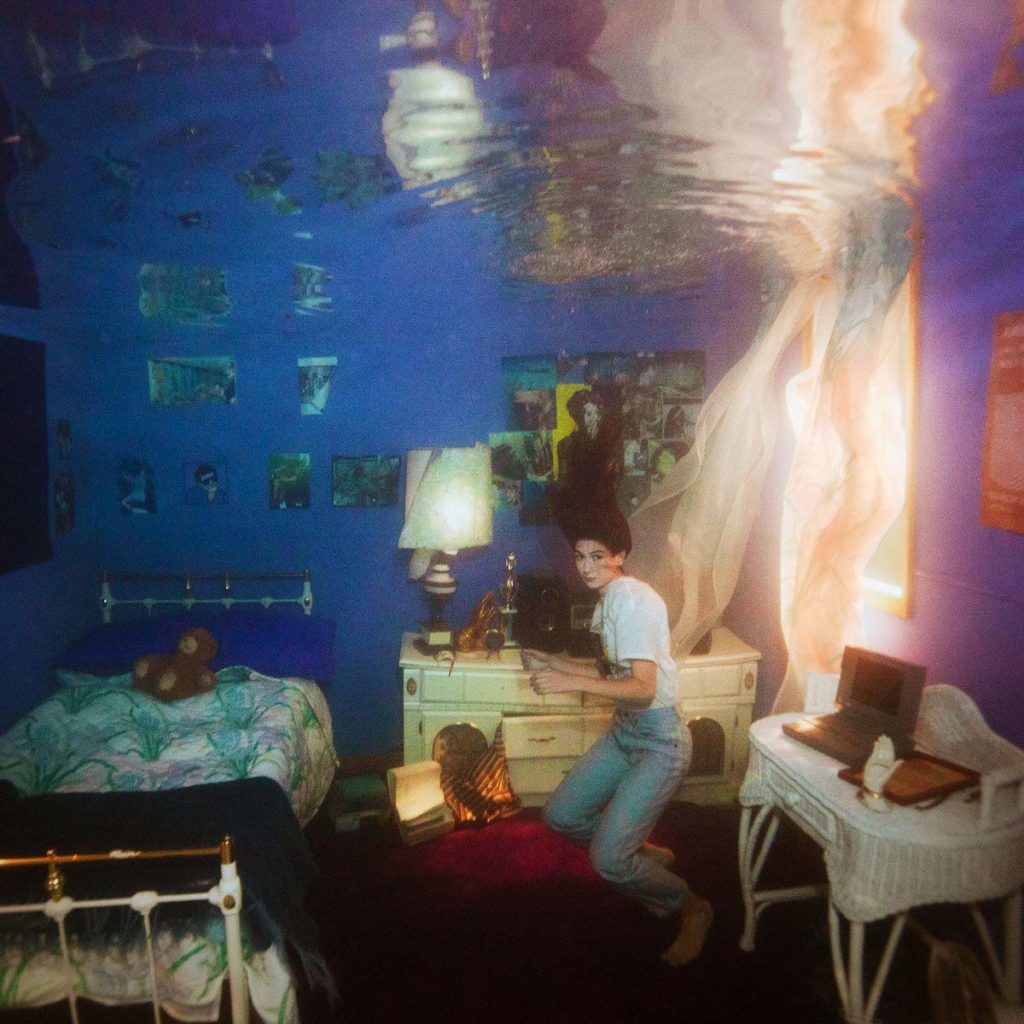
You know, one thing I really wanted to ask you about was the front cover the album art of Titanic Rising, because it's such an amazing photo, and I wanted to ask you how you created it and is it essentially as simple as it looks. I'm sure everyone does know what this image I'm talking about looks like, but in case they don't, it is an underwater a bedroom that is completely submerged underwater, and you're at the bottom of
the tank. I guess if you shot it in a tank, as if you're standing in the room that has got a desk in it and a bed and a laptop, I think, and stuff's on the table, and it's so beautifully shot. But it's sort of a I'll put a link under this podcast so people can view it easily. But how did that image come about? And how did you do it?
I did it in a swimming pool. I found a photographer who liked to shoot things underwater, who knew about what it was like to work underwater, because everything is twice as hard, it takes twice as much time, twice as many things can go wrong. I bet you can't breathe, you know. So I was the root of the idea started with I was talking to my roommate at the time,
who's a painter Ariana Popata Metropolis. She's a really brilliant painter, and I was like, I really want to do an underwater album cover, and I want it to be like a living room and I'm like sitting on the couch, and then she kind of was like, hmm, maybe you should do a bedroom. And then I was like, oh my gosh, that's an incredible idea. So then I kind of gathered all the stuff for the bedroom, like I
found things in the trash, I thrifted. I did all the creative direction, you know, with that with my manager at the time, and we actually hired somebody to build the set underwater, but he failed because he didn't realize
how difficult it would be. So the second time around, we were successful in making the walls and kind of stapling everything down so it didn't completely float away, and then we had, you know, a good three hours to shoot before everything started to disintegrate and bloat and really change. So it was like this very time and space capturing moment.
I've got it. I've got it in front of me. Here there's a dressing little dressing table on the right, But there's a sort of chest of draws I guess at the back there where you're high fi on it, which I can see is sort of bowing. Was that because of the water or was it?
Yeah?
Okay, right, so when you put it in there, it wasn't doing that.
I mean it's all like kind of particle wood furniture. So yeah.
You also look because you're in it as well, and you look so sort of you look very relaxed, and it doesn't look like you're being wayed down. Did you just work?
Did you you just got to exhale?
Okay, like a free diver. Yeah.
No, there was like a major learning curve with like getting over the feeling of being in there and being like you're going to die because you're holding your breath and kind of the mind over matter of like getting down and like sinking into the room and just spending you know, like kind of like ten seconds at a time relaxed and then kind of going back up for air. And it was really really difficult because the chlorine in the water was really intense. So by the end of
the night I actually couldn't see anything. I was like blinded by how many hours I'd spent with my eyes open underwater. Yeah, it was. You know, the sacrifices we make for our it's really beautiful. It's all worth it.
We appreciate it as fans, we appreciate it. Yeah, absolutely, it's worth it. Yeah. It's been a year almost to the day since, and the darkness heart's aglow. Do you genuinely like looking back on things or are you more head forward looking for the next thing.
I'm looking for the next thing usually, Yeah, especially with recorded music, because you spend so much time making it and recording it and mixing it that by the end of it you're kind of like, I just want to make another thing now to erase that memory, and then also playing it for a year, you know, is really fun and rewarding, but also like, yeah, you want to play new songs after a while.
Is the plan still for the next record to be the final part of the trilogy that you're currently working on, Withonic Rising being the first part, the current album being the second. You've got one more, Yeah, which is going to be from what I've heard and read in interviews from yourself, hopeful, we're into the hope stage. Is that still the plan.
Yeah, I've been writing, and I haven't really gone into the studio yet, but I've been writing a lot.
How's twenty twenty three been for you? Generally?
Life changing? I think this year, I mean I love twenty three anyway, So I kind of had good feelings about the year anyway, But it was it was all chemical, you know. I think, like everybody else, my experience of the pandemic really shifted my relationship with the world and myself, and it was a pretty jarring experience for me. So getting to come back out and sing these songs and share it with an audience was really healing and kind of like reaching this point of just running on pure spirit.
Because it was also really exhausting, because the pandemic was such an exhausting experience, Like there would be these kind of expansions and then contraction where it's like summer twenty twenty one, we're back and everybody's raging, and then all of a sudden, like, no, we're not back, you know, Like I think there was a little stop and go, stop and go, and so like everybody kind of had their own reactions at different times because it was it dragged, dragged.
On twenty one was my worst, and then twenty twenty twenty one, what was that real? That was as low as it could get, I think for me.
But the parties in that summer were some of the most fun parties I've ever been to.
So did you have a good time at Glastonbury this year?
Oh?
Yeah, I loved it. It was one of the best.
Was that your first time or you'd been before?
That was my first time? I also like I had like a midlife club crisis. What is it? Is it called Sector nine? What is the section of the festival that's all the clubs, It's you know, Block nine, Block nine. Yeah, yeah, No, I had a really good time at Block nine, and I just found like the whole vibe of the festival was so magical and it's so you know, funny that like we in America had Woodstock, but we just could
not keep that energy going. And it's amazing that in the UK you guys have kept that energy going since the early seventies with one festival. It's pretty miraculous.
It's just amazing how yeah, that they've sustained it and it hasn't got sort of fucked up in any way, like with you know, they still don't really have a they don't have a big sponsor. The money goes to, you know, their partners, Green Peace, and it's it's it's this one weekend where everyone can sort of just experience sort of how good things could be, perhaps for a finite time. I mean, I don't think I want to live in Grastonbury forever, but whilst it's on it, I
mean it's quite it's quite unvaiable. I'm glad. I'm glad you enjoyed it. You played under make you played a lovely stage as well. That park stage on the Hill is really a nice spot.
It was really special.
You're obviously a huge fan of the Velvet Underground and I just wanted to ask you what it was like to feature on John Kale's album Mercy this year.
It was a huge, huge deal for me. It was a really big moment. We actually recorded that many years ago.
How I met John was I interviewed him for a magazine and my questions were just so specific and deep cut that I think he was a little intrigued about who I was, and he checked out my music and then invited me to come sing, and when I sang it was like he was, you know, kind of getting me to sing these really low notes, which he ended up kind of altering in post, and like the song became unrecognizable to what we had recorded, which I thought
was really really creative and cool. And his studio was just kind of full of toy pianos and nothing else, which I thought was really wild, and apparently at the end of the recording he smashed them all. But yeah, just meeting him, it was so wonderful to get to kind of talk about classical music and just all these things that I never get to talk to other musicians about.
It's rare to meet somebody who there's so many meeting points of kind of taste and kind of respect that I have for him, and every moment I get with him, I think is so precious.
Yeah, I mean, for someone who loves that band, and that band obviously means so much to you, It's sort of doesn't much get much better than that, does it, Especially if the experience is a really positive one and you've not gone to meet John Cale and it's been.
Horrible, you know, I feel really lucky. I got to meet Lou Reed too, and he was really nice to me, which is really rare. I feel like that was like a weird like gift from the heavens or something. I was at Occupy Wall Street leaving with with a big protest sign and lou Reid literally came up to me and he was like, how's the protest? And then he took my hand and he started warming my hand because it was really cold, and looking into my eyes, and
I was like, what is going on? Like this guy's being so nice, and then I ran to my car. I got a copy of The Outside Room, my first you know album, and handed it to him. And then I think he was a little like, oh, you do music weird?
So he just approached you. And it wasn't because you were analysis and he wanted to talk to you about that. He was just being a friendly guy.
He just saw I was dressed pretty funny. I was like dressed in a weird medieval outfit and I had like a you know, a sign about not letting the capitalist zombies take over.
Did he join in in the in the protest or was he passing by?
Yeah?
He was. He was around for Occupy for sure.
Definitely amazing God to me. Did you ever see him play?
No?
I was just so young that I kind of missed. I also, I think at that age I wouldn't spend money on concert tickets, something I sorely regret now, but I always thought they were too expensive.
I saw him once towards the end, and it was kind of like, I mean, he certainly wasn't nice to the people on stage like he was to you. He was furious at his band. He must have liked you, I don't like me. I don't know what his band had done, but.
I mean, I hear these stories all the time. It's scary, it's said.
Yeah, he was pretty livid. He spent the whole time just ragging on the whole band for everything they did. And he played some really strange versions of Velvets tunes, which you know is still great. You're getting to hear lou Reid play some Velvet underground, but he would just speak quite contrary and play them all at like half speed or just strange, strange lou reedness.
But you know, Bob Dylan does a very similar thing. It's really weird.
Yeah, have you seen him?
I saw him play maybe eight years ago. I don't know. His recent show is probably different. But the show that I saw he would do, you know, like the answer my friend is blowing in the wind, Like you would just change all the timing and the audience would be singing the old timing. So there was like this weird, cacophonous, like kind of murky like you know version of the song kind of roaring throughout the stadium, and he was just like free, you know, freestyling over it. It was pretty psychedelic.
I don't understand why he does that.
I think they have to. I don't think they can keep doing the same thing for like forty to fifty sixty years, Like, yeah, that guy at this point sixty years, could you sing the same song for sixty years?
That's true? But do you think like just don't play it? Like it's fine to not play, isn't it? Because I think people get more upset hearing it offbeat of strange than just not doing it.
Yeah, but I don't know, I get it. It's a weird decision, but I understand it. It's a meeting point to compromise. Just give the people what they want, but only a little bit.
Midnight Chats is a joint production between Loud and Quiet and Atomized Studios for iHeartRadio. It's hosted by Stuart Stubbs and Greg Cochrane, mixed and mastered by Flow Lines and edited by Stuart Stubbs. Find us on Instagram and TikTok to watch clips from our recordings and much much more. We are Midnight Chats Pod.
For more information, visit loudan quiet dot com