


The first thing that drove me to the story was the pill, and actually through the reporting and spending time in Latin America following how the information spread so quickly, how these women built support systems around this pill, I understood that that was the real story.
From Futuro Media and PRX, it's Latino USA. I'm Maria Jojosa today a conversation about the making of the Network. It's a new series that follows the women who transformed abortion access around the world by taking abortion out of the clinic or Latino USA listener, you know, these past
few days, we've brought you the Network. It's a new series that Latino USA co produced with NPR's Embedded podcast, and it's about this network of women, not an established organization of any kind, but just women who were helping other women to have safe abortions without a doctor present and regardless of the law. And by doing this, the women and these networks completely transformed abortion access around the world.
Latino USA producers and hosts of this series, Marta Martinez and Victoria Estrada, have taken us to Brazil in the nineteen eighties, where the women there made this surprising discovery about mesoprostol and how you can use this ulcer pill to actually have a safe abortion at home. Then Martin and Victoria reported on how the network continued to grow, how it changed tactics and eventually was even able to help change the law around abortion in many countries. So
if you haven't listened to this series, please do. It's just great history and great journalism. You can find all of the episodes on the embedded feed or look for them on this feed. But today we wanted to bring you a behind the scenes conversation about how the series was made. Victoria and Marta have been reporting for this series for over a year. They traveled all over the Americas in order to reconstruct a story that spans for decades,
and they're going to tell us all about it. Welcome Marta and Victoria.
Hi Mariya, thank you so much.
Hi Madia. So you know, I'm part of the generation that in the United States it becomes politicized because of the issue of abortion, the passage of Roe v. Wade, right, But also I understand the Latin American component because I studied Latin American studies and I was a feminist. So for me, this is a story that I kind of have known. And what I wanted to ask you was, how did the both of you are much younger than me, come upon this moment and say, wow, we really need to tell this story.
I think for me it was having reported on reproductive rights for many years in Latin America. It's pretty clear there that this is how you have an abortion. For most regular people, they will take me so prostal and I really wanted to tell that story, but also the origin of how this was discovered, because it's actually a fascinating story, the fact that it was actually appeal that was invented for something completely different like stomach problems, and it's this quote unquote side effect.
I mean, whoever it was that was able to unlock that and we don't know, right we don't. That's pretty incredible. Yeah, Nctodia, what about you? How did you come to this story?
I live in Mexico and I've been covering also Latin America, also Latin communities in the US. But I think that once you're reporting and you pay attention, you see the story of feminism in Latin America, how it's been like for the last couple of decades, women have been organizing because there are a lot of issues that they face in their specific countries, and when you start to look at it, abortion has been like a very strong component of the activism and the organizing, you start to see,
like all of the collectives, it's not just institutions. It literally can be just like women who know about it. And so we were really thinking about that when the overturn of Wade happened in twenty twenty two. So I think that for us the connection was like very natural and clear to try to follow this story.
This is a story to me that is as much about the issue of reproductive justice and reproductive rights as it is about living, breathing feminism, women organizing, women having a whole way of operating that is outside of just institutional norms. So that part of the story Marta, the Feminist Test is really extraordinary.
What I found fascinating is how women actually came up with this whole system of taking care of each other that was very different from what you will find in the traditional medical system. And just being able to document that is something that has been a goal for us because this was just women experimenting on their own and no one really.
From those bigger institutions.
Not a lot of people were paying attention at the time, and so I think it needs to be documented that this happened, and how it happened, and who were the people who made that happen right Because they were taking a lot of risks because in these countries abortion was pretty much banned. They could end up in prison, and that's also probably part of the reason why they were not keeping track. In many cases, not all of the groups, but many of the groups. It was dangerous to keep track of things.
You had to go back and essentially find people who were actively engaged in multiple parts of this story in the nineteen seventies and eighties. You know, I was alive at that time. It's not like one hundred years ago, but finding people in Brazil to be able to talk about this. Can you just share a little bit of how you found some of the people who were actually on the front lines, whether it's the doctor from Casife or it's the woman who can see Cristo from her
apartment in Rio de Ja Neeiro. I love your descriptions. Tell us a little bit about how you did this deep reporting.
We started reporting on this, doing research about this over a year ago. So we had like some ideas, but we knew that we needed to go on the ground. We were actually able to go to Brazil, and so when we got there, they start telling like the more personal how they were living, what they were doing. We mentioned this very briefly in the story, but Brazil was coming out of the dictatorship in the mid eighties, and
so there was a lot of organizing in Brazil. The moment Mestill came out, there was a lot of movement. It was very prime because women were already organizing to try to get rights into the constitution, and so women started building knowledge just like by sharing with each other. That really informed our reporting, like, oh, it really is the women. The women are connecting with each other and it's this network.
Before we went to Brazil, we were like, Okay, I think once we are on the ground, we're going to find someone. And then we were on the ground and we were talking to all these activists, all these experts, and we would always ask at the end of the interview, do you happen to know someone who took side to tech in the late nineteen eighties, And their answer kind
of surprised us. They always said no, I don't know anyone directly, Like I've studied this, I've been, you know, learning so much about this throughout history, but I don't know anyone personally. So we understood that there was a big class element involved. Those were not the people who were actually experimenting with side at tech. It was poor women.
And so we ended up finding the person and we cannot give a lot of details because we need to protect her identity, but basically it was through a personal connection of one of the local journalists who helped us when we were in Brazil. So it was really interesting to understand that we needed to break that class barrier to really find the people who were taking those risks.
Which actually, on the issue of reproductive justice and reproductive rights, the issue of class is central, it really is. There was another thing that was happening that I was profoundly fascinated by, which is these in guentros. They were gatherings of thousands of women activists, the incuentros that you talk about, like you could just imagine that there were either panels or that it was being exchanged in the hallways, which is there's another way to have a abortion. Have you heard?
Can you tell us a little bit about these incuentros, what you know and how important it was when you kind of uncovered that and you're reporting.
So these in quentro's.
Started happening in the mid nineteen eighties in Latin America, especially in Argentina. They are very, very strong, and I became obsessed with this one in quentro in particular that was for all of Latin America, and it took place in San Bernardo, which is.
A coastal city in Argentina.
I think it's more like a Florida kind of place, so a place where people go on vacation, and it was the low season, so they actually got better deals, so that's why they decided to do it there. And
there were more than three thousand women. And I found this incredible footage by a historian named Lola Luna who filmed during the encuentro, and you see all these young women with the like big glasses and perms, the way it was that kind of place that looked like there was a lot going on, like women were really kind of thinking together about their priorities, about how to rethink gender, how to rethink power structures.
And in the nineteen ninety and.
Quintro, a lot of things happened for abortion particularly, and some Argentinian doctors actually decided it's time to do a workshop only focused on abortion, because usually it would be like, let's talk about health issues more generally, but that year they were like, no, we're going to do one workshop.
Dedicated to abortion.
Actually, I interviewed mamel Bianco, one of the organizers of this workshop, and she told me this, we suppose.
Are going to be a small group and we find more than So what happened here all was abortion.
Abortion.
Everybody was talking about that if you open a kid or something and explode.
Also, something else that happened that was very interesting is that they declared that September twenty eighth was going to be the International Day for Safe Abortion. So it really became a priority for feminists in that particular meeting. And then what surprised me in terms of our story following what happened to the pill. What happened to me so is that it's not like the Brazilians were doing like a whole you know, PowerPoint presentation on how to use MISO.
I don't know if powerpoints existed at that.
Point, I know, but you know what I mean, Like, it's not like they went there and explained this is what we use now and this is how you take it and this is what you do.
It literally was something they were sharing in whispers.
It's something that they were sharing in the hallways when they were having lunch together. And actually it had the biggest impact of all right, Like that's the one thing that really transformed access to a for for millions of women in the future.
Can you tell us a little bit more of Victoria about the importance of the feminist movement in Latin America and what it's doing today.
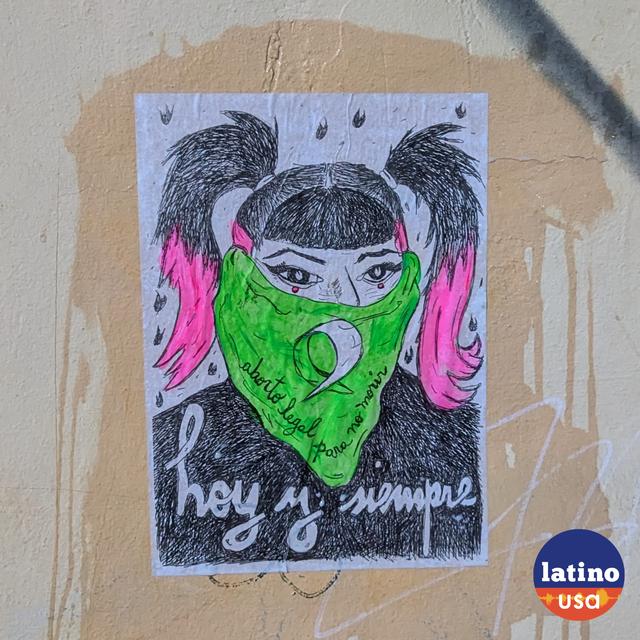
Yeah, I think that one thing that is important about the feminist movement in Latin America is that it's not focused on one issue, like people reach out one collective can't cover everything, so they can form a lot of alliances with each others even that if they're doing different things. And one example of that is the symbol for the abortion rights movement in Latin America, which is the green bandana.
We actually spoke with Marta Alanis. She was one of the activists who back in the early two thousands came up with the idea of using the bandana. And this is Marta Alanis to Mamozilla. Mala Alanis said that they decided to wear a bean like the Madrees Mayo did. These were a group of mothers in Argentina who protested at Mayo Square during the military dictatorship, and they demanded for their children who had been disappeared by the military to be returned, and they all wore white bandanas over
their heads. Then this became a symbol for justice and for human rights, and so Alani's and the abortion activists decided to pay the so much, but they changed the color. And Alanis also explained to us why they decided to make the bandana greenna.
You know, if poor Elila is a total.
She says that purple was already taken by the feminist movement, and for them also green symbolized life and nature, so they decided to go with green. And the green bandana eventually turned into the green wave movement in Latin America. And it has this whole imagery of it's a movement, it's massive and it can have a place for everyone. So it's not like everyone has the same politics inside
the movement. They don't agree with everything. There's a lot of discussions of tactics and what are the specific objectives. But it is a massive movement in Latin America around women's rights.
Well, as you can tell, I'm a big fan of the work, mostly because it's just really phenomenal journalism documenting something we all need to know. So I have a lot of takeaways myself. But you've been both immersed in this reporting for a long time. It is out in the world. Now, what's your takeaway after having dedicated like a chunk of your journalistic endeavor to reporting on the network.
I think for me, one thing I've learned is that the first thing that drove me to the story was the pill and the discovery of the pill, and actually through the reporting and spending time in Latin America following how the information spread so quickly, how these women built support systems around this pill, I understood that that was the real story.
It wasn't only just this super creative discovery.
It was actually the fact that the women understood this is powerful, even though maybe we don't have institutional support to do this. And I was very interested in learning that there was a whole tension and debate about how far are you willing to go to make that happen. How far are you willing to go to help others in the way you think they should be helped, and also that you can actually I don't want to sound cheesy, but like there is power in the collective.
Actually trusting each other, building.
Something together is going to be a lot more powerful than just relying on.
One pill you can buy at the pharmacy.
Yeah, I mean tiny tiny steps that you think, what am I really changing here? It all adds up, Victoria, take us out.
Just being able to follow this pill through all the decades, follow the movement through all the countries and now to the United States. I think you do see like a very specific things that are happening in each place, the barriers, the culture, but also like all of the testimonies of the people who use the pill, who are supported by either like a collective or someone a friend, a family, mother, someone.
The way this method is being used by the women, how their experiences like mirror each other, going all the way back to the eighties until now, I think that was very.
Powerful, all the way back to the eighties. You know, so again, listener, it's whispers among women that then lead to super loud voices Thank you so much Marta Martinez and Victoria Estradra for your reporting on our new series, our collaboration with Embedded from NPR. It's called The Network, and you are going to want to listen to this. You are going to learn so much and it's because of great journalists like Martin and Vittoria. Thank you so much for your work.
Thank you, Adiah.
Remember, dear listener, you can find all of the episodes of the Network on MPR's Embedded feed or wherever you get your podcasts. This episode was produced by Sam Jay Leads. It was edited by Benny le Ramirez. It was mixed by jj Carubin. Fact checking for this episode by Roxana Aghiri. Special thanks to the International Women's Media Foundation for funding this reporting in Brazil. It's part of their Reproductive Health,
Rights and Justice in the America's initiative. The Futuro Plus team includes production managers Francis Poon and Jessica Ellis, marketing manager Luis Luna, development manager Genetzi Men, and engineers Gabriela Bayez and Stephanie Lebou. The Latino USA team also includes Roxana Guire, Julia Caruso, Felicia Doo, Minuez, Domiquinestrosa, Renaldo Leanos Junior, Andrea Lopez Gruzsado, Julieta Martinelli, Monica Morelis Garcia, Tasha Sandoel
Nour Saudi and Nancy Trujillo. Fernando Echavari is our managing editor. Benille Ramirez, Maria Garcia and I are co executive producers and I'm your host Marino Jssa. Join us again on our next episode. ETU Saves not Bay. Yes Bai.
Latino USA is brought to you in part by the Levi Strauss Foundation, outfit movements and leaders fighting for a more just and abundant world, with the support from the International Women's Media Foundation as part of its Reproductive Health, Rights and Justice in the America's initiative, and the v Day Foundation