


From Futuro Media and PRX. It's Latino USA. I'm Maria in Josa today, a Native American reservation in Washington State where Latinos and Latinas are the majority of the population, and also the tensions that flew up because of that. Welcome to Latino USA. I'm Maria in Hoossa. In the late nineteen seventies, Guadalupe Marquez was living in Alto Jalisco, Mexico. Her husband was gone most of the year in the United States doing farm work.
Mid Sevenia Cestawaki orso on River Mezes, Wuidalupe's husband would spend eight or nine months working hard to make a living to provide for his family across the border, and like thousands of other labor immigrants before and after him, he would then take time to go back to Mexico and visit his family.
He'd stay for a month before leaving to the US again. But nine months after every visit, something big would happen, Whilalupe would end up giving birth to a new child. And not once or three times did this happen, It happened sixteen times, Yes, sixteen times.
What is Amilia?
That's why our family's so big? Wadalupe says, of course, sixteen kids. But finally, one day, Whadalupe decided enough was enough. She didn't want to keep raising her large family on her own. She wanted her husband to be a permanent part of their life too, not just as a visitor, and so she convinced her husband to take her with him to the United States for good. They ended up joining some relatives in Washington State. They rented a house
in a tiny town surrounded by fruit orchards. Whidalupez daughter, Yesing, was five years old when they arrived. Her most vivid memory of that first house was finding these tiny little clues.
And I remember in the closet of the house there was beads, like Native American beads. I just remember finding beads. For as long as we lived in that house, there was always beads in the closet.
It took you, Senya years to realize what made this town Wapato different from the rest of the country.
It wasn't really evident to us that we lived on a reservation. That wasn't something that we were conscious about. It was just something that we figured Indians lived here.
But she was on a reservation. The Yakama Nation. Ten years ago, the Yakama Nation was home to about eleven thousand tribal members and three times as many Latinos and Latinas. Now this divine it has increased, with nearly four times as many Latinos and Latinas as there are tribal members outnumbered on their own land. I wanted to know what does that look and feel like. So in twenty fifteen, I spent about a week in the Yakuman Nation reporting along with my.
Producer, I'm Rowan more Garrity.
And today we're teaming up for a special edition all about the Yakuman Nation, a Native American reservation where Latinos are the majority. Now, just so you know, there are moments in our story where you're going to hear language around race that will be offensive to some listeners. So that's just a heads up. But before we go any further, I think it might be helpful to paint a picture
of what the Yakama Nation is now. To get there, I drove about three hours east of Seattle, So Rowan tell us what does this area look like.
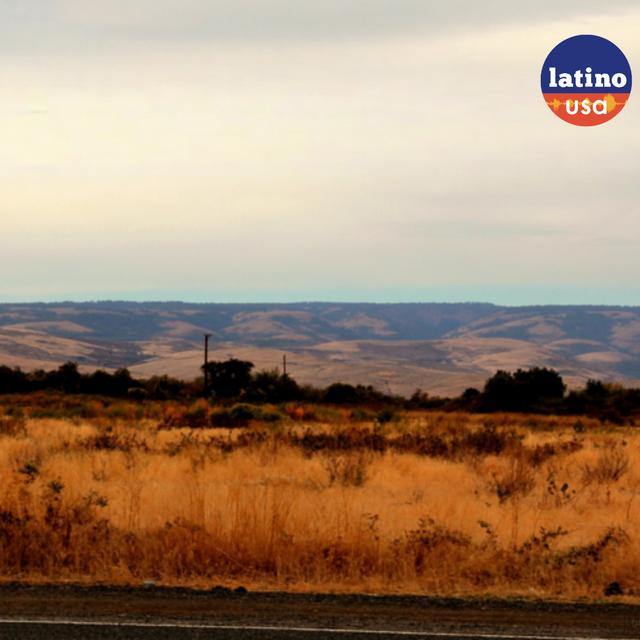
So, first of all, the Yacma Nation is in eastern Washington, and it's pretty big, wide open country. The reservation lands cover more than two thousand square miles of plains in the lowlands and then forested mountains. Most people live in a cluster of towns along the Yakima River, so there's a big Latino population along with the tribe, and then there are also Filipinos and white people, so it's a real mix.
Right after I got to Yakima, we met up with a woman who grew up right in the middle of all of this.
I got two little ones. I got to get out of my car.
Okay.
That's Rena Marquees, Guadalupe's granddaughter and Yessenia's niece. Rena is twenty seven years old. Her father is Mexican and her mother is Yakima and Filipino, and she's got four kids of her own.
She's totally well.
Princess Medal Indian one.
She loves to be barefoot, come back to me.
Rena says there are a lot of people in her generation who are part Yakima and part Mexican, and she never saw a problem embracing both sides of her heritage. But back when she was a kid, she felt like there was a war between Native Americans and Latinos on the reservation.
There were some Native men that would fight with my dad, so, you know, because it was Hispanic, just you know, go back to your own country. And then on the other side, I always heard, you know, dirty natives, drunks, bumps.
And when you would hear those things, what was going on in your mind?
I didn't understand it. There was just so much hate here, just hearing it on both sides, and it was like they just they really didn't like each other.
And Rena says, this still goes on.
One of my sons gets in trouble for fighting, and I'm like, why are you fighting kids.
Rina's son, by the way, is in fourth grade.
Well, he called me a dirty Indian. He gets in trouble for that. He's taking a look from nobody.
Rita's kids are mixed like her. Her son's father is mostly Native.
You know, I've told my kids, you know, you guys are Hispanic and you guys are Native. They'll make comments like we're not Mexican, we're Indians, and mom, like you're a Mexican. I don't know if they just don't think I look Native enough or something, but they always make little comments like that and they just laugh about it.
Being Native isn't just about how you identify or what you look like. Tribes are officially sovereign nations, and there are specific rights that come with being a member of a tribe. You can vote in elections for the tribal government, you can visit parts of the reservation that aren't open to everyone, and you can receive a share of the tribal income that comes from things like the casino or the logging industry.
But here on the Yakama Nation, I learned it's more complicated because a lot of the land is actually owned by white people.
And the reason there are so many white people here is that it's a great place for making money from growing apples.
All over the reservation. There are these huge warehouses, bigger warehouses than any I've ever seen, I think in my whole life, that are filled with apples.
That's right, The Yakama Valley is the nation's apple capital.
This is the biggest apple backing facility on Earth.
That's mikey Hanks, he's my tour guide at Washington Fruit. It's this massive concrete warehouse filled with the whirring and clicking of all these giant machines. So you'll see here it's just kind of like a river of apples.
The easiest way to get the apples out of the bind let's put the bin in water.
About three and a half million apples go through here every day.
Three and a half million apples are worth a lot of money. And to understand how white people came to own these fruit factories on native land, you have to go way back.
So this is just a valley floor, and you could see there's a lot of areas in here that aren't owned by the acamanation.
This is Matthew Tamaskin. He's a part of the tribal government and today he's showing us a huge map of the reservation on the wall at the Yakama Nation headquarters. The map is divided up into a big grid and some of the squares are yellow, others are pink and blue.
So what you see is the yellow parcels. Those are tribal lands and they have numbers.
In eighteen fifty five, the Yakma people signed a treaty with the federal government that created the reservation, and it set aside land where only the tribe could live. But the Feds didn't keep their word. Not long after that, Congress passed something called the Allotment Act, and basically what that did is it took land that belonged to the tribe and broke it into little pieces. The goal was to give those little pieces of land to individual tribal members as a way to get them to assimilate.
So some of that was was they wanted us to be farmers. We're not farmers, we're gatherers.
Now.
Government's idea was that tribal members who agreed to move on to those individual allotments could become citizens of the United States, and any land that wasn't given out in allotments would be sold to non Indians. But by the turn of the century there were whole real estate offices here just specializing in selling reservation lands.
The tribal members owned the land, but yet you know, you hear these stories of hey, chief, we'll give you a bottle of whiskey for that land, booms turned over, we lose it.
When you think of a reservation, you probably think of land that's set aside just for Native people. But there are actually a bunch of reservations like the Yakiman Nation, where the majority population isn't Native American at all.
Within fifty years of the Allotment Act, tribes all over the country lost ownership of more than two thirds of their land. The Accamanation has been trying to buy their land back ever since. But it's a lot easier to take a piece of land out of tribal control than it is to bring it back in.
So that's how you start having what we call now a checkerboard reservation.
That's sister Kathleen Ross. If you can imagine the checkerboard she's talking about. Let's say some squares are owned by the tribe, and a lot of other squares are owned by white farmers and growers, and that's made it harder for the tribe to control what happens on the reservation, even for something as basic as who lives here.
That checkerboard has also enabled discrimination against Native Americans on their own lands.
The settlers that came in that started the towns to support the agriculture that was starting up. People that started a restaurant would put up a sign that said no dogs here and no Indians.
In the first part of the twentieth century, white settlers from all over the country moved onto the reservation to start farms and take advantage of a new federal irrigation project.
They're creating these farms, but they didn't have workers. So prior to the Mexicans coming and being workers, we were the workers. Our elders were out there picking hops or harvesting grapes or harvesting apple. Those are harvesting peachers, what have you. We were that. We were their workforce, you know, cheap labor. That's where we were, just as ys today.
And you see some of that work depicted on the murals here in Toponish.
Ricardo Garcia has been an advocate in the Latino farm worker community for more than forty years. When you drive through downtown Toponish, one of the reservation's main towns, you see whole buildings painted with scenes of Native American families doing farm work.
But they don't do that work anymore. The agricultural industry kept growing, and it continued to expand to the times when they needed to recruit workers from Texas.
Families like Garcia started to come north for a few months out of the year, and gradually, he says, Mexicans and Mexican Americans started to replace Native Americans as the main workforce on the farms on the reservation.
The Native American was a good worker, but they also celebrated the times when they would go fishing and they would take off, perhaps in the middle of a harvest, and the industry didn't like that very much, so they started to prefer and recruit and hire labor from Mexico as well as Texas.
Right now, this is something that I learned by being on the reservation that there are certain seasonal activities that are really central to tribal life and identity, like fishing or foraging for roots and berries, and it happens on very sacred land, and so when it's time to do that, that's what you do.
Yeah, And that shift to Mexican farm workers means that over time, more and more single men were coming here and putting down roots, and eventually their families came too.
And it was the beginning of a demographic shift that would profoundly change the Yakma Valley. Latino settled in the reservations towns in large numbers, bringing their language and their culture with them, and with new neighbors they're came and new tensions coming up on Latino USA are Latinos. Pushing the Yakama people out.
When I'm going out to launch with my friends is like we're gonna have Mexican, Mexican or Mexican. If you think about it, you know what does topplers have to offer? Are they the Mexican fact?
Stay with us?
Yes, Welcome back to Latino USA. I'm Maria Ino.
Jossa and I'm rowin more Garrity.
And today we're revisiting a special episode from twenty fifteen about the Yakama Nation in Washington State, a Native American reservation where Latinos have expanded to become the majority population. Now, when we left off, we were talking about how the reservation lands became dominated by farms, mostly owned by white folks and worked mostly by Mexicans and Mexican Americans.
Today, agriculture in Yakoma County is an industry worth almost two billion dollars a year, and almost everyone we spoke to in the Latino community here has spent some time working in the fields. Yesenia Navarette Hunter, that's the woman who found the native beads in her house as a child. She says the hardest part of doing farm work was just trying to get enough sleep.
My mom would have us get to bed, you know, at maybe eight or nine. And in the summertime, it was even harder because still light out and you're trying to sleep, but you know that in just a few hours you're going to get up again.
During asparagus season, Yesenya says, the day started at two or three in the morning, and.
We'd get ready and run out out to the cars because there were always several.
Remember we're talking about a family with sixteen kids here.
And the way that we pulled this off because how do you pick in the dark. So my dad would he would park his jeep facing the asparagus rose and leave the lights on, and so you pick as far as you can see, and then you come back, and then you pick as far as you can see, and about that time the sun's coming up, so you go back and you finish the rest of the rose.
So what that means is that the kids would work five or six hour shifts in the fields and then they would rush home, shower off their morning work, and head to school.
Yasenya's niece, Rina Madkez, had a different kind of childhood though. Remember Rena is the part native part Mexican woman that we heard from earlier. Growing up, Rena says she saw the worst of both of her parents.
My mom left me in a hospital when I was firstborn.
Both her mom and her dad drank heavily and used drugs, and her dad was in and out of jail.
So my grandma got me out of the hospital and she would tell me stories that or your mom would come see you as a baby, and like my baby's age, the little one, she said, your mom would push you away.
When she was seven, Rena moved in with her parents. They lived in one of the low income housing projects owned by the tribe. A lot of the adults there were unemployed and struggling with addiction, and from the time she was eight or nine, Rena was responsible for getting her little sister fed and dressed in the morning and then walking her to school. At the time, though, Rena says she and her siblings were just used to it all.
There's a lot of stuff as a child. I don't really remember a lot of stuff that I've blocked out.
There were a lot of kids in the projects like her, with mixed parents, mostly Mexican fathers and Native American mothers, but she still felt alienated at school. Most of the kids were one hundred percent Mexican.
American around here, It's like his Phoenix almost the way that week, you know, they were almost like the white people, like they dis acted like better than everybody else.
When Rena got into arguments with Mexican kids, she says, just being viewed as Native felt like an insult.
I felt a lot of anger towards those people, and I was ashamed sometimes to be like some people would be like, oh, you don't look Native American, you look Mexican. But sometimes that made me happy, like knowing that I didn't look like a Native, because I knew how people looked at Natives.
Things were tough at home too. Her mom wasn't around much, and her dad was abusive.
My mom had already left the home, so he would fight me, like physically fight me, and I fought back because I didn't know any other way to survive.
The last straw came when Rena was fourteen, and her father hit her so hard she went deaf in one ear. After that, Rena's little brother called their aunt to come pick them.
Up, and so she came and told my dad, if you don't let me take her. I'm going to call the cops.
She has, in fact, forgiven both of her parents, and she's up.
Her life absolutely. Her mom even comes to stay with her at her house sometimes. Now, she was really able to turn the corner. She got through college, she's got a pretty good job now working as an auditor at the tribe's casino, and she's got kids of her own.
You know, I was fortunate enough to be pulled out of my dad's home and see a different life. I think a lot of people. I just feel like some people don't ever see a way out of it.
Now.
Those tensions between her Mexican and her Native American communities were very real for Rena. But one person who says he's trying to remind them of what these two communities have in common is Matt Tumaskin. He's the legislative laison for the tribal government that we heard from earlier.
And he's also a teacher at the tribal school. A couple of years ago, Matt was talking to his Native students and he wanted to see what they knew about Mexican culture. Justa heads up, you're about to hear some offensive language.
When I say, Mexican, what do you think? So all of those those negative annotations came up, went back, you know this that whatever, solo's whatever. You know, there's just those stereotypes. But I started educating and I say, you know what, they're indigenous, just like Eve and me. They're from the south and we're from the north. We need to realize that that the border was created by the white people.
A few weeks later, Matt brought an indigenous Mexican congresswoman to his class. At first, she spoke to the students in Spanish while someone translated, but then she switched to Puripicha, an indigenous language, and the interpreters sat down.
And hip couldn't interpret it. So that's what I told him, was like, we speak English down there, they speak Spanish. They they're not Spanish, they're put Apache.
And when you say that to the people, you know, there is a brotherhood between us, there's a sisterhood. And they say, yes, I believe it, or they say I don't think so.
It's a little bit of both. They don't believe it yet, but yet you know, when they heard her, they knew the difference. So classroom full of students that I was teaching government at that time. It clicked, you know that, you know, they are indigenous.
Just like us malec Yeah, Yankasas Marlvetx, Yeah, Yankasas.
It's undeniable that Mexicans have transformed this area. The Hispanic population in Yakoma County, which includes the reservation, has quadrupled in the last generation, from about twenty five thousand to well over one hundred thousand today.
And Matt says Latinos have become a convenient scapegoat for the spread of crime and drugs. Toponish and Wapato, the two main towns on this tribal land, have both had trouble with addiction and gang violence as the Latino community has grown, and a lot of Yakima people have absorbed mainstream stereotypes about Latinos.
That's what we were told by the dominant societies. They're bad, They're no good. So that learned hatred is still there. So we need to come to a point where let's break that cycle.
But even for Matt Tamaskin, it's not easy to see the towns where he grew up looking more and more like Mexico. In downtown. Top of it, the reservation's biggest town. There are Mexican businesses everywhere, restaurants, bakeries, music shops, car repair.
When I'm going out to launch with my friends, is like, we're gonna have Mexican, Mexican or Mexican. If you think about it, you know what does Topiners have to offer? Are there than Mexican food.
For some people, there's a feeling of a takeover on the reservation, a second wave of Mexican and Mexican American settlers taking the place of the white settlers who moved in one hundred years ago.
Someone who hears a lot of that resentment bubbling up day to day is Carla Ernandez. Carla and her sister are manager at Western Gas, a gas station in Toponish, and outside there are these murals of Native American dancers. Inside it's a convenience store and a tac area where literally everything is in Spanish. Carla is from Hajalisco and she came to the US when she was fifteen.
It was a gift for my fifteen birthday for Kinsenera. I always wanted to have a big party, but I knew we couldn't afford it, and my mom asked me if I wanted to come over and miss it with my family, with my grandma, and I just didn't go back.
That first visit was to Arizona, but her father was a migrant worker in Topenish, so before long she ended up on the Yakoma Reservation, and she likes it.
You get to know everybody, You see their kids grow older. I mean you used to feel comfortable, you used I mean even though they casted you, sometimes it still feels like home.
The day Carla is talking about are a subset of her Native American customers. Regulars come in every afternoon to buy beer and to drink in a park nearby.
Let's say that I don't want to sell alcohol to someone who's already intoxicated. Then the answer back to you and said you would back go back to your country. So that's when you feel more the resentment. If they don't get their way in anything, then they're added to changes. Then they start insulting you, and then they start making it a point for you to know that you're on their land.
How often do you get insulted and told you shouldn't be around? Once a week, once a month.
M I would say it happens once a day.
The customers who drink and insult her are only a tiny fraction of the tribe, but they have shaped Carla's impression of the Yakama people, and a lot of Latinos here hold the same stereotypes about Native Americans and alcoholism.
In the past, the tribal government has actually tried to make the reservation dry by stopping stores from selling alcohol altogether, but many of the stores wouldn't go along, and that's one of the problems with the Checkerboard reservation. There's no way for the Yakima to enforce tribal law on land they don't own, and.
Not everybody who lives on the reservation wants to follow tribal law.
This is a letter we got.
The latest flare up came a few months ago when the tribes sent out a letter to all the shops and restaurants on the reservation.
It says their Quickpick Quickpick has been identified as a business operating with this The.
Letter says that non tribal businesses operating on Yakama Nation lands have to pay an annual two hundred dollars fee to the tribes, but most businesses haven't paid it so far. Carla says people worry that paying the licensing fee means they'll have to answer the tribal government for all kinds of things, and.
If at any point they fail that you are not in compliance with their regulations, then they have the right to come and shut you down.
In the Latin community, there is talk that all of this is some kind of retaliation against outsiders living on the reservation.
I understand it from the perspective of a Mexican that still feels resentment from when Mobsuma and all that. You know, people come and in by your land, and people come and take stuff from you, and what do you get. They just kind of got pushed away. I mean, I do relate to them.
But even if Mexican farm workers are the quote unquote colonizers here, the tribe does rely on them. For example, the tribe has been building its own farming business. Now they've got big apple orchards and a packing house just like the one we visited before.
Even if they don't like the Mexicans who's working the land. You see all these signs looking for pickers during the harvest season. You don't see the accommodation going and applying for those shops. Even they have their own wreckage company for fruit and the warehouse, and who's working those businesses. Go to the casino, there is Mexicans working.
There, or go at the end of the work debt, when everyone's done working in the field, you.
Find ninety percent of the people who're spending their money there is still Mexicans. So it's kind of contradictory for them to say, get out of my land. But then they open the doors and they give you jobs and they take your money.
So the Carla Mexicans are the engine of the reservation's economy. But for Matt damaskin the tribal liaison, it's a different story.
There are special concessions that are set aside for the Mexican people when it wasn't for us. The balance being written in Spanish. When we go to events, you know, they have interpreters.
The Yakama never got any of that. He says, instead, there were no special concessions for us.
Our elders were beaten. Our elders. You know, you see me today, I have long hair. You know, they were forced to cut their hair, they were forced to speak English basically at gunpoint. I don't hate it It's just I see a disparity there. How do I get that special treatment too?
Now, there are some things that you do get by being a member of a tribe. For the Yakima and for a lot of tribes all over the country. Those special rights and the privileges like, for example, healthcare or employment preferences for a tribal job, all of that depends on this one thing.
Okay, So that's my tribal id.
This is Rena Marquez again, and she's showing us her Yakama Nation enrollment card.
It says Confederated Tribes and bands of the yakam Nation. It has my enrollment number, my Social Security number, birthdate, birthplace, my degree of Yakama blood. Yeah, I'm about thirty three percent Yakima.
Why does the blood percentage the bloodline matter? And the fact that it's so specific.
Because to be enrolled as a Yakama you have to be a quarter Yakima.
This is called a blood quantum. Every tribe has different requirements for membership, and most of the time they're based on this very thing. Who your parents are or your grandparents and ancestors.
Can you tell me how they drew your blood?
At some point no, they take a family tree, so I actually have them for my kids.
The way it works is that you have to prove to the tribal government that your native lineage can in fact be traced back to specific people.
So like my kids's dad, the guy that was here when you guys pulled up, he's twenty four percent and I was thirty three percent. So when we had our kids together, they were twenty seven percent.
Just enough to be in the tribe. Those area's two older children, they're both boys, but her daughters, Malika and Ariela, their father is Latino, so Rena says they're seventeen percent Yakima, not quite the quarter needed to be enrolled.
And all of those numbers go out the window when it comes to actual relationships.
You can't pick and choose who you love and who you don't love.
That's Matt Tamaskin again, the government liaison for the Accamanation.
So if my relative, my sister, my brother, my cousin, my niece, my nephew, they fall in love, you know, I can't tell them.
Now.
If people live in the same towns and go to the same schools, it seems inevitable that some of them will end up starting families together, like Rena and her ex husband or like her own parents. Now most of us would see that as a good thing. You get to love who you love, right, But you could also see these love stories as a kind of existential threat to the tribe. Matt to Maskin says, sure, love happens, it's a wonderful thing, but.
It's killing us, killing us. You know, I have nieces and nephews that you know their dad is from Mexico, and I love them, I love them to death. But yet what happens is their blood is diluted.
Besides, it can be hard to figure out a family tree. Matt has one friend who spent forty nine years just trying to get her daughter enrolled.
The Indians are the only race that have to prove they're Indians. You know, you can say you're Mexican, Your Mexican, that's it. Boom, there's a magic wand. But yet with us, we have to produce an enrollment card.
A lot of people face pressure to marry within their culture, but Matt says, for the Yakima, it's different than it is for say Mormons or Cuban Americans. Keeping tabs on enrollment is part of what makes the Yakama Nation a tribe in the first place. That's how they can figure out who's eligible to vote in tribal elections or to visit sacred landmarks that aren't open to outsiders. It's how they figure out who can inherit land to.
A lot of elders within the tribe. Is the best way to preserve Yakima culture, but even that has its obstacles for starters. There are only eleven thousand tribal members, and a lot of them are related.
When when I was growing up, my dad was a tribal leader. So with my dad, you know, we would go places. You know, we'd go to how I was here and there, you know, just because he wanted to visit to people there. I would come up with, Hey, this is my new girlfriend. He goes, oh, hey, who's your parents?
Oh?
My parents? You know, he's talking to this to this girl because oh, my parents are so so it's like, oh, you're my niece. So that's what we're stuck with is, you know, either we're making babies with their own.
Cousins, or or they're making babies with non tribal members who aren't Yakim up and that puts the tribe's very existence in jeopardy. Latino, USA, we dive deeper into blood quantum.
I know they do refer to people who are not full blood, ads breeds or half breeds as if we were like you know, dogs or horses or some sort of stock.
And we hear what teenagers on the reservation have to say about all this notes. Welcome back to Latino, USA. I'm Maria Ino Jossam.
And I'm rowing more garrity. Now.
When we left off, we were talking about something called blood quantum. How for many Native Americans, the exact amount of tribal blood that you have decides if you're in or if you're out, if you're part of a tribe or if you're not.
And to learn more about blood quantum, we met with this guy.
I'm Grayson Squaawks, thirty three years old. I grew up in top Nish, Washington.
Grayson is an enrolled member of the Yakama Nation and he has a different idea of the direction the tribe should go in the future.
Says, the tribes themselves always intermarried at least a little bit.
You know, I have myself Cowlitz Nez Perce and Caulville.
So let's say Grayson were to marry a Callville woman.
My son would then be, you know, part Caulville and part Yakima, and he could potentially not be enrolled on either.
In the past, he says, claiming your tribal identity wasn't so rigid. It was more about who you lived with, what you did, what you believed in.
But in the nineteen thirties, the federal government began forcing tribes to use blood quantum, and so legally speaking, being recognized as Native American would hinge on proving exactly where your Indian blood came from.
These days, there's almost a generational split within the Akama nation about the best way to deal with this. Today, when some elders see young people marrying outside the tribe.
They're frightened of it because of their perspective of identity. I think comes down to the blood quantum.
But there are a lot of younger people in the tribe like Grayson. Mixed couples are a sign that people are getting along.
To me, I think blood quantum is something that should be removed.
He says. The tribe's identity should be its own choice. And it could start something more like a citizenship program.
Basically, you know, mimicking that of the American government, saying like, you know, if you're eighteen years of age, you can stand before counsel and say I have contributed culturally to the community by ABC and dee whatever.
But he knows that's a hard conversation to have, he says, partly because some people try to uphold the kind of racial hierarchy within the tribe.
Grayson says social status often goes along with your degree of Yakima blood. So for example, his father was full Yakima what people call four forts, but his mom is mixed with white and Yakima blood and she isn't enrolled.
So clearly I am not full Yakima. But and there are like derogatory terms associated with that, Like I mean, I haven't necessarily had people call it to my face, but I know they do refer to people who are not full blood, ads breeds or half breeds as if we were like you know, dogs or horses or some sort of stock animal like where you can state your lineage.
Grayson says, holding on to blood quantum is bound to backfire over time. After all, it only takes three generations to go from one hundred percent Yakama to kids that can't be part of the tribe at all. And that's what's actually happening in Grayson's own family. He married a white woman, and his one year old son, Remy, is only one fourth Yakima.
And so if he makes the decision to not marry a Yakima woman, specifically a Yakima woman, their children will no longer federally be recognized as a Native American, even though he may be very immersed in the culture and consider himself a traditionalist, but federally he wouldn't be considered a Native American. And that's something that my wife and I actually have a very difficult time with. It's something that is just I kind of have to accept.
What the federal government considers Native American. Isn't the last word. Life on the reservation is changing pretty quickly, and in a way everyone is engaged in a kind of soul searching. Yeah, so let me ask you this, then, is there a Mexican element to Yakima identity today if we're honest about the place and time.
Yes, absolutely, I mean even older generations will halfheartedly like tribal cultural gatherings, there will be you know, discussions, you know, people joking about eating menudo at a traditional meal.
And Grayson says, you do sometimes see Mexican food at family gatherings along with traditional native food like salmon and forage berries.
Even the boundaries between people themselves can be pretty fluid. Sometimes people don't know who's what, who's Mexican, who's Yakima, who's both? And are the differences more important than what they have in common?
If we look back far enough and not really that far, my indigenous roots are very similar to the indigenous roots of the Yakama nation.
That's Yasenya Navarete Hunter, the Mexican American woman who we heard from earlier who talked about getting up early to do the farm work with her family. Now, what was unusual about meeting Yasenya was that she was clearly proud of her Latina roots, but she was also really proud of her Mexican indigenous roots. She listens to Herochro music. She was wearing her Camisa bordada, which is an indigenous
shirt from Mexico. But she says, when it comes to the Yakama people and the Latinos in the valley.
We see ourselves completely different, but we're much more alike in the desires that we have for our families and our mothers being so and our grandmother's being key to maintaining culture and ritual and tradition, and in needing to be grounded to the earth and to our language.
What's going to happen on this reservation in the future all depends on the young people, and so we wanted to find out how the next generation of Yakama and Latino kids is grappling with these very same questions of identity. We went to a high school in a town called White swan, Oh.
It's pretty remote and it's also the last majority Native town on the reservation. We stop buy a classroom where kids are learning the Yakama language ichieskin.
Pa qua.
Pa alkus. That word you just heard by It means forkhuck o us.
They are muscles that they're not used to using when they're speaking English, and so I purposely pick some of those hard words because if they get those, everything else is easy.
This language class is being taught by an ex cop named Hollyanna Littbull. She's one of about fifty people who are truly fluent in the language of Ichiskin. And the reason for that is simple. Most everyone else in the tribe never had the opportunity to learn it.
Starting in the late eighteen hundreds, the federal government would actually send Native American children to boarding schools by force and an effort to get them to assimilate. Right through the nineteen seventies, kids were taken out of their homes and made to wear Western clothes and speak English.
I'm first generation not boarding school raised. And one of the stories I told the.
Schulitla that means students was.
How I grew up speaking in the language was because my uncle, who lived down the road, told me these are very strict rules. You don't break these rules. Only allowed to speak in the house when it's just me, you and your auntie.
The consequences could be severe. Sometimes families were broken up when kids were heard speaking their indigenous language.
That's why some of us, some of the kids, they don't speak the language because the elders were protecting them.
Now, she says, people are finally feeling secure enough to reclaim their language so they can talk with their elders. But for students like Kristin himsa her Yakama name is a Lahat. There's another reason too.
So that me and my two cousins can have a conversation that nobody else can hear. Like the Spanish, they talk in their language, and sometimes it's about us and we don't like it, like we can tell but not what they're saying. So I'm actually happy we had those class.
Even with feelings like that, we still got a sentence from a few people that this next generation is actually getting along just fine.
One of my favorite things around here is Indian tacos.
Yeah, that's the principal. Joey Castilleja. He introduced us to a few of his tenth grade Latino students.
I haven't had one taco. What's in India?
Taco guys, It's.
Like, literally it's so big.
It's like, uh well yeah, like they're saying their vision of the sofa, but it's fried bread with them, you know, meet on top and basically taco salad. I guess.
That last voice you heard is of Oscar Swatis. He and his friend spoke to us about what it's like to grow up Latino in the heart of the Yakama nation.
Over the holidays, Oscar's family swaps food with Native American friends.
My dad, you know, my mom will be making tamals and he gets like twelve reps him up and he's like Frank, Frank India. I mean my dad. I know it's a little bit of English, but whenever they see each other, you know they'll spend like thirty minutes it's trying to try to talk.
But for Alejandro Dame, what brought them all together was sports, and her case, the middle school volleyball.
Team, because in sports you have to bond, You have to somehow tolerate each other, and you forget why you don't like each other. You try to find a reason, but there's not really a reason why you guys weren't bonding all those years.
Principal Joey Castieha told us about a special moment at last year's homecoming dance.
And the homecoming dance started up just like every other homecoming dance in America, and I remember about halfway through there was a round dance, a Native American round dance.
The dance. Round dances are a kind of traditional song usually played at family gatherings. You dance in a big circle.
And you go around for the entire song, and as you're going, you're shaking everybody's hand.
I about teared up.
I don't know if you guys saw that. I choked up because everybody did the round dance and not a single adult had anything to do with that.
That round dance was the talk of the school for days. The group of Latino students we met with also told us about that other part of high school culture dating.
I personally like the American girls more.
It's just a personal thing.
But why, why why? I don't know, there's just something, I mean, there must be an intrigued what.
They're really Sometimes they're really strong, they're really they've been through law.
That's Danny Carrillo. He and the other Mexican teenage boys say they look up to their Native American classmates because they've had to rely on themselves a lot growing up, mainly because Native families have had to endure so much.
And it's not like Hispanics.
You know, we're prout here.
Our parents tell us what they've been through, and the tell us, you know who we came here for for. You guys are kids, don't mess up.
There's a girl that Oscar's going Hong Kong with She has one of the best personalities that I've seen ever. And she's funny.
She has.
Beautiful, very very beautiful, and she just thinks differently than me, and she thinks differently than all of us.
All these kids are genuinely attached to their town, White Swan.
This is my home. You know, I believe I'm Mexican first, American second, but this is my first home.
For Oscar, even though he's Mexican. A lot of that connection has to do with the fact that White Swan is a majority Yakima town, a town on tribal.
Land, and I'm proud of that. I'm proud to know that wake up every day on her reservation and I meet good people, and I never want to forget that. I mean, I know there's gonna be times where I'm gonna leave for school, but I mean, I want to get a house down here.
I got a rough planed out.
I want to get a house down here, and I want to raise my family down here. I want them to go to school here. Because I used someone to forget this place.
Before we let the Yakima reservation, we paid a visit with Rina Marguiz. She's the mixed Yakima and Mexican woman that we've been speaking with throughout our program, and we went to her grandmother's house. That dog does not scare me. And then Rena sat down with her who was teaching her how to embroider or bor that just the way that my grandmother used to try to teach me. Rena really hopes that her kids will feel proud of being both Mexican and Yakima.
But I also want them to to have the acceptance of one another, you know, the differences, and just not be like what I've I've known growing up and what I hear now. You know, I don't want to see my kids ever been that way.
You might remember Rena's oldest son has been getting into fights with his classmates. Mexican kids have been calling him a dirty Indian. Still, Rena says she feels good about the little changes. She sees it as school.
And they also do like a little power my boys' school where they'll celebrate the yacmanation. They have drummers that will come in and sing, and the kids can wear their regalia and dance in a little assembly. It's pretty cool, now, you know, I thought when I was growing up. We would have never thought, you know, I would see this for my kids.
For her kids, Rena hopes it won't be so tricky to be both Mexican and Yakima, that more and more it will be normal. Two of her children are enrolled in the tribe. The other two don't qualify, but all of them love to dance.
Tell me, mom, put on a power music you know. Do you guys want to hear some music? Yeah, like your brothers.
Yea.
What do you do when you hear that?
With close to eleven thousand members, the Yakima Nation is among the larger tribes in the United States. But the hard truth is if the rules about blood quantum and membership don't change, and perhaps even if they do, the future of this tribe is uncertain.
At the same time, something new is emerging on the reservation, a culture and a people that's Yakima and Mexican and American all at once.
Good Dad not lacked I better than a tha.
Rina's daughters don't have enough Yakima blood to be enrolled in the tribe, but that doesn't stop them from feeling something deep when they hear power on music. Even at such a young age. Maybe one day there Abulida will teach them how to make enchileas and bosolito. And we have some updates for you, dear listener, because since we aired this story in twenty fifteen, members of the Yakaman Nation have entered into a new battle for their land.
In twenty eighteen, the US Federal Energy Regulatory Commission issued a preliminary permit to build a hydropower facility. The Goldendale Energy Storage Project would generate clean energy for the Pacific Northwest and California. The facility, however, is located at Bushpoom, a sacred site for the Yakamanation. In twenty twenty two, seventeen tribal leaders from across Washington State sent a letter
to the Governor Jay Insley. They asked him to reject the building permit, saying they were quote a violation of yakamanations in parent sovereignty and treaty reserved rights. However, the project has continued to clear regulatory hurdles, and in February twenty twenty four, the Federal Energy Regulatory Commission recommended moving forward with the plans to build the facility. This episode was produced by Rowan Moore Garrity and Marlon Bishop. It
was edited by Rita Hartman. It was mixed by Michael Simon Johnson with engineering support from J. J.
Krubin.
The Latin USA team also includes Julia Gruso, Jessica Ellis, Victoria Strada, Rinando Lanos Junior, Stephanie Lebau, Andrea Lopez Grusavo, Luis Luna, Jori mar Marquez, Marta Martinez, Nor Saudi, and Nancy Truquillo. Benilei Ramirez is our co executive producer along with myself and I'm your host. Join us again on our next episode. In the meantime, I'll see you on
all of our social media, especially at lest gem. Yes Joe Latino USA is made possible in part by the Ford Foundation, working with visionaries on the front lines of social change worldwide, the John D.
And Catherine T. MacArthur Foundation, and the Heising Simons Foundation unlocking knowledge, opportunity and possibilities. More at hsfoundation dot org.
Good Morning, YV Tech. Hold on quick announcement. We are resetting alarmed, so I'll keep myself muted when I'm not reading in case we get ambushed by a fire alarm.