



Hi , this is Stuart Weems and welcome to the Investopoly podcast .
My goal is to give you simple , easy to understand strategies , insights and tips to help you master the game of building wealth , and in this episode , I'd like to talk about the Perth property market and put to you that it might be the next market that's about to explode into a bit of a growth cycle , despite bearish property forecasts over the past couple of
years , capital city markets obviously have proven to be pretty resilient and I note last week , westpac joined the other big banks by revising its property growth forecasts higher to 7% for the 2023 calendar year and most of the other banks kind of that same level .
And while most capital cities have experienced pretty good growth over the last 10 to 15 years , perth is definitely the outlier . Its median house price is only appreciated by 1.2% per annum over the last 15 years , according to data from the Real Estate Institute of Australia . That is less than inflation . So in real terms , house prices have fallen .
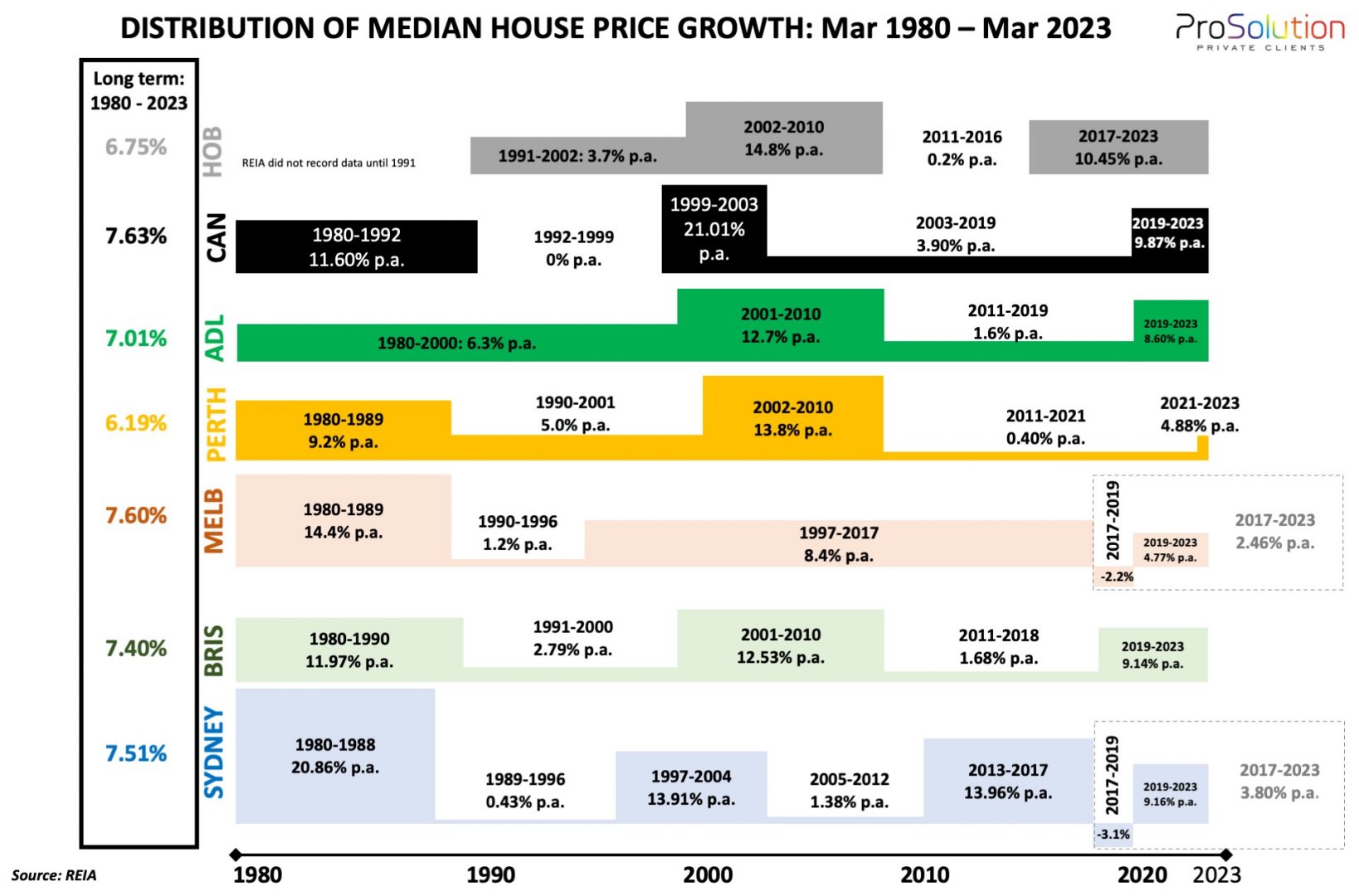
At least median house prices have fallen in Perth . But I put to you that perhaps this is going to turn around and I've shared a chart through this podcast previously . Of course , the link is in the show notes because I've updated it for recent data .
Anyway , this chart looks at property price growth over the last four decades and demonstrates that in most markets there are two distinct cycles . There's a growth cycle and a flat cycle , and the combination of these cycles over very long periods of time results in an average compounding capital growth rate over the last 40 plus years about 7.5% .
And so what we find is that after we go through a flat cycle , we go through a growth cycle , and that growth cycle tends to generate or deliver compounding capital growth at a much higher rate than the average rate , and this is called mean reversion .
Mean reversion means that after a period of below average growth or with respect to property markets tends to be very low growth , are followed by periods of above average growth , and actually put a table together in the blog on the website .
You can certainly have a look at that , and what I did is had a look at what is the subsequent growth after flat cycles that we've seen . So let me give you a few examples , although I'd encourage you have a look at the table yourself . But between 1989 and 1996 , that seven year period in Sydney they had virtually zero growth .
The subsequent seven years after 1996 , almost 14% growth in Melbourne between 1990 and 1996 , that was the recession we had to have . So that six year period , just over 1% growth . Subsequent 20 years was 8.4% . In Brisbane between 1991 and 2000, . That nine year period , about 2.8% growth . The subsequent eight years was 12.5% . Sydney , again between 2005 and 2012, .
1.4% growth , the subsequent five years , 14% growth . And so , as I said , but Perth over the last 15 or so years has been very flat . And so the question then is what is the subsequent growth going to be ?
Well , when you look at those , that data , that historic data , it's suggesting that the growth over the next five to 10 years could be certainly in double digits , and that would be enough to see median prices double over that sort of period of time .
Now , the longer the flat period lasts , for the higher probability that the growth period , the subsequent growth period , will last for longer or , if it's shorter , will be more pronounced . So there is that strong trend of mean reversion . We can I've talked about a number of times in this podcast we can invest , assuming that that mean reversion will kick in .
What we don't know is when it will kick in . You know , the Perth market might actually continue to go sideways for another five years . What we do know is , with every subsequent year that passes , the probability that we're closer to a growth cycle is higher and higher . So I wanted to talk about some pros and cons of investing in Perth .
Obviously , the most obvious one , which I'll talk about in a second , is just the size of the capital city . It's a lot smaller than Melbourne and Sydney . But let's talk about a couple of positives and then we'll talk about a couple of negatives or risk considerations you need to think about if you're contemplating investing in property in Perth .
Firstly , high rental yields in a really tight rental market . Arguably , perth has the tightest rental market in Australia .
Its vacancy rate is only 0.6% of 1% , which is certainly an all-time low , and of course , there is a well-documented rental crisis in Australia at the moment , and so most capital city markets are tight and tightening , but rising rental yields are often indicated the market will soon go through a growth cycle , and the reason for that is simple Higher rental yields
make investing in property more affordable , especially if and when interest rates reduce in the future , and also it reduces the risk of investing in property as well , because if I'm banking a gross rental yield of , let's say , 5% , then I only really need another 5% in capital growth to generate a total return of 10% , whereas if my rental yield is really low ,
then I am very much relying on future capital growth from that particular asset to justify its investment . So , as I discussed earlier this year , the only way to solve the rental crisis is to really attract more private investors into the market .
Look , I think governments will probably play around with a few stupid ideas first , like rent caps , and probably force more landlords out of the market before they eventually realize , hey , we need more private investors and we need to get them back into the market .
Meanwhile , rental yields are just going to increase , I think , and it'll just become a bigger and bigger problem , but at some point most investors are gonna turn around and go . Well , it's pretty attractive to invest in property , despite the fact that the government keeps interfering and changing tenancy laws and so forth .
So I came across this property that's sold in Mount Lawley in Perth in July this year . Mount Lawley's a blue-chip suburb about 4Ks away from Perth CBD . This property was a solid three-bed , two-bar family home on 880 square meters of land in a really quiet street . Now Mount Lawley's a great suburb .
As I've said , it's sold for 1.15 million and is currently being advertised for rent for $820 a week , which equates to a 3.7% gross rental yield . Now , to get a rental yield above 3% for a property that's 4Ks away from the CBD and a really big block of land really anywhere else in Australia would be a struggle .
I mean , you might get close to doing that in Brisbane Brisbane rental yields are pretty attractive as well but it is and I think it probably is good evidence that the value of that asset is intrinsically undervalued , because really , if you're buying an asset that's mostly land value or predominantly land value , typically it means you're gonna get a lower rental yield
, and so it's really strange to find this sort of situation where you're getting such a high rental yield . And that's your starting point . So really , the longer you hold the asset , the better off you'll be in terms of overall yield compared to purchase price .
Now , when I look at this property and think about what's the probability of it being worth , say , $2 million in 10 years , I think it's a bit of an o-brainer . I think that looks like to me a really great and attractive investment .
The next positive is Perth's projected population growth , so its projected population is expected to grow from 2.2 million in 2022 , so it's last year's population to over 2.6 million by 2033 . So just in about 10 years , which is a growth rate of 1.3% , which is really the third fastest rate behind Melbourne and Darwin .
So of course there's been a major influx of overseas immigration , probably since that forecast was put together by the government . So of course , the population could end up being higher than that and whilst Perth is the fourth largest capital city population-wise , its higher growth rate should certainly stimulate demand for property .
So let's talk about a couple of the negatives or risk factors associated with investing in Perth , and the first and most obvious one is its industry concentration risk . You look back at Perth's previous growth cycle , which was between 2002 and 2010 , was in a large part stimulated by the mining boom .
The mining energy companies are very large employers in Perth and that means that the property market is susceptible to a downturn in mining .
You know , apart from the large energy companies and there's about 14 of the largest international energy companies have offices in Perth most corporate head offices located in the eastern capital cities , particularly in Melbourne and Sydney , and those head offices attract , you know , very large salaried employees .
So if you're looking for a head-off position in any sort of listed company , for example , you're most likely gonna find that employment in Melbourne and Sydney , and so by attracting people that earn well above average incomes certainly helps those property markets . I've talked about population , but that is a potential negative downside as well .
The larger the population you have , the more diverse set of demand factors that you get to benefit from , particularly with respect to property markets . Again , having that sort of concentration risk isn't so great . Melbourne and Sydney have more than 5 million people , brisbane 2.6 million plus . So there are bigger cities and they do have more diverse demand factors .
Are the distance and isolation factor , being a different time zone , that there's some pros and cons , I guess , with that .
But if people are going to benefit , or capital cities are going to benefit , from interstate migration , it's much easier for people to say look , I'm gonna leave Sydney and go to Brisbane because same time zone , proximity , the distance , I mean it's still plain flight , but it's not as longer plain flight , say , from Sydney to Perth , and that tyranny of distance
really does , I think , reduce the possibility of increasing interstate migration . Having said all that , I think Perth probably , at least in my opinion , has the best weather in Australia and also , if you're an overseas immigrant , its housing market is relatively affordable compared to Eastern capital cities , so it does have that going for it as well .
Now , perth wouldn't necessarily be my first choice in terms of investment location . If I'm met a client that didn't already have a property investment , I would say I would typically say stick to the larger capital city markets first and start .
Use those capital city markets to start building your wealth , because they're low risk and higher probability of generating better returns . However , if you already have exposure to other capital city markets , well , I think Perth has a lot of merit because it's likely to enjoy a really strong growth cycle .
And remember , all you need from a property investment is more than 7.2% . At 7.2% will mean on average , over long run your property value will double . So if you buy a property for a million dollars today , in 20 years that'll be worth four million dollars and you've accumulated three million dollars of equity .
Three million dollars equity in 20 years time won't be worth three million dollars today , of course , but it'll still be a whole lot of money and go to a very long way to helping people achieve their retirement and lifestyle goals . Now , I'm not just pro Perth .
I think other capital city markets also are well-primed to generate really good growth over the next couple of decades . And I would remind you that Melbourne and Sydney's growth rate over the last five years has been well below average . And we know again mean reversion means that periods of below average growth are typically followed by periods above average growth .
So Melbourne over the last six years in fact sorry has generated 2.5% growth and Sydney 3.8% growth . And remember , the longer term average is close to 7.5% to 8% . So well below average , which means certainly that Melbourne and Sydney aren't attractive markets either .
Anyway , if you think about investing in property and you're comfortable to accept a slightly higher risk by investing in a capital city that's smaller and has more demand concentration than the other larger capital cities , I think you'd be well placed to consider Perth . All right , that's it for this week , until next week . Bye for now .