


¶ Darwin's Evolutionary Insights and Predictions
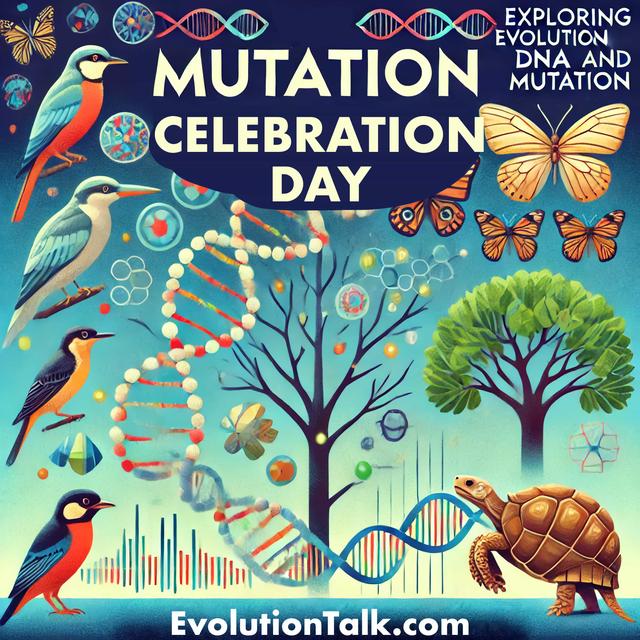
Many thanks to the show's supporters on Patreon. They helped make today's show possible. And to find out how you can help the show, please visit evolutionalk.com forward slash support. Today is Mutation Celebration Day. I bet you didn't know that. Well you won't find it on your calendar though. That's because I made it up just at this very moment. So mark your calendars going forward. September twenty-third is now a special day. For some of you, it's also your birthday, so happy birthday.
in this view of life. Welcome to Evolution Talk with Rick Coast. An introduction to the oldest story ever told. When the idea of evolution by natural selection first entered the mind of Charles Darwin, he knew he was onto something. He could see it in the tortoises of the Galapagos, as well as the many finches found on the islands. He sawred in butterflies and also in barnacles.
It also allowed him to make predictions, as he did when he theorized that it would take a moth with a extremely long proboscis to reach the nectar at the bottom of the Star of Bethlehem orchid. It has an extremely long nectar spur. He felt natural selection would enable a moth to evolve to the point where it can reach the nectar under the right conditions.
Those conditions would involve many minute changes that allow for that proboscis to elongate over an extremely long period of time. It wouldn't happen overnight. It could take centuries. And Darwin was right. Twenty years later, after he theorized about it, the hawk moth was discovered in Madagascar. Madagascar is a hotbed of species that are endemic to the islands.
Endemic means that they're found nowhere else in the world, and depending on the source, you may read that 60 to 75% of its species are unique to the island alone. According to the World Wildlife Fund for Nature, in the decade between nineteen ninety nine to twenty ten, six hundred and fifteen new species were discovered. Six hundred and fifteen. And of those, one hundred were mammals and reptiles.
¶ DNA: The Engine of Mutation
While Darwin knew that small changes in an animal, if they were beneficial, of course, would persist. He didn't know the mechanism behind those changes. What caused them? Were they random changes, or if so, how were they recorded in the organism itself in order to be passed on to its offspring? In the early twentieth century a theory emerged to help understand these changes. It was advanced by the Dutch botanist Hugo de Vries, and he called it mutation theory.
While mutation theory itself, at least as it was originally formulated, supposed that new species formed almost instantly by sudden genetic changes, as opposed to an accumulation of changes over time, There was still the mystery of where this information was ultimately stored. And this was solved by Rosalind, Franklin, Francis Crick, and James Watson in 1953 by the discovery of DNA.
And DNA, if you've been listening to the show for a while, you probably know that DNA is the recording and the transcription mechanism behind these changes. You can think of DNA like the instruction manual for building an organism like you and me. Change those instructions even slightly. and strange and sometimes wonderful things can happen. All that is required to make a change is to swap even one DNA letter for another, or add or remove an entire section of DNA, or copy an entire gene.
¶ Neutral, Harmful, and Beneficial Mutations
It might seem that changes like this would be harmful, and sometimes they are, but not always. The effects of a mutation are dependent on many factors. You have to look at the environment that the organism lives in the pressures that that environment places on it, and how the animal whose DNA has mutated adapts or deals with the change.
A change can be neutral, meaning that it doesn't help or harm the organism, like say, a typo in a book. Sometimes that typo won't change the meaning of a sentence. Let's say I were to write the sentence, that lake is large. and you were to repeat it in your writing as that lake is big. We see the word large change to big, but it still conveys the same meaning to the reader.
There's no harm and no foul. Maybe from that moment on people use your sentence instead of mine, but the information in the sentence remains the same. The change was neutral. It's safe to say a majority of the mutations in our DNA is neither harmful nor beneficial. It just is. Now, what if you wrote the word small instead, as in that lake is small? From that moment on, people who read about the lake would imagine it as being small. It's now a completely different lake in the mind of the reader.
Put it another way, let's say a change in an animal's DNA causes a disease that decreases the animal's chances of survival. What if the animal lives in a cold environment and other animals of its kind have thick coats of hair? If the genetic mutation or say an error in the DNA copying process results in an animal with less hair,
That could be said to be a harmful mutation. The animal may not survive because of it, unless it finds a way to adapt and cope with this change. If not, it is far from neutral. In this case, that mutation was harmful. And the opposite is true as well. A mutation that allows for an even thicker coat of hair might prove beneficial and allow the species to migrate to even colder areas, increasing its habitat. In this instance, that mutation was beneficial.
Now accumulate those changes over time, all of these small changes, however minute they may be, and that animal could conceivably evolve into an entirely new species. It's mind blowing, but it's also true.
¶ The Grand Story of Evolution
While we can see the effects of beneficial mutations all around us, the entire world is populated by the recipients of these changes. What's amazing is that this all came from one single organism, or last universal common ancestor, also known as Aleuca. And that ancestor lived around 4.2 billion years ago.
Now a lot has happened over the last 4.2 billion years. Imagine what it will look like in say another 4 billion years. Our sun will begin its dying process in about 5 billion years, so hopefully our species has found a way to save itself. Once that process has started, there's only a couple billion years left. Now who knows, we may even find a way to manipulate our own DNA to enable us to survive the hazards of extended space travel, or live on worlds that are entirely covered in water.
Future mutations in our DNA may be completely intentional as well. Let's all say thank you to the millions, if not billions, of mutations that have made us who we are today. Without them, we would still be wiggling around in a warm little pond somewhere. And think of mutations as the raw material of evolution. They provide the genetic variation that natural selection acts upon. Not all mutations are passed on and many are lost to time. While mutations can sometimes be harmful, as I said,
But they're also a wonderful part of the natural process that drives evolution. So the next time that you look in the mirror to comb your hair or say brush your teeth, say thank you to all of the mutations that made you possible. I hope you enjoyed today's episode of Evolution Talk. I'm Rick Host, and if you find value in this show, please consider becoming a patron or supporting the show at EvolutionTalk.com forward slash. Support. It will greatly help the show survive. Financially.
I'll put links in the show notes for that, but spread the word and share the show with your friends, your classmates, your professors, or teachers. At EvolutionTalk.com you'll also find some more information, you'll find recommended books and ways to contact me. I'd love to hear from you. And I hope your week is going well and until next time, please take care of yourself. Evolution Talk is a Rick Coast production.