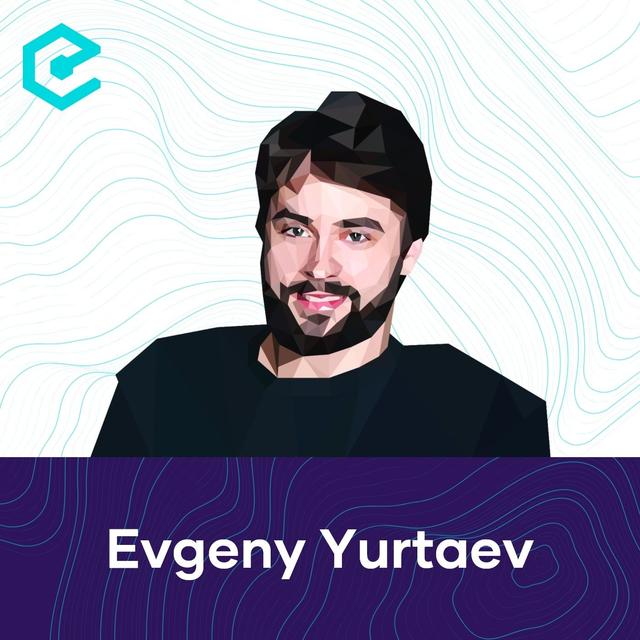



This is Epicenter episode 517 with guest Evgeny Your Tev. Welcome to Epicenter, the show which talks about the technologies, projects, and people driving decentralization and the blockchain revolution. I'm Fedelikka Annes and today I'm speaking with Evgeny, who is the cofounder and CEO of Zarion, which is a well known web three wallet Afghani welcome. Thanks, Frederica. It's really a pleasure to be
here. It's the podcast that I've been known, I've known for a while, so I'm super happy to be here. And yeah, thanks for hosting. Cool. So you know about us, but what about you? Tell us about yourself. What's your background? Sure. So as much as already I'm at Guinea. I've been in the crypto space since roughly forever, I would say like since the, yeah, like my first interaction was like very like early on in 2015 or
even earlier than that. But I really really got into crypto after the the white paper for Ethereum. That to be quite honest, I still remember the day when I was I was on the subway just like scrolling through the Internet. And I was I came across the white paper and I just read it through it. It blew my mind. So that's how I got into like the whole space basically. Since then, I've been. I've been committed to working in Web 3, even though it wasn't called Web 3 back in the day
and. Yeah, before that I I was still studying. At that moment I was studying computer science. That's my background. I'm an engineer by education and like my first adventures, but honestly in like in my spirit, I'm I'm an entrepreneur. So I've been working on my own projects basically since high school and I started like various mobile apps, chat bots and some of them like with variable level of success. I think the the most interesting one was actually already in the
crypto space. That's before 0 in was an app called Crypto Trader. It had over 1,000,000 downloads with like pretty like 0 marketing efforts or anything. It was just for tracking whatever price was and I built it for myself and it just scaled to to many people liked it and before that I worked. This is how I actually found my cofounder. I was. Building mobile applications with like a venture studio in Moscow. So that's the background.
When you were on the subway reading the Ethereum white paper, what was it exactly that appeared kind of the technology itself, or kind of the idea of what it could empower in the long run? Yeah, so this is. I think a fairly typical story for anyone living in a third a
third word world country. So when the financial system basically like after the Soviet Union collapse, obviously Russia took a capitalist approach but the financial system was not nearly as stable as it was in Europe, for example in the US. And 1st I was intrigued by the the. Idea of programmable money. This is like first when I read about Bitcoin, but as a as an engineer myself, I was not convinced fully. I would say that this is going to be you know, I kind of liked it.
I started reading about the nature of currency, the nature of money, how it all works. Why is the currency in my country collapsing and in others it doesn't? Why the stock market behaves by but like the way it behaves? And so this gotten my interest, but really, really got excited when I understood that you could leverage the technology of blockchain to extend that to essentially programmable trust. So it's not just about money anymore.
And if we can't have this shared trust layer which is the Ethereum computer, this is where I got, I was sold basically. And yeah, I think there were a lot of other. Really forward-looking ideas in the white paper, many of which were I guess took years and years to realize. But I think the main proposition was, yeah, changing, like changing the rules basically And where this whole thing is headed. Yeah, absolutely. So after the success of Crypto Trader, you guys started Serion
together. What was the motivation behind? I mean, basically even back then there were a multitude of wallets, right? So, kind of What was the motivation behind starting yet another wallet? Yeah. So I think it's fair to kind of took it a little bit of a D route here and talk about zeros evolution. So zeroing was zeroing is a wallet only for the last year and a half roughly and all the all the time before that zeroing was kind of.
Three different companies. So we really started with even like you can call it the Spark concept development studio. So we were helping out the companies and with ideas who knew what they want to build on top of theorem just realize their things. And later I think like the first really the story where of 0 in itself starts with the folio
tracking. When we decided that we actually didn't want to build a wallet, there were so many already, like there were quite a few wallets, The space was. Pretty much starting to be filled with a magnitude of tokens and that people really needed tools for them to keep track of stuff that is happening, what they have even in their wallet. And this is by the way still a big issue for the existing big wallets.
We don't have to call them out here and we've started with that mission to track basically everything that happens on chain such that the users don't have to worry about it and they have. Control, because control means safety and this is how we got our first user base. So people were coming to zero and just to see what they really have in the portfolio, what kind of transactions they were making and that's been fairly successful. And this is how we got started.
But what we realized over time is that DFI is becoming like a big thing, and it's now much easier than ever because of this. Access to the centralized trust in a way we could just integrate uni swap without even like going and talking to uni swap and people could start leveraging that within our interface. And we soon noticed that basically the users who are transacting using Syrian, they are our you can you can call like super fat. So they just love the experience.
They love the UI, they like love the combination of the portfolio tracking with the transacting part and we kind of. We dived into this path and we started doing more and more integrations. We were the first ever integration of union swap, I think the first integration of Maker Dow, the first integration of Compound V2 and like a few
other protocols. So really, really early in the Defy journey and eventually this this whole I guess pathway led us to realizing that this is time when we are ready to start our own bullet because the existing wallets were still. Lagging behind in terms of the I guess the data capabilities so the and the UX in general. So UX I think in crypto in a big way is build on top of good data and like fast.
Yeah like a fast understanding what was in your wallet to make good decisions to sign transactions in a safer way to exactly know like and how connecting to the apps and etc etc. So that requires good information and we had that for for a while now and. We decided that the bullet should have all, should have it all and yeah that's that was the whole motivation behind if I'm moving into the wallet space eventually I think it I kind of see it as like the the end game for Syrian.
We we were thinking of doing a wallet for a very, very long time. We always like postpone that and like it's much harder to compete, it's harder to monetize etcetera, etcetera. But yeah, I feel like we are ready now. And yeah, lastly, I think what's important to mention here, a very long time ago, I think it was like 2017 we even had an attempt at wallet. We didn't put too much effort into it, but it was called Tokinary, it was one of the, it was built by one of our
engineers. So basically like a kind of like a sister company or speed off from Zirion and. It was cool talking, Larry. So that was like very, very simple wallet. It was built using the kind of telegram principle of removing all the clutter and just keeping focus on one single wallet, just the tokens and signing transactions. That's it. It was a cool thing. We still have users on that, but we're not really doing anything anymore with this. And obviously now zero is the main thing.
Okay, maybe. Let's talk about kind of how Xerion handles for the user and then we can kind of talk about kind of the spectrum of wallets and kind of what they do for you X and kind of what you guys plan to do for you X because obviously it's, I mean it's super apparent that user experience for wallets has to greatly improve for this to kind of see any mainstream adoption. So kind of talk us through if I go to xerion dot io now and want to create a wallet, how do you
guys do that for me? Where are the keys? How do I safe keep them? Yeah. So I think the best experience would be on mobile still. So we are in the process of releasing. So for our web users, we are in the process of releasing the extension. So this is happening already. We're going to go public life in about a month from now. So we're pretty much gearing for that and excited for this launch. We still, we already have over 10,000 beta users of the extension, but yeah that would
be the milestone. Majority of our users of the wallet are on mobile and the way it works is a very classic non custodial wallet. So you come, you create a seat phrase. We'll guide you through how you should recover that we. We're obviously thinking about other ways of custody, but I think for us the main reason why we wanted to keep it very simple is that first we do rely a lot on composability, so daps have to work for for the world to be
useful. And 2nd we wanted to it's you can go like a vampire attack on meta mask. We want users to migrate over, and we still have a pretty big chunk of users just moving their seed phrase from meta mask to Syrian. And yeah, the C phrase just stays on the device and we obviously don't have access to it. You can back it up in I cloud if you want. And yeah, that's about it in terms of just creating a wallet. So it's very simple, just a few
taps, yeah. And in terms of the experience, I guess what you get is the DAP browser that works. So you can connect to any DAP and you can site transaction transactions. You can connect to pretty much any network out there. So we support fully support in terms of data capabilities, we support about 10 chains and the rest you can just add any custom RPC and start signing
transactions. We do check every transaction before it's sent by simulating it and giving you what is going to happen as a result of this transaction. I know that the safe does that too and like good better wallets are doing that now. So that's good. And we obviously checked the domain names for phishing and basically doing all kinds of security checks in the moment of transactions. And we plan to add more and more stuff on the security of the basically interacting with the
blockchains. Okay. We'll dive into that in just a bit. Let's kind of just remain on the seed phrase for now. So I assume the seed phrase is in some sort of secure enclave in your phone, right? When you say you can back it up to iCloud, can you also just write it down kind of pen and paper, or do you never get to see it? You obviously can, yes, so that would be the default way for most people who know how to handle the seed phrases. But backing it up to iCloud is still.
It's kind of an easy way for you to for someone who is not too experienced with crypto but still want to give it a go. To not lose the key. And if for example their device is stolen or lost, in that case they might have forgotten to back it up using like a paper and a pen. And in that case they could just using their Apple ID or Google account. They and plus like their biometrics, they can restore access to the seed phrase.
So basically the seed phrase is not stored in the open way in I cloud or Google Drive. It's encrypted with your biometrics and stored. So basically if you lose both your, I guess, PIN to the phone and your phone, that's the one you actually lose the key. Yeah, but in other cases it saves from. The most common way of losing A/C phrase is when you forgot to back it up. So yeah, that's, that's where we are. It doesn't obviously protect from the leakage of the seed
phrase. So if you've written down some seed phrases, that's the biggest concern. So if you write it down somewhere and someone finds it out, finds out, you see it, money's gone. And obviously there are ways to rent from that, but but that requires using completely different stack of custody. And yeah, I think next year would probably be when that gets more and more adoption, who, who are your users?
So basically if you kind of look at financial applications, there are typically kind of users who are kind of happy to use their phones for stuff. But at some point kind of at some level of awareness, this stops, right, you're not going to make, you know, $1 million transaction from your phone. People just have an aversion to that. So kind of who who is your user base? Actually that's a new question. So yeah, I have two things on
this. So Speaking of the user base, it starts with obviously we're not focused on a whale type of user. So if you really want to store a lot of money and Zerian is not the right now at least is not the place where you should be doing that. So Zerian is primarily for your. I would call it like a public on chain identity. So if you want to. Mint out of T's if you want to quickly sign into something on on a conference.
If you are trying to, I don't know, like buy some random token or mint a sound on sound XYZ or mint a post on mirror. So these types of actions, whether that's collecting or like buying some random tokens in small amounts just to play around, testing new stuff, new daps, new protocols, games, whatever that is. And that's where we we shine really. And the Xerion was meant for users who are doing a lot of transactions.
So that's kind of opposed to what Ledger is meant to be or maybe safe like I mean those is safe where you keep a lot of funds and you try not to touch them, but when you do, you do it like very carefully. So that would be the use case for a Ledger and that's why like obviously Ledger is not convenient. You need to carry it around
like. Plug in and obviously like you won't do that in like a minute in zero and you can just like pull it up, scan up your code or admin stuff or like test out a new DAP on the go. So that's the main use case. And the second thing I wanted to add is I think in the future it would still work really nicely with these types of use cases and for that it's just a little. A bit more time is required.
So obviously the safe integration on the Xerion end could be one of the solutions where you could like initiate transactions from the phone and there's not going to be any security concerns because you would have a second key where or like you have a friend who would need to confirm a transaction. And even with the Ledger, we have some users who are using Xerion mobile experience with the Ledger. And soon they'll be able to do that with extension.
So it's kind of like an interface, so you don't have to worry about the key being leaked in any way. Or yeah, you can keep as much fun as you want obviously on these types of bullets. So we kind of separate the bullet experience from custody. And currently our custody works for these like smaller type of like amounts of money but much
broader set of use cases. Have you looked at kind of second signers and so on that kind of connect with NFC because kind of you know being mobile first that sort of you know a low hanging fruit, no? We did. And by that you mean like kind of like a UB key, like NFC, something like a tandem, a card or something? Yes, they usually with all of that. So it all sounds great and I would really love to have something like that and I've seen tested numerous.
Parts that you need to tap to confirm transactions I even like. I have an NFC ring like. Here that I'm using for payment, so I'm a big nerd for these types of things, but I think when it comes to a more mass adoption, this is logistics, It's expensive.
So basically. If we have this much user base, like only whatever 10% tops would be willing to pay for it, reveal their address like their like levels and levels of considerations that we need to take care of before using that specific solution and it never really took off. So I'm I think our our way is honestly software rather than hardware when it comes to adoption. So making things cheaper and making them, making them more.
Like available through existing technology and that's why for example abstraction to me is more I guess a reliable way to progress with the UX and also like the new signature, so if we can reuse the signature from existing hardware devices which. That they're not currently compatible with theorem
signatures. But if we can make easy and kind of abstraction then compatible, then we can leverage existing hardware in the phone and we don't have to even have a Ledger. So I think that's the best pathway for it. And yeah, for all the mass adoption, cool. So I understand that kind of the users that use Sareon currently are kind of like people who go to events, who kind of want to try out different apps, kind of have spending money just kind of like on a low barrier to entry
mobile app. What are your intended users? Because kind of that's as a market, that's a very constrained set of people, right? Yeah, I think it's constrained right now, but I'm a big proponent of the growth of the Web 3 user base and we kind of we define our users as Web three citizens and we've been pretty vocal about that. And I still feel pretty strongly that we don't really have to change that.
I know that a lot of people are talking about onboarding the newbies, billions of users to Web 3. But to me I think it should grow from within, it should grow from the the web three citizens themselves.
And we really want to support the use cases that are actually working and useful in Web 3. And that's why we we want to kind of what we're focusing on what people are doing now in Web 3 because that kind of gives us early hints of what could be useful for the rest of the market when it when the time comes. So yeah, I don't think, I don't really believe in us kind of deciding like someone finding out randomly that this is what people would want.
And I think the UX of the wallet is no matter how bad it is, we need to find the use cases within the Web 3 space that will attract people. And once we have that, and I hope we won't miss that. So as these narratives are created within the Web 3 ecosystem and zeroing supports them, then all the new users who are going to come to Web three and become web three citizens, they would be the ones like they would try to look up to all the web three citizens who were
there and they were coming. They would be coming for the use cases that we've developed. So that that's my point of view. So I'm not like again a big believer in copying something and just putting on on Web Three and and making it like look like it's Web 2 because because why? Like it's the same, but just more expensive. And users would probably come for maybe some incentives, but that's it. They would just leave next day. Okay.
Then maybe looking at the wallet as it is now, not kind of at the user experience as you wanted to develop in the future, what are the challenges of building a wallet? So kind of I assume there's kind of like you need to run archiver nodes and have like databases and so on for several chains. But it walk us through the details or there's quite a few and and that really depends on what kind of we're talking
about. So first of all, none of the, I guess like very, very few wallets run archive notes just on even notes. Even though we do a lot of focus on the data, we don't run our own notes because this is like someone else's business. They do that better for us. I think that speaking from like the product perspective, I think the biggest challenge is really understanding what's key to have on the wallet level versus what's what should live on the DAP level and that's that's the balance.
And I think every, every wallet is really going through that. So some some wallets were like OK, we have to do things very, very certain way like this. This is the only way you can do stuff this. These are the only Daps you can access and being very restrictive. There are wallets that are completely kind of removed from your experience and they just say OK, that's the key. Everything else is like up to you. I think Madam Mask is probably on that kind of that spectrum.
So they don't really make any decisions for the user. They don't try to net like help the user do the right decisions. That always I think we sit somewhere in the middle. So we are being more pragmatic I would say about it. So we know that spam for example is a big problem. So we do work on our end to remove spam because this leads to phishing, it leads to people losing funds. Same goes to anything when it comes to like signing off the transaction. We want by default to have
protection for our users. So stuff like that is where we take a stance, but we don't want to limit the user and that's another reason I've mentioned that already. We wanted to go with C phrases because we want users to be able to access a wider range of things. So whatever that they want to access, we want to have that. Yeah. And I think that's on the product level from I guess the business angle obviously is monetization. We will talk about that I guess
later. But yeah, modernization is obviously has been a pain for most of the wallets with an exception I think of 1 or maybe 2 Okay, two Ledger we can call Ledger, Madam ask as like the ones who were not struggling really with modernization. And lastly I think on the infra side, I don't think it's a, it's a really hard thing like a challenge, it's more of hard work that we need to put into into that. But I hope that pays off.
So. If you think about kind of the decisions you make for the user, so kind of what dabs to display in your wallet, for instance, what's the approval process and kind of if I'm a Zarian user, can I make sure that these are kind of audited or trusted or that there's at least so and so much TBL that kind of hasn't been. So I mean what are my assurances?
That's a good question. We actually on the on the DAP list side, we don't do any kind of restrictions so you can access it's more like a Google live interface and this is where we're different from I guess majority of OS where which run like a mini marketplace of the approved Daps.
We decided against that for for the sake of openness and basically we don't really want to recommend any particular app, So usually users would come with an intention in mind of what exactly they should do and we provide that with that. What we do though to help users kind of make slightly like basically not to go to a different uni swap, maybe mistype. We have a small blue check mark so if they start typing uni a few options would show up and uni swap would have the blue check mark.
But that's just a list that we maintain of domain name associations and that's a pretty exhaustive list of non spammy non phishing depths. Yeah, we don't have a process for this one. So it's currently just managed internally we used to have. So for the tokens we do the same, but the process there is a little different. So we are relying on token lists. So token list is like the centralized effort for curating legit tokens. So we rely on that.
With apps, there's no such thing as far as I understand right now. We would want to have that if that's available. And honestly, we don't want to make these decisions for the user. That's something that we think users should be on their own when making stuff like that. How do you think about kind of the Attack Attack vectors that kind of come with being a front end to kind of other people's smart contracts, right.
So basically if your front end were to be hacked, kind of your users could be kind of siphoned off by malicious sites and so on. So what kind of security do you have in place for that? Yeah, this is I think a very, this is somewhat of a more solved problem in a way. So that's not novel. It's something that every startup is running into that runs any kind of front end. So I think it's, first of all, it's a little, yeah, it's a
smaller problem. And then that just takes good hygiene in terms of cyber security. Yeah. And we just do testing of our own infrastructure. We've employed white hackers to poke around and like try to find stuff. The attack vector is still fairly limited because it's basically we only need to safeguard the deployment of this new up like the new versions of the front end. And the biggest risk of me see is where the keys are stored.
So deployment of extension, deployment of mobile apps and that a big portion of that security is on the Apple and Google side. So they help you not to make like basically if there's a deployment happening, we would all see that and it's a, it's a fairly removed risk I think for us where we did pay out bounties for example, where you can call them like informational attacks. So I still remember like one big case where we had to pay, it was like $40,000 or something were
lost. And that was because someone created a fake balancer pool that looked like a regular balancer pool and had and they faked that pool to look like it has a lot of tbl. So it showed up in in Syria and people were like okay this, this is like a legit. They thought it's a legit pool because it has a certain amount of tbl and we didn't check the factory contract that was created creating that. Since then, we've started doing that, but that was a bug that we didn't anticipate.
So it was put up on the front page with like high TVL. Someone put somebody that lost it. So we assume that this is our mistake, even though obviously, like it's you have to verify everything. But we, yeah, we didn't mean to show this pool anyway. So yeah, that's these are some learnings we didn't go through like a massive breach of security. And for us, I think like not sending a seed phrase somewhere where it shouldn't be, that would be the only thing we
should worry about really. And for that we just always do the audits. I think it's been, yeah, like 6-7 already and we keep doing that. That's going to be a big expense. Another attack factor is kind of having transactions you can't read, right? So basically human. Readable transaction code rather than kind of like the ABI that you kind of get. How do you feel about that? Because it's a difficult problem to solve, kind of generally.
But if you don't know what you're signing as a user, it's really difficult, right? Yeah. So for that, I think what really works, I would say, well is the simulations. So that's been getting implemented across the board. So I think it started with a few extra extensions that were that you need to run in parallel with like whatever matter mask, but now it's integrated in zero and obviously in the coin based wallet and save.
So I think that saves you and kind of allows you to do a quick check of what is actually happening. It's still not perfect because sometimes the daps would be asking you some signature that is the you have. You don't have any idea what can happen. You have to have a more yeah I guess like a secures adapt to you understand where this signature can be applied. But I think this is going to be solved over time as well. So we do for specific signatures.
When when you are issuing a permit for some contract to spend your your USDC or something else, we would also recognize that and and show you in the in the human readable way that some DAP is trying to you know spend this much money. Is it something that you really want to be doing or not. And yeah simulation I think really really helps. So if you weren't your intention was to min to NFT. If this is what you see as a result of simulation, then most
likely that's correct. I think in the future this is even kind of better than in the web two world. So in web two world you just plug in your credit card and you you leverage the trust network of all the POS connected to Visa. And they do like all this fraud prevention if they see something iffy. But you have to rely on someone else doing the job of verifying that you are actually doing something legit. And not every every transaction supports like 3D security with
cards. So in crypto you can have basically deterministic outcome of the transaction. In most cases you could see exactly what's happening. I think the security when it comes to signing will just keep getting better and users won't even need to know what like ABI is. And I really hope that they don't. Absolutely. So I think if we can't make that happen, this is going to remain very niche. So what networks are most of your users on? Good question.
It's been changing honestly and we've been very positively surprised how the adoption of layer twos is growing. So we had like during this year it went from roughly like 70% Ethereum domination to now Ethereum being. I don't, I don't want to be like I cannot give specific numbers. I didn't rehearse them but we have it's it's a lot of the change. So you can you can see it's it's full list of transactions that are made being done all different chains and they roughly similar.
I think the biggest one is still Polygon but it's kind of shrinking in comparison to ZK saying for example transactions or base transactions optimism, arbitram were historically growing pretty much every months and the theorem is kind of like at capacity. So it's it just sits there and
everything else is growing. So it's very exciting to see and we do believe really like we kind of refocused our attention from D Phi protocols more towards supporting more and more chains because we think that in terms of the primitives were pretty much there. Because like I think regionally people were thinking that D Phi would create you know,
thousands. And we were one of the believers in that that like that we're going to see at least hundreds of different, I mean meaningfully different protocols in D Phi or just the outside of D Phi. But it turned out, I think that we have a pretty stable set of primitives that people use and everything else is more like, yeah, forks or just slight adjustments of what we have. And we've decided that OK, we have to support this set of
primitives. But really where we should spending spend our time is, you know, the number of tokens and chains that are being created because we had kind of solidified the architecture I would say, of this world computer. So we have all the bits and pieces in place roughly, these computers can now talk to each other. So now we just need to support this network of computers as the wallet. How do users go between different chains or between Ethereum and then L2? Do you guys kind of have?
In those bridges that you kind of offer as a standard interface or how would I go about it? Yeah, we actually support socket dot tech, so we've integrated them and they are in aggregator bridges. The way it works is just they find the best rates across different bridges for any kind of swap, and the users just go and select the bridge that they
want to use. So they could optimize for faster transaction, faster settlement or just cheaper basically like matching how much they would get on the other side of the bridge. I would say this experience is suboptimal. Yeah, we've been even calculating the number of steps it takes to bridge to like a new chain. So switching to new chain is very simple. It's like a few taps, but if you want to move money, you need to go and do probably 15 different
steps as far as I remember. And it also requires a lot of waiting time and it's not transparent. Even in Syrian we do as much as we can in terms of tracking assets. But the bridging experience is not optimal because you kind of have this moment where money is gone. You have it in banks all the
time. But encrypt is unusual when you don't understand what is happening with the money because it kind of it went away and you just like wait there and hope that it's going to come on the other side.
So we really want to optimize that in the future and the way to do that would be basically and that's a general principle of moving away from multi chain to 1 chain UX as we started describing it inside Syrian. So when users already need to understand the differences between chains unless they want to and you can seamlessly move and transact on any DAP on any chain without really like going through bridging first and then
doing a transaction. So kind of bundling these two things together, inciting them all at once. So I think that's the future and we, I don't know when, but we're definitely gonna get there. What are the steps kind of necessary to get there? Kind of the seamless bridging that kind of just goes on behind the scenes without the user even realizing. It's a good question.
I think it's first, it's obviously some UX work that we have to do and we need to have more universal guess adoption of signing either signing multiple actions on it with one tap. So that's some ball. It's already started doing that before, the convention was that you will have to sign everything, like every transaction 1 by 1, but with approvals. That kills the experience because you have to sign multiple things. Permits are not universally accepted, so that's an issue.
And ideally, yeah, we can bundle a few transactions together and the bridges are fast and they could execute on that other side. Yeah, I think these are the necessary steps. I don't know what would be the guarantees between moving the for just to work between different kinds of and different versions of roll ups. So whether it's going to be the same security guarantees to move from like an optimistic 1 to the ZK one, I'm not too sure about
that. But yeah, I think that would be what we want ultimately as the goal. So basically you also cover some chains that are not Ethereum L twos, right. This was you didn't call it an experiment. We've added support for tracking Solana addresses but that we all know the FTX story.
But really it was I think we're not like our users don't really, they're not Solana users in short and to be quite honest we have one of the zero values is is done be a Maxi and that's just like a you know the whole company value and we wanted to explore other things we wanted to to see. So Solano was obviously getting a lot of traction. So we wanted to support it and we did since the the FTX and just overall we didn't see a lot of traction in it and we haven't
really put any more resources. Personally, I'm a big EVM supporter and believer and because I feel that we're kind of past the threshold where it's easy to compete with EVM just simply because we have so much code written down and so much investment done in security. I think we were never maybe like someday a new Apple will be born that is going to use a bit of a different architecture. I don't think that's anytime soon it's going to take. Years, I would say.
So EVM is the way to go and we've been basically the whole infrastructure that we've built for tracking assets, tracking positions is built on EVM and specifically for EVM. We touched upon it earlier just a little bit. How do you think about account abstraction in MPC? Right. This is a, this is a long debate. We've been researching both for a long time. I think it started obviously more with MPC and the counterstruction became a more recent theme. I think NBC is a little.
So there there are many things I can say I guess on this and the short answer, it depends what we're trying to build towards when it comes to experiences that remove the basically the wallet from the picture completely. So like applications that kind of integrate the world inside. I think for them NPC is the only way right now to manage that.
I think in the future though, NPC has much less flexibility than account abstraction for anything related to user experience, like recovery of phrases, making actions on behalf of the user. So with NPC, I think there are a few attempts how you can implement the same programmability really of NPC. But this is a little so complicated and it's hard to see like how that's going to necessarily get all the traction. So it feels like to me when it comes down now, now we can talk
about the count obstruction. So with the count obstruction, I think in the current form there's still problems. So we started a long time ago with this idea of let's replace all the existing accounts and with with mark on checks on the protocol level. And I think it was like EIP 2000, something I don't remember exactly, but that EAP was not a priority for the community and for the protocol developers.
So it kind of was worried and now everyone is talking about ERC 4337 which is making a kind of abstraction kind of on the application level and without necessarily being hard for it. So I don't think this is a way to go for a theorem at least because primarily because of the costs associated with that.
And I think the future of account obstruction is really on L2S where L2S make this hard choice and basically implement it on the level of the protocol when we actually remove the need for users to upgrade and move their assets from private keys to account obstruction obstructed worlds. So I think that's the way to go. And I know that there are some teams that are working on for example Gelato team, they're
doing a roll up as a service. So they are thinking about implementing that for all their potential launch partners such that this becomes a more of a standard in the space where every account is indeed an account abstracted wallet. And in terms of possibilities, I think one would be ideal.
In terms of the Uxs, as I mentioned previously, when we support the same cryptography on account abstracted worlds together with account abstracted worlds being in the protocol level, I think that's where we get all the flexibility that is needed and it's not going to be associated with an increased cost for every transaction and we don't have to do this massive migration. I don't know what the theory is going to do though. It's tough.
I think majority of value is already on account on smart contracts, which is fine. Probably no one will just use the theorem with private keys support at some point and with ethere will be just for roll up transactions and block confirmations. But we'll see. Yeah, I think that's our current view on the whole thing.
We are exploring more native support for count obstructed votes in Syrian without necessarily launching our own version of it. We kind of see it as in a current form it would look like a 0 bolt in some way because you still need to have a private key stored somewhere and that would be the first step. And we actually already enabled some of the standards for construction for tracking.
So you could plug in if you have an account you can plug in and get at least the full your value over time for these wallets. We haven't done on, haven't done transacting with these wallets yet, but we are ready to do that. Yeah, let's leave that there for now. I think there's something I want to come back to later, but let's talk about kind of the business models for wallets first.
So kind of monetizing wallet has been notoriously difficult in this ecosystem and with the two notable exceptions that you kind of you mentioned earlier that and meta mask. What kind of business models exists and why is it so hard for wallets to kind of monetize? It's a really good question. So we've researched them all. I would say at this point at least like everything that's available on the market right
now. I think there are a few things that really work, but they require skill and they require a bit of a if there is speculation and market movement, obviously trading fees work and that's been working for Meta Musk, it kind of does. Still because they have a massive user base, they're obviously earning a lot less with the bear market, but all sorts of fees. They work because users are ready to pay for convenience and
trust. So as they develop trust to your product, if they store enough money in it and they kind of been using it forever, they're OK with paying fees. We took a bit of a different pathway here in comparison to like some other wallets. So most of the wallets they don't have any option for more advanced users to stop paying fees and we took it one step further.
So we allow allow you to basically hold a certain specific entity SO0IN DNA with premium that allows you to not pay any kinds of fees and that's basically our we wanted to be using zero swap ourselves internally as a team and for the majority for like actually big charge of our users who are pretty active and they do a lot of transacting. It makes sense to have the same good experience but not pay you
know very high fees for swaps. But at the same time, this works for less experienced users who are OK with paying fees for the sake of convenience and trust. So that's the one model that works. And yeah, but I'm not really excited about it. And the reason is that training fees and all kinds of like breaching fees or stuff like that is all driving the wallets, the words, the financial use cases. And we see less and less transactions specifically for token trades or stuff like that.
So a lot more activities on maintaining or doing some governance, so people are doing more things with their wallets rather than just trading. And I think that drives away the value of this business model. So we don't want to be like Robin Hood and that like Robin Hood selling options to retail users just to boost the bullets. So for us like another big thing was API. This is something that is not accessible for majority of other ones because they are just the
front end. We provide the data for the wallets and we've we support quite a few wallets out there. For example Rainbow is one of our clients since 2020 they've been relying on Syrians data and they are ready to pay for that data because this powering the user experience and we have more and more bullets who are using and leveraging outlet data. So that became, you can call it like a bear market, the rescue in terms of revenue and monetization for us.
And lastly, I think the way to go honestly a long term vision is to ideally own the whole stack. So moving to monetizing pretty much any transactions that user, any transaction that user does and the way to do that is either the applications or the chains share revenue with bullets or we primarily work with our own change or layer twos and we direct users to layer twos that we can monetize.
So for example, like launching our own layer two would be an example where we can monetize any transaction with like sequencer fees. So that's I guess the path forward potentially, but it's a little too early and we haven't seen. So this is like very experimental. There are no bullets currently who have their own layer twos. Madamus is kind of with idea is kind of moving in that direction. I think that's what consensus once at least that's the feeling
that I'm getting. But this might be an interesting Ave. Have you looked at kind of becoming even more of a service provider and kind of abstracting fees away from people and kind of having them pay like a flat fee or like a service fee that kind of because?
Kind of what account abstraction also in principle enables, it's kind of abstracting the gas away from the user, which I think kind of if this kind of if this were to become more mainstream, this is I think where we have to go because I mean this is kind of the Web 2 experience. No one would ever say you're browsing to my website, please cover your part of the AWS bill
sort of thing. So do do you think kind of abstracting that away and then having people pay for the package, do do you see that as viable? We've researched that. I think first of all, from the UX perspective, you're completely right. This is definitely how it it will work. So we'll abstract away the fees and I think we're not too far off from that. I think when it comes to monetizing that, it's a little different.
So what you're suggesting is that we add a certain amount of like margin on top, so we make users pay more for the convenience and? Or you just charge them a flat fee per month, right. So basically kind of like, yeah, kind of like you do for kind of a regular bank account, kind of you have like €5 per month kind of in fees and but then you don't have to pay for like every transaction, right. Yeah. But even with banks, right, like most of the banks now provide this service for free.
So it's kind of like a race to up to to zero with these types of fees. So you would ideally want to charge users for the added value and not for just maintaining you know the Ethereum, for like running Ethereum if they're not transacting like basically covering our node and node costs. So most of the services on Web two, you would pay premium only for the features that you really want and not just like them running from the AWS, sure. So I think the analogy here is similar.
So we are moving, we are releasing this premium kind of in the more finalized state this, yeah next month as well. So that would be we'll see basically what our users are interested in paying for like if we provide them with premium, can we provide them a few transactions in months for free. But these are all more of the economics questions and we need
to test how it really works. Yeah, I'm more excited of like basically if we, if we have the chain, so users are interested in paying for transactions, right. So that's pretty much universal and currently all of that revenue goes towards the chains themselves and none of that goes to wallets and this is a problem. So that I think that value distribution have to switch.
So either chains start sharing more with the originators of transactions or yeah chain or while it's become kind of like more vertically integrated with their own chains. I think that would be. That's my prediction for the future, cuz this revenue stream exists, the users are willing to pay a lot of money for fees for settlements. Yeah, absolutely. I take it it's not on the near term roadmap, but kind of where would you see that in terms of like future developments for Xerion?
I don't think it's so we are very agile still as the startup. So first of all, you never know. I think that that's the short answer. We we are convening with basically a portion of our team later in October to talk about what we should be focusing on really in 2024 as the big priority. So for 2023 the the goal was to build the bullets the best world for our pre citizens and we are almost complete with that. So with the extension release that would be basically what we wanted to achieve.
And yeah, the next phase is a little up in the year. So we'll we can talk about that probably early next year. OK, cool. And what else are you excited about in the ecosystem there are quite a lot of things actually.
But honestly this whole up chain movement is what I'm really, really interested in. It's not that like we haven't known that already, but with I think we're getting, we're opening up an Ave. with with scalability we're opening up an Ave. for more types of applications that are feasible. So I think D5 was only possible because like only D5 as possible because block space was extremely expensive so only financial applications that run for Wales would work.
But now we can see for example with friends, tech or like even lens a little earlier this year that people are excited about social use cases. For example with all the publish shake with mirror or sound XYZ where artists can directly
connect with fans. These are the use cases that are very new and only were possible because of the layer 2 adoption and kind of acceptance of layer two as also feasible Ave. for for settlement and I'm I'm excited to see more stuff that is very much web three native that is built using the capabilities of more scalable networks. That's that would be like the short answer. Fantastic. So where will users learn whether Serion Chain will be launched?
Where can they follow you? Is it on Twitter or do you have a Discord? We've been the router for a long time. We have actually over 100,000 people on our Discord. So yeah, whatever your preference is Twitter. You can type in Zerion or Discord as well. I think the ideal way is just to
go ahead and try our wallet. If you are still using Matter mask we call Health and Switch, we have a bunch of people being super happy about it. If you want to provide feedback, you can ping me anywhere on Twitter for example, and I'll add you to the better test service group so you can shape the future of Zerian together with us. Perfect. Thank you, Evgeni, for joining us today. Thank you very much. It was a pleasure. Thank you for joining us on this
week's episode. We release new episodes every week. You can find and subscribe to the show on iTunes, Spotify, YouTube, SoundCloud, or wherever you listen to podcasts. And if you have a Google Home or Alexa device, you can tell it To listen to the latest episode of the Epicenter podcast, go to epicenter.tv, subscribe for a full list of places where you can watch and listen.
And while you're there, be sure to sign up for the newsletter so you get new episodes in your inbox as they're released. If you want to interact with us guest or other podcast listeners, you can follow us on Twitter. And please leave us a review on iTunes. It helps people find the show and we're always happy to read them. So thanks so much and we look forward to being back next week. I want it.