



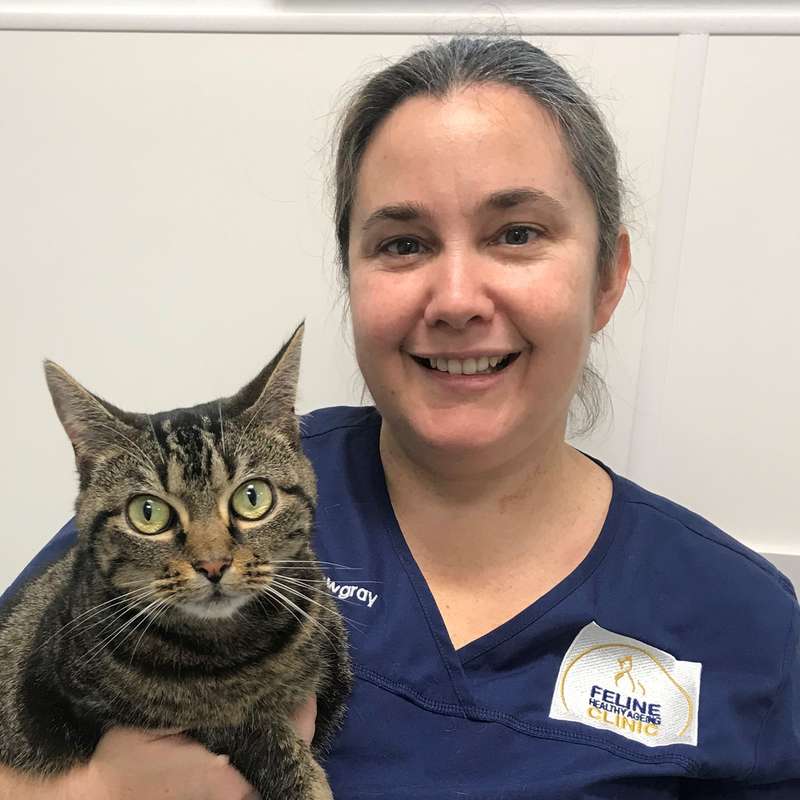
 Nathalie Dowgray
Welcome to Chattering With ISFM, the official podcast of the International Society of Feline Medicine. Hello, I'm Nathalie Dowgray, head of ISFM, we're pleased to present the first of our monthly podcasts on the topic of our new joint cat friendly guidelines that have been created with AAFP, the American Association of Feline Practitioners.
These new guidelines, Cat Friendly Interactions: Approach and Handling Techniques and The Cat Friendly Veterinary Environment, have been created with a task force of authors based on both an extensive literature review, and where evidence is lacking, the author's experience and expertise. The guidelines are being published in November 2022 and will be free to view on the Journal of Feline Medicine and Surgeries website.
Earlier this year, we took advantage of the four co-chairs of the guidelines, myself and Sam Taylor from ISFM, and Ilona Rodan and Kelly St Denis from AAFP, as well as Sarah Heath, one of the taskforce members, all being in Rhodes for the ISFM Congress, and we recorded a roundtable discussion and shared our top tips on being a cat friendly vet.
Kelly, you were the AAFP president when the decision was made to update the feline-friendly handling guidelines, which was the original cat friendly guidelines that we had as joint societies. And then we also started the discussion at that point to create this other set of guidelines as well on the cat friendly veterinary environment. Why was it time to update the guidelines? And why did we decide to do two? Why did we create more work for ourselves?
Other than the 10 year anniversary, which seems like a logical time to update them, we just have so much more information available to us now. And I think this culture change has opened up a new mindset for a lot of veterinary professionals to think what can I do? What can I do to be better? And so there are a lot of things in the older guidelines that need to be updated to meet that demand that we have. So it's going to improve things even better, hopefully. And then as far as creating a
new set. So the veterinary environment has really offered us this opportunity to isolate what our professionals can do in the environment. So in the veterinary clinic, both from home, the visit to the clinic, and then within the clinic itself, in terms of making things cat friendly. So it really separates that veterinary interactions with the cat and versus that environment that we welcome them to. And that really helps to tailor things for our clinicians. So I guess I would ask Ilona a
question now. You were an author on the original handling guidelines. Why did you support the name change to interactions instead of handling? And what's different about the new guidelines compared to the previous?
Yeah, it's a great question, because the first set of handling guidelines was in 2011. And we had very few references, we now have almost 150 references because now we have so many studies to prove that we need to interact with cats in a different way. And so, that's really helped. And the name change is because, it's not just about handling, there's non-physical and physical interactions that we
are having with the cat. And that means that before we've ever touched that cat, we should be observing the cat, giving body language, everything they're taking in all this information about us, that we need to make sure that is pleasant from the cat's perspective. And at the same time, we are looking at the cat, talking with the caregiver, and identify whether this cat has any fear or any other problems. And so that we can learn how to work with that cat better just in that introductory period.
Nathalie DowgrayI was really keen for all of us, maybe, just to give our one top tip. So, I don't know if I start with with Sam, what would be your top tip?
I suppose mine would be hiding boxes in hospitalised cats. It's still a frustration of mine and I'm sure they're fed up of me at work because I walk, you know, walk in and go why does that cat not have a box? You know, straightaway, because it's so easy and you don't have to have a posh expensive box. So what I do, if the nurses are really busy, I just go and get a cardboard box out of the stockroom, and you know, put it
in that cage. We know, we've got evidence, we have you know scientific evidence, but all of us have personal evidence of the difference that makes to a cats emotions if it can, you know, hide. And we've got a few different solutions because we find that some different cats like kind of slightly different, some of them like to perch, so it's nice to give them that opportunity as
well. So we will try and sort of also look at the cat itself and what its preferences are but there's no excuse not to have a cardboard box. This is what I say, there's literally no, yes you're busy, yes we havent got time, but every cat in that hospital needs somewhere to hide. So yeah, that would be my bug bear.
Nathalie DowgrayHow about you, Kelly? What's yours?
I really think I will go back to what I said earlier, which is if you take the time, you actually end up saving time. So I know that a lot of people can't have very long appointments, we used to have half hour appointments at my clinic and I was the boss. So I got to call the shots, that was good.
But if you just get yourself into that room with the client and the cat, and just you're in your own little world, take a breather, and let the cat do what they need to do and take that time to understand what the cats emotions are in that initial time that you're in the appointment, so that you can move forward in that appointment more successfully, you will get so much more done, more successfully, that way.
Nathalie DowgrayBrilliant. How about you Sarah?
Yeah, I love that one Kelly, we say that such a lot about the time, it's so important. I think my top tip is think cat. Are you looking at what this experience would be like if you were a cat? And if we think in that perspective, both sensorially, emotionally, physically, trying to think what is this experience like from a feline perspective, that can make a huge difference to the whole veterinary experience for the cat, obviously, but for the caregiver and the veterinary
staff as well, for everyone. So think cat.
Nathalie DowgrayIt makes a massive difference because we know, if owners have had a bad experience or seen their pet have a bad experience, they're not coming back to see us. And that's detrimental to that cats welfare. So, yeah, how about you, Ilona?
Well I was going to say hiding places everywhere in the practice, even in the exam rooms, but I guess I will say carrier training. Because it makes such a difference. Because we need to start at home, wherever the fear starts, where frustration starts, and probably pain. And then we move forward. And once that cat goes willingly into the carrier things are so much better already.
Nathalie DowgrayYeah, I think that's really true. One of the cats, the first time I saw her in the study, we opened, we always put the basket on the floor, we open and allow the cat come out. I opened the door, she flew out and attacked my leg. So the frustration level in this cat, from having been put in the basket and transported to the vet clinic, was through the roof. And my leg was the first thing she encountered to take it out on, I was grateful I was wearing
jeans that day. Subsequently, with food bribery, this cat has gotten a lot better. And she doesn't, she doesn't get quite so frustrated in the visits to the vet clinic now, though, it's borderline sometimes, bless her. I'm just trying to think what mine would be. I've mentioned food treats already. Mine is probably, there's a really nice saying that I learnt years ago, less is more when you're handling and interacting with cats. And I think this is a really important one for team members
to consider. I hear it with nurses when I'm asking for some assistance to maybe take a blood sample. And they go straight in with quite, what I consider, a heavy handed hold, you know, holding the legs, neck sort of extended, because I always do jugular samples. Whereas, I'm saying, oh no just, just gently tilt the head now, 'oh but I'm not holding legs', I'm like, that's fine. 'You might get scratched'. That's my responsibility. I think that to
me, it's a team thing. It's not their responsibility to ensure I don't get scratched, it's my responsibility to be watching that cats body language and adapting what I'm doing to what the cats telling me. And I think, I think that one's a really important one that, that it's a team, it's a team thing. That's not just one person's job to ensure that someone else, you know, it is personal responsibility and work as a team. We've sort of talked quite a bit
about the guidelines. I mean, I think, you know, even if you're not going to engage in we're hoping that this sort of extra material will be useful for people and encourage them to read the guidelines in full. becoming an accredited cat friendly clinic or a member of the cat friendly practice scheme, just reading through both sets of guidelines, and as Sam said, sometimes just the smallest changes, one little thing at a time, is going to massively improve the experience for your cat patients.
So thank you all for taking some time out away from the beach in Rhodes to do this recording. Thank you. We hope that you enjoyed this recording. Please visit the JFMS website to read the guidelines. For ISFM members, the full recording of this roundtable discussion is available for you to listen to. Please visit portal.icatcare.org.
We look forward to talking to you again next month, where we'll have the first of our two podcasts on FIP with Dr. Sam Taylor speaking to professor's Danièlle Gunn-Moore and Séverine Tasker. Look out for that dropping at the end of November.