



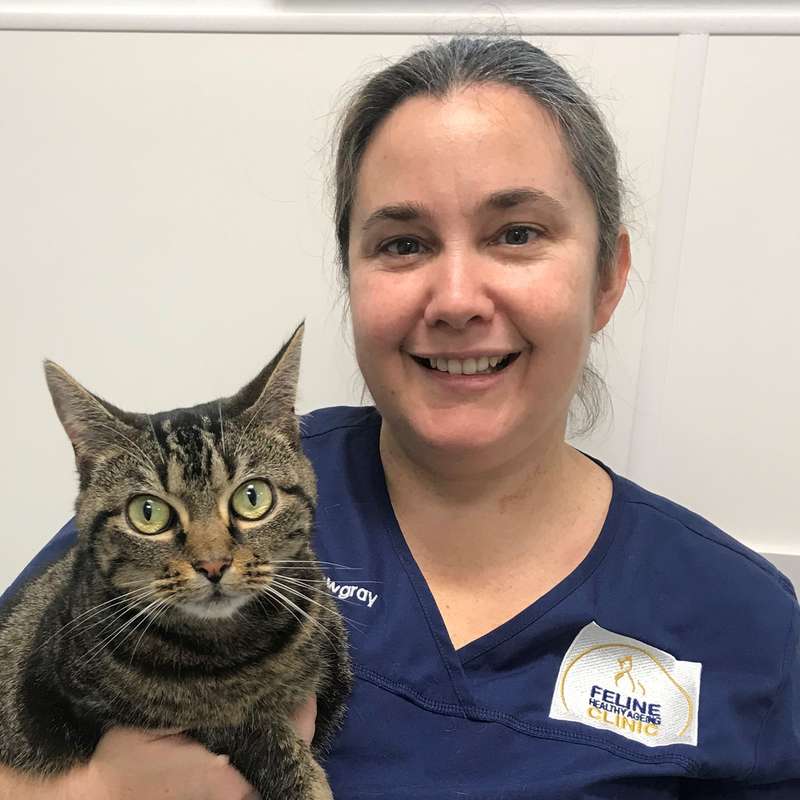
 Nathalie Dowgray
Hello, welcome to the December 2023 episode of Chattering with ISFM. I'm Nathalie Dowgray, Head of ISFM, and host of this month's podcast. For December, we're going to be focusing on the JFMS Special Collection, and that's on accessible veterinary care. Firstly, I'm speaking with Dr. Linda Jacobson, and she's our special guest editor of this collection. And then in the second interview, I'm going to be joined by my colleague at International Cat Care, Vicky Halls. She's our Head of Unowned Cats.
And we're going to be speaking with Dr. Gemma Ma on her paper, Characteristics of Cat Semi Owners. So welcome everybody. And I'd like to welcome my special guest today, Linda Jacobson. And when we started the special collection, I think it took us a while to agree that accessible care was going to be the best title. Would you be able to explain what was meant by the term and what the scope of the special collection was going to be?
We talked about calling it affordable care versus accessible care and ended up choosing accessible care because what we're really looking at is perhaps not so much access to care as barriers to access to care. Among those barriers, affordability is really important one, but there are many others.
We found there were many other barriers to care that included fear of being judged, veterinarians not taking new patients, not knowing where to go, language barriers, transport, and then lack of a leash or carrier. I'd lastly just say that I think it's a mistake to think that barriers live in isolation from one another. They're often interlinked. In Canada, we have a very substantial geographic barriers.
We have some communities that are extremely remote and have no veterinarians and often no veterinary care. When they do have access to veterinary care, that's often clinics that go in once or twice a year to do vaccinations. So very limited access to care. Even in more affluent communities in Canada, sometimes there are three, four, five hour drives to certain types of care, particularly emergency clinics.
Nathalie DowgrayAnd I guess we also have to think about cat factors as well. There are a lot of cats that they themselves are the physical barrier from going to the vet clinic too. It's something that both ourselves at ISFM and our colleagues at AAFP recognise with our Cat Friendly Clinic and Cat Friendly Practice programs that creating an environment that doesn't put the cat and the cat owner off coming back to the vet can be quite important too.
Yes, absolutely. And it's a reason that this collection belongs so nicely inside the Journal of Feline Medicine and Surgery simply because cats lack access to care compared with dogs. We're hoping that the cat friendly practices will start to help close that gap. The other factor is that cats are so good at hiding illness.
So if they aren't receiving regular preventive care and people are only taking their cat to the vet when they're sick, that would mean that many cats would not be seen until the illness is quite far advanced. It's very interesting in our survey, something like 10 to 12 percent of respondents said that the barrier to accessing care was fear of being judged.
So the concern is that if people wait too long, either because they haven't realised the cat is sick, or because they felt that they couldn't afford the care, but then they get to a point where it's urgent, that they may still not access care because of a fear of being judged.
Nathalie DowgrayDuring COVID, there was more demand on services. I'm really interested to know what sort of impact that has had on the work that you guys do at the Toronto Humane Society.
So in terms of the impact of the pandemic and what we've been seeing after the pandemic, there are really three big factors at play. One is the veterinary capacity shortage. There's also shrinking of disposable income because of escalating housing costs, food costs, inflation, and then growing inequality in many countries. And then veterinary costs have far outstripped inflation from the perspective of the Toronto Humane Society.
We've seen a real crisis in the city post pandemic with pet caregivers really struggling to find a lot of different needs for their pets, not just veterinary care, but veterinary care being a really important one of them. As an organisation, we have really been shifting to a much more proactive approach to pet human families, not just accepting that relinquishment is the solution to caregivers who are struggling.
So we start off with our Pet Parent Support Network, where we try and understand what the problem is and whether we can help to keep that pet in its loving home. We do some counselling. We have training services that can sometimes help people. We can offer food carriers and other kinds of support as well as preventive veterinary care.
And then we also have an urgent care foster program where if people are in temporary trouble, we can foster their pet for six months and sometimes up to a year while they get back on their feet.
We have a really sad cat story that happened recently where we were sent a photograph by an older man of him and his cat, and he said he was about to be evicted and that he wanted us to help his cat by finding a foster home for her because he was worried that she wasn't going to be able to withstand the cold. And there we were thinking, what is this poor man going to do in the cold?
So one of the things we've done is we've hired a veterinary social worker and she actually has very good connections with agencies in the city, and hopefully we'll be able to reach out to them and see if we can actually help this person as well as just helping his cat.
Nathalie DowgrayBrilliant. That's really interesting and, and really interesting to hear this, the proactive approach that, that you guys are taking. I just picked up on a term that you mentioned there around a veterinary social worker. Would you be able to just briefly tell me what that sort of skill set looks like?
We work at the interface of people and animals, and we're pretty good at the animal side. And there's a lot we don't know about the human side because that wasn't what we were trained to do. So veterinary social workers at the organisational level, they can help staff with stress, compassion and fatigue and burnout. And those types of issues, and they can also help both staff and clients with grief counselling in shelter environments.
That's really important because people become very attached to the animals in our care. And then they also act as an interface between us and people who are in trouble and the agencies in the city who support those people. For many people in those kinds of circumstance, what keeps them alive and what gives them something to live for is their pet. And that's where we can step in through our veterinary social worker and really help to maintain those bonds.
Nathalie DowgrayBrilliant. I think that is really important, isn't it? One of the biggest barriers for people that are homelessness in terms of seeking out shelters is often they don't want to lose their pet if they actually go into it a more suitable accommodation for them. So it is such an important piece of work. So thank you so much for all of your work.
You're very welcome. Thank you.
Nathalie DowgrayAnd now Vicky Halls and Gemma Ma are going to join me and we're going to be talking about cat semi owners. So firstly, Gemma, what I found really interesting in your paper is this sort of concept of semi ownership. Why did you think they were an important group to understand? What's different about semi owners?
This is behaviour that we've observed in our shelters for a really long time. We know that people have relationships with stray cats, but they don't consider they own them. We have, in our community, lots of people are really worried about wildlife. They really are worried about the impact that cats have on wildlife.
This is interesting because semi owners are a population that we found in this study that have really different beliefs about cats, they're less concerned about the impacts they have on wildlife, they're more likely to believe that cats should be allowed to roam and that they shouldn't be contained. So they're a bit different to the rest of the cat owning community and the rest of the Australian community, but they're also a group who obviously really care about cats.
They love cats, they really prioritise cat well being and welfare, which is really interesting because it creates this polarization in Australia, between the people who are semi owners or the people who really support the semi owners and love the cats and the ecologists and the wildlife conservationists, but the good news is that when it all boils down, the objectives on all the sides are the same, that we all believe that there are no cats left living these difficult lives on the
streets with no one looking after them. We have to find a way to get these two groups of people who disagree to work together towards the same objective of actually just getting all these cats into homes and looked after properly.
Nathalie DowgrayVicky, I don't know if you had some questions around that as well. I'll hand over to you if you want.
You were very specific in your paper, which I really liked about categorising cats differently. And I know that in different parts of the world, we use these same words, but we don't use them to describe the same type of cat.
Definitions are so important. I think what is less important is the actual words that are used are less important than how they're defined and making sure that they're defined really clearly and in a way that's relevant to management. The important point to consider is that all the cats in Australia are essentially the same. They are the same species.
We don't have great genetic data, but what we do have suggests that these are one continuous population, all the cats in Australia, the difference is in their relationship with people. So some cats have no relationship with people whatsoever. They're living as wild creatures in the bush, living off their own instincts, no support from people whatsoever. We call those feral cats. And then we have ones who have an indirect relationship with people or people who don't consider themselves the owner.
So we refer to them as unowned cats. Often they're called stray cats. I think that can be a useful term as well, because it's very commonly used in the community and lots of people understand that as a reference to an unowned cat, but I think the problem with using stray as a term, is that it can also describe the cat's behaviour rather than its actual relationship with people.
And then a stray cat, a cat that's roaming in the street, for example, could be a feral cat, it could be an unowned cat, it could be an owned cat. And you don't know, but it's straying, it's roaming in the streets. I think it's very important that the current threat, the draft updated threat abatement plan, has divided cats into a binary of feral cats and pet cats, which I think is very problematic. That third category in between is missing.
The unowned population in between the feral cats and the owned cat is the key to managing cats in Australia. The narrative generally is if you're feeding stray cats, you're making the problem worse. Just don't feed them, which is really unhelpful advice because if you've got a hungry cat in front of you, it's really hard to just let them starve on your doorstep. So trying to stop this compassionate behaviour without providing an alternative for that animal is really problematic.
And it's going to make it harder to work with the semi owners. And it's also going to create this huge barrier for the semi owners to take on official responsibility for the care of the cats that they're looking after. Because if they have to become an owner in, inverted commas, that can be impossible for them.
Often people who are semi owners are semi owners because they can't take on ownership officially of the cat, whether they're in accommodation that doesn't allow pet ownership, whether they don't have the financial resources to commit to all the obligations of having a pet cat. A whole bunch of different reasons, but I think we want to remove as many barriers as we can to getting these cats looked after properly.
I think that's a really interesting point. It's then difficult to engage with those people at all, if they then feel that they're doing something illegal.
In our experience, there's a whole bunch of different categories, different types of semi owners. There are the people who just have one cat who turns up on their doorstep and they look after it. There's the people who have 50 at their house, but they consider them to be unowned cats, but they look after them all. There are the people who travel out of area and all over the place, feeding different colonies in different locations.
And they do that, they spend huge amounts of their own time and money looking after these cats who are not their responsibility. I say they're all united. They're not just empathetic, but they're acting compassionately on their empathy for these creatures that are seen in front of them. And they're actually a huge resource. They really care and they can really help with cat management intervention. We're actually working, we've got 11 of these desexing programs that we're running right now.
We're heading into our second year at the moment. So, collecting lots of data and we'll be writing this up eventually. Watch this space.
That is very exciting.
Nathalie DowgrayThank you for listening. The Accessible Care Special Issue is available on the JFMS website. We hope you'll find it a useful collection. If you're an ISFM member, don't forget you can access the full version of the podcast and all the other ISFM member benefits including congress recordings, monthly webinars and clinical clubs, the discussion forum, and much much more at portal.icatcare.org. We'll be back again next month with our regular monthly chattering.
If you don't want to miss out, do make sure you've signed up to Chattering with ISFM on your preferred podcast platform. Have a happy new year everyone.