



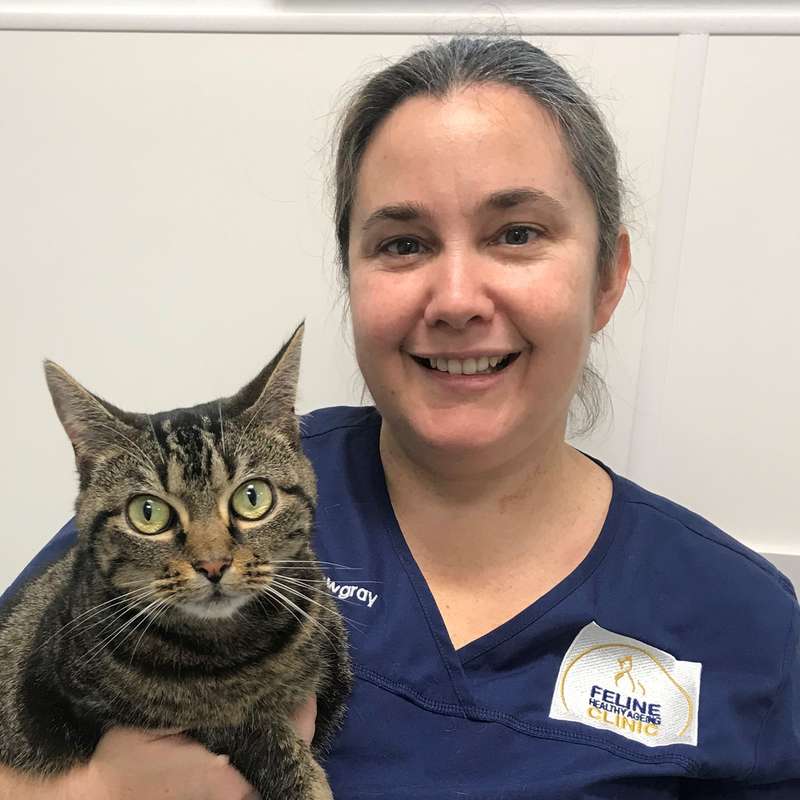
 Nathalie Dowgray
Hello, welcome to the April episode of Chattering with ISFM. I'm Nathalie Dowgray, Head of ISFM and host of this month's podcast. First up this month, iCatCare's own Yaiza Gomez Mejias is speaking with Cecilia Villaverde on feline nutrition. In particular, how much protein should there be in a cat's diet? And we're also featuring our monthly JFMS Clinical Spotlight interview.
This month we're celebrating the release of the new 2024 ISFM and AAFP consensus guidelines on the long-term use of nonsteroidals in cats. Kelly St Denis is speaking with doctors Sam Taylor, Paulo Steagall and Duncan Lascelles on these useful new guidelines.
So hello Ceci, welcome to the ISFM podcast and thank you for being here. So we know the cats are strict carnivores but what does this exactly mean?
When people hear that cats are carnivores, they think they should only eat meat, right? That's definitely not what being a carnivore means. It means that they at least part of their diet must come from animal tissue. The reason cats are strict carnivores is there's a variety of nutrients that are either more abundant or more bioavailable in animal tissue compared to plant tissue. Cats need retinol. They cannot use beta carotene and retinol is more abundant in animal tissue.
Arachidonic acid is another example. There's a fatty acid that's much more abundant in animal tissue compared to plants. So a lot of these things is what makes the cat a strict carnivore because they need those nutrients in those amounts and in those chemical forms to be used. Cats compared to an omnivore like the dog, they require twice as much protein than they need, and definitely the diet that they have evolved eating that's prey-based meets all of those things, right?
How reaching the protein target? Would you say it's easier to reach the protein target with the raw or home cooked food than with the commercial diets? And is there a difference between canned and dry food?
For sure. And I think sometimes the confusion is confusing the ingredient with the nutrient, right? And we'll be talking about cats and being carnivores and meat usually associated to protein, so sometimes it's, Oh, okay, if we're feeding a diet that's maybe raw or homemade, that potentially we could make it with more meat, for example. You could reach your protein goals with any form to be fair. Like they're not as high as people think.
When you look at, for example, in Europe, the recommendations for minimum protein come from FEDIAF, and their minimum for cat is about 23 percent calories, we say, and most diets in the market are 30 percent or above. Dry diets can meet this, wet diets can meet this. It's not a problem number wise. Then the other thing is the quality of the protein, the amino acid profile of that protein. And that's going to be affected by processing.
Wet food, the processing to making pet food, it's called retorting, and that's pretty high temperature. Formulators need to be very careful that when they make wet food, that protein quality is maintained. For dry food, you do extrusion. It is a slower temperature than retorting, but it can also affect protein digestibility. And it all depends on your ingredients. Some, the fact of cooking it, like when making wet food or dry food can actually increase the digestibility.
But for some amino acids, it might decrease. So it's very important that the person who's making the diet knows that and takes that into account to ensure that the final product is correct. For homemade diet, potentially the processing is milder. So you could get a higher digestibility of the protein, which again, in some cats may be a good idea. In other cats, it won't be a problem. And raw diets, even though they're perceived as less processed, there is also processing going on.
Like they might be ground, they will be frozen, and all of that can also affect. So companies that make raw, It's not something I recommend, but if someone chooses to feed raw, they need to make sure that they choose a reliable manufacturer that does all that testing because just because it's not cooked, it doesn't mean that it cannot affect the digestibility or the quality of that protein.
We have a very interesting study in cats where they fed them like the same thing, but one was, it was a whole chicken and the other was the same thing, but ground and made into a hamburger. And they found that just grounding the chicken increases digestibility so much, actually, because you have all these feathers and these tendons that were affecting digestibility. So, I would say you can meet your protein goals with any dietary form.
You just want to make sure you choose a manufacturer that's actually testing that the protein is there in the right amounts and with the good quality that it should have. Usually wet diets can be higher in protein than dry on average. Not necessarily true because for dry food, you need some starch to make it. There's a lot of overlap and the fact that it's higher in protein, is not necessarily beneficial for the health of any cat in most cases.
You need a smaller volume of wet food to feed the same amount of protein?
Not necessarily no, because wet food, you have a lot of moisture, right? Every time I do a feeding plan for a cat, there's three things I want answered, like what do I feed, how much and how, right? So if we focus on what and how much, the what is the diet, there's a lot of things that are going to affect that choice.
And, for example, between dry and wet, that's also going to be depending on client and patient preferences, the budget, any health issues that we might want to push more water into that cat, et cetera. But the how much is determined by the calories or the energy that this cat needs.
So think about dry food only has 10 percent moisture, wet food has about 70, ballpark, this is going to vary depending on the product, but I need to feed four times more to meet energy needs from a wet food than for a dry food. So that's why I say dry food sometimes can be your friend. If you have a cat that doesn't have a lot of appetite and waxing and waning and thin, having dry food that you can leave out. And then when the cat is hungry, something's going to be there.
More calories can be super helpful. So both dry and wet have their pros, have their cons, but you're always going to need to eat much more of the wet than the dry to meet your calorie and your nutrient needs just because of that moisture.
Brilliant. This has been so helpful. I think this will facilitate my conversations with my clients. Thank you so much for your time.
Nathalie DowgrayAnd now it's over to Kelly St Denis and she's going to be speaking with authors on our 2024 ISFM and AAFP consensus guidelines and the long term use of of NSAIDs in cats. She's going to be joined by Sam Taylor, Paulo Steagall and Duncan Lascelles.
Dr Lascelles, if you could just talk a little bit about these guidelines and how we identify chronic pain in cats, what are some of the things that we are going to look for? Is it specific conditions, specific clinical signs?
I think a major update in terms of these guidelines is the new information on the identification of persistent, longstanding, maladaptive chronic pain, depending on the term you want to use. And I think you can see the shift from rather generic descriptions of behaviours that may or may not be altered, to now some more specifics around behaviours to look for, behaviours to watch for. We've got emphasis on caregivers. We've got emphasis on the behavioural aspects of identification of pain.
We've got emphasis on cat behaviour. There's beautiful sections on what normal cat behaviour is, what cat needs are. And I think for me, all of these areas start to talk to the biopsychosocial model of pain, the biology of pain, and how to manage that. The psychological aspects of pain around behaviour and how to manage that by addressing that needs and they talk about the social aspects because we bring in the caregiver and support for the caregiver.
And I do love that. And that's so much of what we've started to see in our focus is in all of our guidelines, in our literature through the AAFP and ISFM. And that emotional aspect of pain, there's such a fantastic section on pain not just being a sensory experience but also part of the emotional complex of fear, anxiety, frustration. Sam, did you want to tell us a little bit about how pain is an emotional experience and how that's addressed in the guidelines?
In the last few years, I've really tried to understand that relationship between anxiety, fear, and pain, and not being able to pull those apart. And if you think about it, it actually makes sense. To me, if you have a cat who is fearful, then their experience of pain could be different to a cat who is not fearful, and vice versa. I know that in human medicine, if you're in pain, then your other emotions like fear and anxiety are going to also be heightened.
And I think for our older cats, their tolerance of stressful situations is going to be much lower if they're in chronic pain. If you encounter a novel and frightening situation and you have chronic pain, then your reaction is going to be different to if you don't have chronic pain. So I guess what I mainly learnt is that it is impossible to pull those experiences apart.
To me controlling pain is a key part of improving a cat's experience of life, really, and that goes hand in hand with controlling stress, anxiety and fear.
That's amazing. A wonderful description. Thank you. So when we're talking about NSAIDs and people are prescribing, say, in acute pain situations, what are we going to ask our clinicians to tell the caregivers to be monitoring for? When should they stop using non steroidals? Or has anything changed with that? And Paulo, maybe you want to address that question?
I would start with the basics and the classic questions. You want to make sure that the patient is drinking and eating normally. The anorexia, it's actually the first clinical sign that you would see in most studies leading to adverse effects. So I would be very concerned to give an NSAIDs in a patient that is not eating as one of the first GI signs. But in terms of in the acute pain scenario, I think that would be the first thing in making sure that there are no comorbidities involved.
And if these comorbidities are involved, such as CKD, you want to make sure you know how stable that is and so forth. So I think the take home message is to really look at a patient on a case by case basis before determining what you're going to do at the end of the day. I will push for a dose of non steriodals towards the end of the procedures.
So I think we have to be careful with the myths and facts about non steroidals and making sure that we're a bit more black and white in terms of contraindications. Is there a contraindication or not, or is just you're being fearful of giving that drug?
In the guidelines, some hot topics that seem to come up often when I lecture are interactions for potential for non-steroidals with, say, frunevetmab, in terms of any concerns with interactions, risks of chronic kidney disease or kidney issues. What are your thoughts on what we know about that at this stage?
I think the one that comes to the top of the pile all the time is, can we concurrently use an anti-NGF, anti-nerve growth factor, monoclonal antibody and nonsteroidals, and, very briefly, because of some side effects seen at a relatively low level in humans, that combination is still of concern to us, even though those side effects have not, to my knowledge, been seen in cats, and those concerns revolve around rapidly progressing osteoarthritis.
That's come over from the human side and has led a lot of people to be concerned about concurrent use and, honestly, in the face of a lack of knowledge about what happens when they're used concurrently, my stance would be to avoid the concurrent use until we know more. And I think probably short-term use, a few days, a couple of weeks, is going to be fine because it really was the long term use in humans where those issues were seen.
But this is quite interesting, Duncan and Kelly and Sam as well. But I don't know what's your feedback on this, but what would be the cases or the reasons of using both drugs together? Would it be that, cases that are, you have severe OA that is refractory to non-steroidal, what's going on there?
I think that's a really good point, Paulo. Thanks for bringing that up. Because I think that's almost a red flag to me. If you think you need both non-steroidals and an anti NGF mAb, you probably need to look at that cat again and really ask, what is going on? What is behind the signs that we are seeing?
That was a really great point. Thank you. Just want to remind everyone that the April Journal of Feline Medicine and Surgery will be seeing the 2024 ISFM and AAFP consensus guidelines on the longterm use of NSAIDs and cats landing there. It is open access, so you can access that guideline as well as all of the other JFMS and JFMSOR content. Thank you again, everyone.
Nathalie DowgrayThank you for listening. If you're an ISFM member, don't forget, you can access the full version of the podcast and all the other ISFM member benefits, including Congress recordings, monthly webinars, clinical club, the discussion forum, and much, much more at portal.icatcare.org. If you're looking for more CPD from ISFM, we have a number of open access webinars going live in May, so do keep an eye on our social media for more information. We'll be back again next month with another episode.
If you don't want to miss out, do make sure you've signed up to Chattering With ISFM on your preferred podcast platform.