



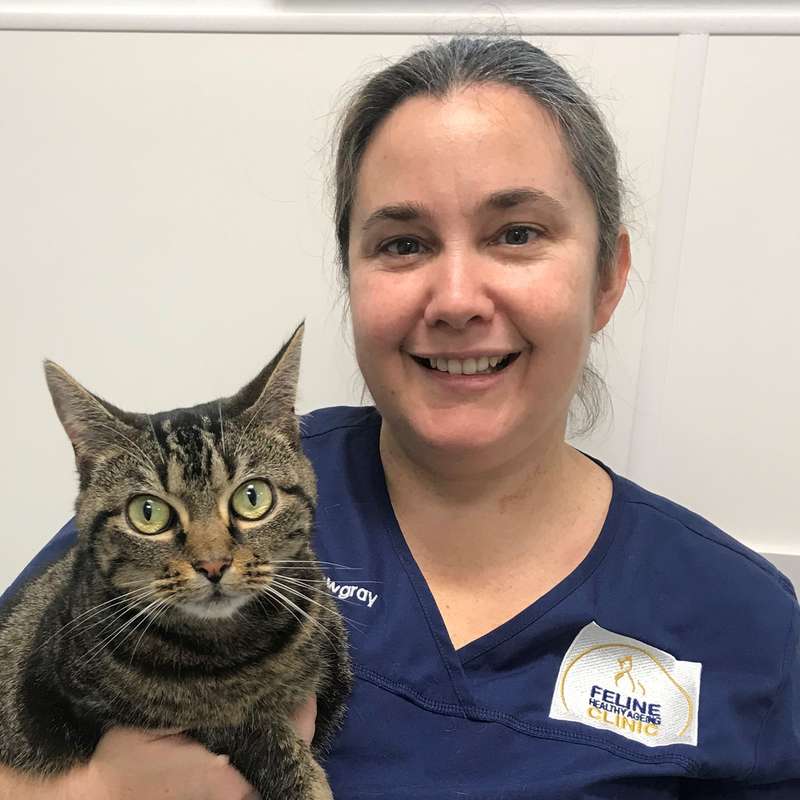
 Nathalie Dowgray
Hello, welcome to the September episode of Chattering with ISFM. I'm Nathalie Dowgray, Head of ISFM and host of this month's podcast. This month I'm speaking with Dr Hugo Swanstein on his clinical spotlight article, Feline Friendly POCUS, How to implement it into your daily practice. But first up, we have the second part of the discussion on feline chemical communication with iCatCare's own Sarah Ellis speaking with Daniel Mills.
Daniel, as well as different pheromones and different synthetic pheromones, we've also got different ways of them being given or distributed or preparation and I feel it's constantly changing. Is there one method that's better than the other or are these all different tools for different situations?
I think they're largely tools for different situations, what's convenient. So yes, you've got the plug in diffusers, you've got the sprays, etc. People are starting to now develop impregnated gels, which means you don't have to worry about an electricity source, but it allows you to produce the pheromone over an extended period of time, bit like the old fashioned gel air freshener. And that can be useful.
I think if you're talking about cats and things like urine marking, then it's always important to clear up the urine in an effective way, either a commercial cleaner that has enzymes in it, or I still swear by using biological washing powder. Rinse it, followed by surgical spirit, lift off any fatty elements. I find that very effective.
And if you've got wooden floors and the cat's done it on the carpet, then potentially if it's sprayed the wall and it's run down into the carpet, you may have to lift the carpet and scrub those areas as well. That's one thing you have to be careful of though, if you do use those sorts of enzymatic sprays is that if you apply a pheromone spray over it, the enzymes may be active and can break it down. So that's one of the reasons why sometimes people say, I tried the product, didn't work.
So in those situations, the sprays are useful if you want to apply it tactically in particular areas. So we know that cats tend not to scratch, for example, where they face rub. So it can be useful, I think, using some of the sprays where the cats tend to be scratching, as long as you provide them with an outlet where to scratch. And I know that there has recently been a big clinical trial, which actually looked at the rate of scratching in cats.
And the classic Feliway does seem to reduce that as does the Feliway Optimum. When I first got in to this, we really knew very little and we were starting to probe and it's a new treatment modality for vets and other people and to try and understand it. And while some people will just embrace it and misunderstand it, they'll think about aromatherapy, but it's not relevant to them. For vets, it was very difficult for them to get their head around that this wasn't a drug. What was it exactly?
Was it just an odour? And I think in the first 10, 15 years, people were very skeptical because they didn't understand it. And were these products going to be successful? Clearly they are, they've been well adopted. And as long as people use them appropriately, they can be life changing for both the cat and for the owners. And now companies like Ceva are prepared to do those large RCTs.
And that was one of the criticisms I think that was made by some of the skeptics early on was, well, these aren't big RCTs. You wouldn't invest in a large RCT unless you're confident in your product and your product has got a big enough market share. And that's easy for a drug, but when you're talking about completely new treatment modality, it takes time. These sorts of trials cost a lot of money and you don't invest in them until you've got all the available information.
And over the years, we've accumulated through a number of small trials, but also some of the stuff that we've done outside of a clinical treatment setting to understand how these work and say, okay, these are the routes to go down.
Absolutely. I've read a lot of that research and seen it develop and expand in different areas. And it's been mostly focused on the pheromones that Ceva have produced, but, more recently, I've seen a huge uptake of other companies producing pheromone products or products labeled as pheromones. It suddenly just seems to have exploded and I think that could be quite difficult for not just caregivers but for veterinary clinicians as well to navigate.
Are they all the same thing made by different companies or are we actually dealing with different pheromone compounds here?
It's a really important point and I can reassure you if you struggle to keep up with it, I'm struggling to keep up with it. But the first thing I think to appreciate is this is an unregulated industry. So if you claim that your product does this and you can't evidence it, then potentially you can be done. But using a word like a pheromone, it doesn't seem to be something that advertising standards want to go after.
So, the first thing I would say to people is, regardless of what it says on the bottle, whether or not it's pheromones, and as we've already said, pheromones are different to odour therapy, and there are chemicals that have all sorts of effects on us as well, but look at the ingredients. I did look at the newer products and one of them says that it's particularly good because it's a unique blend. And I'm thinking, what does that mean?
A unique blend could actually have things that, rather than things that complement each other, when you put them together, they could antagonise each other. And I've already said that I've done a lot of work for Ceva and I should, for the sake of transparency, people need to be clear of that. But I am a traditionalist. I will stick with Ceva products because I know what's in them and I know that they're reliable.
It's an important part of veterinary medicine that you don't just switch because there's a new product. A new product doesn't necessarily mean a new class and if it's just another manufacturer. The reason why there has been an explosion, I think is partly because Ceva have been very successful in producing very effective products. So people have jumped onto that bandwagon and there is some unscrupulous advertising there. And secondly, the Feliway formula is now out of patent.
So other people can make generics. And so there is much more opportunity there, which means that potentially there are cheaper versions out there as well, which are just as effective. But because I deal with clinical cases, I'm not going to say there is this cheaper option and I'll recommend that instead. Now, if a client comes back to me and they say, I really can't afford that, then I might say, I don't know this product as well, but it's not going to be my first line.
My first line is going to be what I'm familiar with.
Exactly. And I think one of the other things that I often hear as well from our vets and the veterinary team is the use of pheromones in conjunction with other products as well that, for example, Pet Remedy or some of the other products that are available that don't require a license, very often there's sort of a either or kind of attitude. I don't use this one because I use this one. Do you think you only have to use one or is there benefit to using both?
Are they doing two things trying to do the same thing? Does one plus one equal two? Or what's your thoughts on that?
My starting point is, where's the evidence for any of these products? So there's a wide variety of products and a lot of them are marketed on the basis of testimonials. And nothing sells a product like celebrity endorsement, I'm sure, but that doesn't necessarily mean that it works. Animals get better, they fluctuate in their behaviour, and that is always an issue. The first thing I would say is be cautious of that.
I would start with those with the best evidence, and of all of those sorts of products, I would say that the pheromones are better than things.
There have been some trials published with Pet Remedy, I'm, I don't find the data that convincing, but I hear enough people telling me that it's really good that I do think that there is something there, but exactly what the indications are, just to flip back to what we were talking about earlier about the different parts of the territory and the emotional reactions. Personally, I don't think saying that something helps stress is terribly useful because stress is such a general term.
And my job as a behaviour clinician is to work out what emotions relate to that stress. As we've said, you've got fear, you've got frustration, they're different emotions. They have different solutions. So I could be cynical and say it's lazy to say stress, but people understand what the word stress means. But if you get the wrong type of stressor that product's not going to work. That doesn't mean that product is useless. It just means you've used it for the wrong indication.
And that's part of what my training is.
And I will still tend to use the individual Ceva products rather than the Feliway Optimum, unless I'm uncertain, or I think that there is a social element that needs to be included together with the physical, then I might recommend the Optimum, but to go back to answering your question, actually, we haven't got any evidence to suggest that, certainly, yeah, with things like pet remedy and some of the nutritional supplements, there's no reason to suppose that one should antagonise the other.
But some of the products that I'm starting to see labelled as pheromones, I struggle a little bit more with because some of the ingredients, they talk about calming scent with added catnip. Yes. And you're thinking, hang on.
Nathalie DowgrayAnd now I'm speaking with Dr Hugo Swanstein about his JFMS Clinical Spotlight article, Feline Friendly POCUS, How to implement it into your daily practice. So to start with, I just wondered if you could explain to us what POCUS is for those listening who may not be familiar with the term.
So, point of care ultrasound is quite different from formal consultative ultrasound. It involves more questions or series of clinically driven questions that you have asked yourself even before putting the probe on your patient. Of course, it's ultrasound, but it's not really in the same sort of area, because you don't go around assessing organs or structures and don't have these open ended differential diagnosis questions.
It's more of a rapid, evidence based, non invasive, of course, repeatable, and specifically cage side or patient side sonographic examination. And in this article, me and the other authors have really tried to point out that POCUS can be done in a way where we really try to ask clinically driven questions without compromising the felines wellbeing.
Nathalie DowgraySo do you have any tips for how we could start to integrate it into our day to day practice? Is it just for emergency cases or can we use it for other things as well?
It's not just for emergency. I would say it's a first day or first practitioner's skill that you should learn. It's about practicing a little bit every day, five minutes a day will do wonders in two months or in two weeks even. And you start on one skill, build on it, and you will be surprised about what you find in your patients.
Nathalie DowgraySo how do you manage that fur? What's your advice for getting good views without clipping?
Especially in feline patients, the problem with gel and not clipping is that you will trap the gel within the fur, and anytime you get an air bubble in that gel pocket, your view is lost. And it's a mess to clean up, and the cat doesn't like it, and everything is just horrible, right? When I started doing POCUS, I learned that the best way was to have a spray bottle with a bit of mixture between alcohol and water.
So what you should start with is that you should part the fur until you see a bit of skin. And then you apply a little bit of alcohol and you put your probe on. And just having that coupling agent, a little bit of liquid between the probe and the skin, you will actually get quite a good picture. There's no point in just taking a cat, putting it on the table, spraying him down with alcohol because you won't see anything.
You really need to part that fur to actually get the alcohol between the skin and the probe. And then once you have quite a good contact, you will be surprised about how much you can usually move that probe around by taking your non ultrasound hand and moving the skin around and, in a cat on the thorax, most of the time you're able to scan almost the entire thorax in one go. It doesn't take a lot of practice, but you really got to be thorough with the parting and the spraying and so on.
Nathalie DowgrayWe obviously recommend not using alcohol in some of our cat friendly guidelines because cats find the smell aversive. Do you find that, that because it's diluted that reduces the problem?
Definitely, it definitely helps to dilute the down in the cat doesn't really smell it as horrible, or they don't seem to react that much.
Nathalie DowgrayWhat do you consider the most useful clinical questions that POCUS can answer?
Oh, this is a big one. My entire way of operating has changed since I discovered POCUS. Since I don't have to drag them down to radiology anymore, I don't have to go on suspicion. I can do everything in the examination room. It's fantastic. It's like having eyes inside the patients. You can really get the smallest amount of fluid or in the patients that no one can put an IV catheter in, you can use the ultrasound as well. It helps you with the practical problems of your daily life.
Nathalie DowgrayAnd definitely reading through the article, it really sounds like there's a lot of uses for POCUS within just our day to day sort of workload. We sort of hear feedback from the audience about just not having enough time to do it. Owners not wanting to pay a bit extra. Do you have sort of any suggestions about how we could overcome these barriers?
Oh, yes. This is important, right? The big thing I think is the selling argument for POCUS compared to consultative or formal ultrasound would be the time difference. So a traditional ultrasound, I would say be 45 minutes somewhere around there, really go into all the nitty gritties and look everywhere. A POCUS is 5, 10 minutes. So time wise, it's a big difference.
If you would be charging an hourly rate, you know, POCUS should definitely cost less because you could do more in an hour and you don't really go into all the details, meaning you shouldn't pay as much. You might not need the necessary training in the same way as a sonographer. So, should the owners pay the same? Probably not. They should probably pay less because you can see it as an extension of your physical examination.
Nathalie DowgrayYeah, I have to say I really like that idea of incorporating it into your hospitalisation fees or your sort of triage emergency management costs because then you can be including all of the things that you need to do like blood pressure measurements, et cetera. And they're often things you do need to repeat because you're looking for changes and trends. I guess the other thing around, especially some of these views that we may be doing repeatedly to monitor for changes.
Are they kind of things that nurses or veterinary technicians could also be trained up to do in the hospital situation?
Yeah. So the tracking areas of POCUS can definitely be done by technicians and nurses. In POCUS we tend to talk about the six T's and the six T's are targeted, trauma, triage, treatment, tracking, and total. And I advocate for maybe we should add a seventh T, which would be team, because the entire team could do it. When I was a veterinary nurse before I graduated, I did it a lot on our ICU patients. So no, get your nurses trained as well. It will definitely help your time.
Nathalie DowgrayThank you for listening. If you're an ISFM member, don't forget you can access the full version of the podcast and all other ISFM member benefits, including Congress recordings, monthly webinars, the clinical club, the discussion forum, and much, much more at portal.icatcare.org. If you are looking for more free CPD from ISFM in October, we do have an open access webinar brought to you by Purina. That's Helen Ballantyne speaking on One Health Approach, Human Cat Welfare.
We'll see you again next month.