



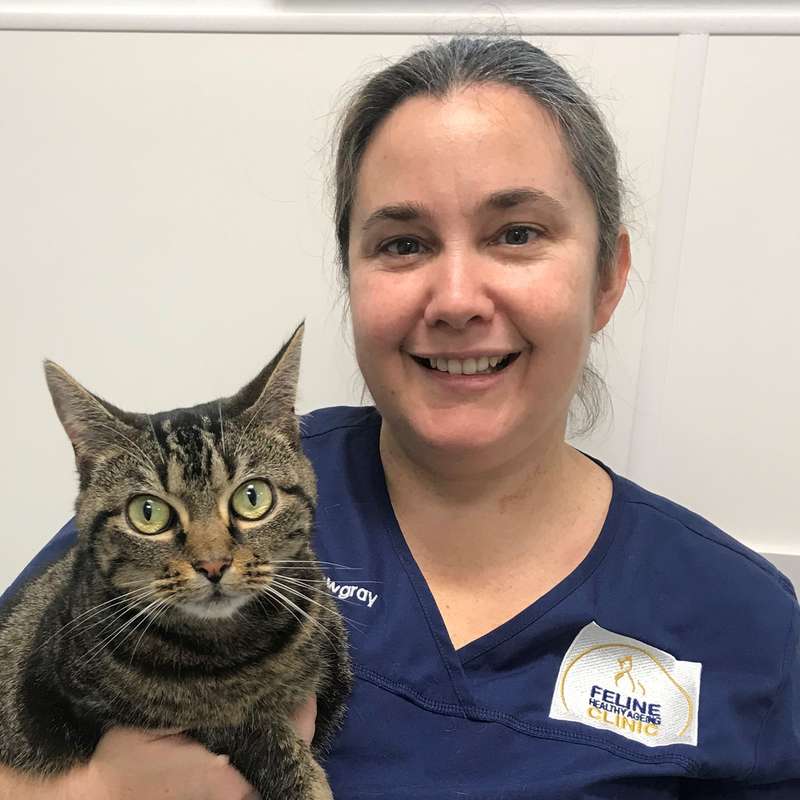
 Nathalie Dowgray
Hello, welcome to the March 2023 episode of Chattering with ISFM. I’m Nathalie Dowgray, Head of ISFM and host of this months podcast. This month we are sharing another of our in conversation with sessions that were recorded live at our Rhodes congress last year. Dr Sam Taylor is speaking with Dr Matt Gurney on feline pain management and we are also featuring our monthly JFMS clinical spotlight interview. This month I’m speaking with Dr Zoë Halfacree on feline urinary
tract trauma. We hope you enjoy this episode.
So Matt is the clinical director at Anderson Moores Vet Specialists. And I think as you all know, he's an RCVS and European specialist in anaesthesia and analgesia. He's very passionate about pain management and does lots of lectures on this subject and we know him also as the co founder of zero pain philosophy. Subcutaneous low dose ketamine. Can you tell us a bit about how that works? Why it works? When you use it? Yeah, what are the indications for this?
I'd love to be able to tell you how it works and why it works bit I don't honestly know. I first used subcutaneous ketamine in a dog, it was a dog with lumbosacral disease. And this dog was struggling on nonsteroidals and I can't remember what else we'd added. And we gave the dog 0.5mg/kg of ketamine subcutaneously. And it made a difference. And we said, okay, fine, let's just work out how long this makes a difference for. And he ended up having 0.5mg per/kg subcutaneously
every month. And this went on for 18 months, two years. And then he became progressively more painful. And we started doing this every two weeks, and then every one week and then when we got to every one week stage, she said look, I know that we're getting right to the end. And this is my line in the sand to say that enough is enough. So that's an example of where we went from managing him on a monthly basis right into a kind of palliative setting.
Really, for me that was the sort of basis of my use of ketamine. I have used it in cats since. I use a slightly lower dose, I use 0.3mg/kg in cats. And he responds very well to that. And if we're going to do anything novel, or we're not quite 100% sure about, let's identify those behaviours. What are the pain behaviours in that individual patient. Have a conversation with the owner, work out three to five pain behaviours, make your intervention, reassess
using those pain behaviours. And whatever else the owner notices in the meantime, you can guarantee, the minute you trigger an owner in a consult to start thinking about behaviours, they go away, and then they notice things. We definitely need to get to the stage where we can start a prospective study. I don't think we can really run that against a placebo because that'd be challenging from an ethics point
of view. We probably need to do a group that have subcutaneous ketamine and subcutaneous methadone maybe, methadone is licensed to be used subcutaneously. So, I think you could arguably say that that is a suitable control treatment. Ketamine is what we refer to as the antihyperalgesic. So when we have a central sensitization and activation of the NMDA receptor, it's the NMDA receptor that we think we're switching off with ketamine. Although ketamine does
have a lot of other actions. So actually, this effect, it could be another receptor, or ion channel action rather than an NMDA action we're talking about with subcut ketamine. With central sensitization, we see a general sensitivity so we see allodynia hyperalgesia, we're looking to drive down that hyperalgesia with our use of medications that target the NMDA receptor, hence the word antihyperalgesic rather than
analgesic. Most of my experiences with a population coming into the hospital anyway that are suffering with pain, I think there are two categories there, there are those painful patients that are coming in for x procedure, absolutely. I would use ketamine in those patients. In a general practice population, a chronic pain
clinic population. If you're seeing those patients on a repeated basis, maybe you've tried subcutaneous ketamine, it doesn't work and I would always try that to start with because it's it's quick, easy, it's cheap. If that's not working, if you're just scratching your head with what do I do next with this patient? I would bring them into the hospital. I normally say a 12 to 24 hours CRI, some people don't want to leave the pet overnight, so, and we don't honestly know, is 12 hours
better? Is 24 hours better? We know in human clinics, they bring people in for the day. I think it varies from clinic to clinic how long people get those ketamine infusions for. So yes, it is definitely something that I think is worth doing in those chronically painful patients. Definitely.
If you can't examine a cat, and you don't have any blood, so you don't have any sort of knowledge of its general health. What sedation protocol would you use in that situation?
We are thinking a lot more about before that cat even comes into the clinic now and thinking about Gabapentin as part of the perianaesthetic care for a cat, I use 20 mgs/kg one or two hours before either the visit to the vet or we need to try and get that blood sample or get that IV. So I think there is a huge value to thinking ahead and using Gabapentin in those cases. We know that that's a suitable option in healthy cats.
We've studied that in hypothyroid cats, you can read that paper open access in JFMS. And we also have a licenced pregabalin coming at some stage, so that's a fantastic option that we need to think about beforehand. If we then move on, we've then got to ask the question, what do we actually need to do with the cat? Are we then looking at subcutaneous option are we then looking at an intramuscular option? If you go on alfaxan.co.uk there is an article on IM alfaxalone in
cats. It's got all of the options that are available there. We also talk about subcutaneous options. So there was a study from the University of Melbourne, and they looked at 3mg/kg of alfaxalone and 0.3mg/kg of butorphanol subcutaneously. The aim of that study was to get these cats relaxed enough that 45 minutes later, the cats could be pilled. And they were still able to hold their heads up and swallow a pill. So it's a very mild level of sedation, but that might be
suitable for your purposes. And then moving forward to needing a deeper level of sedation. We are really looking at intramuscular options in that circumstance. And alfaxalone is a brilliant drug in those cases. For those ones, like you say Sam, we might not have bloods, we might not have an echo, maybe we know that cats got a murmur, but we can't touch it. The combination we tend to use for the feisty hypothyroid cats, so let's say we've given them gabapentin, and we've given them Trazodone as
well. And we need to sedate our cats that come in to the radioactive iodine clinic, we need to do their bloods, we need to clip a patch on the back of their neck, we need to give them their their radioactive iodine injection, we need to do that in a safe manner. So none of our staff get injected with radioactive iodine. So we do need to restrain these cats chemically. Alfaxalone, midazolam, butorphanol, is my go
to combination for that. When we have either undetermined cardiac disease, we're actually some of those cats, we do have those echo results and we know what's going on. The doses, I'm not going to verbalise the doses now, but take a look at that article on the Alfaxan website because that goes through all of those options for you.
Brilliant, thank you very much. I think we could spend the whole day asking you questions, but we don't quite have time. So we're gonna let you go. And say thank you very much.
Nathalie DowgrayAnd now we're speaking with Dr Zoë Halfacree about her JFMS clinical spotlight article on Urinary Tract Trauma in cats. Why were you interested in writing an article specifically on surgical management of urinary tract trauma?
So I was approached to write the article, which I was really happy to do, I think it's valuable to discuss urinary tract trauma in the cat because it is something that occurs quite often. And whilst we do have notes and evidence base of new literature to support our decision making, it was useful, I feel to provide some case examples to help people have that information being more accessible.
Nathalie DowgrayBuilding of that, do you have any tips or advice of things we can do to just try and reduce the risk of iatrogenic ureteral trauma when we're catheterizing cats?
Yeah, sure. There are a few really important ones. The key one is that the cat should be adequately sedated or anaesthetised so that they are fully relaxed. Unfortunately, if they you know, were not adequately sedated, then there would be a significant risk of causing iatrogenic trauma. And having the patient adequately sedated, also allows more careful manipulation of the
penis in the prepuce. One key aspect to recognising the cat is that where the penile urethra sits, sort of caudal to the pelvis orientated caudally, and there's a change in angulation as the penile urethra comes to meet the pelvic urethra, and it's that point going between the penile urethra and the pelvic urethra, where it's most common for iatrogenic and catheter injuries to occur because the catheter trajectory is going up and damages the dorsal surface of the urethra.
And so the real key is to actually when the patient is having the catheter inserted is to pull the penis caudally you so that you're stretching that out and straightening that out, and then the catheter should advance straight ahead
Nathalie DowgrayThank you for listening, if you are an ISFM member you can hear more from Dr Halfacree with her full interview being available on the ISFM members podcast, to access this please visit portal.icatcare.org. As well as the podcast you can access all the other ISFM member benefits including Dr Gurney’s lectures from our ISFM Rhodes congress, monthly webinars, the discussion
forum and much more. Don’t forget, JFMS is now an open access journal so if you wish to read Dr Halfacress clinical spotlight article then please do follow the link in the show notes. We'll be back again next month with more interviews recorded at ISFM Rhodes and next month's JFMS Clinical spotlight interview. If you don’t want to miss it make sure you sing up to Chattering with ISFM on you preferred podcast platform.