



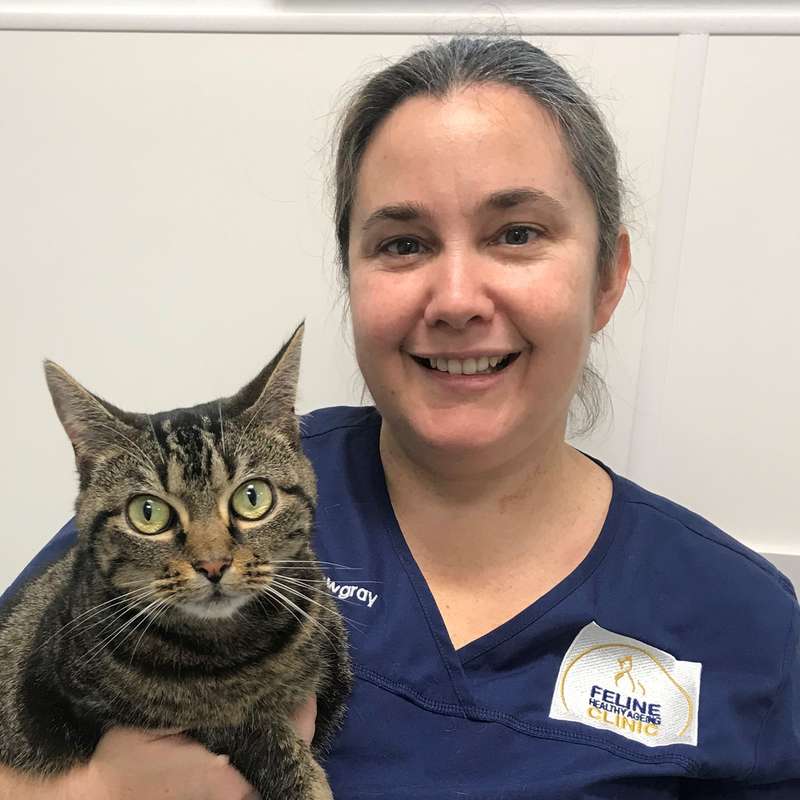
 Nathalie Dowgray
Hello, welcome to the April 2023 episode of Chattering with ISFM. I’m Nathalie Dowgray, Head of ISFM and the host of this months podcast. This month we are going to be sharing another of our in conversation with sessions recorded live at our Rhodes congress last year, I spoke with Dr Sarah Heath about some of the more common issues she sees with cats that lead to problem behaviours and we are also featuring our monthly JFMS clinical spotlight interview.
This month I’m speaking with Dr Rodrigo Paulino on Chronic Axillary wounds in cats. So we hope you enjoy this episode. What are the most common issues with the cat's home resources that you encounter that lead them to be referred to you?
I think feeding is the main resource issue that we see. And not necessarily the fact that cats are often fed together. Obviously, that's not ideal. They're solitary feeders, so they should always have the opportunity to eat alone, even when they're in a socially compatible group. So not, just because they are socially compatible, still doesn't mean they should be eating together, eating is a solitary behaviour.
But one of the things I would just say as an added tip is if they say, Yes, I do feed them in separate rooms, which actually a lot of people have heard that now. And do do that. Ask them where the cats are when they're preparing the food. Because that I find is the biggest stressor that is still around, even when people have heard about solitary
feeding. And there's a video I show in one of the talks that I give, which is of a nurse colleague, who very kindly let me video when I went to see her cats, and she was very aware of resource distribution, she did feed them separately, very meticulously weighed out foods, because one of them was on a weight management programme. And I observed a feeding and took a video of it. And as she's preparing the food and weighing out, the two cats are behind her
so she's not seeing them. And we're getting staring and we're getting a blocking behaviour, we're getting some swiping. And we have one fat cat. And one thin cat, which is always a bit of a telltale. And actually, the preparation of food twice a day was very stressful. But the food was then delivered separately in completely separate rooms with the door closed between them. And I see that so often. So that would be my one, don't forget about the preparation as well as the delivery.
Nathalie DowgrayAnd how would you suggest people get around that? That's a really hard one to do.
It is really hard. And so we need to be thinking a little bit laterally. And so if they're outdoor cats, so they have time outside, then prepare food and put it in the fridge and then have it ready so that you can get it out quickly. You don't need to be doing any, if it's dry food, weigh out in the morning. So weigh out however many meals you're gonna give in the morning so that they're all done, you don't have to go through that each time. So it's a much shorter period of time in
preparation. The other thing is using neoprene sealed feeders, so that they can actually self access wet food that's fresh for 24 hours in a neoprene sealed type of feeder. So that's another way of doing it. If you have more than one person in the house. For someone who lives alone, I know how difficult it is when you don't have that luxury of another human being. But if there is another human being there who can take the cats into another room and play with them individually, not
together. So do something with them. So have one of them in the kitchen while you're preparing and the other one in another room playing with someone else. So they're not in the same room that can help. So all sorts of little ways in which you can get round it but it is difficult. And if they're indoor cats, it's even more difficult because as soon as you open that cupboard door, good old Pavlov, here we go. We know that cupboard door means something and yeah, they
were asleep on the bed. No, they weren't. They were lying on the bed, because they heard the cupboard door downstairs, and suddenly they're all there. So of course, it's not always easy. But there are practical tips and things we can do. And we get very imaginative in the ways that we solve these problems. But it's very individual, of course, to the client and the house and the cats.
Nathalie DowgrayOf course, yeah, feeling some guilt that my cats bowls are in the same room, quite far apart.
It's visual protection that's important to cats. So if you have a peninsula bar type style, or a central island in your kitchen or something like that, and you can use that as a visual barrier, that can be enough, you can use a height barrier as well if, as long as you cause visual segregation, so it doesn't have
to be physical. I remember, Ilona won't mind me saying this, she had two cats and when I went to stay with her, she was having a little bit of an issue and I looked at the way they were feeding and we just put a cardboard box between them and immediately their body language changed. It's like look at those ears, look at that tail. Immediately they went into a nice crouched feeding posture, that was what we're looking for.
And it was just a cardboard box, and then we were able to look at how we do that slightly differently in a longer term. But we don't need to spend a lot of money. There are ways of doing these things without spending money. And I think that's quite important as well.
Nathalie DowgrayBrilliant. Thank you for that. It's really helpful.
I advocate kitten information evenings. It's something I've talked about for a long, long time. But I do urge you to do kitten information evenings, that is where you invite your kitten caregivers to the practice. And you give them a talk about cat behaviour, about natural cat behaviour, about the five pillars, about emotions, and you get that information to them as early as possible in that relationship.
Nathalie DowgrayAnd now I'm going to be speaking to Dr Paulino about his JFMS clinical spotlight article on Chronic
what do we know and how should we manage them? If you had to give some or two top tips for managing axillary wounds for vets in practice, what would they be?
Top tips is wound preparation. Working with less experienced colleagues, the most common mistakes would be the initial wound management, the adequate flushing of the wounds, making sure that we collect a sample, make sure that we are using the correct antibiotic. Because this is key. We need to be very careful with our antibiotic use because we don't want to eventually run out of antibiotics, run out of choices. We need to be very careful with our antibiotic use. Definitely clear as much debris
as possible. So decrease the debris burden and the bacteria as much as possible with our flush. Appropriate antibiotic and then just wait. Don't, Don't rush. So I would say top tips are appropriate initial wound management and don't rush into anything that you're not ready or the wound is not ready yet. So it's just kind of careful planning.
Nathalie DowgrayGreat, thank you, yeah, I think it's a really good tip. Because yeah, I think I could say I've probably been guilty of rushing some of these cases, you see a wound and you think I just need to close that. So that's really, really good advice. You mentioned some bandaging techniques in the paper. Do you have any tips for us about bandaging these type of wounds and how to get the bandage to stay on?
Yeah, I think cats are always tricky because they don't behave as they should and there much more flexible, more wile, so it needs to be something that allows the cat to move freely. So what I like to do is a tie over bandage, it doesn't need to be super close to the wound, it can be quite far away from the wound edges. So I mean, the anchors can be
quite far away. And then on top of the tie over bandage, I like to place, for instance, like a pet shirt, the cats really feel comfortable, feel secure, and then allows a little bit of fixation of the of the bandage as well. And then if it slips a little bit, it's fine, because we still have the pet shirt. So yeah, I really like a nice tie over and then a pet shirt. Maybe if the cat is well behaved, not wearing the buster collar. But that's another subject.
Nathalie DowgrayIf we can build on that actually, do you generally use buster collars in these cases? Or does it really depend on the individual cat?
I think it depends on the individual cat, I would prefer to keep it just on the pet shirt. But it is case dependent too, these guys are proper ninjas. So we don't know how they're going to be until we actually have them in the hospital with a bandage, with the pet shirt, with the buster collar. So I would prefer to keep as minimal as possible so that they can feel more
comfortable. But in some cases, if keeping the patient without the buster collar would compromise the wound healing, I would definitely place a buster collar.
Nathalie DowgrayThank you for listening. At International Cat Care we advocate for microchipping as being the primary source of identification for cats and, where collars are being used as a secondary form of identification, we strongly advise that they are quick release collars to prevent these types of injuries occuring. This is an issue where the veterinary profession has a strong role to play in educating and advising the public about what appropriate collars for cats
are. If you are an ISFM member you can hear more from Dr Paulino with his full interview being available on the ISFM members podcast, to access this please visit portal.icatcare.org. And as well as the podcast, ISFM veterinary members can also access all the other ISFM member benefits including Dr Heaths lectures from our ISFM Rhodes congress, monthly webinars, the discussion forum and much more. If you are looking for more CPD in May we also have two open access webinars. The first is from
IDEXX and Purina. It's early chronic kidney disease in the cat: how to detect it and what to do next. And that's with Sarah Sweet and Dottie Laflamme. It's going to be live on the 11th of May. The second webinar is from ISFM and it's on creating a cat friendly veterinary environment with Sam Taylor. And that's going to be live on the 16th of May. And, don't forget, JFMS is now an open access journal so if you wish to read Dr Paulino’s clinical spotlight article please do follow the link in the
show notes. We'll be back again next month with more interviews recorded at ISFM Rhodes and next month's JFMS Clinical spotlight interview. If you don’t want to miss it make sure you sign up to Chattering with ISFM on you preferred podcast platform.