



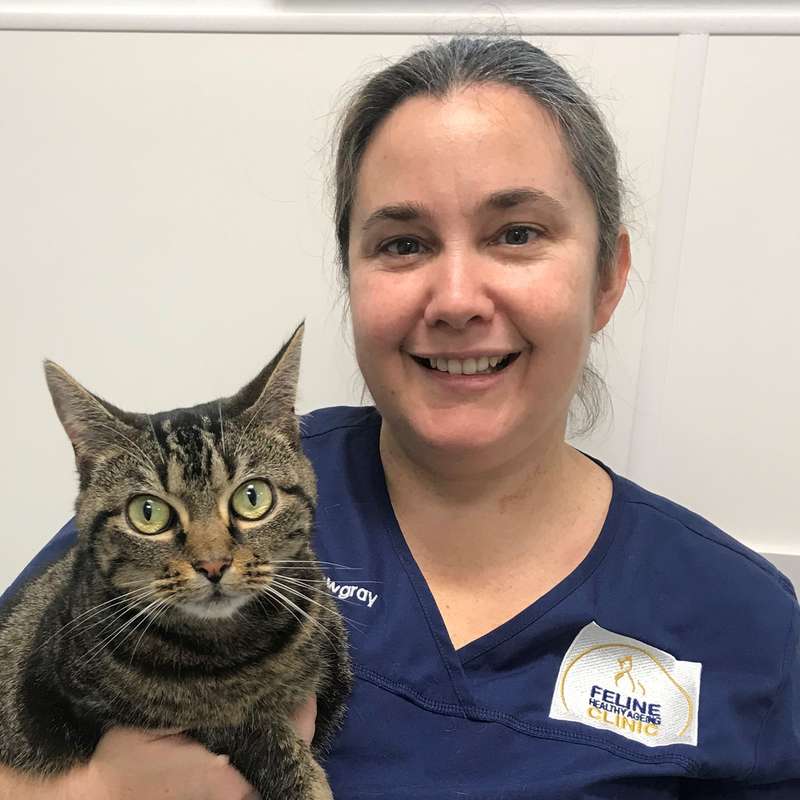
 Nathalie Dowgray
Hello, welcome to the March episode of Chattering with ISFM. I'm Nathalie Dowgray, Head of ISFM and host of this month's podcast. First up this month, Yaiza Gomez Mejias is speaking with Dr Ryane Englar on the continuum of care. And that's following her two articles on recasting the gold standard that were recently published in the JFMS special collection on accessible care. We're also featuring our monthly JFMS Clinical Spotlight interview.
Following on from January's eepisode, I'm speaking again with Professor Vanessa Barrs. And this month, the focus is on the treatment of invasive fungal infections.
Thank you for your time today. Congratulations, by the way, on these amazing articles you recently published in the Journal of Feline Medicine and Surgery. So, what inspired you to write these articles?
Yeah, thank you so much. They're really two of my passion projects that I was really grateful to see come to fruition. They stemmed from this feeling that we need to really broaden the lens through which we see veterinary care, not just on a community level, but nationally and globally. There's been this transition in the veterinary profession as a whole from gold standard care to beyond that. The reality is that's a bit of an antiquated approach to medicine.
It really implies a medical monotheism, in a way it's saying, you have a pet that comes to you or a patient, there's one approach, right? And if you're not doing that approach to diagnostics, or if you're not doing that approach to treatment options, that you're giving lesser care. It's an all or none approach, either or. And I think that what really bothers me about that is, when you get into practice, we realized very quickly there's very rarely the time that you can apply that approach.
Then you discover that, in fact, some of the other approaches for whatever reason, in context, can actually be quite beneficial for that patient. And so, I really play a role as that general practitioner mindset of trying to think about how do we help ourselves and our patients and our clients embrace that contextualized care. It's not lesser care. It's care that is actually tailored to that patient. And in a way, that's the optimal care.
why do you think terms such as contextualization of veterinary care, spectrum of care, and patient centred medicine have become so popular just over the last couple of years?
I think it's something that was always under the surface. And it's things that we didn't always talk about because when I was trained to think it was subpar medicine to think about doing something other than gold standards, CBC chem, UA, fecal, T4, full thyroid panel imaging for everything that came in the door. That I was almost embarrassed sometimes to admit, I have a dog that's vomiting and we're just going to do supportive care.
And I didn't really want to feel like I was not offering to the best of my ability. Clients now want individualized care, right? It's not, I want vaccines for my dog, that's a cookie cutter vaccine protocol, right? Clients are more well read, they go to the internet, they find sources, they find evidence, they find journals and they say, does my cat really need that leukaemia vaccine? This is the lifestyle, let's talk about that. Could we add it in later if we need to, right?
So, I think that customization can serve us well. By virtue of embracing it, start to rrealize there's lots of different ways to practice and there's not one right way. It's about what does that patient, veterinary team and client need as a trilogy. And if we can embrace that, we can really create power in our ability to serve individuals and communities.
Your second article introduces strategies for initiating conversations with clients about healthcare options and case management decisions. Would you like to expand on any of those communication strategies we can use to navigate a spectrum of care clinical conversation?
Yeah, I think transparency is huge, we don't have a crystal ball in front of us. We can't predict everything. We wish we could. Here's what I know. Here's what I don't know. Let's talk about that. And let's figure out where's our comfort level. Where does that fall in that spectrum? We need to do a lot more eliciting the client's perspective. What would be helpful is to stop and pause and just say to the client, what concerns you most? What do you need from today to make a choice?
And if we can ask those questions, our clients are going to feel more apt to share. Perspective is everything, and I need to start asking, what do you need? What can you do? What's your capacity? And we often think about capacity in terms of economics, that's really true. But what is their emotional capacity to navigate this next steps, right, what's their physical capacity? And all of those things that go in. So I think those are the biggest ones.
The third one would be regard for the choice that they make. It's tough because I've been in situations where we may not agree with the choice that was made. But if you offer it as a choice option, then we can't be wrong when our clients choose that. If we're offering it as a viable option, then we need to believe in it and have partnership. Let's just take off that doctor uniform and have a conversation with someone else about what they need to know and how we can help them.
Do you think we talk about that enough and that we assess quality of life enough in our clinical work?
I think we're improving with the publications of more quality of life scales and that we're starting to realize again, there's not one scale, there's multiple ones. we're recognizing there's more ways to identify suffering, pain, quality. We're realizing the importance of subjectivity, having different people to assess. We're realizing to be focused on subtle cues that we never thought before, like the face grimace scales and things like that.
I think where we need to sometimes be more proactive is helping the client understand how they can use these tools and that they're not always the end all be all, but which one resonates with you, right?
Do you think we talk enough about ethical dilemmas with our colleagues as well? Because we been talking a lot about the communication between vets and owners, but I think communication between vets is also important. So what's your view on that?
We often ended up with euthanasia and then no one talked about their emotions and we tended to just shove it down and not talk. I think there's been more awareness now of the impact of those cases. There's caregiver burden, yes, but there's also provider burden. The healthcare burnout, compassion fatigue, all of those have made it more okay to start that conversation.
I think that we don't always know how to hear each other and I think where we still need room to develop is recognizing that we each have different stop points. Our colleague may have a different line in the sand, and we need to support each other. We need to acknowledge why does something trigger us? Why does something make us react? Can we talk about it so that I can still feel okay with the choice I made, but I need the support from my colleague.
I also need to support them when they make a choice that I might not have agreed with. We just need to be kinder to each other, I think.
That's great. It's always good not to forget our human side. Yeah.
Nathalie DowgrayAnd now I'm speaking with Professor Vanessa Barrs on invasive fungal infections and oomycosis in cats, part two, antifungal therapy. These cases really require quite prolonged treatment. So 3, 6, 12 months. How do you frame that discussion with the owner? Are there factors that maybe need to be agreed or discussed before you decide to proceed with the treatment?
I suppose one of the first things that I'll talk to the owner about is say, I've got good news in that this disease can be curable. Obviously, some of them have got better prognosis than others, but if we talk about fungal infections in general, yeah, I'm going to say it's good news. This can be cured, but then I've really got to let them know that it can't be cured by a course of antibiotics. And there's a few things that need to be considered.
One is you need to be able to medicate your cat, you need to have the time to be able to do that. You need to bring the animal, your cat, back in for regular rechecks and also, understand the costs associated with treatment. I try and let the owner know upfront as much as possible so that they can make an informed decision.
Nathalie DowgrayGiving long term medication, I know it's been talked about especially with some of the mycobacterial cases where actually in some cases they place an esophagostomy tube to facilitate medication. Is that something that you've considered with some of these fungal treatment sort of cases?
Look, I think it's not needed in most cases. I mean, you know, it can make the management a little bit more complicated than you want it to be. I think the good news is that a lot of the fungal medications come in oral solutions. So it's not necessarily always going to be a capsule or a tablet and some of those things like posaconazole is generally very palatable. I used to have one cat that would stand up on his back legs and beg for the stuff out of the syringe.
Nathalie DowgrayBrilliant. And that's good to know. With the sort of long term nature of the treatments, are there any circumstances where you might consider giving antifungals without having done that sort of susceptibility testing?
That is a great question, and I know in the article that I talk a lot about antifungal susceptibility testing, but the reality is that probably the majority of Invasive fungal infections are treated in practice without having done that. So, in the treatment section of the article, we've indicated which drugs can be used for first line and second line therapy and these can be given regardless of whether susceptibility testing has being done or not.
Nathalie DowgrayOkay. Now that's really interesting. And we talked obviously about oral drugs, probably being the majority of them, but definitely for some cases, IV infusions are required. How do you approach that to get the best outcome?
Yeah. So it's going to depend on the type of fungal infection that you're treating. So if, for example, you're treating cryptococcus and you've got really severe disease or you've got CNS disease, you need to be able to give perhaps something like Amphotericin B and you can give Amphotericin B as outpatient therapy by giving the subcutaneous infusion three times a week and that's great. IIt makes it much more accessible to people and more affordable as well.
But, there are some situations where you need to use an IV drug and probably the best example would be with the echinocandins. So they're a newer class of antifungal therapy that haven't been used much in veterinary medicine.
But occasionally, you might get a mould infection that is really got low MICs for caspofungin a nd you can really only give that drug intravenously as a once daily infusion, but fortunately, the number of times that you're going to be confronted with that situation is pretty rare. Subcutaneous infusions of amphotericin being for severe infections is something that can be readily done in GP practice.
You need to be able to monitor for azotemia and also, you've got to think about whether they've got any underlying heart disease as well. Because if you've got a cat that's got a quite a severe heart murmur, it might have an underlying cardiomyopathy, you don't want to be giving it 300mls of subcut fluid three times a week because it might tip into heart failure.
Nathalie DowgrayThat's a really interesting point, isn't it? Because you were saying the risk of overload is less with subcutaneous compared to IV. But yeah, I can see on that volume on a regular basis. Yeah. Are there any circumstances where you wouldn't necessarily advise treatment?
There's one situation where you might think about sporotrichosis, for example. So sporotrichosis is polyzoimotic. If you've got an immunosuppressed family member, you might be having a different conversation about whether the owner's really concerned about zoonotic infection, and that's problematic, then, if they can't treat the cat somewhere else, they may not be able to manage that risk appropriately.
I think with each of these invasive fungal infections, it's a matter of looking at, okay, first of all, what type of fungal infection is it? And then how bad is it? How severe is it? How advanced is it? That's also probably going to help advise whether to treat or not. I tend to be an optimist and I always think it's worthwhile trying to treat fungal infections because I think that you can have a really good result.
Nathalie DowgrayWhat would be your top tips for successful long term management of these cases?
Yeah, I think I've got four top tips. The first one is focus on getting a definitive diagnosis with an accurate identification of the fungus to guide your treatment. So remember it's not to just only to do histo. If you're taking a sample for histo, always stop and think, should I do culture on this as well? Should I do a double culture on this?
And if you're not sure, remember to keep that little bit of tissue in the freezer for PCR in case you forgot, or in case your fungal culture was negative. The third thing I would say, remember that antifungal drugs can have adverse effects. So do your baseline monitoring of liver enzymes. And finally, get your patients back regularly so you can follow up and see if your treatment's working and if not, use some of those newer tools that we spoke about.
Nathalie DowgrayThank you for listening. If you're an ISFM member, don't forget you can access the full version of the podcast or the other ISFM member benefits, including congress recordings, monthly webinars, the clinical club, the discussion forum and much, much more at portal.icatcare.org. If you're looking for more free CPD from ISFM on the 16th of April, please do join the Open Access webinar from Royal Canin. Toilet Trouble, Diagnosis and Management of Feline Idiopathic Cystitis.
And that's with Doctors Sam Taylor and Cecilia Villaverde. We'll be back again next month with another episode. If you don't want to miss it, do make sure you sign up to Chattering with ISFM on your preferred podcast platform.