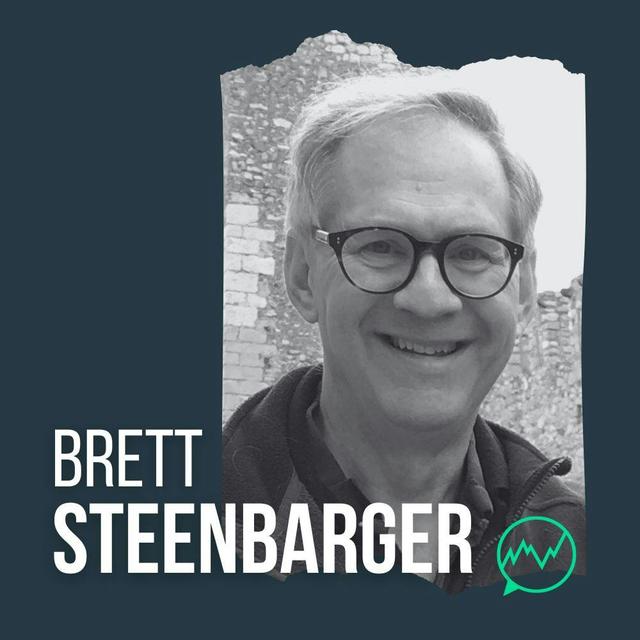



¶ Intro / Opening
Chat with Traders is brought to you by Trade the Pool. Did you know that every decade the market reinvents itself? Online brokers opened the doors, mobile apps made trading seamless, and commission-free trading erased barriers. Now a new era has begun. Meet, trade the pool, limited risk trading. And now you also have unlimited time to reach the profit target. From now on, your trading risk is capped, and your trading opportunities are limitless.
Trade the pool funds home-based stock traders with up to$200,000 in buying power. That means you can trade larger positions and scale your strategies without risking your own savings. It's time to trade with more capital, making it truly worth your time and effort. Ready to trade the pool? Click the link in the description and join the stock trading revolution today.
Trading in the financial markets involves a risk of loss. Podcast episodes and other content produced by Chatwith Traders are for informational or educational purposes only and do not constitute trading or investment recommendations or advice.
¶ Psychology, Ideas, and Trading Success
Yeah, one of the things that we see among very successful traders is a love for generating ideas. for studying markets, identifying opportunities in markets, digging. Seeing things that other people don't see. It's all related to creativity. It's all related to research. But really, really good traders are motivated by idea generation. They're not simply motivated by PL when opportunities are not.
forthcoming in the market. They're able to be patient and not overtrade because they're so absorbed in researching and generating the new set of ideas.
🎵 Music
Hey traders, investors, and explorers of trading, welcome to Chat with Traders. As always, we're so glad to have you join us. This is Tessa, my co-host is Ian and we're in episode two ninety six. So how do you feel about trading psychology? Think about this. Across our 296 episodes, the topic of trading psychology, or aspects of it, shows up in about Two hundred and forty two of the two hundred and ninety six episodes. That's eighty two percent of all of our episodes.
The trading community has long held that success in the markets is about eighty percent psychological. When I look at those numbers side by side, our eighty-two percent coverage and the often quoted eighty percent rule. You start to see a pattern of So coincidence? I'm not sure. I don't think so. While some traders dismiss the psychological aspects of trading as nonsense and others wrestle with it daily, the data tells a compelling story.
Maybe we keep coming back to psychology because it's impossible to ignore in trading. And guess what? In our interview today, Ian chats with a very prominent psychologist that you may already heard of. His name is Dr. Brett Steenbarger. And we're thrilled to have Dr. Steen Barger return to the podcast after eight years.
He was first featured in episode sixty five, which was a very wildly popular episode. And by the way, I would like to reference several other useful episodes dedicated to the topic of trading psychology. They're episodes sixty five, eighty six, one hundred ninety nine, two hundred, two hundred fifty two, and of course today's two hundred ninety six.
Some of them are oldies but goodies. And if you ever need help in searching for a certain trading topic across our collection of episodes to listen to, feel free to reach out on our website, chatwithraders.com, and we're happy to help. So back to what I was saying about our guests.
Dr. Steenbarger is a psychologist and performance coach for professional traders and hedge fund portfolio managers. You may also be familiar with his work with traders and giving really awesome presentations at SMB Capital. Much has been going on with Dr. Steenberger over the years, including some of his views that have evolved over the years as he's worked with many traders. What are those views on trading psychology or trading in general that has changed for him?
What's cool about Doctor Steenbarger is that he's also an active trader, so he gets us, you know. He's also published numerous articles and books on trading psychology. And we also get a sneak peek on topics discussed in his new book called Positive Trading Psychology, set to release sometime later this year.
Oh, and by the way, we started adding a bonus clip section at the end of the interview for a behind the scenes conversation for some episodes. So if you make it to the end, you might get a bit more extra listening time. I hope you like this new format.
¶ Trading Success Through Strengths
Well, without further ado, let's dive into this great conversation. Ladies and gentlemen, we're so pleased to welcome back Dr. Brett Steenbarger.
Well, Brett, I would like to welcome you back to Chat with Traders.
Well thank you very much, Ian. I uh I appreciate the interest.
Yeah. Well, it's been uh over eight years since you were last on with us. Um, what have you been working on since we last chatted with you?
Wow. Eight years. Been doing uh quite a bit in different areas. I still teach at a medical school in Syracuse, New York, uh, and uh teach uh short-term approaches to change, changing our emotions, changing our behaviors. And and a lot of that is what I apply to my work with traders, with portfolio managers. So I continue to do that and uh I've uh written a new book and that will be coming out later this year. Uh it's called Positive Trading Psychology.
And it's looking at improving our training by building on our strengths, not just working on weaknesses.
So yeah, go into a little bit uh more about that. Some people th say that you should be aware of your weaknesses, uh, so you can improve them'cause who wants to have weaknesses, right? But you're focusing on more on the just the strengths.
Well, uh focusing primarily uh on on strengths, and that is a way to address weaknesses. Um if we focus, focus, focus on our weaknesses, we reinforce the concept that we're weak. And what happens in positive psychology is that you look at problems as being the result of not playing to our strengths, not making full use of what we're good at. So the idea is to study and study and study our successes.
our our our wins uh what we do well in trading and then figure out okay how did how did i do that what am i really good at And build, build, build on those strengths. And sure enough, that uh takes care of many of the weaknesses.
For say uh some newer traders or people just getting into the field, are there any ways that they can know about potential strengths that they have prior to getting a bunch of experience trading so they know where to focus on? Yeah.
Clearly you couldn't know your strengths prior to that experience. So it's like someone just starting to get involved in sport. How can you figure out what you're good at? Well, you have to try basketball, you have to try baseball, you have to try, you know, uh soccer, what have you. Um you you play different sports, you play different positions in different sports. And you see what you do well, you see what speaks to you. So there's a whole process of exploration that precedes specialization.
One of the big, big, big, big problems that beginning traders have is that before they do that exploration, they trade, they put money at risk. They don't really know what they're good at and predictably they become frustrated and they lose money.
¶ Mastering Self-Coaching and Learning
Some say that human psychology hasn't changed in thousands of years. Did you learn nearly everything about this subject uh before your first book that you wrote over twenty years ago?
Well wow, that's a really good question. Ian um, you know, prior to my first book, which came out uh early in the 2000 period, uh 2003, uh I had been teaching for many years. at the medical school in Syracuse and teaching these very top So my career as a psychologist taught me a lot about working with people, taught me a lot about positive psychology, and I ended up applying that.
to traders and trading. You need to learn. I keep learning. I read new things. I, you know, I learn for the people I work with. And that's what keeps it fresh. That's what keeps it excited.
In uh in a previous interview you you mentioned uh you said that, quote, many traders don't really know what they do best. They are invisible to themselves. Why is that? I mean, what Why are traders invisible to themselves and how how do they get to know what they do best?
Yeah, because they're not focused on learning markets. They're not focused on discovering what they do best. They want to trade and make money. Period. Well, let's say as an analogy that I go about meeting people for romantic purposes. And I'm focused on just making a connection and getting them into bed. And then I wonder why I don't have a fulfilling relationship life.
To have a fulfilling relationship life, you have to explore relationships. You have to see who you get along with, who you don't get along with, where the chemistry is. And it's out of that that you develop something long-term. When traders short circuit that development process, that leads to frustration, that leads to losses. But the frustration and the losses are not the problem.
I mean, to say that if you work on your frustration, if you stop going on tilt, you're going to do fine. I mean, that's pretty close to insane. They need to learn what they're doing. They need to explore all the different types of trading, time frames, styles of trading, see what they're good at, and then build upon those strengths.
On the topic of self coaching, which you have mentioned in the past and continuous improvement. Many traders struggle with self-deception when reviewing their own performance. Uh how how can traders develop an objective self-coaching framework that prevents confirmation bias and excuses?
Yeah, that is a risk. You know, the coaching framework that I often talk about in my writing is just to review each day one thing. That I did really well, that I want to build upon tomorrow. And one thing I could have done better. that I want to improve tomorrow and a specific plan for improving that. So you're really looking at, well, I'll give you a perfect example just for my recent trading.
I trade as well as a coach. So um I found an opportunity. Uh it was uh go going short in the SP, which has been weak last uh two, three days. And timed it really well. and exited too soon. Okay, well I did something right and I did something not so right. And so that becomes my review.
And out of that review, I have specific goals and plans for working on those. How can I do what I did right today? How can I make sure I do it tomorrow? But how can I improve what I didn't do well and take it to the next day? So it's looking at what you're doing concretely, specifically, identifying what's working, not working, which you know objectively from your PL, and uh then creating a process. of improvement on that basis.
¶ Personal Example: Entry and Exit
Would you mind sharing with us uh kind of what you felt you did good and what you felt you need to improve uh in the last few days um regarding the recent drop in the market?
Yeah. What I did well, and I and I have a blog post, uh my trader feed blog uh alludes to this. Uh I had the patience to wait for different time frames to line up. So the first thing I did right was not trade. I just waited and waited and waited for the time frames to line up. And what we had were overbought signals on multiple timeframes. where the market could not make a new high. And so once that started to turn over, I was quick to sell and take advantage of that.
That's why I did well. Um in a sense, it it was. Waiting for everything to line up to for the for the trade to come to me rather than for me to try to make it happen. With the exit, I made the reverse mistake. So it went down quite a bit. It was oversold. And not quite oversold or really oversold on the larger time frame. And I was premature in getting it. I was too eager to take the profit.
And I know what I was telling myself at the time, but uh that was a mistake. And so I was patient on the entry, need to be more patient on the uh exit.
¶ Elite Traders: Idea Generation and Context
Great. Thanks for sharing. Uh you've worked with traders, um, from my understanding, um, coached them across different types of asset classes and timeframes. Have you observed psychological traits or mental models that consistently separate the elite traders from the merely competent? And if so, what are they?
Yeah, and I've actually been involved in research at several different hedge funds to identify predictors of success. And there are a few. You know, one of the things that we see among very successful traders is a love for generating ideas. A love for studying markets, identifying opportunities in markets, digging, seeing things that other people don't see. It's all related to creativity. It's all related to research. But really, really good traders are motivated by idea generation.
They're not simply motivated by PL. And so when opportunities are not forthcoming in the market. They're able to be patient and not overtrade because they're so absorbed in researching and generating the new set of ideas.
Mm-hmm. Uh, can you give us an example of an idea that you heard uh from a trader um that you found interesting?
Yes. It's a type of idea. The trader, and this is actually a team at a hedge fund, they noticed that certain things were going on in the currency markets in FX. Certain things were going on in the interest rate market. And certain things were going on in specific sectors in the stock market. And they identified that there's a theme, a single theme, uniting all of those.
And that very large market participants, that would be uh groups like uh asset managers, were investing their money based on this theme. And so by identifying The themes that these big, big asset managers were following, they were able to be more nimble and get ahead. of uh the anticipated moves. What they don't do is just look at a chart and look at a shape on a chart. and decide to buy or sell. Like no one does literally no one does
Ah, interesting. So the traders that you you've worked with primarily institutional traders is
Yes. Um I work with one proprietary trading firm and I work with all the rest are um multi-strat multi-strategy hedge funds.
So uh the traders that you've worked with, they're not purely a technical trader.
They may look at technical factors, but that's one among many things that they look at. They would never put money at risk. Based on the shape of a chart. Now, they might say that for this and this and this reason, I want to be long. I'm seeing that. I'll talk about the current market. Um, uh I see that defensive stocks are behaving better than growth stocks. And people are shifting money away from growth and toward value.
And that is showing up on the chart in this and this way. And in fact, with the growth stocks like the NASDAQ 100, I can see we're breaking a trend line. And that becomes a meaningful idea. So I I'm looking at the chart, but putting it into a broader market context.
¶ Importance of Feedback and Mentors
In previous interviews, you've mentioned about using structured feedback loops to refine trading strategies and decision making. Uh, what is a structured feedback loop and how do we create one?
Journaling is one structure that we can use to constantly get feedback about our performance. And what I just described earlier is a very simple form of journaling, just writing down the one thing I did well and writing down the one thing I could have done better. but you are creating a structure for regular feedback about your performance.
And if you look at how people are coached in professional sports, for example, they have a coach working with them, observing them in real time, and giving them ongoing real feedback. Uh it's a structured process so that they can make continuous efforts at improvement. Uh that's called deliberate practice. And it's really the foundation of improving performance.
Sounds like you're a a fan for um traders getting a mentor.
It's uh I'm hesitating because that's not so available to many traders. Now, at the places where I work, everyone has a mentor. People belong to teams. the more senior members of the team mentor the more junior members of the team. So that is a hallmark of the places where I work. And if you think about Performance fields in general, performing arts, athletics,
There's always teaching and mentoring. People don't learn on their own. Uh oh, I'm gonna become a professional basketball player and so I'm gonna go out and shoot baskets outside and on my own. But that doesn't happen. So it's very difficult, it's challenging for individual trade. to find that kind of mentoring, which is why it can make a lot of sense to have some initial success and then join a trading firm that can move you from there.
Have you ever watched a stock explode and thought, if only I had the capital, or sat on the sidelines because your account balance felt too small to matter? Good news. With Trade the Pool's limited risk platform, you don't need millions or even thousands to start trading the US stock market. Bypass the PDT and tap into over twelve thousand US licit equities. From penny stocks to big caps, ETFs, even the newest IPOs, and short anything you like, with zero locate or hard to borrow fees.
Start your evaluation. Get funded with up to$200,000 in buying power so you can go big without risking your own savings. And now you can also have unlimited time to reach the profit target. It's a game changer. Not ready to trade yet? Trade the Pool offers a free demo and educational resources. Practice on live data, master the platform, and build confidence risk-free before you even pay a cent. Click the link in the show notes to start trading with Trade the Pool's capital.
¶ My Journey of Self-Mentoring
So in your early trading, uh did you trade for a while uh without a mentor and did you at some point uh get a mentor and uh how how what were the uh
Yeah, good question. Yeah. So what happened when I first learned trading and I started trading in the late 1970s? Every single day I printed out. Multiple, multiple, multiple charts. of all the variables I was interested in. And then I would study patterns on those charts. So, for example. I would have a chart, like a one minute chart for the day of the S P. And I would have a one minute chart of advances declines, a one minute chart of upticks versus down ticks in the market. And I would look
for patterns day after day after day after day after day. That was me mentoring myself. I it was just intensive study and to this day I make use of some of those patterns. Now later on, I started working for professional trading firms and learned a lot from the people I met with. And that was a kind of mentoring as well. But I've never full-time worked at a trading firm where I had a formal mentor.
¶ Focus Trumps Emotional Control
Great. Let's um go on to the topic of uh emotional resilience and adaptability. Traders often hear about the importance of emotional regulation. But is there ever a case where controlled aggression or frustration can be beneficial in trading? And if so, how would it be managed?
Yeah, good question. So I'll I'll back up and and just challenge the premise a bit. I had a teacher many, many years ago named Ayn Rand who would challenge premises. The most important thing in trading psychology is not emotion. Period. Um People have negative emotional reactions because they do things that they're not prepared for. They don't go about learning the right way.
And so emotions are the result of the main problem. They're not the main problem themselves. Now, that being said, what is most important, especially for active traders, is focus. of, you know, really being zoomed in on what's going on in markets, what's going on in different markets, how is it all related. And l uh as I mentioned before, letting patterns, letting ideas come to you.
Now, in terms of making the most of those patterns, yes, I think there can be a role for controlled aggression, for being aggressive, for being assertive. in taking proper advantage of an edge that we perceive. So it's not that we're trading like robots completely emotion free.
In extreme volatility, emotional discipline can be the difference between survival and ruin. Uh, what psychological techniques do you recommend for traders to maintain clarity and adaptability in fast moving chaotic markets?
¶ Navigating Dynamic Market Conditions
Yeah. So in fast-moving chaotic markets, those are typically markets that traders have not had a lot of experience with. And the patterns that show up in those markets are quite different than the ones in lower volatility markets. So if you have a very low volatility market, particularly in the stock market, you'll see a lot of range bound or cyclical action.
With when the VIX gets really high, typically that's happening in a bear market or a rebound from a bear market. So completely different pattern. What makes it difficult for the trader is that because of the greatly increased volatility, you have to completely adjust the sizing of your positions because everything can move so much more.
Unit time.
It it's very, very important to practice trading volatile markets before putting money at risk in those. And one way to do that is to go to various historical markets and play them bar by bar on your screen and practice thinking through what's happening and how you would respond and so forth.
So okay, moving on to the topic of cognitive biases and trading decision making. Recency bias and overfitting are common pitfalls for traders using historical data. How can traders balance learning from past patterns while ensuring they are not trading outdated strategies?
Yeah, uh good good question. Um, if the strategies are going to be outdated. It's because something fundamental in the market has changed. So the professional traders that I work with, they are always monitoring volatility of the market. They're always monitoring the correlation of their market to other things that are trading. And when they see that volatility and correlations are changing meaningfully.
Volume, for instance, in the stock market would be a good indication. Uh, that's correlated highly with with volatility. When you see those change, your first thought is look, this is a different market, and you want to step back. from risk taking. So an example would be if you're a car if you if you're a a race car driver and suddenly you see that a portion of the track is wet or icy, you immediately make an adjustment.
Uh would you characterize the market uh that we're in right now at the end of February twenty twenty five as uh a market that's uh changing to a new regime? I mean a new new t a type of market that that we've been in in the past. Or do you think this is just a a pause and and a continuing uh bull market? Um
Um, it's a really, really good question. Uh I do believe we are in a corrective phase. of what has been quite a bull market. Uh, and we are seeing rising volatility. And we are seeing a number of sectors of the stock market that are not making new highs, even though the averages are making new highs. So that's a pattern we've seen at bull market peaks. We saw it in the late 1990s going into early 2000. We saw it in 2007 going into 2008. Fewer and fewer stocks.
Participate in strength, and that leads to subsequent weakness. I believe we're seeing that now.
¶ Skill, Luck, and Smart Stops
So in trading, uh randomness plays a major role in short term outcomes. Uh, what methods do you suggest for traders to distinguish between skill based results and those driven by sheer luck?
Yeah, yeah. When you have a trading idea. You want to clearly identify what would tell you that idea is wrong. Because as you're pointing out, Ian, there's random movement moment to moment. But if I, to use my earlier example, if I see that the market has bounced higher on multiple timeframes, and seems to be making a lower high. And now all of a sudden we see more sellers coming in. I may aggressively get short there. But I know I'm wrong.
If we make a relative new high, if if suddenly a big flow comes in and we make or a news event occurs, we make a new high, that's telling me I'm wrong in that anticipation and I have my stop level. So the stop is at a level that tells me objectively that my expectations are not being met rather than being based on just short-term movement.
Uh-huh. So do you set your stop level based on rather certain levels that uh that if they break that level then you think that we're in resuming in a bull trend rather than a a fixed percentage?
Definitely not a fixed percentage because yeah, because the market volatility can change from day to day and week to week. Um yeah, I'm uh basing the stop on my idea, on the trade idea. And what will tell me that idea is wrong? And so if I think we have topped out. I usually don't want to try to buy The absolute high, uh sell the absolute high uh of a market that I think will fall, or buy the absolute low of a market that will rise. Um in technical terms, I love to sell The right shoulder.
of a head and shoulder pattern or by the right shoulder. Uh and and so we've seen the absolute low. And now you get, let's say you see the absolute low, you get selling, and we can't make a new low. They're selling, selling, selling. We can't make a new low. And then you see buyers starting to come in. I'll hit that. And the previous low, that's the stop, because that tells me it's the reverse head shoulders.
¶ Macro Investing for Adaptability
So some traders uh struggle with adapting to changing market regimes, kind of what we were talking about. What habits or approaches have you found do the most adaptable traders use to stay ahead of evolving market conditions?
Many times we can identify market conditions by seeing how certain markets or parts of markets are trading with respect to one another. So for example, I collect uh breadth information, how many stocks are making new highs, new lows on different time frames. uh for every single stock in the NYSE universe. And I post some of this occasionally to the blog. If I see that there's lots of breadth strength in certain sectors, but weak breadth in other sectors. That tells me it's a rotational market.
Money is not going into stocks or coming out of stocks systematically. Rather, money is shifting from one part of the economy to another part. And so that will help me frame my trade ideas for that day or for that week. Now, if all the sectors are strong or all the sectors are weak. That's called a trending market. And so I'll be looking for ideas that take maximum advantage of that trend.
But I'm looking at different parts of the market to identify conditions, and I'm looking at how those change over time to see if those conditions are changing. With respect to the large institutional money managers that I work with, they are looking across many different markets.
So they'll look at stock markets in different countries of the world. They'll look at how what's going on in stocks is related to how what's going on in interest rates, for example. And they'll generate ideas on that basis and they'll generate ideas based on changes in those relationships. That's known as macro investing.
¶ Finding Edge in the AI Era
With the rise of AI driven trading and algorithms, uh strategies. Uh where do you see discretionary traders fitting into the future of the financial markets? What human cognitive advantages do you believe will remain irreplaceable?
You know, certainly there are th I work with systematic traders and there are certain things that they're able to do that individual traders uh just can't do because they can't process all that information. So there are systematic traders I've worked with who literally look at every single transaction in the market. Every single trade. And where is this transaction occurring?
And is it occurring on an uptick, a downtick? Is it occurring at the same price? And they're updating, updating, updating, and they're seeing very quick changes in patterns and exploiting those. uh maybe just to make a tick or two or three in the futures market. The individual who doesn't have that computing power and can't process those data really can't compete with that. where where the individual uh can compete is in stepping back.
With uh patterns that the institutions don't focus on, can't focus on. or markets that they typically don't focus on. So for example, we see a lot of inefficiency. among in the trading of small cap stocks, very, very small uh companies. Because they're so small that the larger institutions can't participate. At at the hedge fund I first worked at, the minimum portfolio size, the minimum, the smallest size, 200 million.
Well, if you're trading a microcap stock, you can't just put hundreds of millions of dollars to work. The bid offer will come go through the roof. So uh by focusing on the least efficient markets, individual traders can find edge.
Have you ever been tempted yourself to du uh go into the small cap uh stock arena uh where it's less efficient?
In in working with traders, yes. In my own trading, I haven't felt a need to do that. Uh, because I have an approach that does make use of high frequency information or higher frequency information. And so far I haven't found that edge going away.
¶ Learn From Every Loss
So it's a solid trading process uh can include proper research, disciplined execution, and risk management. Does this process change with changing market conditions? And how much of a drawdown before you and other traders you have talked with uh would take before changing one's strategy?
I mean, my feeling, and I'll just speak for myself here, if I've done my research and really have a good idea and confidence in that idea, a lot of research backing it up, and the idea doesn't work. Then my first hypothesis is I've missed something. Something is different. Something's going on that I was not able to account for. I have to figure it out before I start trading again. So the loss becomes information.
And often I'll even say to myself in my head, that shouldn't have happened. Like this was a good idea. Why didn't it work? And typically I'll identify something that I didn't account for. Uh and I have to put that into my process. I have to now account for that before I go forward with trading. So I want to use losses as information. I want to learn from losses. to improve what I'm doing going forward.
¶ Quality and Uniqueness of Returns
In the past, you've emphasized a process-driven approach over an outcome-focused mindset. But in an industry where capital allocation depends on performance. How can traders balance the need for consistent results with the patience required for process mastery?
Good question. And now you're really up my alley because I'm involved in capital allocation at places where I work. And so many places allocate capital, not simply based on level of profit. though that's relevant. They are also looking at things like sharp ratio. How much are people winning with their trades compared to how much are they losing? How smooth is their profit curve? Because if someone has a very liquid strategy,
and a very high sharp, a nice smooth equity curve. They're not drawing down a lot at all. Then you might just want to give them a lot of capital and let them do what they're doing. Again, as long as what they're doing is liquid. So you're not really just focusing on absolute returns, you're focusing on the quality of those returns. Now, the other thing, if you're a trading firm is that or working at a proprietary trading firm, you have to be concerned about the uniqueness of your returns.
So if you're making a good amount of money doing the exact same thing as everyone else, why do they need to hire you? Why do they need to keep you? If everyone else is doing what you're doing, you can just allocate. reduce headcount and allocate more capital to the existing people.
So you want to not only do things well and do things consistently, but do things uniquely. The really good traders I work with are Mm, to some degree playing the game better than others, but to some degree they're playing a different game. They're doing something unique. And that's how I identify talent when I help hedge funds hire.
¶ Aligning Trading with Your Mind
Mm-hmm. Could you go in a little bit more about uh unique, like give an example of what you've seen uh would classify as a unique approach?
Yes. Uh let's see if I can think of a really good example. Um Okay, so uh uh a person who I work with who heads up a team talks to many different informed people. During the course of the day and tracks what they're thinking, what research they've read, the people they've talked to. And he shares with them what he's been thinking, what he's been researching, and so forth. Across many different people that he talks with, he can see patterns.
And he can see when informed people are doing something different from what the majority are doing. And that helps him frame a trading idea.
Hm. Interesting. In the past you've you've mentioned about Using personality assessments to identify whether a trader is better suited for scalping, swing trading, or long-term investing. Can you share with us a a few examples of questions that are asked in these types of uh assessments?
Uh and when it comes to scalping versus longer time frame uh trading or investing, it's not just personality, but cognitive style, how people process information that ends up being important. So uh, for example, there are some people who are very, very, very good at quick thinking pattern recognition. Daniel Kahneman has written a book, Thinking Fast and Slow. These are fast thinkers.
There are other people who are very good at deeper, more analytical thinking. That's the slower mode. And so they become good investors. The pattern recognizers become good short-term traders. At the firm I first started working at many years ago, the average holding time of a trade was Yeah, they weren't doing deep analyses. There's no time to do deep analyses. And so they were recognizing patterns in order flow.
That's an extremely different game than someone who is looking at macroeconomic data across countries, across uh different uh industries and putting those together, figuring out patterns of strength and weakness, and making investment decisions based on those.
¶ Emotions: A Consequence, Not Cause
As someone who's spent decades in both trading and psychology, what personal beliefs about markets, traders, or coaching have you changed your mind about over the years?
Wow. What have I changed my mind about? Um, I've probably changed my mind about. the importance of the role of emotions in trading. I think I understand trading a lot better than I used to. Just as just as a result of working with so many people are successful and also my own experience. And controlling emotions is necessary but not if sufficient. The analogy I sometimes use is becoming a surgeon. You know, I teach in a medical school.
And there they have to learn detailed surgical techniques. So they have to practice those again and again. And they're observed doing that. They get feedback doing that. And that's how they develop confidence. So for example, a surgeon who's gone through the right learning process. How often do they go on tilt with our patients during surgery? Never. I would argue that surgery is higher risk reward than trading.
And yet those emotional issues literally don't occur in the way that they occur for traders. That's because the learning process has been structured in a way to create. familiarity, experience.
and ground people in rules, best practice rules about what to do. If traders can do the same thing, emotions are much, much less of an issue for traders. When I work at hedge funds, The number of people who will meet with me during a day, let's say I'm working across the day with multiple teams of multiple people, the number of people who will want to talk to me about things like
going on tilt or you know, the stuff we hear about, losing discipline. Zero. None. No one talks about that. No one talks about that. So that's what I've learned is that if you learn the right way, if you have the right team structure, you learn within a team, you get the right mentoring. You learn to do the right things. It becomes second nature to you. And that really uh puts the emotions into perspective.
¶ Growth Lies Beyond Comfort Zone
In a previous interview, you mentioned uh you said, quote, pursue your anxiety because that is where your growth lies. Um, you know, we can be anxious about many things. How can we know which anxiety is worth pursuing?
When we think about our goals, when we think about how we would like to develop, sometimes those thoughts can become scary. And the goals can seem like they're they're a little too big. I'm afraid I won't make it. You know, that kind of thing. But it's not a fear, it's not an anxiety out of danger. And anxiety that stems from questioning ourselves. But as I've also mentioned, great things never come from within our comfort zone.
And so by definition, when we get outside our comfort zone, there's going to be a little anxiety. There's going to be a little uncertainty, but uncertainty over goals that we want to pursue that are meaningful to us. that's worth pursuing. So I'll give a quick example. Many years ago, over 40 years ago, I was dating a woman, and we decided, I decided that I was going to ask for her hand in marriage.
Huh, it's a sentimental occasion because we were at the top of the World Trade Center in New York City. Yeah. Uh so we're uh at the uh uh top of the World Trade Center and I'm ready to pose the question. I have a ring in my pocket. What do I do? I excuse myself and I go to the restroom. And I look at myself in the mirror and I s l literally this is what happened. And I say to myself,
Are you sure you want to do this? Are you ready for this? It was like gut check because at the same time it was a big goal, a big development. It was there's some anxiety there. Um, but it was the anxiety from coming out of a comfort zone, doing something new um I had never done before. And I looked in the mirror and I said yes. And so I posed the question. And over 40 years later, we're still together. So I guess I made a good decision.
That was a trade. That was an investment. And uh yeah. Um, but that's a good example of pursuing anxiety. It it's it's anxiety from stretching oneself.
Sounds like you're saying to be selective on which anxiety we um we pursue. Um or th the anxiety that's related to Something of substance that's that has a meaning, because we we can have endless anxieties about many things, right?
So a good example would be we've been successful trading and now it's time to bump up our size. So when we bump up our size, our the volatility of our PL is going to increase. And that could make people anxious. So we have to be prepared for that. That's getting past our comfort zone. Yeah.
Excuse the last interruption here. This is Tessa. We hope you're enjoying this episode so far. If you love the podcast, Please give Chatwith Traders the best review you can on whatever platform you're listening from. This will help us to keep the episodes coming. Also, if you haven't subscribed to our email list, please hop on to chatwithraders.com and click on subscribe. so we can keep you posted of information that may be of importance. Thank you. Now back to the chat with our guests.
¶ Strengths-Based Trading Psychology Book
Um, so tell us about your new book called Positive Trading Psychology. Um, supposed to be coming out.
Be coming out this year. Uh Herriman House is the publisher. And uh it's about the application of what's called positive psychology to trading practice. So in positive psychology, we're focused on strengths. We're working on challenges by learning about our strengths and building on those. And so for instance in solution focus work.
A trader will come to me and say, I'm having these problems and I need to work on this and this. And I might say to them, tell me about times when you don't have those problems. Tell me about when your trading has been really focused, when your trading has not been impulsive, when your trading has not been overly emotional. Tell me about when you've done good trading. And let's figure out what's gone into that. So immediately we turn the tables and we talk about successes, successes, successes.
And from those, we generate best practices, what this person does really well. And we work on ways of building on those best practices and becoming more consistent with those. That would be a good example of positive psychology. There is positive psychology applied to teams and to teamwork. Where you you can identify your best practices in teaching others and learning from others. and functioning effectively within a team. So I cover all of that.
¶ Cultivating the Trading Flow State
Um, how how often have you found that um being in the flow state is how important is that to generating positive returns in the market or or being on your game?
Great question. I'll speak personally. For me personally, it's probably, if not, the number one predictor, very close. If I'm not in that flow state where I'm so absorbed in the market that ideas and patterns are coming to me. then I don't see things nearly as clearly. I don't trade nearly as effectively. So immersing myself in different time frames, different markets, seeing what's happening, seeing the patterns that are showing up, letting it come to me. And at some point.
It's like a light bulb goes on, like, ah, this is what's happening. Those are always my best trade.
And ha is there a way that we can measure whether we're in a flow state or not? Because it i is it subjective?
Yeah, uh there is a subjective element to it. And uh what people talk about uh with respect to the flow state and creativity. Mihai Shent Mihai has done a lot of the research in this area, is that we're so absorbed uh that we aren't really focusing on should I trade this, should I trade this? You're not focused on outcomes. Time can pass by uh without you even noticing it.
uh because you're just so absorbed in what's happening. Uh an example might be if you're just really, really into the music on a dance floor. You know, you're just you're in the flow of it. That's a very different state. And you learn to recognize that flow state. And that helps you. get back into it um more often.
¶ Challenges, Insights, and Resources
What has been the most challenging parts for you of being a psychologist for traders?
Wow. Um the most challenging parts, I would say the evolution of the industry toward larger and larger and larger teams. And working, I mean some teams I work with, you know, 15, 20 people. Uh, so it's like a miniature trading firm. The challenge of working with large teams where members of the team are interacting with each other.
They're helping each other. They're learning with each other, from each other. They might be supervising more junior people. It really is like coaching a business. And that has been. uh an evolution uh for me.
Mm-hmm. Great. Well, thanks for sharing. Well, Brett, I'd like to thank you for coming on uh Chat with Traders.
Well, thank you for having me, Ian. I appreciate it and uh look forward to staying in touch.
Yeah, well how how can our listeners reach?
Well, the blog is called Trader Feed, T-R-A-D-E-R-F-E-E-D. And I've been posting, I think since 2006. Uh, so there are a lot of blog posts. And in fact, if you're interested in a topic, you can simply uh go to Google and type in the topic and then trader feed and articles on that topic will uh show up. Uh I do have other books that are out.
uh including a self-help manual of trading psychology called the Daily Trading Coach. And all those are Reviewed on Amazon and sold on Amazon and and and so people can find that under my name.
Fantastic. Thanks for coming on the show.
Thank you.
¶ Bonus: Style Impacts Psychology
Hey, for those who made it all the way to the end, thank you so much. Here's an extra five minutes bonus clip of my own behind-the-scenes chat with Dr. Steenberger. I started trading about ten years ago, uh, on and off, but it was only last year that I went all in on my trading, being laser focused on trading and taking it seriously. But I I find that I know that my psychology and mindset, you know, affects my trading, but I'm also convinced that the type of style of trading that I chose to do.
affects my psychology. It's like the other way around and makes me feel like an idiot sometimes. So it tells me that maybe it's more important to choose the right kind of trading that suits your personality. And then the psychology of trading might be less of an issue. But that's just, you know, what I'm I'm finding, you know.
Yeah, I I couldn't agree more. Um and that's uh what I was referring to with Ian with respect to cognitive style. Uh some of us are big picture thinkers, some of us are very quick. thinkers. And if we try to process market information in a style that is not our strength cognitively, then we create frustration, we create overload. And and so it's very important. To figure out
what style, what type of market, what style trading. I personally do not do well in very fast moving volatile market conditions. Um and that would just overwhelm me and make me feel anxious. I also um don't do well with very long holding periods, uh, which more like active investing. So I've learned uh through experience what timeframes work for me and what style of training, what markets work for me.
Um
But that's taken some experience. But your point is very well made. Being in the wrong type of trading for you itself can create emotional challenges. So it's not that working on the emotions is going to help your trading.
¶ Bonus: Process Minimizes Moment Emotions
You're you're playing the wrong game. You know, I mean if you're in a sport that isn't really what your body is good at.
But you don't know that until you you try all kinds of things like in trading. I I didn't know that until I tried scalping, uh day trading. And then in the end I find, you know what? I'm going back to my options trading, which is just the right I mean, I love you mentioned creativity. I love options because it allows me to be creative because I'm naturally more of a right brain person.
And so um I I find that options trading uh is just the right level of challenge and I still have uh have to deal with the emotional part of trading and I think the psychology part of it is less of an issue and it's more about You know, putting in the reps and and gaining the experience and honing your strategy, kind of the processes and, you know, and treating it like a business. That's kind of like where I'm at right now. Yeah.
I have one more question though. It's still related to emotions though. When you're in the moment, like in the trading moment, and what is your method to manage those emotions when you're starting to feel that? of like you know you're gonna do something like stupid but you can't stop it because of your emotions. I mean how do you manage those emotions like in the moment while you're trading?
I don't have those emotions. It's like asking me, yeah. I work with people in psychotherapy. I'm a psychologist. And people will come to me with their personal issues. It's like asking me, well, how do you manage your emotions while you're talking to these people? Well, I'm so focused on the person. I'm not. thinking about, oh, is this therapy going to work out or is it not going to work out or will it work out quickly? Again, that um analogy I used with a surgeon.
You're so focused on the process of what you're doing and the steps of what you're doing, uh, that it's not about the PL. Now, one thing I found very helpful is when people are learning trading, if they are already financially secure. then they don't have to worry about losing on this trade or how much money I'm gonna make.
Sure. They they they don't have that kind of pressure.
No, it's it's very helpful to not have that pressure. Uh and what I have seen people have those emotions that intrude, it's because they're not just wanting to make money or planning to make money, they're needing to make money. Um and and that creates a lot of the emotional pressure.
¶ Bonus: Community and Life Balance
If if I may ask one more thing, because you mentioned a lot about um like you notice the the successful traders are ones that I think you mentioned they they work in a team structure, they're team structure based. But the the truth is I I think a lot of um traders or retail traders. I think there are more retail traders than there are like proprietary traders right now or institutional traders. And so naturally there people who go into trading like myself. Uh I I consider myself a retail trader.
Are naturally more like I guess entrepreneurial or they they're they wanna do things independently. They they don't they don't maybe don't like to work in teams like myself. I I like doing everything by by myself. So do you think there's hope for the rest of us? That don't work that way, you know, trade that way and
Well, I I think you can work collaboratively with other traders without having a boss and and that kind of formal structure. And I think that's why many people are joining trading communities. Because they want an environment where they can communicate with other traders, learn with and from other traders, but still maintain their autonomy. Uh so for for them, I think that can work out very well and have many of the advantages of teamwork uh while still preserving the independence.
Right. Good point. Community is extremely important. And um yeah, thank God that there are a lot of uh trading communities out there that we can access.
Yeah, and there are some good ones. The other thing that I've mentioned before, by the way, this is Mia Bella. Oh cute. Russian blue cat. It's a good friend. But it really, really, really, really, really helps to have lots and lots of things in your life that are more important than trading.
Absolutely.
Yeah, and me is one of them. Uh we have three other cats and uh my wife and I have five children and we have seven grandchildren and we have four cats. And I have a career as a psychologist and teaching in a medical school and et cetera.
And trading. How do you do it all?
Is it on a trade? I mean, seriously, big effing deal. I mean, really? You know, is that going to define who I am and what I achieve? And it you know, it's something I'm into, it's something that I work at, I something I enjoy. It really helps to pursue something when you don't know. Need it with a capital N. And by having a well diversified life, it takes so much of the pressure off each individual trade.
Yeah, that is so true.
🎵 Music
But rest assured there are more episodes of the channel.
Insight and if you'd leave a rating. We'll catch you next time.