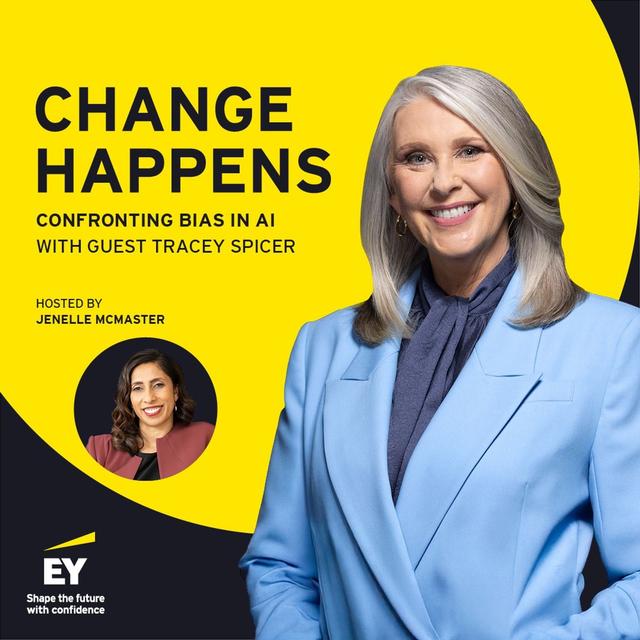



¶ Uncovering Bias in Everyday Technology
Bias is all around us. It's an inherent part of who we are. But what happens when you leave it unchecked in technology you use every day? I'm surprised the politicians aren't talking more about AI Some are saying AI is creating a racial divide. Facial recognition over ninety percent misidentified. Today's guest has dedicated the past few years of her life exploring the critical intersection of technology and bias, particularly in the realm of artificial intelligence.
They're a young group of homogenized white men in Silicon Valley. They test the innovations on themselves and their friends. They don't test it on an inclusive group of people. Tracy Spicer is not only an accomplished author, journalist and activist, but she's also a passionate advocate for and fairness in technology. We need to master it before it masters us. And we know throughout the history of humanity we've done that before and we can do it again.
Tracy has a long-standing history of raising awareness of issues, creating wake-up calls and driving calls to action. Tracy's been at the forefront of discussions surrounding bias in AI, having written extensively on how these biases can shape the development of technology and impact. I found this to be Really enlightening discussions. It forced me to think about the importance of being aware and intentional in the use of AI. It made me think about the
And intersectionality of bias. And it made me realize how much agency we can all have in reducing bias in technology. Yeah.
¶ Personal Journey and Historical Biases
Now, Tracy, you've had an incredible career as a journalist and you've been a powerful voice for gender equality. How have your experiences and observations throughout your career informed your perspective on the biases that are embedded in AI? Thank you for the kind words, and I think it was because of the contrast. You see, I was brought up by very non stereotypical parents. My mother was the strong, powerful career woman.
And my father was the soft sensitive guy who'd broken out of what we now call the man box. So when I went into journalism, I was really shocked. to see that it was the opposite, that in positions of power it was all men. I mean, for decades I didn't have a female boss. And the roles were very prescribed. For example, if you wanted to be a p a foreign correspondent, you simply couldn't as a woman for many years. You had to be a health reporter.
or you had to do court reporting. There were certain roles that you could do. And when it came to presenting, I was a T V presenter for a very long time. the man read the first story always. It was never mixed up because he was the one with the credibility and the gravitas and you always had to come second.
The other stereotype that really jumped out to me was the idea that women in the industry had to be over-sexualized, that we were there from a decorative perspective rather than what was in our hearts and our heads. So one of the reasons I wrote my book Man Made is because I started to see a lot of these ideas from the past, a little bit like madmen in the nineteen fifties, being built into the technologies that are running the present and the future.
Firstly, I think it's fantastic that you had the role models in your family that you did, which then allowed you to be so aware of the contrasting situation when you w when you went into the workforce. actually listening to you it makes me think about your very well known TEDx talk which you gave. I think it's eleven years ago now, which was the lady stripped bear. To me, this almost feels like a continuation of the themes that you were talking about back then. Would you see that the same way?
It really is. I can't believe it's eleven years ago. I was so terrified. That was the first time I'd ever used a PowerPoint. Oh, right. And it was for a memorized 18 minute TEDx talk, which was probably not the smartest thing to do. Look, what I did in that talk was I wiped off my makeup. I took off my uh corporate dress really. I had a singlet and a pair of shorts underneath. I sprayed my hair. Women screamed and my hair went
to the frizzy mess that it usually is, right? To show the amount of time and money it takes for women to be ready for the workforce. And of course that's exaggerated when it comes to television. I was also talking about things at that time like airbrushing of images in magazines, that we can't appear the way that we naturally appear.
And the logical extension of that and the things I'm seeing a lot now are are the filters using AI on social media and the expectation with generations coming through that they have to look like an extremely exaggerated version of themselves, with the perfect skin. They have to look younger. their hair can't be frizzy. It has to be poker straight or perfectly blow dried. So everything I spoke about eleven years ago is on steroids now.
I'm pleased that you've made the advancements that you have. My hair is a good example of it not being pocused straight or hair-dried. I want to turn to your incredible book, Man Maid.
¶ The Intersectional Roots of AI Bias
In the book, you say uh a couple of things. One, you say this involved six years of research that almost killed you. And second, you say that what you learnt during that six-year odyssey changed your feminism forever. Can you tell me about both of those statements?
It almost killed me because towards the end of the writing process, about three-quarters of the way through, I was struck down with long COVID as a post-viral illness. And Not only did I have chest pain, extreme fatigue, I was in a wheelchair, I couldn't leave bed most days for a long, long time. It's brain inflammation. So I would try to write a chapter and I could only write for about twenty minutes each day. That would exhaust me.
I'd look back at the chapter weeks later and I'll use the same word twenty six times in this chapter, and it could be a word like salient, an unusual word. So my brain was getting stuck because of the inflammation. When I eventually got over the long code, I went back and rewrote those chapters, which was fine, but it was an incredibly difficult journey to finish the book. With regards to how it changed my feminism, it genuinely made it more intersectional because I realized that.
Not only was it gender disparity in these technologies, it was racism, bigotry. It was ageism. It was ableism. It was homophobia. It was transphobia. It was the whole box and dice. Well, that's a perfect segue to the next question I was gonna ask. If we dive deeper into the topic of bias in AI, your research primarily focused on gender bias, and I can understand exactly why given the background you have.
But as you've just said, AI goes well beyond that one category. So tell me more about the other forms of bias that we should be aware of and what kinds of impacts they have on the way that the AI models operate. I'll answer it by way of anecdote. There was something that went viral. Back in twenty sixteen a Nigerian tech worker tried to use an automated soap dispenser. It didn't work for his hands. but it worked for the hands of his white colleague, and it worked for a white piece of paper.
Now, how does that happen? Well, we think of big tech as big and certainly they have profit margins larger than the GDPs of nation states. But each group making the innovation is small and usually They're a young group of homogenized white men in Silicon Valley. They test the innovations on themselves and their friends. They don't test it on an inclusive group of people. Now that happened back in 2016. That's annoying when it's a soap dispenser, but consider this.
That same AI light sensor technology is in self-driving cars that are coming to pedestrian crossings and in many cases not recognizing people of colour. So that's one shocking example of how racism is embedded in these technologies. But another reason why it's embedded is from the data sets. Inevitably the data sets, the bin fire of the internet, the photos, the images, the videos, the words, are from the past. They're historical. Every doctor is a male, every nurse is a female.
It's very heteronormative, it's very young, it's very urban rather than rural and regional. So the bias starts with the data set. Then there's the algorithm, and people think of algorithms as a mathematical equation. It's not really. It's actually an opinion of how the world should work written in code. And so people who are making the algorithms put their own unconscious bias into it. Then the third step is machine learning, which deepens the biases.
It's an interesting point you make around an algorithm being an opinion expressed in code, and I absolutely agree with that. Perhaps what I'd add to that as well is it's also about what's missing from the data sets, as you say, not just an opinion, but gaps in data that exist there. I know that you're doing quite a lot of work. Helping companies who are building AI to understand biases. Can you tell me a bit about what you're seeing and doing on that front?
the digital divide is huge. And while there's a lot of content on the internet, it's predominantly from the more developed countries, because in less developed countries, in what we call the global south now, Fewer people have computers, fewer people have mobile phones. And so their likes, their dislikes, their interests, their very selves aren't being included in these data sets. And that's at the heart of this lack of diversity.
¶ Corporate and Individual Actions Against AI Bias
So when I speak to corporates about this, you know, often it's a light bulb moment. We're talking about it more and more now. But Education is the first step, understanding that some of these foundational data sets in the programs that they're using might be biased. And it's really difficult for companies because If they're building something from scratch, then they can put more diversity into the data sets. They can clean the data sets.
They can even use synthetic data, you know, that has what's called intentional bias inserted into it, so there's a proper representation of the wonderful broad diversity of the population. But if they're getting a foundational set, you know, if they're using something from OpenAI, for example, they've got to rely upon those data sets there. So that's where there's gotta be some bolt-on solutions, such as
Auditing the data, auditing the algorithm, doing it every year to make sure the bias doesn't creep in, doing machine teaching to try to reduce the bias. There's a suite of solutions, but the problems are are deeply embedded. Hmm. What do we do about that? Well, the problems are deeply embedded because the capital for artificial intelligence sits in the global north in places like Silicon Valley. And the unpaid and underpaid work, the terrible work of
labeling horrific and violent images for machine learning is being done by people in Kenya who are paid two dollars an hour. So in the book I call it neocolonialism, the Structural inequity in the development of artificial intelligence is incredibly deep. And that's why I do talk a lot about. what individuals can do and what companies can do to try to change it because otherwise those structures seem so difficult to be able to tear down. And it's why I'm genuinely optimistic about
the amount of regulation and legislation that's popping up all over the world. Certainly There's a backward step because of what's happening in America, but I always try to remember that Europe has twice the population of America and they've got the EU AI Act which has come in in the last couple of years, which is a wonderful template for the world.
It's an interesting thing around the shifts that are happening. In fact, I saw some very recent research. I'm not sure whether you've seen it from the Stanford team. It's some new AI fairness benchmarks. So they're starting to look at
difference awareness and contextual awareness and how you train to understand the difference because very often we if you put everything as the same, you're actually creating a whole new set of biases. So I am heartened to see some a level of dynamism that's happening in this space. You talked about, you know, thinking about what organizations and individuals can do. What are some of those things? Some of them are really simple, but
One is human in the loop systems, which sounds really nerdy, so I love it. But what it really means is having human oversight every step of the way, whether you're developing something or using it. One example of that is you might use Chat GPT to write an email. Run your eyes over it before it's sent out. Really simple things like that. If what you're using comes up with something that's a hallucination or sexist, then tell the bot.
Say, this is sexist. Why have you come to me with a sexist answer? And the bot will come back to you. I do this all the time and says, I'm so sorry. You're right. This is sexist. Isn't that right? I will learn to be better. Yeah. I did this nine times once with Chat GPT.
And we kept back and forthing about what if what if the answer was this? Oh no, that's not good enough. Because one of the things that comes into particularly Chat GPT is if you ask it to tell a story, it will in almost all cases Make a man the hero of the story. You have to specifically say, I want someone with a disability, I want a woman, I want an older person to be the hero of this story. So we've got to teach it to be better.
training. That's such a good example. We've all got a role that we can play in training. Our our chief technology officer at EY actually One of the things that she has said to me about the way that she assesses whether there's bias in the AI that she's using is she asks the particular model that she's using to generate images of women in the workplace.
And the vast majority of models will generate the women all wearing high heels. And so then if she asks a particular model to do that and it's showing women in flats or sneakers or steel cap boots or crocs or whatever the thing is.
then she knows that there has been an intentional bias correction in that particular model, which I think is a really powerful way of doing a bit of a sense check on what are we dealing with here. But I think your example of Try again, this is sexus is quite incredible. Look, I love that example that you've just shared with me. That's brilliant. Because with ChatGPT now creating images using DALI, an image generator.
I noticed something very interesting over the past month. If I put in, show me an image of a lawyer, in a hundred percent of cases it's a man. A hundred percent. Whereas last year it wasn't a hundred percent. I gave a speech in front of librarians, a profession that has eighty percent women. I said, show me an image of a librarian, hundred percent of times, a man. Now what's happened there is very interesting because there was a bit of an outcry overseas early last year about this bias. So
Some of the companies in big tech decided, oh well, we better try to fix the bias. But they fixed it in a ham-fisted way, and that's when we came up with Black George Washington. And people started complaining about if we fix the bias, it's going to change history. That's not necessarily true. You can fix the bias in a nuanced, clever way without using a sledgehammer, but big tech didn't want to spend the money to do that. So now they've gone back completely the other way.
They've thrown their hands up and said, Well, we can't fix the bias because we don't want to change history. So that's why every time you say, I want an image of a lawyer, it comes up with a man. And even if I put in Show me a corporate worker from the future, right? Because we keep moving forward when it comes to progress. It didn't only have one man, it had one man in the future with a VR headset on, it had a man in the background and a robot that looked like a man.
Wow. So do I take from that, Tracy, that we can't even rest on our laurels that when we're making advancements, that they continue to move us forward. In fact we can take step backwards as well. So we have to be vigilant about this at all times. I'm reminded of that quote by Martin Luther King junior The Ark of the Moral Universe is long.
but it bends towards justice, and it certainly does. But if you look at the women's rights movement and the civil rights movement, it's always been two steps forward, one step back. We're in the middle of a backlash at the moment. There's no doubt about that. We've had them throughout history. But we will keep moving forward, and it starts with education, then training.
And then also contacting our local member, you know, and saying, I want you to do something about AI bias, using our power as consumers and members of civil society to not necessarily support the companies who have the worst practices. Mm. And and I would add to that potentially what's our focus on giving access to more people to then be able to input their data into the system as well. So if they don't have access, then we've got an issue there as well.
Definitely. Well, here's a positive story on that. There's a wonderful program called Digital Sisters that's run by an Australian not-for-profit. called good things. And it teaches migrant and refugee women how to use artificial intelligence. It increases their digital literacy in order to try to do just that, to diversify these data sets to get more voices out there.
¶ The Dual Nature of AI: Risks and Rewards
Well, what happens if we leave this unchecked, do you think? Oh dear. So I know that sounds like a really doom and gloom question, but I guess to paint the picture of why we must do it, what happens if we don't? If we leave it unchecked to quote Midnight Oil, the rich get richer, the poor get the picture. That's my working class background coming out there. The people with the capital and with the wealth become richer and richer.
And everyone else ends up becoming almost serfs to to big tech effectively. I know that sounds a little bit extreme, but What we're seeing with misinformation and disinformation, the siloing of opinions, polarization, people going into camps because of the algorithms that are supercharging that. We will see more conflict, we will see more war, unless we have some kind of intervention to stop that. But on the bias piece, yes, we might actually go backwards very quickly.
Okay, so let's let's continue on the more positive thing here, the the uh the bend towards justice. One of the things that you say in your book is that you're not anti tech. And that being anti tech is like being anti air and that we just can't survive without it. So if we accept that as true, and you did talk to optimism right at the beginning of this conversation, then perhaps let's look at the upside that could exist and does exist with AI. What do you see as those upside areas?
It's an absolute game changer, and I'll answer that by way of anecdote. There's a wonderful Commonwealth Bank program, Combank program they've had for uh one or two years now and they've now released it on open source so other banks and financial institutions can use it, that uses machine learning to determine whether coercive control is happening when, say, there's been a relationship breakup,
The man puts certain amount of money every week into the woman's account, and he puts in the comments or message section some abusive material. So it's financial coercive control and it's tech facilitated abuse. It's the intersection of those two things. This algorithm can pick it up, and it picked up fifteen hundred cases of that last year.
In medtech, I mean, there's an app you can use to work out whether you're going to get breast cancer in the next five years, even if you don't have any symptoms. So when it comes to the workplace, women's rights. medical health. There are tremendous benefits for this. And You know, I think it's important to look at history as well. When the printing press came out, people were furious they said that people would suffer the confusing and harmful abundance of books.
Which is ridiculous. You know, when the calculator came out in nineteen seventy six, maths teachers took to the streets, saying it would lead to arithmetical illiteracy. We know that didn't happen. And in this fourth industrial revolution, we've got to remember that artificial intelligence is merely a tool, and we need to master it before it masters us. And we know throughout the history of humanity we've done that before and we can do it again. Mm. Love that.
¶ Addressing AI Bias in Hiring and Images
Most of our listeners are em employees or uh leaders in organizations. So what are some of the areas where there might be hidden or overt AI biases that affect employees or organizational outcomes? What are some things we could be looking out for there? Well, reputational risk and brand management is huge.
And that's to do with image generators. You might have remembered a story here in Australia where there was a politician from the Animal Justice Party and there was a quarter frame, the photo of her over the shoulder of the newsreader one night. The algorithm using AI took her white top, made it a crop top and made her breasts bigger without her consent and without the editor saying, This is what I wanted.
So every time someone in a workplace is using, and it's so easy to use image generation these days, you've really got to make sure it's not inadvertently sexualizing women and girls, because it does it without you asking for it. So that's one thing to keep an eye out for. Another thing is representation of people with disabilities. There's an advocate called Emma Olivier who runs a company called 20%.
Only a couple of weeks ago she put on LinkedIn that she put a photo of herself into an image generator asking for a headshot for a C V, right? Now Emma was born without a left hand. In every single photo uh for a professional image, it came up with an image of her with two hands. Wow. So it made her disability invisible. So these are the really subtle things you've got to keep an eye out for when you're using image generation that you might not even be aware of.
It's incredible. It's uh it it's a really um interesting, I guess, projection of what society thinks we need to be, isn't it? You know, well, we need able-bodied people who uh look a certain way. It's really quite competent.
That's right. And I guess the big one that workers have to keep an eye out for, whether they're involved in employing people or involved in going for a job themselves, are the algorithms in hiring software. Because even if if CVs are de-identified through machine learning, they'll look for clues as to whether the person is a woman, say in the hobbies section, Oh, I played in a netball team, and they'll put the C V aside because they identify that as a female C V.
Any clues about age. If you're over fifty, they'll put the C V aside. There are solutions to that now. That can help get rid of these biases that machine learning is deepening in hiring algorithms, but it's still a really fraught area.
You can see both sides of the ledger on that one, where I think you can also use AI on the positive side of the ledger to say, how might I make this a more inclusive job description? Where might there be gendered language? So I guess both sides of those elements are in there as well.
That's exactly right, and in fact a doctor said this to me one day. He said our biases come through in all the decisions we make in hospitals because I was telling him about how If an algorithm makes a decision on who can have a scarce resource like a ventilator in a pandemic, it will always go to the younger person, not the older person who needs it, because they're seen as more valuable.
And he said, in actual fact, because we can identify this with technology now, we can point to it and say, This is what's happened, it might make it a little bit more clearer, these unconscious biases that we've had for years. It shines a light on what has always been.
the opportunity there is to take a look at it, isn't it? It's not just okay, ignoring it, perpetuating it to saying, why does that feel awkward? What what is happening here? So there's an opportunity in the light being shone at scale through these algorithms. Definitely that's really wise words. So you've been working on this for years. You've been collaborating with leaders and pioneers in AI. What do you see as the future here of AI? What does it look like to you?
I am genuinely tremendously excited now, and I started the book with this. dichotomy of are we going to face dystopia or is it going to be a utopia? But I've come to a new place called Protopia, which is a term, have you heard of that one before? Oh no. The idea of protopia is the society doesn't fall into dysfunction like dystopia, that it's not all sunshine and rainbows like utopia.
but that we use technology as a tool to make incremental changes to move society forward to create a better, fairer, more equitable future for all. And I think that's tremendously exciting and also doable.
¶ Lifelong Learning for an Ethical AI Future
So take me then on the arc of your emotional journey through all of this. Where was it? Where did it go? And seems to be you've landed in this pro topia state. What was that emotional journey? Does it continue to keep going up and down? Very good question. There were punctuation marks in that journey, and the worst moment was when I had the long COVID, and I thought, the end is nigh. Why am I bothering riding a book? Salient though.
It was saling it. It was extremely saling it, my friend. Then I finished writing the book and found some really good solutions, then some regulation, legislation started to come in. I was very excited. There was a great report by the Human Rights Commission here in Australia that had some good solutions. I thought great Australia can lead the way and I still firmly believe that. But my optimism actually came from pragmatism too, because I thought I'm 57 years old. If people like me
Particularly older women don't keep engaging with this technology, then it won't be embedded in the machines for the future that are used in either the medical sector or the workplace. And we're going to be left behind and we're going to be left out, so we have no choice. but to keep engaging with this and to try to be part of the solution rather than throwing our hands up and saying, Oh, well, that's too hard. I'm not gonna engage with that problem.
What's been the reaction to your work and conversations like this that you're having in many, many different forums? What what has been the general reaction you found? It has been fascinating. Do you know the first person who turned up to my very initial public event about this book was a nineteen year old machine learning expert. from university and he said, I wanted to come to this because I'm going into this sector.
And I want to find out how to reduce bias for my sister, for my mother, for my friend in a marginalized community. And I went, Oh, this is good. I'm onto something. The it's been interesting over the last year and a half seeing the change because I always ask In audiences, how many of you use AI? And at the start, very few, one or two people. Recently, almost everyone in the room, because it's saturating every aspect of our lives.
And because of that, it's become more of a talking point. People understand it better. And therefore, we can all be part of that change. On that note then, now that our listeners and people navigating this in the world Now more aware of the pervasive nature of bias in AI, what's one key takeaway or one call to action that you would like people to embrace as they navigate the increasing presence of AI in the world? I would say...
Be a student of lifelong learning. Keep up to date on what's happening with AI. Don't think I don't have a part in this revolution. There are free training courses through TAFENOW on artificial intelligence. This is open to anybody. Go up to your boss in the workplace and say, I want
extended training on this, I want to understand it properly. And if you're a boss, get your staff educated on it, because the more we understand it, the more we can incorporate it in an ethical and responsible manner. Very clear call to action. This has been a really insightful discussion. For me, I I guess I feel incredibly grateful that you have continued the thread of work that you were doing well before all of this around gender bias and then bias more broadly.
You continue to shed a light on important issues for us, definitely highlighting that technology is never neutral. And I know that your work has been a labor of love for humanity. And I appreciate that on behalf of all of humanity. I appreciate that.
I think it's important for us to be very aware of the systemic inequality that can potentially exist there. But I love a few really important reminders here. That we all have agency in here. And I think that can be easy to forget when there are so many big players in the mix, but we all can play our part here in training, in getting knowledgeable, being curious. A good reminder about the importance of having humans in the loop.
and I hope that we do end up in a place where you are actually I I am there, with Protopia. feeling that, you know, I don't think we can be naive about what we've got, nor should we be Pollyanna about if it's left unchecked. So let's exercise that agency, let's put the humans in the loop and absolutely seize the upside of AI. Oh, Janelle, thank you for those eloquent words and for this rich conversation. I've enjoyed every minute. Thank you, Tracy.
The Change Happens podcast from EY. Insights from leaders in a changing world. Discover more where you get your podcast.