



¶ Apple Watch Workout Fixes
It's been a it's been a busy uh busy few few weeks. All right, well we'll talk about that later. And speaking of we have a lot to cover, so we're just gonna plow right into follow up and I will start Um, I don't know, Marco, if you choose to dub in We Are the Champions, I can we use that outside of the context of the Mac Pro? I think we can. Um, but you're welcome, world, uh, because we have apparently caused Apple just us, nobody else.
has caused Apple to ship a more sane workouts app in I uh watch OS twenty six point four. Uh I haven't actually tried this myself, but allegedly uh in the new version of Watch OS, you can actually press on a workout type to start that workout. You don't have to wait for the stupid animation, for the stupid play button to show up.
You can actually just hit the giant green thing that says, you know, like traditional strength training or whatever, or outdoor run or what have you. Uh allegedly that is now fixed. You're welcome, Moral. Yeah, that's uh that's very promising. I'll also um a couple of quick notes.
Um when when we I was last ranting about the workout app, I did I mentioned that I wish they had some smarter smarter settings around like reminding you to unpause workouts when you like, you know, when you start moving again. This actually is a built-in feature. They do have reminders automatically to remind you to pause a workout if you've like stopped moving for a while and to unpause it.
And in fact, there's even a feature where it will try to automatically pause and unpause it when you start, you know, if you like stop in a in a run um and then you you resume again, it will actually try to remind you. What I found though is that those are, first of all, very annoying. Like when you if you're actually on a run, I I have used those and I have found them to be just so aggressive of just like if you stop for a second, like if you stop like at at an intersection.
Tap tap, you want to pause your workout? Like, no, I'm just I'm gonna be here for eight seconds. Like, no. Um, so I I don't like those for that. But then also I have found that in walking workouts, they tend to be a lot less uh accurate. And I don't know if they're just looking for bigger changes in speed. Um so I have I have not found the current implementation of those to be very good.
It it also doesn't address things like ability to undo a bad GPS point or undo a a missed save. Um there is, however, at least a setting that I turned on the the end workout button there's an option to have it prompt you before it officially ends with a confirmation step. That helps accidental endings become less likely. Um, but it's still it still needs a lot of just kind of Polish.
What we like about Apple, what got us all to Apple in the first place, was lots of little smart design and lots of little delights throughout much of their user interface and many of their features of their of their software and hardware. And the Apple Watch seems to have like none of that. Like it just seems like the Apple Watch has was designed
in a very rigid way, to have exactly these features, nothing else. And again, part of that was, you know, for hardware constraint reasons that were very good reasons. But So many of those kind of like little nice delights of like, oh, that was smart and I needed that. Thank you. Those things seem to be mostly missing on on Watch OS. Um and so the workout app is is one example of manywhere, like there's a lot of room for that and I wish they would add more of it. What they have is
A nice start, but considering we're like what, eleven years into the Apple Watch platform, something like that, um, it could be a lot better. So I hope it continues to get better. But this is a good start.
¶ Formula One Season & Cameras
All right, let's enter uh Form Formula One corner for hopefully just a couple of minutes. Um Do Formula One track Apex have corners or are they all like rounded? Wait, they sure do have corners, although I think you can come with a better name for this instead of calling it Formula One Apex. I don't know. I don't know. We'll we'll workshop it. But anyways.
Uh, first of all, I wanted to very briefly uh spoil last this past Sunday's uh China Grand Prix and say that this really so far is a very interesting season to start watching Formula One. To briefly recap, there's all new rules, all new regulations, the cars are totally different. And uh my favorite team, McLaren, they have two drivers as every team does, and neither of their drivers made it to the starting line this this last race, which stank.
But I'm gonna claim that that left the space for a very interesting podium. So the winner of the race. uh is a nineteen year old who races for Mercedes. His teammate was uh, I believe second, and then former Mercedes superstar now at Ferrari, who has not done anything good in the last season or two, Lewis Hamilton. arguably the greatest of all time, potentially I think by winds he is the greatest of all time.
was also on the podium and it made for a really adorable moment where you have these two actual you know current f Mer Mercedes drivers and a former Mercedes driver and their the race engineer for the winner, which is basically the dude on the other end of the um radio was Formerly Lewis Hamilton's race engineer. And so, you know, it was a really, really lovely podium, even though my particular team didn't even make it. Um
And so again, really good time to pick up Formula One if you're at all interested. But that that that I will stop trying to sell it. I'll stop being a shill at this point. With regard to follow-up. Uh we have a little bit of information about cameras. John and I got ourselves wrapped around the axle with regard to cameras when we talked about it last week. Matt Rigby writes, In the TV broadcast, I'd say that onboard cameras are perhaps fifteen percent of the coverage at most.
And they mostly use the track mounted cameras like any other sport, which is exactly true. I should have made that more plain when we were talking about it. Uh but again, you know, you can choose if you'd like to view other cameras. Uh a account that goes by the name of the Racing Line. Uh if an onboard camera fails during a race, then no action is taken. The only time an onboard camera failure has had a direct impact on a race.
was the nineteen ninety-five Italian Grand Prix. Farr Ferrari was leading first and second when Gene Alesi's I hope I have that right camera detached from the lead car. And hit Gerard Berger in the second car, breaking the suspension. Whoopsi dipsies. Alesi's leading car broke down lap a lap later with an unrelated wheel bearing failure. Ferrari throwing away race wins is a constant in F one history can confirm.
Uh also uh the Racing Line pointed us to a really great about ten minute YouTube overview of all the cameras in the car, of which I think there's seven or eight or something like that, the k the video said. It's very, very interesting, very cool stuff. Additionally, uh something I should have talked about when we were discussing cameras and whatnot, uh Eric Fox reminded me that.
One thing you didn't mention was that the other that the other two might find interesting, as in Marco and John, uh for follow-up is how the driver feeds also give you access to their radio communications with their respective teams. Of course, the best radio messages read the whiniest.
uh get put on the main broadcast, which is true. And I don't think I mentioned that at all. And that's a really great point from Eric. And that can be very fascinating. Normally it's not that interesting, but it can be fascinating.
¶ F1 Replays and Apple TV
And then finally with regard to F1, uh Brendan Webb writes, I'm not sure why Apple hides the Sky Sports replays on the main navigation, but You can search for Sky Sports China or whatever race you're looking for and they magically appear. So I should have set a little context. I had said in the last episode that uh as far as I could tell, at least in replays, there's no way to get the Sky Sport.
feed, which is mostly about the commentators. Um, I I like the the Sky Sports commentators. I find them to be egregiously uh UK biased. You know, Lewis Hamilton and George Russell, you know, and and Lando Norris can never put any foot wrong anywhere for any time. And that's I mean, hi, I'm American. I know how that goes. But
Uh it gets to be a little much from time to time. Well, anyways, uh a lot of people prefer it because that's what F1 used or excuse me, that's what ESPN used to broadcast. Well, apparently instead of just using it as like a different audio track, which I think is all it really is. Apple treats it as an entirely different broadcast, but I think the only way I've been able to find it is exactly what Brendan says. You have to actually search for Sky Sports.
Whatever, in order to find it, which again is just bananas to me. I really think that Apple does have a lot of potential here for F1 coverage. and being, you know, the American partner for F one coverage. But golly, it's been slow out of the gate. But what are you gonna do?
¶ Rosetta Emulation and Mac Shifts
All right, let's talk Rosetta. Colin McKeller writes with regard to processor emulation and how long it lasts. I did some Wikipedia diving and put together this post about how long Apple's processor emulation lasts on the Mac. This looks like a three-mile-long post, but it's actually a bunch of charts and stuff. It's it's pretty good stuff.
Um and uh John, I think you've extracted some stuff which we'll talk about in a second. No, that's uh yeah, that's Colin continuing here. Yeah, so c Colin continues and writes, In short, sixty-eight K emulation was supported on PowerPC for as long as classic macOS existed.
Including what it lived on as the classic environment in Mac OS ten. PowerPC emulation, the original Rosetta, was around for five and a half years after Mac's transition to Intel. According to Apple's present plans, Rosetta two will last about eighteen months longer than Rosetta one. Yeah, and then I pulled out the some more interesting info from uh this post, which is how long uh each architecture was the current architecture for the Mac. So sixty eight K was
the the architecture for the Mac for 10 years and seven months, PowerPC for 11 years and eight months, and Intel for 14 years and four months. And so far Apple Silicon has just been five years and four months. So Intel, uh the Mac has been Intel longer than any other processor.
Um and maybe that's why I feel like uh even though they're uh according to these uh stats, it's gonna be eighteen months longer than Rosetta One lasted, it just feels shorter because Intel has been around so long. Maybe it's just because of the prevalence of Intel software, like going to Intel opened up this whole new world of
stuff that became easier to compile for Darwin essentially. Um but yeah, uh it's uh you know, I I I my recollection of sixty eight K to Power PC is basically what they said. Like it basically never went away. It didn't go away until
classic Mac OS one away. Even then it was classic classic environment inside Mac OS ten. Uh but Power P C to Intel Power P C didn't stick around that long at all. The other thing was Intel was so much faster than Power P C and I guess that's also true of uh Apple Silicon with uh Intel. So
Anyway, um I it really is just a feel thing. Like it just feels like it's a little bit too soon because circumstances are different, but it will in fact be eighteen months longer than one of their transitions, but shorter than the other.
¶ Final Cut Pro Deprecation Alert
Then related, Tom Obarski writes, On Reddit, I saw that a user received a pop-up warning of upcoming deprecation from a fresh install of Final Cut Pro non subscription on a brand new MacBook Neo. That's something else. And so Uh we'll put a link to the Reddit post, but the little uh notification reads support ending for Intel based apps.
This version of Final Cut Pro will not open in a future release of Mac OS. Learn how to update on to an Apple Silicon version. That's a terrible message because I'm assuming it's not Final Cut Pro is not the problem. Uh anyway, you can keep reading. Yeah, so uh Tom continues, there's some speculation as to whether this is because the A eighteen Pro is not seen as an M chip. and therefore is assumed it must be Intel, or whether a component within an FX library could still be flagged as Intel.
And thus would invalidate the whole install. Weird edge case to say the least. M if I were to guess you know th hi, this is Casey. Uh if I were to guess, I would say that it's probably a library or something like that. But I mean I don't think that the the A eighteen not being seen as an M chip is definitely wrong. It's plausible for sure.
I don't think that's very plausible. I mean, uh there's a bunch of ways to look up the architecture and they you know the answer is is it ARM or is it not ARM? And the eighteen pro is very clearly ARM. Uh if you were to look it up on a phone that ran it, I think it would the answer would come back as ARM, so
No, that's true. I think that's true. I think it's gotta be a library or a plugin or something. And speaking of that, I don't have the notes, but Apple just bought whatever that uh that File Cut Pro plugin company. Yeah, yeah. I do wonder if they're Uh, you know, the best way to make sure that any Intel only plugins are no longer Intel only, uh, just buy the company, then make sure they're all Apple Silicon before the deadline.
¶ Leesa Mattress Sponsorship
We are sponsored this week by Lisa. So a few months ago, I was looking to get a new mattress for Michaela because we bought something unremarkable off of Amazon, and despite being well reviewed, it's a pile of trash. And I felt terrible about it. And I at this time that I was looking about for a good mattress for Michaela, Lisa reached out and said, Hey, would you like a mattress so you can talk about it on the ad read? And I said, Yes, please.
And I got Michaela a natural hybrid hybrid mattress. and then immediately regretted my choices because I wanted a natural hybrid mattress after sleeping on it for a night or two. Uh it is genuinely very, very good. And so what makes it good? Well, Lisa has a whole lineup of beautifully crafted mattresses tailored to how you sleep.
Each mattress is designed with specific sleep positions and feel preferences in mind. Their mattresses are meticulously designed and assembled here in the United States for exceptional quality, plus They back it all up with free shipping, easy returns, and a one hundred and twenty night sleep trial.
Lisa isn't just about sleep either, it's also about impact. They donate thousands of mattresses each year to those in need while also partnering with organizations like Clean Hub to help remove harmful plastic waste from our oceans. And who doesn't like that? So, like I said, we got Michaela a natural hybrid mattress. This features some moisture-wicking organic cotton that apparently is from New Zealand.
uh on the top of it, which keeps you cool, but also warm all at the same time and it gets that sweat away from you. It is genuinely very, very good and I'm pretty darn sure a Lisa mattress is in my future. So If you like me are thinking about buying a Lisa mattress, go to Lisa.com for 20% off mattresses plus.
Get an extra fifty dollars off with the promo code ATP exclusive for our listeners. That's L-E-E-S-A.com, promo code ATP for twenty percent off mattresses plus an extra fifty dollars off. Support our show and let them know that we sent you after checkout. Lisa.com promo code ATP. Thank you so much to Lisa for sponsoring the show.
¶ iPhone 17E Teardown & MagSafe
Some teardowns have been released recently. Uh the iPhone 17E has an iFixit teardown. We'll put a link in the show notes. And it appears that a lot of the parts are the the same as we saw in the 16E. Yeah. And interestingly, one of the things they pointed out is that um say you've got a 16E.
And you wish it had MagSafe, you can just put the 17E back on there with MagSafe. And it mostly works. Like so there's a few play like it doesn't so MagSafe will attach to it and charge it, but you don't get the little like animation. You know, the little circle filling thing or whatever is because like there's a little it's it's a little bit of a Frankenphone, right? It's not not a Francophone. So to be clear, so so the 16E did support Chi Chart.
Just not MagSafe. Right. But that means but y the the animation that you get for MagSafe is the the like the green ring that appears or whatever, but it will charge it. So it anyway, many parts are I think basically every part is the same except for the like the
the logic board or whatever and they they they made a a phone out of a mixture of a whole bunch of parts. They were very excited about the part interchangeability and the fact that they didn't get hassled by the software for like parts pairing and stuff like that. But uh Yeah, 17 E is just a 16E with uh a different logic board and a different SOC and a magnet on the back.
¶ MacBook Neo Security Indicators
All right, let's talk about MacBook Neo. Uh first of all, Gruber had a post with regard to the on camera and also mic uh uh on screen indicators. And uh Gruber link to Apple's platform security guide, which states the MacBook Neo combines system software and dedicated silicon elements within the A18 Pro to provide additional security for the camera feed.
The architecture is designed to prevent any untrusted software, even with root or kernel privileges in Mac OS, from engaging the camera without also visibly lighting the on-screen camera indicator light. And the context here is that the MacBook Neo doesn't have a a little green LED next to its front facing camera like all the other MacBooks do. Instead they have um
An icon in the menu bar, like the green little like FaceTimey icon, and also like a green dot in the corner of the screen. And that dot is basically a stand in for the light. And w last time we mentioned it, I'm like, I'm sure uh Apple has done something.
to try to make that more secure, but it's obviously more difficult when you're trying to secure software versus trying to secure it in hardware where in theory the LED Um ha if the camera's on the LED's on because it's like electrically hardwired connected to it and you'd have to stop that from happening, you'd have to
uh get physical access to the uh laptop and cut a you know trace somewhere to prevent uh you know that from working. And even that might be difficult. Although there was a bug with that. Um I I couldn't find this link, but
The first time Apple did this, they tried to say, and the light will always be on as long as the camera's on and they messed up the implementation, but that was a while ago. The current implementation is pretty solid, but that's all in hardware. So how what do they do to try to make the software more secure? So this
First bit from Gruber is there from Apple security document saying, even if someone like, you know, puts a root kit on your machine, they have super user privileges. They have root kernel level access to your Mac. Uh still they can't stop that green dot from appearing in the corner.
Indeed. So Gruber got talking with friend of the show, Guy Rambo, and Guy wrote to Gruber, the software-based camera indicator light in the MacBook Neo runs in the secure exclave part of the chip. So it is almost as secure as the hardware indicator light. It runs in a privileged environment separate from the kernel and blitz the light directly into the screen hardware.
All of that applies to the mic indicator as well, which is a bonus compared to the camera-only hardware indicator. And then Ghee also provided a little footnote. Exclaves run on a completely isolated real-time operating system that communicates with the kernel in user space using a very limited API surface. Not to be confused with the secure enclave, which is a totally different thing.
Yeah. So to actually stop the light from working, they they need more than just access kernel level access. They need to hack the exclave, which is a lot harder to do because it is very limited. It is a whole separate thing, running a whole separate operating system, and it talks to the main operating system.
But it doesn't go through the main operating system, it seems like, to get those dots onto the screen. It just does write them directly into the video hardware, old school style. So that's pretty cool. Yeah, yep. And then also Gruber linked to Random Augustine's post about the Apple Exclaves, uh which you can read over on Medium if you can hold your nose to long enough to read something on Medium. All right.
¶ CPU & SSD Benchmark Analysis
That's the worst. Uh CPU benchmarks. Apparently we got something a little bit wrong. John, can you tell us about that, please? Yeah, the iPhone 16 Pro Max with the A18 Pro, which is what I was using for CPU benchmarks, because the Neo had not been released to anybody yet. Has 46% higher single core in Geekbench, not 30%. I just plain did the math wrong. So it was 30 34 28 versus 2347 and
Uh I think those are the numbers from uh the earlier episode, but I just didn't do the math right. So forty-six percent faster in single core, not thirty. Thanks to Philip Summer for the correct. Then with regard to SSD benchmarks, Vito Treno writes, Your MacBook Neo SSD benchmark figures in the last episode came from the Virges benchmarks, which only measured sequential speed.
While those are important for large file transfers, random speeds are a better reflection of using the computer, you know, OS boot, logging in, launching apps, etc. Sequential speeds may be more visible to the user in finder progress bars. But random speeds are arguably more important to the user experience.
uh contributing to the feeling of snappiness and ultimately the longevity of the machine. This seems to me to be a far more important metric for the target market of the Neo. I would agree with that. Well so before we go on, so obviously um then the Neo has an SSD and not a spinning disk. Back when spinning disks existed, uh random access versus sequential access was a key way to measure performance because uh as Vito noted, um
You're doing random access when you're doing most stuff. You're mostly not just copying one giant file from location A to location B, although even that could be random, depending on fragmentation on a spitting disk or whatever.
But spinning discs had to move actual disc heads on an arm to get to the track where the data was, wait for the arm to settle, wait for the this the sector that you want to spin underneath the heads of the track and then do that all over again, back and forth and back and forth, making all those lovely noises that we remember from the spinning disc days.
And so random seeks on a spinning disc were murder because you spend most of your time waiting for physical items to travel to be aligned and settled, and then a brief reading of uh some magnetic information, and then you start the whole process over again, most of your time was burned on overhead.
SSDs, on the other hand, do not have any moving parts in that way. They don't have arms that move, they don't have disks that spin, they never have to wait for the for an arm to move to a different section of a disc and they never have to wait for a disc to rotate several more degrees and they never have to wait for the things to settle.
And so you would think, well, isn't random access on an SSD basically a constant time operation? Like it doesn't vary. It doesn't care if you're reading address zero or address four million. It's all just chips. Well
There are things that can affect random access because the chips have to be read in certain size chunks from certain regions at a time and so on and so forth, but so that's why you still do random tests on SSDs. But the difference between random and sequential is not nearly as pronounced as it used to be. And
What most people feel like they're waiting around when do you feel like you're waiting around for a disk? It's when you're copying a big file and you see a big progress bar. Like if you're copying some huge movie from one disk to another or whatever, if you're not limited by your internet download speed or you're not limited by the other disk.
Um it's especially now that with APFS that you get the uh you know, the clones, like when you duplicate a a gigantic file in APS, it's like instant, right? Because it doesn't actually copy the data. So that is entirely eliminated, but copying To and from multiple volumes or to and from multiple, you know, physical disk mechanisms.
That's when people say, Oh, shouldn't this be going faster? It's two SSDs. And that's where you'll see the difference. So I agree that random and sequential are not are two separate things, but I really think that Sequen the reason people show sequential is well, first of all, it's the number that's going up. So it's fun to show in benchmarks. Look how much faster it is.
Uh and then also I think that these days with SSDs, that's the main time people feel like they're waiting. Like, I wish my SSD was faster because I'm copying this. giant video file from this external SSD to my internal one and I'm looking at a progress bar and I'm walk looking at my watch. All right. Uh so V Vito continues. I've only found random seek benchmarks in one review, which is Andrew Mark David's review at eleven minutes 17 seconds. We'll put a timestamp link in the show notes.
But the random speeds seem to be on par with what we've seen from the M1 MacBook Air. They also, from what I can tell, don't seem to be to differ much across the entire Apple Silicon lineup. So I looked at that and I think they do differ across the Apple Sun lineup. So we'll put a link in the show notes to the the benchmark app, which I had never heard of, but you can download and try it if you want.
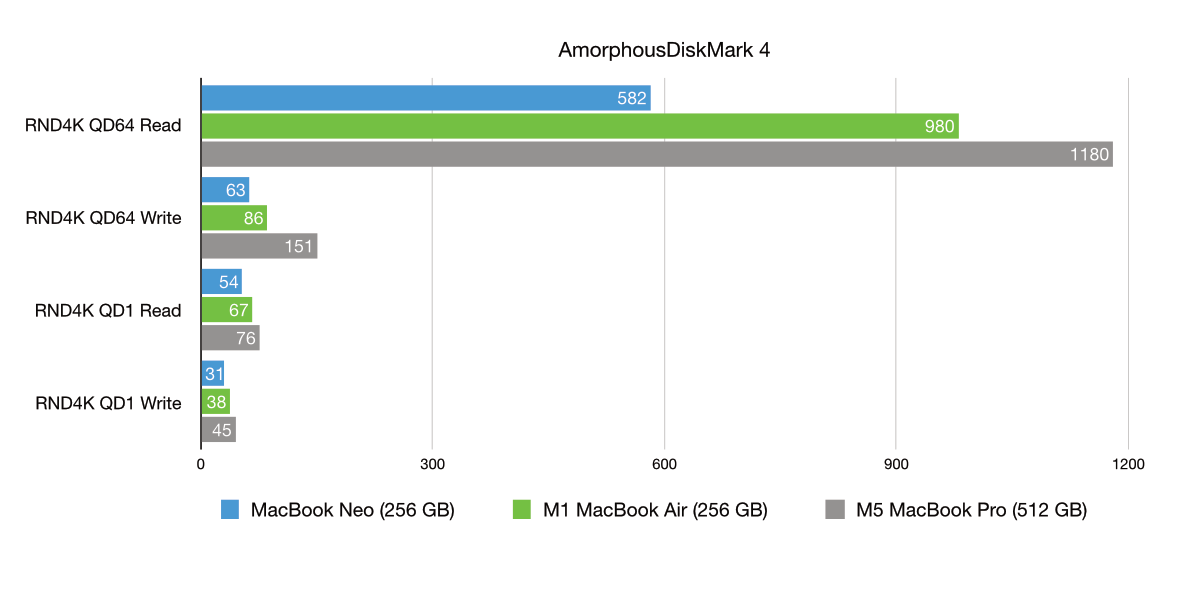
And then I graphed the numbers for the RND 4K QD sixty four read and write and RND 4K QD1 read. I don't know what that means. I'm assuming random 4K. But I don't know what the QD means. But anyway, two different read and write benchmarks for uh three machines the MacBook Neo two fifty six, the M1 MacBook Air two fifty six, and the M5 MacBook Pro 512. And especially on the RND 4K QD64 uh read and write test.
The MacBook Pro is way faster. It's like twice as fast in these rand random seeks as the Neo. So I wouldn't say that random, they're all about the same. I mean, granted, when you get down to the the whatever the R and D four KQD1 right one, maybe they're a little bit closer, but look at look at those graphs. I'm gonna say there's still a uh appreciable measured different difference between uh the fastest and the slowest. So for example
I don't know what these numbers are, but they come from the disc benchmarks. But the the NEO is five eighty two and the M5 MacBook Pro is 1180. That's close to double. Um, and similarly on the on the other, like the closest benchmark is 31 to 45. Still a somewhat substantial difference. So yeah. Um I I agree that people should be still testing random, not just testing sequential, but I think just people
Especially in this YouTube I've I complain about this all the time because my entire y'all childhood was spent arguing about benchmarks. Nobody argues about benchmarks anymore. We just YouTubers just used Geekbench and are like, well the number says what the number says and nobody so I
I applaud Vito to be out there saying these benchmarks are BS, you're just measuring sequential. There's much more to the story. I agree. And there's much more to the story than random. It's like, well, random, I don't care about your benchmark. Your benchmark has this problem. We need to test the launching of Photoshop, but not that version of Photoshop, and yeah.
Uh that's the culture I come from, so I applaud Vito for calling it out here, but I will say that I think random random access still differs between the less expensive and more expensive uh SSD MacBook Pros or Mac.
¶ MacBook Neo Design Impressions
All right, John, you went on a field trip? Yeah, I was happened to be in the mall. Um, well, I actually I took the trip to the mall. I was driving my son there um uh get his hair cut, and I the reason I drove him is so I could go to the Apple store. I went to the Apple store to look at all the new stuff.
Um, and I went right to the MacBook Neos. And I don't I don't know what I was expecting. Like I had this image in my head of the product. Obviously I'd seen it on Apple's website and we talked about it on the show and I knew all these things about it. Um
I just I I didn't I didn't go in with any expectations, like I'm just gonna go in and look at them and they're gonna be exactly like how I thought they would be. And they weren't. I picked it up and played with it and and touched it and like They have pulled off something with this product that is tricky to do, which is All right. Think think about the laptops. What are they? They're
They're like flat rectangles made of metal, especially when they're closed and you're not using them. Like what is there to the flat rectangle made how many flat rectangles made of metal has Apple made since? the univody laptop started all those years ago. Just so many of them. Surely they're all the same at this point. Is there any room within the flat plank of aluminum to do anything, literally?
Uh and I think there is because P they've turned I mean, I don't know if they did this on purpose or whatever, but like one of the things that separates the Neo from its more expensive brethren is And we'll get to this in a little bit. Um this the screen the screen part of it is not as skinny as it is on the other models because it's more expensive to make them thin, I guess, right? It's a little bit fatter in the screen part. It's a little bit fatter overall, uh like a millimeter.
And one of the things you can do when the screen part is a little bit fatter than it might be on like the old MacBook Air that came to like a really sharp like the M1 MacBook Air comes to a really sharp point at the at the part that you pick up. uh like the lid, you know, the the screen lid. One of the things you can do when it's a little bit thicker is you can put a bigger corner radius on all of the corners.
And I think and also by the way, this the Neo is I forget the exact measures, maybe like a quarter inch, a half an inch, uh less wide and deep. You know what I mean? Like r if you if you put this on top of uh a M5 MacBook Pro, you'd see the M5 MacBook Pro sticking out around the edges because this is smaller. So this is a little bit smaller and it has a bigger corner radius on all the corners.
And the result of that is picking this thing up and just handling it as a thing that you tuck it under your arm and carry it to your, you know. I don't know, to the library or to your class or whatever. It feels so good and so solid and so friendly in a way that the more professional laptops do not, because the more professional laptops
are sharper. They're thinner a little bit, but they're also sharper, like literally sharper on the edges, uh, because that's just the way they're designed. Rounding this thing over makes it feel pleasant and solid and friendly and approachable. And I know this sounds so dumb. It's like it's a rectangle of aluminum. How friendly and approachable is an extra, you know, millimeter. I'm telling you, this was my impression upon picking it up. I'm like, this thing feels great.
And it feels great in the same way. The only analogy I can have is like the um the IMAC G four with the little uh like the the metal arm with the floating L C D display on it. Remember that one? That arm looked and felt so good on that machine that you were like, I can't believe that if I pay this amount of money, I get this.
And that's the impression I got from the Neo that like this thing feels like you're getting more than you paid for. You're getting more than your money's worth. It feels solid and expensive and Nice in a way that I did not expect it to I don't know, I don't know if I expected it to feel janky or something, but it like
I know going on about this and you're like, so it had rounded corners and you were wowed by that. Who cares? This this is my impression that they really knocked it out of the park, that it feels solid. And the second part of this is
The trackpad, which I I did uh know going in, I was thinking, this trackpad's gonna be a little bit janky. Nope. It's it's great. Like maybe it will get bad over time. I don't know. This is a floor model on like the first day it came out or the first week it came out. Feels so good. I pressed everywhere on that thing. It is pleasant and easy to click everywhere on the thing, and it doesn't feel loosey-goosey and wiggly and tilty. It feels great.
So I think if you got somebody one of the a MacBook Neo, they are gonna be so happy, especially if they've never had a Mac before and they've only had PC laptops. Oh my god, this is so much better than I thought it was gonna be in terms of fitting to finish. And I don't know why I had these these doubts in my mind, but
I was blown away about it. And obviously it's still got eight gigs of RAM and a bad screen and blah, blah, blah. But it's like it's$600. So MacBook Neo, they think they knocked it out of the park with this machine. Coincidentally, I happened to also go into an Apple store yesterday and also for with the goal of like, oh, like I was literally I was walking past it, I'm like, oh, I should go in and check out all this new stuff. The first thing I did was walk over to the MacBook Neo.
I must have looked very strange to the staff because I was basically like fondling it like at different edges, like trying to figure out like, at what point is this gonna feel cheap? And I did not find that point. Yeah. Yeah. Like it so I was going over all the corners, all of the like the the rounded edges, the sharp edges, the finished I I you know I As I often do in Apple stores with you know picking up new products. I closed it.
And I moved it around and I'm like, what is the bottom look like? The feet uh are the feet worse? I love the even the even the feet. The feet on the MacBook Air are sharp little cylinders, like they're not domes like they were on the M1 MacBook Air. The current M you know, M two, M three, M4 MacBook Air, the feet are kind of like sharp edge cylinders. The feet on the Neo are rounded and friendly?
With flat bottoms, amazing. I moved my hands over every inch of that thing. And I like I would I open it up. I felt even like the the screen, like the interior screen hinge, like the like above the keyboard, I even felt that like Where is the sharp edge? Where is the sign of cheap manufacturing? I could not find one.
It just feels like any other Apple laptop. Like I even I I s I forget I'm sorry, I forget who it was. Somebody I think I mast it on somewhere said a few days ago, like, oh you can tell there's like a different like a not as good of a grain pattern. I looked. I couldn't tell. I ran my hands over the flat parts. Does it feel different? No, it doesn't. I picked it up, moved it around. Is the weight balance off? Does it does it feel less solid? No. It just feels and looks great.
I was shocked. I really thought there would be some kind of like noticeable lower quality level about it compared to the MacBook Pro and MacBook Air. There isn't. I was not able to find one, at least in a in the in the Apple store with a good, you know, few minutes of it. And I I actually I hope they take some of these decisions and bring them to the MacBook Pro. I'm not saying they need to make it as rounded as this, like I do like the thin lid on the
MacBook Air, MicroPro, stuff like that. But like some of these decisions are just they're not obviously they're not more costly. In fact, they save money, but they're just better decisions. Like at various times we have complained on this show about exactly how sharp certain edges are on Apple's laptop. And I think the NEO shows that if you're willing to round things over a little bit more, it makes for a more pleasant two-handle machine. It also helps if this is smaller.
And it does look like a little baby because it's not like eleven inch MacBook Air size. It's not, you know, the uh MacBook uh adorable MacBook One size, although that was very sharp as well. But the fact that it is a little bit smaller I think is going to make it even more attractive to somebody who doesn't want to spend two grand on a laptop. They just want a nice laptop. And not spend too much money. And this boy is just a nice laptop without spending too much money.
¶ Neo Colors and Platform Impact
Yeah, I I was blown away. And I even of course, you know, I I I opened it up and I I did similar tests as John, like I was put I you know, knowing how the trackpad worked. I was clicking not only clicking the trackpad, but also I was like I tried to click it like on the corners, on the edges. Like, does it feel bad if you click like diagonally from a corner? No.
'Cause it used to. Like I I have some MacBook Pros with mechanical clicking trackpads that did not feel good. And this does not have any of those problems. Yeah. It I was shot. And of course, you know, opening up apps and I even tried like the keyboard. I was like, oh, the keyboard feels a little bit
I thought it felt like a little bit squishier, but then I went over to a MacBook Pro to compare and that felt exactly the same. Like, no, that's that must be just in my head or as it's I think it's like the same keyboard mechanism. So Yeah, it's it felt like it. Um On the colors, I thought they all looked Pretty good. Uh the the yellow and the pink were more pale than I expected.
My favorite color was actually the blue. I thought the blue would be a lot closer to the MacBook Air midnight color, which is so dark it's almost black. Yeah, it's lighter than that though. It's way lighter than the MacBook Air. Um and it's it's not a light blue, it's still it's still like a dark blue, but it's it's more like a like a denim jeans color. Yeah, like jeans color, yeah. Yeah, and I I really I thought the blue Neo was a really nice looking computer.
Um and if I were to need one of these, which I don't, but if I were to need one of these, I would almost certainly go with the blue. Um but I also respect people going for the yellow'cause that's it's a really fun color. Um but the blue is a little more my style but I was blown away both from just sheer pride in this platform o uh of the Mac that I love so much that so many more people are going to be joining us. Like this it's gonna be like
Finally, like all the people who who weren't able to afford the other Macs, like were bringing more people into the fold. That's a great thing for the platform, as I said. It also made me feel so impressed by both Apple's hardware prowess. And also just th how great computers are right now, that everything the MacBook Neo can do, all of the like high-end pro apps that like it can run. It might not be as fast as everything else, but like it can do it.
Your iPhone in your pocket can also do that. What a time to be in computers. Like, yeah, th it's not all roses. There's some problems that we need to work out. That's always gonna be the case. It always has been the case, but Wow, what an amazing time we are in for hardware. That not only is it possible to make a laptop like that, that is that good.
for that price. And it's not like Apple's like not taking any profit on this. You know Apple doesn't do that. You know they're making twenty or thirty percent at least margins on this thing. Um and to to also have all that power in our pockets all the time is an incredible resource. Like
We have amazing supercomputers available to us all the time. And for not even that much money. Like that's wonderful. And I think this product is a hit. And I think this is like when you c when you look at what PCs do in this price range. Apple's gonna kick their butt. And It they honestly could use the the butt kicking. So this is this is just fantastic. I am blown away by how good the the uh Map McNeil was.
¶ iPhone 17E & Studio Display XDR
Um I also briefly got to handle the iPhone 17E. It feels great in the hand. It's just like, you know, just like the 16E. Like you feel it and you're like, wow, that's really light. That's awesome. Do I want it? No. But it's it but it's great for people who who want it. Um and I walk right out the store and I didn't even realize until today
I totally forgot to even look for the studio displays. Oh, come on. I was so blown away by the Neo. I was like, all right, you know, mission accomplished. I'm out of here. Walked right out. I didn't I didn't forget I looked at the studio display XDR. Although unlike a Casey store, the they had these back to back, so I couldn't see them at the same time. Not that I not that I needed to, but
I play with all the settings on it. Um I was looking for the thing that lets you pick between like the reference mode and whatever, and I couldn't find it in my brief looking there. But I honestly I didn't know where to look. It wasn't I didn't see it in the displays thing. Um they don't have a lot of well, there's two problems. The Apple store is really bright, so it's really tough for even two thousand nits to show.
You know,'cause the the light sensor, the ambient light sensor is going to put the monitor already at pretty high brightness. So the best you're gonna get is like two X, because if the if the monitor is at a thousand nits and the HDR is two thousand.
It looks less impressive than if the monitor is at like 300 nits because you're in a dim room and then the HDR comes on at 2000. But anyway, their sample photos in the Photos app didn't really show off HDR that well. So you'd be forgiven, Casey, for not being able to see. Oh good. They also didn't have it in the mode. They had it in P three, like the the the display profile. They didn't have it in the combined P three and Adobe RGB mode.
I tr I switched it to that mode and then the screen blinked and then it blinked again and it it had switched itself back. I'm like, well, there's some bugs. And then I switched it back to the mode again. Eventually I got it to stick. I couldn't see any difference, but I just it was interesting that that wasn't the default mode for the stuff. But otherwise it sh looks like a studio display, but it has better black levels and it's brighter. Cool. And it costs twice as much. Yeah.
I mean I did you did you notice the refresh rate at all? Like when you were scrolling a web page or something? I mean yeah, I could tell it's 120 Hertz uh for scrolling stuff, but I didn't like that's why and I put it in put it in adaptive, but I didn't know how to really test that. But yeah, it's it's
It's hi it's high refresh. It's a good monitor. It's a good monitor. The only the only thing it has going against it is it's not thirty two inches and six K. But everything else about it is very good. No, the only thing it has going against it is that it's $3,000, whatever the heck the price is. Well, I mean, proportionally, given the difference in size in pixels, that's not actually that bad compared to the uh Pro Display XDR.
¶ Zapier Sponsorship
We are sponsored on this episode by Zapier. Zapier is how you actually deliver on your AI strategy, not just talk about it. You know, these days there's AI everywhere. And honestly, the biggest problem that most people have with AI is just figuring out how to use it and figuring out where to integrate it into their workflow.
So Zapier has this amazing AI orchestration platform so you can bring the power of AI to any workflow so you can do more of what matters and have AI help you out in all the other ways. So you can connect top AI models like ChatGPT and Claude to the tools that your team already uses. So you can add AI exactly where you need it.
Whether that's AI-powered workflows, autonomous agents, customer chatbots, or whatever else you can imagine, you can orchestrate it all with Zapier. And it's easy to use. Zapier is for everyone, whether you're a tech expert or not. So many teams have already used AI tasks with Zapier. Over 300 million tasks have been automated. And Zapier is just such an amazing platform. You know, they've been around.
for a very long time in the automation space, be b way before AI. They're a very mature platform and they've all have always specialized in automation. Obviously AI has huge advances in automation possibilities. So Zapier is right there helping people actually deploy AI to their real work across their real company with their real tools. all happening right now. This is not something you just do in the future. This is something you can do right now with Zapier.
Join the millions of businesses transforming how they work with Zapier and AI. Get started for free by visiting Zapier.com slash ATP. That's Zapier spelled Z A P-I-E-R dot com slash ATP. Zapier dot com slash ATP. Thank you so much to Zapier for sponsoring our show.
¶ MacBook Neo Teardown & Weight
All right, let's talk about MacBook Neo teardowns. Uh first of all, Tech Renew did one where they they did fast forward a bit, but effectively they tore the whole thing down ten minutes. I think we talked about this briefly last uh last week. It was six minutes they had a department.
Oh, okay, there you go. Uh iFix It did a teardown. There's a video as well as a uh a blog post about it. Uh they did some interesting things. They they were talking about, hey, how is this how does this weigh what it weighs? In the good way and the bad way? How does it weigh what it does?
And so the Neo's bottom case and keyboard is only eight grams lighter than the MacBook Airs, despite being being six and a half percent smaller in a two-dimensional area, uh 101.3 square inches versus 95.1 square inches. Uh the Neo screen and lid is forty eight grams heavier than the airs. And at 86 grams, the metal H that's under the trackpad that assists in like the way the trackpad works.
Seven percent of the Neo's total weight, which is bananas. I mean, weight weight well spent because that trackpad feels good. Yeah. Yeah. Uh and the Neo's full trackpad assembly is almost twice, almost exactly twice as heavy as the M3 M3 MacBook Air.
And I would not have guessed that because you would think like, oh, the Taptic engine, isn't that gonna add weight and everything? But I guess having moving parts and like those those leafs, those steel leaf leaf springs in there and the big heavy metal H, it's it's fascinating. That where is the weight? It's in the screen lid. And the trackpad. Um and metal's heavy.
I can't tell. So it's eight grams lighter. The the the bottom case and keyboard is eight grams lighter, six point five percent smaller. But in their video, they had like You couldn't see they put the stuff on a scale with like the one those kitchen scales with a little like non-backlit uh LED readout or L C D readout for the weights.
I couldn't read the weight. So I don't know. Is eight grams lighter at six point five percent smaller? Is that proportional? I need to know the title the the total to to do that math, but anyway. That's They didn't d dive too far into it, but I I would say that most of the the weight difference the the reason the Neo weighs exactly the same as the larger MacBook Air, despite having a smaller battery, is the track bed weighs twice as much and the lid.
Uh of the uh where the screen is way a lot more as well.
¶ Neo Stiffeners and Repairability
Right oh, uh with the trackpad, there's a screw in the center of the trackpad mechanism that lets you adjust the force required to activate the membrane switch. That triggers a click, which is pretty cool. So you can I presume I mean it's not for the user to do. It's right if anyone needs to repair it or if the trackpad ever started feeling wonky or got too loose or got too heavy or whatever, it's nice to know that there's an adjustment screw there.
Um they also did their usual thing of like doing whatever whatever scanning thing is. Is it a is it a pet scan, cat scan? I don't know. They're doing some kind of scan that shows the insides of the thing. It's like an X ray, but like they colorize it and everything. And so you you can see the speakers. I put in our show notes you just look at the video, you'll see you'll see all the images, but in our show notes here, I have I'm showing the same speaker from two sides.
That's the same speaker from the top and from the bottom. I know and I know it looks like it's left and right, but that's just the same speaker. So you can see how big the speaker actually is. Everything else in those big black squares that are to the left and the right of the trackpad is not decidedly not speaker and
Good old iFixit opens it up, although they did it so fast and a sped up thing that I had to frame by frame to get these screenshots, but they used like a essentially a hot knife to cut open those black things. And yes, the speaker is in. I don't know, let's say one quarter of it, and the rest of it is completely empty air. Um, it's just hollow inside there, and I think I know what.
Do you see these pictures here? And the bottom one where that wire is dangling, that's just like laying on top of it. That's not there's that wire is not inside there. That's just the wire like you know, from you see from the top right. Anyway. There's nothing in there. It is empty air and it is not air that is channeled to like like a base port to try to like have a tuned length of tube to increase nope. That's not it at all. It is just plastic, but it is not
Flat plastic. It is plastic with those little uh diagonal ribs for cross bracing and X patterns. Like there's it's it's separated into little boxes and within each box there is an X all and the box and the X are made of ridges of plastic. And then you see the four holes um where screws go in. This is what I think these black plastic things are doing, and probably also doing the same thing in the iPad.
These black plastic things are essentially uh Stiffness braces because that square of plastic has nothing to do with the speaker, but is braced in this way and then screwed at four points. into the chassis to make it so the corners of the chassis don't twist and bend. It's like for torsional rigidity. Yep. It is a mechanical stiffener. That is my theory and I'm sticking to it unless someone
from Apple's design team tells me that's not what this is for. Because they're definitely not air pockets to increase base, because they wouldn't put those cross bracing in there. That's not the what the inside of any, you know, base port ever looks like. But you do put things like that in to stiffen things. So
Uh MacBook Neo and possibly also the iPads as well, though I haven't seen inside their black things, has plastic stiffeners bolted to it to make it so the corners aren't floppy, which is maybe why it feels so expensive.
Yeah, because otherwise like if you had like battery in there, battery is rigid and and so you know you you probably wouldn't need to add more stiffeners to that. But in this case, when you don't have enough battery to fill the cavity inside the case, yeah, that makes a lot of sense. So that that's I think that's a very good theory, especially looking at these. You're right, like this you wouldn't design a ported speaker enclosure with that pattern in it.
Uh I can't even tell if that is open to the air, like'cause they didn't do a good job of peeling off all the plastic. Like th this went by really fast in a few frames, so but it I uh it's just totally separate. And another thing
So uh we just talked about how they take this thing apart and the battery isn't glued in, it's screwed in or whatever. And there's been some talk about um obviously for repairability, you don't want to deal with glue and stuff like that, but also like that perhaps uh this makes it less expensive to assemble. I don't know a lot about assembly.
But I'm thinking that eighteen screws versus sticky stuff, the sticky stuff might be cheaper to assemble because you just put the sticky stuff on and you slap it in there. Like a a machine could do it that much more easily than a machine could do eighteen of these tiny, precise screws.
Um, but I don't know, maybe the machine does all of them, maybe machine does none of it. But at any rate, t 18 tiny screws. And also, this is another thing that may contribute to the weight. The the battery in the Neo. Looks like it's in like a metal frame with flanges and those flanges are screwed down with 18 screws.
And so the when you have the sticky stuff, you don't need a metal frame to hold the battery and then s because you don't need you're not screwing anything down, the battery itself is literally stuck to the chassis with glue or in the case of the iPhone, that electrically releasing glue thing. So I think that metal frame adds weight, those 18 screws add weight, uh, and it is much more repairable.
But it also might be a little bit heavier and might actually be more expensive to assemble because you got to put in 18 individual screws versus one sticky thing and slap and you're done. All right.
¶ MacBook Logic Board Miniaturization
Yeah, just to compare like what what is the m uh MacBook Neo logic board compared to the MacBook Air M three logic board and I mean the Neo logic board looks more like an iPad logic board, it's it's a skinny little thing. It looks like a an extended phone logic board or you can you can compare it to the uh the iPhone sixteen pro, which has the same SOC and yeah, you can see it's the same SOC, but the iPhone is just massively miniaturized. I can't t I think they're just showing
Two board is that two boards or two sides of the same board? I can't even tell in this uh i fix it thing, but you can watch the video and see the size comparisons. Suffice it to say that the logic board portion of Apple laptops has just been shrinking and shrinking and shrinking over over the decades and it is now disappearing to the point where now it looks like an iPad logic board and I wonder if in five or ten years it's gonna look like a phone logic board.
¶ AirPods Max 2: John's Victory
The unthinkable happened, uh particularly to to Marco, actually. Uh AirPods Max two are out. That is not the AirPods Max with USB C that came out a few months ago, whatever it was. This is an honest to goodness AirPods Max 2. And John, you get to do a victory lap.
Yeah, I d it's just a happenstance that I saw this because some listener said um was uh asking us to do an ask ATP in the future, which I don't know if we'll do, but it's saying like you should list all of your periodic reminders as an after show or a member special or something.
Um, and I actually have a reminders category called far future. So I don't so those things don't get jumbled up. And what do I put in far future? Stuff like this. I went to the far future saying, I wonder what's in there these days. And the very top item was uh
I check if there's an AirPods Max Two for the Marco Bet blah blah blah, like whatever. I'm like, you know what? AirPods Max Two did come out today. So I gathered all the info. In ATP episode six oh four at one hour, three minutes and eight seconds, Marco said
after I had said something about uh the uh AirPods Max and uh a revision, he said, John, I think you're being optimistic. Yeah, you can make a bet, add it to your calendar. I don't think there's a chance in hell the AirPods Max will get another update at least for two years. I did add it to my calendar. And there it was. And I added to my reminders. There it was to my far future reminders. Well, guess what? That was September twelfth, twenty twenty four. Apple got it just under the line.
Although I didn't actually agree to the two-year bet, I actually uh uh agreed to take the bet at three years. But either way, I won, and uh the world gets AirPods, Max. Two. Uh which are so very different from the presentation.
¶ AirPods Max 2: Features & Flaws
Yes. They're very, very different or something. I mean they're different in the way everybody wanted, because when the one that with USB C came out, you're like, That's it, they just added USB C. Where's the revision? I want one with an H two. Well guess what? I mean So it's It's very similar in the approach. to the Vision Pro update, which is like, all right, here's this product that immediately upon launch, everybody was like, well, this part's good, but these parts really suck.
Here we are, like, you know, many years later, and Apple has released the next version of it and Literally all of the problem people have with it are unaddressed. Totally just left exactly the same. And it's like, all right, if you liked what we shipped before. Here's an update with essentially a spec bump. Nothing else has been touched. It's like, okay. Now, the difference between the AirPods Max and the Vision Pro is that people buy the AirPods Max.
Honestly, the AirPods Max, this is not a product for me. Just comfort wise, they are extremely uncomfortable for me because they are so heavy. Um, and they did nothing to change that. They did nothing to change the clamping force. They did nothing to change the annoying weird case thing that they come with. None of that is is different. They did they didn't change the kind of awkward control scheme on them because they insist on digital crowns and everything they make.
They probably do still sound great'cause the first one sounded great. That's that part's probably fine. It is nice that they are matching the many of the features of the newer AirPods that that have come out. So that's that that's all great. Um but if they didn't work for you before, they won't work for you now.
If you love the AirPods Max and maybe you have like an older pair where the batteries are starting to wear out, and maybe you're annoyed at the lightning cable or whatever, then this is this is a great time to upgrade if you still want to use them. Um they are also still very expensive. Uh, but I see a lot of these out in the wild. Now maybe just cause, you know, people in New York have a lot of money, but like
I see a a lot of AirPods Maxes out there, especially on young people, like teenagers. I'm like, your parents bought you a$550 pair of headphones. Damn. But uh, but I do see them a lot. I do think people are buying them in reasonable numbers. Not enough, you know, I'm sure it's nothing compared to like the AirPods Pro or the regular AirPods, but it does seem like it is a successful product that has a market. the price and the physical downsides of it keep that market smaller than it could be. But
Apple seems to not care. So for the market that Apple has chosen to stick with for this product and seems to have no interest in trying to expand that market. This is an update. It's not even a great idea. It's just this is an update. Okay. It took it takes them from being like embarrassingly far behind the feature lineup to roughly on par with the feature lineup. And it solves nothing else. But okay, they did an update.
Yeah, so what's changed? Well now we have the H two in it, which means you get adaptive audio, you get conversation awareness, you get personalized volume, you get live translation, and you get voice isolation. Additionally, you get one and a half times more effective uh active noise cancellation. You get a new high d high dynamic range amplifier for even cleaner audio.
Uh you get reduced wireless audio latency for uh game mode and iOS, macOS, iPad OS, but you get the same color, same price, same case, same not folding headband thing, basically all the same stuff.
Yeah, I mean it's good that they just that's what everyone wanted. They said, why doesn't it have the H two? It's kind of like when the uh the Vision Pro came out with the M two and everything else was on the M three. Um so it's just a catch-up thing. Uh it should have the H two. It should have had the H two a long time ago. Now it does and it's got all the features.
¶ OnePassword Sponsorship
We are sponsored this episode by One Password. Now if you're a small business, it's easy to assume that you might fly under the radar security-wise, but small businesses are being targeted more and more by bad actors because cybercriminals know that lean teams often lack the resources to prevent a breach.
So teams of any size can be a target, but even the smallest of teams can foil cybercrime with one password. One password provides simple security to help small teams manage the number one risk exploited by bad actors, weak passwords. OnePassword provides centralized management to make sure your company's logins are secure. It's a simple turnkey solution that can be rolled out in hours whether or not you have dedicated IT staff.
And and m no matter how complex your security needs may get as your company grows, one password will stay with you every step of the way. But of course, the earlier you start, the easier it is to build your business on a secure foundation. Compromised passwords are the number one way bad actress attack companies. So a password manager should be the first security purchase you make for your team. I personally use one password, both for my own personal stuff.
But also for my business logins. Now, I have multiple businesses. One of the you know, many of them are just for me and I'm the only person. I still use one password for that because it helps me help helps me generate all these like amazing passwords and keep all the accounts separate. But where it really shines is with my family.
And with my business that I do with other people. So we have a family share plan where my wife and I and even my son can share passwords and we can assign what's shared and what's not. And then for the business, for the restaurant. We share passwords with the managers and my wife and me, all at different access levels.
All super easy to manage and it's wonderful to have everybody on the same page, to not have to like have post-it notes with passwords written on them, and for all those passwords to be really secure and centrally managed. I love using one password for this. It is fantastic for this. So Take the first step to better security by securing your team's credentials.
Find out more at one password dot com slash ATP and start securing every login. That's one password dot com slash ATP. Thanks to One Password for sponsoring our show.
¶ Overcast Transcripts Announcement
Uh Overcast is shipping in beta. In beta. Overcast is shipping transcripts. Tell me what the heck is going on here because this sounds pretty freaking great. I've been working on this for some time. Apple Podcast launched transcripts probably what a year and a half ago now, two maybe two years ago. It it's been a while. Um I knew back then, oh crap, that's a really good feature, and I'm going to have to do that someday. But
How am I going to do that? Apple Podcasts operates at a much larger scale than I do with much more resources. Um, and I just had no idea how I could possibly ever match that. Last summer, with the release of uh or with the beta of iOS twenty six. Apple launched a new speech transcription API on iOS. They basically opened up the the iOS speech model that is used for iOS's built-in transcription of things like when you speak to Siri, it's that model. When you transcribe notes.
You know, it's it's that model. What this meant is that it ran on device, it was very optimized and very fast and very lightweight. Now, I've been looking at different ways to do transcription for a little bit before that, um, especially once OpenAI's whisper models had had come out. That was that was a game changer in in transcription models because the the accuracy was
so much higher than what had come before, it was shocking how good Whisper was. Um but the problem with OpenAI Whisper is that it just it's a really big model. It's really slow. And so it's great for, you know, one person using on their computer. um or m some very specialized app uses. But like for the most part, like it's great if you are transcribing like your own podcast that you make once a week. Whisper is great. Um but if I was gonna try to offer transcripts and overcast for like
all podcasts or many podcasts, that wasn't going to scale. And there are also you know, if if you're operating at a smaller scale, again, like if if you if you have like a maybe a podcast hosting company and you wanted to transcribe you know, audio for your customers that they upload. If you're dealing with you know maybe that's hundreds of uploads a week or something, that's a very different scale than what I'd be operating at. So There are things like
¶ Mac Mini Transcription Farm
transcription provider or transcription APIs from the AI providers. So you know OpenAI has a transcription API. The problem with those is that they're not really designed for podcasts. They're they usually have audio length limits. or size limits that many podcasts would exceed, and just cost wise. You would be talking about hundreds or thousands of dollars per day.
uh at the scale that overcast would need those to be. And Overcast is not going to take on uh uh a thousands of dollars a day API cost. That would Let's just say that would require me to raise the price of premium higher than most people would be willing to pay. Um what happened last summer is when Apple released their iOS twenty-six and all the OS twenty sixes, w when they all had this new API in them.
For Apple's on-device transcription model, I ran some tests. It just blew me away how incredibly fast it was. Um so one thing I noticed like on a regular M4, like on a Mac on an M4. Uh I was running this on my on my laptop and it was able'cause I wasn't gonna put, you know, Tahoe on my main Mac but I so I was doing all this development on my laptop over the summer. And I noticed that, you know, it was able to transcribe if I ran a few jobs in parallel I could have one M4 Mac.
transcribe audio at about 200x The audio's playtime. So, in other words, about about 200 minutes transcribed for every real-time minute that has passed. Goodness. And that was So much faster than anything else I'd ever tried. I noticed I'm okay, well, if one Mac can do like, you know, 200x real time.
Well how many podcast minutes are there? Let me see like what if I just start transcribe if I let's let me get like a couple of Mac minis and just have them start transcribing the most popular podcast.
How many can they get through? And I, you know, I I have some information of like I can see what the most popular podcasts are, I can see how many episodes they release, you know, per per month or whatever, and I can do some division and figure out like, you know, usually I can f I can download a copy of what they serve and I can see how long it is and start analyzing things. I'm like, okay, let's let me try what can a couple of Mac minis do? I was blown away by how effective that was.
¶ Remote Mac Management Lessons
You know, I'm like, okay, lem these I I can't just keep burning these in my house. And let me see what I could do. So put'em next to the water in the closet, it'll be fine. Right, exactly. Yeah. Um so I went to uh Mac Mini uh Vault, Mac Mini uh which is um
I think the yeah, their actual name is Cyberlink. That's the actual company name, but it's Mac Mini Vault. Um and'cause what they are I think they're the only provider where you can you can like rent a Mac Mini from them for a hundred bucks a month. But if you buy your own and mail it to them, then they'll host it in their data center for only fifty bucks a month.
And I was like, Well, it doesn't take that many months to come out ahead if I'm just buying the base model. Yeah. Um and and it turns out and I analyze, by the way, I I don't know if Listeners might recall I recently have had strong opinions about the uh the bang for the buck for uh M4 family chips and what the what the maximum bang for the buck for processing power is. This is why I did all this analysis last summer and and it turned out
The base model Mac Mini was like way more bang for the buck for processor performance than any other configuration or any other computer. Okay, great. So I got two Mac minis and I sent them off to Mac Mini Vault in Wisconsin. And I even I leased one. Um there's a company called Green Mini Host in the Netherlands. I'm like if if there's certain podcasts that are like EU region locked.
the I found a Mac mini host in the EU. I think the Netherlands is in the EU. Uh anyway, so I at least in Europe. And uh and uh so I'm like, great, all right. So I had those three. And this this required me to learn a bunch of stuff. Like I had to first of all fi you know, first of all, I'm I'm installing the Tahoe beta.
and every single time there's a new beta the API changes a little bit or some limit is imposed or some limit is released or some bug is fixed. So all summer I'm updating these these Mac minis. with the betas and that's that was another question I had to like first ask Mac mini hosts and like can I or Mac mini vault rather like can I run betas on your Mac minis? Like is that is there any reason why I couldn't do that? And no, there's no reason, so it's fine.
So I'm running the betas, I'm doing everything via remote desktop, like uh you know, v like V N C like two to the Mac minis, like from my home computer. And meanwhile also doing it all like on my laptop locally and updating that every time and then updating like this whole thing. I had to had to learn how to basically run Mac servers. Which is something I really had not done beyond just occasionally having a Mac mini in my house to be like a NAS or a streaming thing or whatever.
¶ Expanding the Mac Mini Fleet
I think in twenty six point three or something. That file vault um now lets you uh Oh yeah, yeah, yeah. Unlock the file vault encrypted drive over SSH. Yeah. Like be before your thing boots. That would have been nice. I mean, be I'm presumably th these hosting companies will do this for you, that's what you're paying them for or whatever. But for people who don't have that, but yeah, apparently we'll put a link in the show notes to the Apple support article.
that even before the OS boots, when it's just at the thing where it's like, hey, enter your password to unlock this file vault disk so we can boot the OS, you can apparently SSH in remotely and enter the file vault password. So it will continue with the boot.
Yeah, and I I've I've learned so many things about running Macs remotely. Like, you know, all the different like I have a big text document of all the things I have to do, you know, uh for a fresh install, like to prepare it and everything. Um Because um you know, every time there's a software update
I gotta do the whole th I gotta do all this again and go go to all of them and and of course in the summertime, like during the beta period, it's every two weeks. So every two weeks I'm going and updating all of these, running the tests, like making sure I can still do what I wanna do. Um and meanwhile I have to also integrate this, you know, this these three Mac minis into Overcast's infrastructure.
So I have to build in a job queue, performance and health monitoring, like from from like the Overcast Transcription app that I'm running on these Mac minis that integrates with my other performance and health monitoring on the server side. And I have to you know build in things like all right well if
If the Mac Mini takes a job and then crashes, then I have to have some kind of like repeat job queue entry to re queue that after a while and have some other Mac Mini handle it. Like it was it was such a journey, but it was working. I want more coverage. I don't want to just do like the top hundred podcasts. I want to do, you know, anything with more than X followers to it or X subscribers to it. Great. So I got two more Mac Minis in August.
So, you know, started out like really, really simple, you know, just the three, like the two that I own and the one I leased in in the Netherlands, and then now I'm up now I'm up to two more, now I'm up to five. And what five could do was great. You know, it was like, Okay, all right now.
But you know, the cost is starting you know, now I'm you know, two hundred fifty dollars a month plus the hundred like it's you know, it's like it's starting to get like, okay, this is this is starting to get to a decent amount of money. And I thought, okay, let's see how the five do. The five it, you know, it it ramps up pretty much linearly. Okay, well, how many more podcasts can I cover? And it was, you know, I'm starting to cover like a a somewhat reasonable percentage of popular podcasts.
But then I'm like, all right, well I want I also want to do like some of the back catalog. Like can I go back like a few months? Can I go back a few years? Like how how much can I do? Since I don't really need a lot of like help from the host. I'm just running these anywhere. I wonder if there's like a local data center that I can co-locate, like if I can if I can get like, you know, people people make these these brackets that hold six Mac minis.
into like a three U space on a rack. And I'm like, if I can get let me let me see like what would it cost? to host a three U rack of Mac minis in a data center. If I can get that for a few hundred bucks a month, then I might, you know, I might be able to come out ahead of what it's gonna cost me if I'm gonna if I'm gonna I was thinking, you know, maybe I'll have like
ten or twelve of these. Like that could like that could do a lot. If I can what what I was doing with three and then with five, is like if I can get like twelve, like hmm, this this could really be something. And so I bought a few more and I'm like As I'm ca as I'm doing this, I'm like, let me see like here, I'll paste you in in the Slack. This is this is where this went.
¶ The 48 Mac Mini Revelation
Before you send whatever you're going to send, I would just like to say that I am looking forward to the day that I get a shipment from you padded in Mac Mini.
Mac Minis as p packing material when the when the exact when the M five Mac Minis come out. All right. So you've sent two photographs that I will describe. One of them is two Mac Minis with little stickies on them that say, what is that, scribe one and two? Yeah. And then Uh a second photograph that has one, two, three, four, five, six, seven Mac minis.
stood kind of upright, if you will, with a post it per Mac Mini, uh connected to I guess that's a UPS of some sort. No, that's a switch on the left and that's an old iPad on the right. Just as just basically'cause you know, when you run them they get hot and I didn't want to melt my rug. Uh and so this was my my thermal management solution. Yeah, that well when you just have one it's not that bad. But when you have seven, you know, it starts to add up. Um so this was like all right.
Now I have a few more and it's going well and I'm like, okay. I ordered I'm like as I'm like looking at different data centers, like I I wanna know like, you know, what are my situations For um, you know, for racking these somewhere. So I got a racking closure to see like what it is. And so here's this next photo here. This is
six of them in a rack enclosure made for Mac minis. It's a very simple, you know, just metal bracket and it's Yeah, it seems like it's a shelf with brackets to mount it on the rack, you know, and very little else. There's not too much here. Yeah, exactly. Wait, I'm sorry. There are so many Mac Mini boxes on the right hand side of this photo. You can build a little fortnight of them. You know it's starting You know, I'm like, do I keep the boxes? Like what do I do? Yeah.
Well, yeah, because that's uh there were already some already in the data centers. Oh my word. So at the at that point, one through six were in the data center. Or no, one through five were in the data centers. six was that extra one off to the side of the previous photo. That was just one that I just ha that that was like my beach Mac Mini like so
That was just I I I conscripted it into into service for for this purpose. You should start looking on eBay for uh M4 Mac minis. Maybe I'll be I'll be supplying them soon. But uh anyway. What what is your power bill for the month or months that these were all in the house? Holy crap. I think all those together are less than my Mac Pro. Oh by far. Um it's probably less than your monitor. So the
The combined power usage of six Mac minis doing transcription is something like two hundred and fifty watts. Well, that's really not bad at all. They're not doing much GPU work. And they're all just the base model M four, so the the s the top of the power envelope is not that high. Um so it's yeah, it's like I think it's like about fifty ish watts or forty ish watts each. It's yeah, yeah, it's it's like two fifty for the whole for that whole thing.
Um'cause I was curious too, I measured it. So that's that's how I know that. Anyway. So I start I start talking to data centers and it was very hard to find any data center that would even take like, you know, just one guy because it turns out what I've learned is that most data centers their business is like big companies or the government, you know, so it's like they don't have like not a lot of data centers will only talk to one guy.
And I I found one locally that was it's on Long Island and it was it was willing you know, they were willing to talk to me. And I was like, all right, so you know I'm looking to I'm looking to get like I'm like I I what I need would be at minimum like, you know, three U plus whatever I would need for like a you know network year or a router or whatever. So like three maybe three or four U of rack space.
you know, f three hundred watts of continuous power usage and whatever you can give me on the internet side. What what would that cost? And I learned basically That was too small for this data center to for any data center to care about. that like I was I was I've never done anything with data center before, so I had no idea what is it like. I was picturing like you just rent, you know, space by the rack unit, like by the by the U, basically, and I I thought I could just ask for like
for you. And like, oh, how much will that be? And like, it turns out it's not worth them dealing with that. The amount of space that we have on Long Island is ample. Um, but power and bandwidth are the expensive parts. And so I they're like, okay, well we can give you like maybe we can give you half a cabinet, but we mostly just do full cabinet. And it's like like like what? Like the full the whole thing, the whole tall rack, like the you know, forty eight or whatever rack use that's in a
I'm like, that's oh God. Okay. And I'm I'm like, Well how much is that? You know You need another fifteen Mac minis then. Well, I'm like I'm like this is like I I don't know how much this is gonna This is gonna be a lot to afford. So I'm like, all right, well that's that's way above what I what I can do right now. So I'm like, all right, let me let me figure something else out. Um and so for the most of the fall uh I just ran that
rack or that that enclosure of the six mech minis. I I had like the the six in the data center and then I ran these seven. Just in my house. In the water closet it's calling to you. You know it is. It's the ultimate it's the ultimate forget about the the you know, entire server cabinet. You've already got one. It's got water bottles on the bottom and you just shove this thing in and you close the door. Well the good th since they're quiet
And since they work as a nice little heater also, um although not much I mean a two hundred fifty watt space heater is a very small space heater, but uh I just had them on top of that file cabinet you see on the right there on that picture. I just had them sitting on top of that for all fall. Like all the whole it was just sitting there.
um just running and especially'cause like, you know, as I was coming back on the mainland for the school year, like, well I have this perfectly good internet connection over here. It's not going to be used very much all winter. Um so might as well use it. And so I'm like all right if I put
Six of them here. Maybe I can put another six of them in the restaurant because the restaurant also has an internet connection that is idle all winter long. Like, hmm like this I start I started like scaling it up in my mind. I'm like, all right, if I can If I can make this work, like I can put them all over the place, like in I I have I have two houses and a restaurant.
And maybe I can like send some to Casey or something. Two turntables and a microphone. Right. It's gonna pick up your couch cushions one day, Casey. There'll be some mech minis under there and it'll scribe twenty seven and scribe twenty eight. Like how?
Oh my word. Um so anyway, so in I I had you know, th there have been in in the fall, around Black Friday and there have been a couple times Mac Minis went on significant sales. And I was like, Well If I can get them for like I did the math and I'm like, if I can get them for like five hundred dollars or less, like their retail price is six hundred, but if it was like five hundred or less, I would look at it.
And sometimes you get them for like four fifty. I'm like, mm, that's getting pretty like that's getting pretty good. So uh uh there were a couple of times uh where I'm like I splurged and I'm like, you know uh if I get Six more. I can do a lot more transcripts. Oh my word. And so I would guess six more. And that happened a couple of times. Well, it it soon became apparent that I I was probably ready for the next level.
Um and so I called the data center back. I'll take a cabinet. Yeah, and it turned out a cabinet was not that much once you had like eighteen Mac minis. And so I got myself a data center contract. Oh my word. Um And I had to learn a lot. About How do you host things in a data center? I had never even been inside one. Yeah, I've never. I had never seen one. I was picturing
A very different thing than what it was. I was picturing everything like black, dark, like, you know, loud, awful, like It wasn't loud? It was moderate volume actually. It used to be louder, let's say. I got this contract with this local data center. They were very nice, very helpful,'cause of course everyone who works in a data center is a nerd like us.
So, you know, everyone's everyone's very helpful and I think they were very happy to see a customer who was not just like a boring, you know, bank or something. Um so Anyway, things escalated a little bit. Did they provide networking equipment or did you provide that? I provided that. So I'll get to that in a moment. Um but I will just show you the final state that I have reached. My god. This is what, 36 Mac Minis?
Um and I still have the six that are in the that are in the beach house and the few that are in the coat the uh Mac mini vault. I now have forty eight Mac minis. Oh my word. You have forty eight Mac. Did you even look at like AWS Graviton ARM you know, uh like how how much of did you price out a cloud uh base thing for this or not? Not really. I was looking at Ape like APIs from the AI providers and stuff, but like actually do like so what I like about this setup.
is the recurring cost is almost nothing. When I build Overcast, I build it for the long haul because I've been around the block. I know like anything I sign up for that's gonna be like$3,000 a month, that really adds up. But this entire thing is like$1,000 a month. And I have a lot of headroom.
I had to pay up front for the Mac Minis, obviously, but they're not that expensive and I was able to get most of them on sale whenever they were like so like I I didn't pay that much for this amount of capacity. And each one of these has sixteen gigs of RAM, an amazingly capable processor. Now it has professional, you know, full time networking in a data center, power redundancy and everything. So actually, when I compare the processing power I have at my at my disposal here.
versus what I'm paying Akamai for since they bought Linode, like this is this destroys anything else I've seen in terms of capability per dollar. Um, this is way better. So I had to learn
¶ Data Center Infrastructure Basics
everything about this. So as you see there, as you mentioned, I have my ubiquity light up cables because of course I got a ubiquity light up switch and ubiquity router. uh because I know how to run those. I and like I already have in my ubiquity site manager I already have multiple sites. I have been at the house at the restaurant like so I'm like I I already manage multiple ubiquity sites.
I know how to do it. Their equipment is rock solid. I had to learn a few other things that were pretty surprising. So number one I had no idea that power in data centers is 208 volts. Oh. I right? You didn't know either, right? No. So, you know, US, you know, we have the 110 or the 220 or whatever. It's like whatever 208, whatever it is. Like it's the two twenty. It's the it's the the the high voltage.
Fortunately, like all modern computer equipment has universal power supplies that it can take in anything from like a hundred to two hundred forty or whatever. Like the like it has a wide range of the power supply levels. But everything else you have to deal with, like So another thing I learned is that power at a data center is usually provided with two different inputs. And I it's they they were great. They they took me on a whole tour of the data center and I saw like
The the entire infrastructure of the place, there's two of everything. Two generators, there's two power regulation sides, there's two HVAC sides, like there's two of everything for redundancy. And it's it's a very nice data center. Everything has to be able to fail over, and when you are connecting to their power, the back of the rack.
has a whole bunch of plugs. Oh, and by the way, they're not just like the US, you know, NEMA fifteen whatever plug. Like what you see on the back of a computer, like the, I think it's the is it the C13 or the C fourteen, they're that. That is what data center plugs are. Here I'll send this picture you can see.
Um this is the back of the rack. Yeah, that's what I wanted to see to see how well you did on cable routing. Yeah, so the the colorful plugs you see on the back of the rack, there's a left bank and a right bank, and that's two different power inputs. And so at first I was like Okay, well I'll just plug into one of them'cause you know, if these the like these are not serving traffic, they're work consumers.
So if some go offline for a while, it's not a big deal. Like the queue will just build up and then when they come back online, they'll just start working through the queue. I told the guy who was giving me the problem, Oh, that's because all my stuff only has one input. I don't have redundant power supplies any of this stuff.
And he's like, Well, once a year we like take down an entire side for, you know, a few hours to test things and and so you d you don't really want to be plugged into that side during that time and then, you know, we do the other side, so I'm like, Okay, well What do how I'm like, what do people how do people solve this problem? Well, that too. Or it turns out there's a device called an ATS, an automatic transfer switch. And so
You can plug in the ATS into both sides and then it w it offers you a single set of outlets that is that is redundantly powered, basically. So you can plug in all your single-ended stuff into the ATS. And since all of my stuff is single-ended, that's what I did. So I had I had to learn that. Like there's so much about this that I just had no idea like this is how servers
were like physically run. Yeah. You're really not taking advantage of this rack. Those MacAminis are just bar they're like the size of the faceplate on the old servers and the whole rest of the rack is just empty space. Yeah. Well it It's a lot of space. Like Yeah, because servers are long. You remember how even how long the X serve was, which is probably the only rack map server you may have been familiar with? They're really long. Yeah, I mean there's nothing stopping me. If I wanted to like
I could use both sides of the rack. You want the you want the hot side going into the hot aisle. You don't want to be pushing hot air into the middle of your rack. So yes, technically you are correct. Um in practice, like as I walk through the the aisles of the of the data center. There's no heat coming from your Mac menus. There no, there there's some, but like in practice, like I'm like I walk I walk past, you know, as I'm walking down the the ostensibly cold aisle
Some people have installed their servers backwards and are blowing hot air into the cold aisle. So like it doesn't seem like it's that, you know, strictly necessary um at this scale. Um and yes, you're right, like the Mac minis are just not producing that much heat. Um you'll see like the big black things I have kind of like at top and midway, those are fans. Um those are they're rack mount fans that suck air in from the bottom and blow it out the back.
'cause the McMaine's are just, you know, having the having the hot air just go straight up. Yeah, the McMaine's are not blowing air out the back of them, unfortunately. Right. They're just kind of you know It's wafting upwards from them. And so these fans suck it in and blow it out the back. But even the like I don't think it's that necessary at at this scale, obviously, or honestly. But anyway, so I had to learn about 220 volt, I had to learn about ATSs.
¶ Overcast Transcripts Full Launch
You know, they they provide the internet via what they called a d a DIA. Oh my god, and I had to of course I'm instantly going to like ChatGPT and Gemini. What the heck is a DIA? How do I how do I connect whatever that is to whatever I have? What should I have? What equipment do I need? What settings do I use? They give you like a yellow fiber wire and they're like, here you go. I ran it to your cage. Okay.
Now what do I do? And I had to like buy like a little fiber transceiver, but it had to be exactly the right kind to go into the SFP port on the Ubiquity um whatever router I got. Um the I think it's the one of the dream the Dream Machine Pro Max Ultra. I don't know. Uh one of one of the high end rack mount ones. Um
I like I had to learn all this stuff. Like and this is all you know, for people who work in data centers, I'm sure this is trivial to you'cause you've been doing it forever, but like when you've never seen it before.
That's all brand new. So I had to do a lot of just learning. And again, thank God for like the AI tools and YouTube tutorials here and there for certain things. I was able to figure it all out eventually. And again, the data center people were very helpful with with the parts they could help with. Um, so it was a really great learning experience. It was very fun doing it. I don't get a lot of physical project.
And like to be able to like wire up a whole bunch of computers and you know, run all these network cables bundled together and, you know, all like have all have everything all organized. I even like I I recently set it up so that like if one of the Mac minis crashes in a way that I can't reboot it remotely. I can now log into the power thing and remotely just kick off an entire bank of them and like have it like have it power cycle an entire you know set of six.
Um so I built a manual kicking machine. Um and it's reference acknowledged. It's just it's a lot of fun. I'm so happy I did this. And what this has enabled is Overcast is now transcribing. Every podcast that has more than one listener. Every single one. Every podcast. Well, uh there are language restrictions. Um because I'm using Apple's API or Apple's um you know models for this, their models only support English, French, German, Japanese, Italian, Portuguese, and there's one more.
Oh no, that's it. That's six, yeah. If I actually look at what Overcast top languages are, um, the one I really want is Dutch. They don't support Dutch yet, and that that is one of Overcast top languages in terms of like podcasts being produced that people are listening to. Um but otherwise like that covers most of what most people are listening to. Among those podcasts that that I can support with this API based on the language.
I am able to transcribe every episode that comes out, you know, easily catching up, every every podcast that has more than one listener that is public. And then I was like, you know, why I wanna do the back catalog. And so I started kind of raising the numbers of like, all right, let me go back again, start out, go back a month.
Go back to my you know the the the you know jobs in the queue would spike up and then th they would slowly churn through them and slowly work through it. I'm like, okay, that's that's good, that's getting there. Um and then I was like, why the number uh that I'm just not keeping up. Like what's there was like a a couple of weeks where like I'm just I was not able to keep up like what is going on here? I I bought forty eight Mac minis.
Why can I not keep up? By the way, when I said a few episodes ago that I've seen the Tahoe Welcome Tour a few times. Oh, gracious. This is why. I have seen it so many times. Welcome, liquid glass. I'm I would love to never see that screen again. But anyway.
So I I was like, what is going on? And I and I I looked it I I built a whole logging feature to see for ev so every server could log every action that was taken on on a transcript. It's like what is going on here? And I found after a little while there was a a bug. that was causing a lot of the transcript jobs to not be deleted afterwards. So they would recur after a few hours. Oh no. So I fixed the bug and within a couple hours the queue went to zero. And I was like, oh
I have more capacity than I thought I had. Oh no. So then I thought. I wonder what it would take. to transcribe private podcasts to. Because that's something that Apple Podcast doesn't do. Wouldn't that be cool if I could do them too? And so I built that. It turns out I'm able to support almost all private podcasts too. So now Overcast is transcribing every public podcast with more than one listener.
Almost every private podcast, like above a certain I forget where I I think I set that threshold at something like ten or something like so if you have a membership that has at least ten people, something like that, um, then you know, in Overcast, then that'll be transcribed as well. And all of this is running on these 48 Mac minis.
Do you really need forty-eight at this point? I I'm that that I'm not trying to snark. I'm genuinely asking you. Like what do you think is your steady state need if in order to handle the load that you have? Before I fixed the bug that was causing them to repeat themselves, um I I thought I could never get enough. Now When I've reached a steady state, I do drop below a hundred percent use. But what I've been doing is just going back more and doing more back catalog work.
Whenever my Q would hit zero, I would just like lower the threshold. It's like all right, now now go back five years. Now go back seven years. Now go back ten years. And every time I would do that, the number of jobs would spike up and then they would slowly churn through them and and and they they prioritize new releases and they prioritize popular podcasts. So y there's not much cost in having the Cube be full of a bunch of work to do.
Eventually I would I would catch up with at the new level'cause all those back catalogs will have been transcribed, and then I just, you know, lower the lower the limits again. The next the next thing to do is lower it to podcasts that have one listener.
'Cause right now I'm at like if you have two or more listeners, again more than one listener, that's one thing. But if if I go to one listener, then that like I think that like doubles the number of podcasts or something that I have to do. So that that's its own decent size jump. But Once I'm done with a lot of the back catalog work, I think I will be probably ready for that at this level. Now I also
I realize like I will have a surplus of computational power here before too long. Um, so what do I do with that? And well I can start moving work to them, first of all. Like things like imagery sizing that I have m right now, my main Linux servers at at uh Akamai. There's, you know, they're doing a lot of that kind of work. I can move that to these.
Why not? They're super fast. They have all this great stuff. I even I actually tried earlier in the winter, you know how a lot of podcast apps will use the dominant color in artwork to tint the interface in some way? I tried running that on these, like where like one of the jobs they would do. Like, so one thing they do is language detection. As I look into more like smart transcript features. I can do things in the future that I I haven't done this yet, but I can do things like
you know, automatic chapter detection or topic detection or summarization, things like that. Well now I have all this computational power I can do that with. And it's not gonna be the it's not gonna be the same as if I was running like, you know, uh ChatGPT's flagship model or Claude's flagship model. It's not that kind of hardware. But it it is basically a whole bunch of computational power that will be almost free to operate over time.
¶ DAI and Audio Signatures
And so there's a huge incentive for me to move work to them or to find work they can do that would help the product. So I'm not worried about that. I I I think I will have plenty of work for them to do over time. And also I had to solve the issue with dynamic ad insertion. I need transcripts to reach a certain minimum level of functionality for me.
One of those is like, all right, I definitely want them to be time synced. You know, I don't I don't just want a a static transcript that just dumps all the text of one version of this, but then the version that you have that has different ads in it doesn't line up. Everything has to line up. And I thought, well, how do I do that?
I spent a lot of the summer just trying developing and testing different algorithms to basically make signatures of the audio, to analyze the audio, to say, all right, where you know, what kind of waveforms are there, or what kind of frequency pairings or frequency patterns, or like they like I tried all these different algorithms to like somehow characterize what this audio is so that way when the server transcribes the version that it gets.
And then you on your phone download your download of of that podcast, but yours has different ads spliced into it. So the you know, it might not line up or it might have things inserted or removed. I want my transcript generated from the server to be able to be lined up with what your phone got from its different download of the same podcast. So how do I do that?
what actually is like a unique way to identify different parts of the audio. Honestly, I gotta say AI was very helpful in this. Um AI did not write the algorithms for me, but it did tell me what kind like it, you know, I I was asking AI models last summer, like How do different companies solve this problem? Like what what do different apps use for this? What kind of approaches are there?
Um and it was like, well here's what you know uh Shazam uses for its fingerprinting, uh here here's how a Spotify does theirs, here's like they tried to take some guesses on how YouTube content ID works. Like there's all these different things like, okay. actually very helpful. Um I was able to over the course of a few months Get a signature algorithm that worked that was able to read the same file, and I could like, you know, I was doing tests, I would like, you know, download.
something from here, then download something through the Netherlands Mac Mini that I was renting and like, all right, we have different ads now. Um, compare these. Like, can the algorithm find the parts that are the same and line them up correctly? Um can it detect which parts were s were inserted or removed so I can then adjust the transcript in those areas. Um and it took months.
But I finally got there. And Between the transcript algorithm and the signature algorithm, all of those things were just barely fast enough to plausibly run on the iPhone. And they all used APIs that were built into the iPhone. So I'm like, wouldn't it be great if I was able to offer on device transcription for any for any podcast episodes that I didn't do myself, server side. Mm-hmm. Mm-hmm.
And so from that point, I was developing the entire pipeline as something that also compiled and ran on iOS. And I'm happy to say I was also able to ship that. So that in in the beta today, like Any podcast that I'd haven't transcribed. You can just hit transcribe on your iPhone and it'll, it'll do it. It might take like, you know, a good, you know, three to five minutes, depending on how long it is.
Um and it uses the new background act the background um activity API that introduced in iOS twenty six for final cut exports. It uses that one where like you can do like the long-running processing task if you start it from the phone or from the app in the foreground and then it puts the progress in the live activity.
So if you have iOS twenty six, you can transcribe on device two. And critically, you're making the same transcript. Like it it isn't like the ones you make on your phone are worse than my server ones. They're the same. It's the same models between the Mac and iPhone, it's the same models with the same quality and running, you know, all the same process.
¶ Managing a Fleet of Macs
Um so that I think is another great feature of this. Um but the I gotta say the signatures took the longest by far. Um and I had to learn all sorts of stuff too about like Long running Mac processes. Uh you know, obviously m memory leaks weren't gonna be uh tolerable, but that was that was easy to get around or to avoid rather. But things like
How do I make like what do I do if if my process crashes? And the answer is Launch D. Like you you basically have like a Launch D you know thing that you you create that says like just automatically always make sure this app is running and if it crashes just open it up again. Um when I was doing the the image color detection that I was saying earlier, like detect the dominant color in this image.
There was a part of that code that kept like segfaulting on a really deep part of the Accelerate framework and I could not figure out why. It seemed like it was actually part of part of Apple sample code and I couldn't it was so deep in the stack it was like I think it's just a bug in like the in the OS about this call that I'm calling. There is no way to avoid this crash.
So I learned XPC and I made it its own little XPC trial process so that when the image detection would crash, it wouldn't crash the whole transcription uh client. Uh Like I had to learn that I had to learn things like, you know, Apple remote desktop, which is how I man right th right now this is how I'm managing all these servers. Is I literally have I have like a setup script, but then and I can SSH into all of them. So like when I update the transcription app
I use a script to just SSH copy it all over and relaunch it. But if I have to like change Mac settings or things like that, I have to like log into the screen of the Mac with remote desktop and do it that way. I'm sure that Mac Like IT admins know of way better tools to do this.
I would love to hear about those because this is ridiculous. Um, and I don't want to log into 48 Macs to do like OS updates down the road. Um, so I would love to hear about those. But just lots of learning about like how to run fleets of Macs. And Apple does not make that easy. Spent a lot of time considering that. But
It has been running just fine. It is working. One trick I learned um for a long time there's been in in like what used to be called Mac OS Server and is now just built in, um one of the things in the sharing panel is called content caching. Content caching basically like Macs detect if there's a content caching server on the network. And if there's like a software update that comes through, the content cache Mac will download it. And then when every other Mac in your house
does that software update, it'll just pull that copy over your local network. Instead of, you know, if you have five Macs, instead of each one downloading Mac OS, you know, twenty six point two point one five times.
You'll download it once the content cache server and then all of your other Macs will download it directly from that one. Well, that matters a lot when you have forty eight Macs on our network. So, you know, I've designated a few of them to be content caches and you know, just little stuff like that. Like it It's been a really great overall experience. It's been a massive undertaking. Just like the amount of work this has been on so many levels.
The signature algorithm, the transcript algorithm Like building out the whole Q processing system for external servers that aren't in my my main Linux server network.
¶ The Value of Transcripts
the health monitoring, the remote desktop, like all there's so much here. And, you know, then serving the transcripts, using them in the app, lining them up. Like when you do get a different signature, like how do you line up that signature with the one that this that the transcript has? There is so much work behind this. But where I've gotten is I got to learn a bunch of cool server stuff.
Um, I got to do some really tricky programming problems, which that's always fun for a programmer. If we're if we're honest, we love trick we love tricky problems, even when they're frustrating and take months to figure out. But we do love when we do f when we finally do figure them out. Um And now I have a very capable computational cluster that I can throw a bunch of work at and it gets it done very cheaply.
And I th I believe I am the only podcast app to do private podcasts, at least server side. Um I also believe I'm the only one where you can like do it on device if they don't have it. I'm certainly the only one besides Apple that's gonna do it for free. Um but uh but that's I I'm very so I I I think it I think this was all worth it. And the feature is great and will only get greater over time.
Um right now it's again it's very basic right now. It's you know you can you can view the transcript and you can tap around you know it automatically scrolls with the audio, it highlights what's being said, you can tap anywhere in it, you can scroll around, tap anywhere in it to seek to that point. Um There's a lot of
kind of obvious features that like, well, once you have transcripts, you will obviously also want X, things like transcript search. That's an obvious like number one. Like, yeah, you should be able to search transcripts. I'll get there. Chapterization, um, summaries of sections. There's a lot of that kind of thing. Like, yeah, that I should do that. Um clip sharing, where you can share a clip, like
Yeah, that that should be transcript based and the output should include the transcript. Yes, I agree. Like there is so much that now follows from this, but This has taken me almost a year, and I wanted to get this at l like I gotta ship something. I gotta get this out there. And even this, like.
There were a couple of days uh last week where I broke the build on my own phone. I I broke its ability to use transcripts. So for a couple of days after I had been using them for a while, for a couple of days I couldn't use them. And I hated it. Like I noticed immediately'cause what you know, what I do is like I swipe over to the transcript view when like whenever I'm like listening to a big show that has stupid DAI ads, like I'll hear of
Great, another ad for the Apple card. Awesome. Oh, another ad for pure leaf iced tea. Okay. And I can I can go over the transcript and I can skim, skim, skim, and just tap right after it because it's very obvious where the ad ends. That's great. Like features like that, you get used to that. Or even just like a what did they say? If you listen to a podcast and a bus drives by and you miss a couple of words.
you don't have to seek back and repeat the whole twenty thirty seconds. You can just swipe, swipe, swipe and see, Oh, that's what they said. Okay. Like stuff like that. It's really great for that kind of thing. It's also really great for like You know, if there's like if there's a podcast that like, oh you I know somewhere in here they mention something like this. You can squeak you can quickly skim around and find it.
Uh or if if it's like, oh I g I I gotta listen to this episode before tonight, but I don't have that much time, but there's information in it that I would like to know generally what they talked about. That's all you can you can skim the text of what they are talking about faster than you could hear it. So you if there's like a if they're talking about baseball, you can skip it. You know? So there's like there's all sorts of
little benefits like that, you know, much of the benefits of chapters in podcasts that do it, but just applied to all podcasts. It's it's a great experience. And it is very clear to me. Having developed this and now using it, it is extremely clear to me that this feature is table stakes, that all podcast apps need transcripts. And once you are used to navigating a podcast with transcripts, using seek forward and seek back buttons feels like you're a dinosaur.
So it is very obvious to me that podcast listening and podcast navigation require this. for any app that wants to be like a serious podcast experience of you know, to be a good listening experience. you need robust transcript features now. And that will only get more so over time as we kind of evolve our UIs and our playback experiences to use them more and to offer more, you know, offer more utility that's powered by transcript.
Um so I think this is uh you know I don't I don't always arrive to the party on time with this kind of thing, but I'm I'm here now and I'm very glad to be here and it it was a long road to get here. It was a ton of work. and a ridiculous amount of unboxing Mac minus. But I'm really glad that I'm finally here.
¶ Transcript Storage and Word Timing
This does sound really incredible and it sounds like it was an astonishing amount of work and expense to to a not small degree. Um I uh one of the things I keep wondering as you talk about this, to the degree you are willing and capable of sharing
How are you storing the transcripts? Because you know, the obvious answer is a question as well. Yeah, you know the the f the obvious answer is oh, it's just a bunch of text. Well, no, it's not, because then you have timestamps and well but I mean where is he storing it? Well that too, yeah. The cloud, obviously. Of course, of course. Yeah, but like where where? Uh R two. Cloudflare R two. Okay. And w what is the data
type what what I I I know some of this is special sauce, so you don't want to get too specific, but to the degree you're willing to share, like what what is being stored for each of these transcripts? Well, you know me. Of course it's a custom format. There is JSON under there somewhere. Um, but of course I'm like, well, if I
customize it, I can compress it to be a lot smaller than that. And so yeah, there's there's compression, there's shorthand, there's like, you know, delta encoded. The total storage space for all the transcripts of all the podcasts in the world in text form G zipped can't possibly be that big.
No, well it uh I wasn't always storing them on R three. I I started out storing them in a database and like that was stupid. R two and not R three. Yes, sorry, R two. Yeah. I think your I think your problem's gonna be that the minimum block size of R two is probably bigger than all your transcript files.
So it would actually behoove you to combine them into multiple files if you cared about storage, which you don't. Well but keep in mind also that like these transcripts so right now in in the UI in Overcast. It is displaying, you know, each kind of like line of text so to speak. It's you know, roughly like one to two sentences maybe. It's you know, it's displaying them like a series of short paragraphs. when it is highlighting whatever is being spoken. It highlights the entire paragraph at once.
But I actually have word level timing. Oh gracious. That was my next question. The the actual data I have is much more precise than what's showing. I have word level timing and word level confidence. So I'm actually storing a good amount of data for each transfer. Like I I knew like i if the API is gonna give me this information, I'm gonna store it. Uh and you know, I don't I might not necessarily use it for anything. At least maybe I may maybe I won't use it now.
But maybe down the road I will. Like for instance, if you're doing clip sharing, you know, if you look at what like there's there's other apps out there that will export videos that have like live captions of what's being said, that tends to look a lot better if you highlight word by word.
Um or if if you're doing something worth exporting a video or a picture and say like the the block the current block of text is just too long to fit like in the f in the frame, uh you'd want to be able to shorten it. And so you would need you know, sub frame precision for that. So
¶ Improving Transcript Accuracy
I'm like if if the API is giving me word level timing, I'm gonna store it. I don't store everything like there's some of it it it'll give you like alternate uh transcription options. If it's like if it's not too confident what was said, it'll see like well
I think it's sixty percent sure it's this, but forty percent sure it might be this. I did experiment with those at first, but I found that the the alternatives that it was suggesting They were such low confidence most of the time it wasn't worth
storing. So I I mostly did not store those. On that front, by the way, that's another one of my questions. So you've you've got all these text transcripts now. And as you noted, you're using models optimized for the fact that they can run on the phone and they're inexpensive to run on the server and so on and so forth. And they're not going to be Up to the standards of the gigantic models that you know that you could run in the cloud or whatever, right? Um, but once you have the tech.
Like'cause I was looking I was testing this feature earlier today and I looked at the uh part of the previous episode where someone sang a line about uh someone walking the length of the city. Um and the transcription was they say he walks the lake L A K E of the city because length and lake sound similar. But what I was wondering is Could you do a post-processing path? with some LM thing where you feed it the text.
Because I think any kind of good model would say the lake the lake of the city doesn't make as much sense as walking the length of the city. Like that it could figure out from context clues in the English language sentence structure that lake is the wrong word choice there. And especially if you have stored alternatives.
It doesn't have to hear the audio, it's not correcting the transcription saying, Oh, I'm gonna use it more process. Obviously, then you're just doing transcription twice. But I do wonder if doing like Essentially text grammar correction or best guess correction with like a system prompt that says
Um, you know, like if you had like a summary description of the podcast from the description and the feed, this is a technology podcast. I don't know if that would help with length of the city, but anyway. Uh just a a world knowledge model. would pick out those lyrics and and correct them and put it in length.
I do wonder, again, for maybe for the top one hundred most popular podcasts in the most recent episodes, that doing a second pass and saying, This is my transcribed thing by my little models, and then chucking the text to another model and saying Fix this up and make it so it doesn't say link of the city. That is something I've thought about. Um and and yeah, and look, the accuracy of the on device model is
Fine, but not amazing. You got you had to do the thing that everybody does, which is you put a big warning at the top and say, you know, this is auto generated. There might be errors. I said there are probably errors. Because they are there are probably errors. Um you know,'cause and y you know, in my testing It is good enough. to know what's going on. It's good enough to to have a have an idea of what's being said to get most of it.
And to be to figure out a lot of that stuff. It is not Perfect enough to be like a document that you're gonna show somebody or especially with like proper nouns and stuff like that where it's gonna struggle.
Right, exactly. Like it again, like it's it's the iPhone dictation model, I think, or you know, roughly. It is not it's not like a world knowledge model that's gonna be like, Oh, I know the name of that because that's the name of a country and the capital of that country is but no, it's not doing that. Right. Like Whisper is better at that.
Parakeet seems in most people's testing. Um, parakeet seems like it is a little bit better at that, so that's why I'm gonna look at that soon. But um, it's not like Massively better because that that is mostly just down to like model size and complexity.
to redoing all of your transcripts on M7s with the more powerful model in a few years. I can't. So they there is a versioning system in the transcript data. So Yeah, no, I'm I'm just saying, like are you are you already setting up to say like I know I'm doing all this work. But at some point in the future I'm gonna have to redo it. All like all the whole back catalog again, because the models will have gotten that much better and because the M seven will be that much more powerful.
I I mean, yeah, so like I I expect over time this will get better. But like so going back to like, you know, if I like you know, using like a a big model somewhere to clean up the transcripts, that is on my list to investigate. I think the costs would be prohibitive to do it for everything. But as you said, like if you g if I just do it yeah the same way, like do have like a
a a popularity minimum. I I do it for everything over this. Yeah, and I do wonder like'cause you'cause it's not transcribing audio. It's just text. I wonder if it would just be trivial for it, you know?'Cause like how much text is there, honestly? It's a tiny such a tiny it's like
Forget about it. Like the text would fit in one thousandth of the context window of these giant things these days. It's just it's so much easier than transcribing audio, you know? Yeah. So like what I'm gonna look at next, uh well may maybe not exactly next, but what I'm gonna what I'm gonna look at soon. Now that I have the transcript.
S what smart things can I do with them? And that again, that would be things like finding like topic changes and trying to make like a table of contents, you know, make f make chapters that aren't that you know, if if s if podcasters don't have them themselves, um, you know, summarization of chapters maybe so I could say, okay, at this part they're talking about volleyball, you know.
¶ Future AI-Powered Transcript Features
Like that's the kind of thing I want to be able to offer. And my my plan in my mind, which I have not tested anything yet, but my plan has been to evaluate like That's when I go to the big API company or the big AI companies and use their APIs. So I would you know use the OpenAI or the Gemini or the Claude API to say like, all right, here's this block of text.
Find me where the topics are, clean up any errors that you see that that are probably unlikely to be what the person actually said, you know, stuff like that. That is the next big step in making transcripts better. I'm not ready to do that yet. Can you use private cloud compute?
Or is that only allowed to do like by users from shortcuts? Like I'm wondering if you could Yeah, so I could theoretically write a shortcut and shell it out to private cloud compute, but I think I would get throttled really quickly. Yeah, yeah. Yeah, there is a limit on that.
I mean I'm I'm thinking about like on device, like because you you mentioned obviously like transcript search and yeah, you know, you full text search of transcripts, blah blah blah. You know, uh you can do that all on device. Again, it's not it's not that much text. You're searching through one podcast's worth of stuff, or even if you do all podcasts or whatever. But I also think there's a place for you to be able to do essentially LM powered search.
Where you just chuck the whole transcript into the context window and let the person ask a question? And it finds the part, you know what I mean? So for for one episode, that's easy. Yeah. Doing it on device, doing that on the iPhone, the context window is only four thousand tokens, so it's it's pretty tough.
Uh, yeah. All right. Well, th that that's what I was asking about private cloud compute. If you could just chuck the whole thing up to a cloud model and it was a I feel like it would fit in the context window of a big cloud model. It would absolutely fit. Like if I wanted to offer that like with a big cloud model through an API, like I could offer that that way. Yeah, bring your own API key or whatever.
I would just I would find a way to do it cheaply. Like that's I would see like what can I do for nothing or for near nothing. A lot of this, I mean, first of all, like AP like API costs. for high end models. are only going down over time. And it's only it's only going to continue. And what I'm asking for
is not that complex. Like this this wouldn't require like a really high end like thinking and logic reasoning model. Like it wouldn't require that level. Yeah, that y that you could run this like you could run this on your Mac minis with some like open weight
like llama model thing because you're really just doing fuzzier full text search essentially, you know. And I'm not saying you should do this first. You should just do plain full text first search first. Because no no AI, no anything, just full text search. when people type in words and you match and blah blah blah. But because it is just text, any kind of remotely reasonable small LM powered thing that you can fit.
the transcript into the context window and then just ask questions about it and get a get a timestamp out of it, that would be amazing because as someone who spends a surprising amount of time searching for Transcripts like it when I tried to find the your the quote that I just read about the uh uh AirPods Pro Max thing. I foolishly didn't put that information in the reminder. So I'm like, oh, sometime in the past.
We talked about airpods and Marco said something and I said something and I had to go find that. Um Just a little bit, just a little tiny bit of fuzziness. helps. It goes goes a long way because And especially for like are s are the transcripts gonna get AirPods Max? Is it gonna get Air Pods? No, that's uh I guess air and pods are two words and you have to think about sound alikes and stuff.
And so I think any any little bit you can do to help pass the the sort of very simple uh full text, you know, uh non-AI full text search will really make this feature more powerful. Yeah, and I think like that's that's something to look at like, you know, in in time. as all these things get cheap and I can run more of them locally. Like, you know, th one limitation is that all these Mac minis are just the again, they're the base model. They're the 16 gig of RAM.
base model. So there's only so much I can do on device when you start talking about bigger models. That being said, There is nothing stopping me from, say, adding a couple of Hi Ram Mac Studios to this and then you know they would take on a certain type of job. Like I could do that. What do you think Apple's using for its transcripts? Are they using their M two Ultra based servers?
Probably. Yeah, because like yeah, whatever Apple Podcasts is doing, yeah. Or they they could they might have also done the same calculation and figured it's actually cheaper to just do a whole bunch of base Mac minis. Like'cause it you know, it is. Like when you look at like
number of you know transcription minutes per minute that you can get on the base model Mac Mini versus if you get like the highest end M four Max or I guess it's an it's an M4 Pro in the Mac Mini. So the highest end M4 Pro It's not twice it it's or i I think it's like it's about twice as much at the most, but it's like four times the cost.
So it's not worth it. I have to imagine that they're using AWS servers to do their transcriptions with probably with parakeet miles, but I don't know. Someone from Apple Red In tell us. Are you actually using Macs to do podcast transcription or is this all farmed out to uh AWS?
¶ Swift and Apple Platform Benefits
I mean with Apple i it it could go either way.'Cause they have they have different deals than you would get with AWS in terms of pricing. Yeah, of course. Going through any of like doing all of this like i any answer that begins with why don't you adjust?
Like why don't you just use AWS? Why don't you just use OpenAI, whatever it is like? Well, I just asked if you had priced it out. I think what you ended up doing is that the first time we're going to be thousands of dollars a day is what that costs. Well, and you you would also uh have to learn an entirely different set of things.
than you learn for this project. True. Yes. Um and I you know one thing I also really like about the the way I've I've built this, I can run all the same code that I've already written. Like So first of all, there's an advantage of Apple's APIs are really good for a lot of this stuff. So for example, the music detection I'm doing, that's using Apple's built in audio classifier. It can do stuff like detect like when dogs are barking. Like
You know, I'm not using that part of it, but I could. That's all just really easy. It's using platforms and languages, tools and everything all of these things that I'm already familiar with. That I already am using. I'm already deploying. I'm already like in it. In this case, running these transcripts is using
overcast code. The same code is running on the servers and in the app. I only write that code once. I'm able to use Swift instead of like PHP or whatever else I would use on the server. There's all sorts of benefits to having this just be one code base. And like as I am As I'm as I'm, you know, getting older in my career and as as the world is getting more and more like there's more and more in the tech business. No one can keep track of all of it.
there's high value in specializing. And so in my case, like if I can write really good Swift code, or if I I mean, to the extent that we're still writing code in a few years, who knows? But like if if I can write really good Swift code and I'm really familiar with Apple's platforms and Apple's APIs and Apple's like infrastructure and how to how to run all that stuff. I can be I it's easier for me to become an expert in that and to keep that up to date rather than like I'm already.
falling way behind on my like Linux server side knowledge. Just because I don't do that much of it anymore. I I obviously I still run a lot of servers for Overcast, but like They're not changing that much. I'm not getting a bunch of new ones all the time. Um, I'm not keeping up with like all the the m the most modern like toolkits and things that everyone's using these days. Like So specialization is is I think is
high value to me. The fact that I can just run like I can do all this cool stuff using Apple's tools. and using the languages I already know and everything I run on the server can run on the phone. That's amazing. And then down the road, i if I'm still running Overcast in ten more years,
At that point, the phones will be so fast, I won't need these Mac minus anymore. Like I my guess is I will probably never replace these. By the time there would be like a major upgrade in performance that would be worth replacing the M4s. I don't even know if I'll need these anymore because the phones will be so fast they might be able to do everything on device and I might like there might be no reason to have all this work farmed out to these Mac minus.
Then you'll need a coordinate server so that it knows, um, you know, this person A has already started transcribing the latest uh episode of the daily, so everybody else just hold off and wait for that. Don't bother burning your batteries. Maybe let two people do it just as a backup or three. Yeah, I mean right now I already have that infrastructure in place. Like th right now, the the code is already there for the iPhone app to be a transcript worker.
I'm just not activating that because there's not much that an iPhone can do in like the like there there's there's a type of background process, uh there's a type of background refresh task. C um not the one that was introduced in IOS twenty six where you can like do the final codec report with live activity. Not that one. There's a previous one called a background processing task.
And you can you can request the system wake up your app in the background and give you a block of like high CPU time when it is charging. So that way you can burn some battery power and it's not like you're not like doing a disservice to the user because it's charging. So usually that'll that'll run like if you when your phone's charging overnight. So I could use that time. uh on like everyone's phones to do some work. I'm not because that kind of feels a little wrong because that
That kind of feels like I'm stealing resources from people. Um and the amount of work you could get done on an iPhone in that time slice, they give you like three minutes or something. It's not enough to even transcribe one episode of most things. So I'm t I'm doing all this work myself. But In five or ten years, when the phones are a lot faster, some of that math changes.
Maybe I can just do all of the work during people's overnight charging if I wake up everyone's phone for one minute and they can they can all do all the work. Like maybe, I don't know. Maybe people can opt into it. I have no idea. But Keeping all the code in Swift in the iOS code base, or at least compatible with the iOS code base.
¶ Distributed Transcription Future
Even if I never do that scheme, that it still allows me to do things like you can on demand hit the transcribe button and transcribe a podcast that I didn't get to yet or that I won't get to. Um so there's all sorts of benefits to doing it this way. Anyway, that's it. I'm looking forward to the
to you reinventing BitTorrent when you go the route of having all these phones do like a minute worth of transcription at a time. I can just see it now. I wasn't thinking of using them as like a as a f as a uh uh transcription farm, but rather instead like on demand, you know, because obviously the phone is already downloading an episode because you subscribe to a particular podcast, the RSS feed updates, the new episode downloads, you know, all that stuff happens on people's phones.
And it's happening because they, you know, it's not like, oh, someone's using my phone to download podcasts. No, it's because you subscribe to it. Like you control that. The the user subscribes to a podcast and they want it to download the latest episode when it comes out so that when they open Overcast and hit play, the episode is hopefully already there. That's already happening.
I feel like part of that process could be, oh, and in addition to me downloading the episode, I'll also transcribe it for you. Um, or cue it up to transcribe that as soon as the overcast is in the foreground or whatever. And I was saying in that type of scenario, you don't want 70,000 people transcribing the new episode of the daily, right? When it comes out, because it's just a waste for all those phones to be doing the same work, but rather you just pick.
Well, these ten, everyone who wants to do it talks to a coordinate server and says, Hey, I'm about to transcribe this episode. Are there any other phones out there already transcribing it?'Cause if there is, I'll just wait for they're done. Because they'll transcribe, they'll upload the text and I'll download the text and you know, that type of sort of energy saving type thing. But yeah, that's definitely down the road when you have the computing power to do that.
it with the consent that it currently downloads. You know what I mean? Like it's downloading because they subscribed. I think people will be fine saying and also when you download an episode from me, transcribe it too. And they don't care how it happens. They just don't want it to hurt their battery. They just want it to magically be there. And it's not really possible to do that now. But like you said, in a few years, I feel like if you did that, that would
¶ Work Sharing and DAI Handling
People would accept that perfectly. They would accept it the same way they accept the fact that Overcast downloaded the episode for them. Right, exactly. And a and like there's already like Right now I'm already I'm already doing what I can to share work where appropriate. So like for instance, the signature, the audio signature that like analyzes the audio and tries to line up with DAI.
that is the same if the copy of the file you have is the same. It's a little bit heavy. It runs it runs at like six hundred X or so real time. So, you know, it might take a couple of minutes or it might take a a minute for for a podcast episode or something. Um And that does run on the phone.
And it ha'cause it has to,'cause like the phone knows what it downloaded. I don't know what the phone downloaded. Do you uh do you do a uh a content hash before you even bother on the signature just to see if it's literally the same file or do you not bother? Yes. So first I do like basically an M D five. So you get the deprecation warnings from the stupid M D five library yelling at you that it's a broken algorithm and you don't care?
It isn't it I I think it's it's one of the SHA families, but it's one of the fast SHA ones. Okay. So I'm still I'm still using M D five and X code. Yeah, I know there's a way to change it. You can use a different API to get it the same thing, but a different API is
slightly slower and I'm like, screw you, I'm just gonna use this API forever. Anyway, go on. Yeah. Anyway, so yeah, I first do like a file hash just to see and and then I and I go to the server and I say, Do you have the signature for this file hash? Right. So Everyone who downloads ATP, since we don't use dynamic ad insertion.
only one person is ever gonna generate that signature and it's probably gonna be the transcript sir servers that do it. Um,'cause they're also embedding the signature that they get in the transcripts. So for podcasts that don't use DAI.
the phones don't have to do this work at all. You need to add a button to the ATP CMS that I can click that uh that forces uh immediate transcription of the latest ATP episode. We don't need to. It's a it's a popular podcast on Overcast, so it'll be it'll be prioritized. Uh I know you have the the Ping Feeds API that people use. I'm just asking for the equivalent of that for transcripting.
Yeah. Well no. It's not gonna happen. Not a public one, just for us. No, I don't I don't need to. All right, we'll see. Yeah. Or you can download the episode onto your phone and transcribe it for everybody. But yeah, so the signature thing, yeah, it's like it it checks the it hashes the file first in a in the fast way, asks the server, Hey, do we know what the signature of this hash is yet?
For most podcasts, most of the time, they'll have that. The only reason you would have to transcribe you you would have to use the signature yourself, i or generate yourself, is if the version of the file that you got has different ads than anybody else has gotten. then your phone will generate the signature for that hash and submit it to the server.
So we are so I am doing work sharing as much as possible there. So like this this the work for the signatures isn't being duplicated. The work for the transcripts isn't be isn't being duplicated. Um but you know, it's still it has to happen sometime. But yeah, usually you're not facing that on your phone. So if I get a copy of ninety nine PI that has
th that's got local Richmond ads and nobody else has seen these ads yet. How are you how are you trans tra uh how are you making the transcript from that? Like are you uploading my MP3 to your server to to Oh God no. No. I mean that would that that would be impossible. So in that context, what would happen is Your phone would download the transcript that Overcast already has for that episode.
The transcript would be, as you mentioned, prefer like a different set of ads that was injected in the f in the copy that my servers got. And your phone would generate its signature for the file it has. And then it would look at its signature and the transcript signature and it would like find the common ranges between them. Like where is so basically like whatever is not different between the two copies, it finds those, aligns the server-side transcript to those on your local copy.
And then any ranges in your local copy that were not on the server copy, it just doesn't transcribe those. So you'll see gaps in the transcript with like an ellipsis there, which I believe is the same thing that Apple Podcasts does on their transcript. Um anyway, so your phone is is doing the bare minimum work it needs to do to figure out what audio was it served, and then how do how does it line up the transcript to that audio?
Gotcha. You could do a local transcription of just the ads. I could. I mean, why? Yeah.
¶ Transcript UI Feedback & Release
We're sponsored by Yeah. True Leaf Iced Tea or whatever it is. The same ads over and over again. That cause it's just I hear everyone talking about it and it's I mean, I guess I've heard a few of them. It's not great, but yeah. Yeah, I I signed up for the Verge's paid thing, which has ad free podcasts finally, thank God. But they still have the ad bumper, so it's weird.
I mean I know we have the ad bumpers too, but I feel like it's incorporated in a way that would you that you wouldn't know it just sounds like a s a segment break, but their thing totally sounds like places where it's. I'm also a virtu subscriber. Yeah, yeah, like I I have like the paid um search engine podcast one and their ad bumper is like forty five seconds long. It's it's it's a huge musical science. I I have to like skip forward past it every time.
Um but yeah, I've I've been even though I have the Verge membership, I've been still keeping the Verge cast. public feed so I could test how my transcripts handled DAI. And I've heard the same ad so many times between that and like I like Trevor Noah is probably the biggest, like the most popular podcast I've probably listened to, I think.
Um and that of course is full of DAI. Like all all the big shows are full of DAI. Um and I'm kind of looking forward to having this finally be out there and having the signature stuff be, I think, done. So I can stop listening to all these ads and just go back to the membership versions. One one final quick feature request for the olds in the audience. Uh you need to make that text bigger or at least an option to make the text bigger on the transcripts and also make the margins fatter.
It is following the body text size that you set. Um so it should it scales up with dynamic text. It needs to be a separate set. I mean I'm I I think just I I'm thinking of like the lyrics in Apple Music, how huge they are. I'd be happy if they were that big, but I understand music lyrics tend to be shorter than podcasts, so maybe there's some limits there, but
My old eyes say, why is this text so small? And also maybe do bold for the current section instead of regular for the current section and faded gray for the other ones. Anyway, those are my two quick feature requests. Yeah, I I the the uh UI for it is very much like a one point oh version of this UI. Yeah and and bold bold the current word since you have that info. You know, the whole day.
Is that bold causes the text to change width and therefore reflow? There's no San Francisco variant that doesn't do that? Um actually, I don't. No, no. I don't think that's Then then just change the color of the current word. Because you got the info. That was th I that'll uh that'll really help like the read along type thing of seeing the word, like the little blue word or whatever color you make up. That'll be great. Yeah. Well and like and w what Apple does with their transcripts um is
They like the whole thing it's almost like the um the genie effect or the um what's the zoom effect on the dock when you hover over things and scale. I thought it was genie. Genie is when the minimized window comes out in a little bit of a little bit of a little bit of a little bit. Uh magnification is what you're thinking of in the dock when the icons get bigger. Like yeah, when you scroll your cursor over the dock icons and the one you're on
grows up in size and the other ones shrink around it. Yeah. They do that with their transcript test. So the current line of the transcript is bigger and bolder and the rest kind of like fade into smallness and into the sides. Yeah, that's not great. It does solve some problems. I think it creates others. Um, you know, so it it I will play with the UI. Um there's there's a lot a lot of you know iteration to be had here, um, but gotta start somewhere.
Well, this looks incredible. You should be very proud. I know this was a lot of work. Um I can't believe you're announcing it when it's beta though, because now everyone's like, When is this gonna be released? Yeah, that's true. Well the good thing is like I so I I mean honestly it it's a big enough deal I considered skipping the beta and just going directly to the public. Not a good idea.
I yeah, I realize that was not I know you're anxious to get it out. But do the beta. But I I don't exp honestly, I don't expect this to be in beta for very long. Um because my goal here is not to revamp the whole feature with beta feedback. My goal here is make sure it works to the level, like to the 1.0 level, and then get it to everybody. Um so we will we will All right.
Seventy, eighty two minutes. That's pretty pretty pretty pretty accurate if you add the marker multiplication factor. That's true. I mean I I thought I was gonna have this done by the fall, so you know. Fair. Thanks to our sponsors this week, OnePassword, Zapier and Lisa, and thanks to our members who support us directly. You can join us at atv.fm slash join. One of the many perks of membership is ATP overtime, our weekly bonus topic. This week in overtime we're gonna be talking about
Goals and features and the future of liquid glass in Apple's twenty seven series OS coming out this summer and fall. Uh that'll be f that'll be fun. I'm looking forward to that. There've been a couple of rumors recently on that, so we will talk about that in overtime. AT.fm slash join to join us to hear that. Thank you so much, everybody. We'll talk to you next week. C A S E Y L I S S.
¶ BMW i3 Electric Vehicle Reveal
All right, so there is some new news that broke. It was spoiled I think yesterday's we record and is officially news, I believe, today. Uh the BMW I three reveal has happened. This is not The little nee nee cars. Yep, that's it. That's right. Well, only when the range extenders No, actually the the the old B and W Y three was before E Vs were required to make all those noises, so it actually makes no noise. No
In any case, uh the I three has been announced. So this is the uh new neue klasse or something like that. I'm sorry, Germans. Um that is basically let's make an E V from the ground up rather than taking the uh petrol cars, the gasoline cars and retrofitting an EV into them. Um, even though I mean again, I'm a apologist for the I four because uh I thought it was incredible. But this is from the ground up, let's make an EV.
And so reading from a couple of sites starting with The Verge, uh, Sebastian Crows, BMW's head of interior design for the Neue Klasse cars, said told me that the IX three was designed with an emphasis on verticality to make it look taller. The I three, on the other hand,
Well, has an emphasis on horizontality. I don't think I'm pronouncing either those words, right? I don't think they're words either, but I'm doing the best I can. If you're a if you're a German designer it is. Yeah. This is design ease. Yeah. Uh the mo more most directly seen in the series of lights that span vir virtually the sedan's entire nose.
The company hasn't quoted a formal capacity for the I three, but I'd expect it to fall somewhere around the one hundred nine kilowatt hour usable battery capacity of the IX three SUV. Enough for what BMW says is four hundred and forty miles on a charge, and four hundred kilowatt charging should mean that adding over two hundred miles of range happens in about ten minutes.
Uh neither of the two motors in this car uses permanent magnets, which has a few advantages. First, you'll find no rare earths here. Secondly, the i3 can disable its motors and coast without needing a disconnect system, uh unlike the Mercedes, which apparently does.
Uh from Arsa Technica, weight distribution is close to fifty-fifty with a low center of gravity thanks to the battery pack and torque delivery is rear biased out of corners and under regenerative braking the rear axle regens more than the front at first to stabilize the car.
¶ BMW i3 Design Critique
So technology wise, this looks really, really good. Like this looks incredibly impressive. Visually, I'm not as convinced. So to my eyes, the profile is excellent. The front is a vast improvement from the pig nose of the I-4. You know, when I when I told you I loved the I4, I said that while just ignoring the fact that the the kidneys took up the entire front of the car. This is better. It's a little weird, but it's better.
I don't think I like the back at all. And the interior, I am not here for the vertical braces on the steering wheel. You're just gonna have to see to understand. And I'm not here for the trapezoidal center screen thing. However, on the whole, this looks really good.
Uh you mentioned this being the this being spoiled yesterday or whatever. Well The way BMW has rolled this out has been I mean you know obviously they had the the original like concept cars to the Noya class of whatever however many years ago those came out, and then obviously the IX3 is is out and you can buy and it is the first
car on this platform, although it's not a sedan, obviously. But this car, this exact car, the I3, um, they've been doing the thing for I think a maybe a year, at least six months or so, where Um, they've been allowing journalists to see and show the car quote unquote disguised. And if you're in the car world, you know the normal way you disguise cars is you put a bunch of
things on the car that use like black and white, like dazzle camouflage with just all sorts of weird swirly black and white patterns to make it so you can't get a read for what shape the car really is. Often there'll be kind of like a bra over the front and rear so you can't see what the front grille looks like. And sometimes they put other panels on it of like
cardboard or wood or whatever to just hide the shape of the car. But this car, the I3, has been shown to journalists with essentially a wrap on it. Meaning like if you put a red wrap on your car, people think your car is painted red. Just a complete, just a wrap. And but instead of the wrap being red, the wrap is dazzle cam.
So it's like how much of this car are you hiding when you've just essentially put a wrap on it where you can see the whole car and yeah it's maybe a little bit harder to see what shape it is, but there's the car. There's nothing disguising it except for of an ugly paint job, essentially. But still I was holding out hope that when I saw the finished version of it it would not be as homely as the
camouflaged cars they've been showing to the press. I mean, they would let them drive them in the snow and do all this stuff, but that's the car. And anyway, uh it there's not much that can be done to save this. I was hoping that they could de emphasize those giant uh, you know, headlights on the front. uh with styling that was not apparent with the wrap on it. But nope, they're there. They're big. I don't like them.
And also in general, even though they said this car emphasized horizontality or whatever. It looks tall, especially compared to the existing i4. I think the existing i4, like, did they make a coupe of this? Whatever, whatever i4 I've seen on the road, I've taken pictures of it before. The current i4, body shape. and back looks so good and so it really does pretty and athletic and nice.
And then you get to the front and it's got big beaver teeth. I understand that. I'm not a fan of the front. But if you never see the front and you just see it from the side and the back, it looks amazing. This car. Looks tall and squat from the side. This car has ugly taillights and an ugly rear, and this car's front, I think, is not actually an improvement over the buck teeth.
It's just ugly in a different way. You are so wrong, sir. As for Casey's steering wheel that he doesn't like, I th I could posted this on our little Slack channel. I think if you get the M Sport steering wheel, those spokes are hor I put a picture of it into our slack. Those spokes are horizontal, not vertical, which helps it a little bit, but I am also
dubious about the comfort of this steering wheel because of the way that they've it's not like a tube around it. They've really done these big cutouts and like these strange sort of you have to look to see. It's it's a strange steering wheel. I'll give them credit for making the squirkle a little bit more U than squirrel. I mean it's not a it's not a circle because you can't put circles on the w on car wheels anymore because it's against the law, but it's not
as bad as like, say, the Corvette wheel, which is just really weird hexagon thing. Um I do like that they've updated their architecture. This is basically the same th I uh same architecture as the IX three, so it's good. Uh I think they went to eight hundred volt with this, so I th I'm sure it'll be a great car, but just the styling problems happening over there in Germany continue to be
Dire. I mean not all in Germany.'Cause I feel like Porsche styling has still been pretty good and I'm mostly on board with it. And Mercedes styling, yeah, but BMW styling, they've been they've been in a rut for what, two or three decades now? Uh I I don't think it's near as bad. Certainly this doesn't look near as bad to me as it does to you.
And I don't think it's been two decades. It's probably been one ish. No, no, you you start with the bangle butt. That's the nineties, right? Or was that two thousand? No, that was early to mid two thousands, I believe. And even I don't know. And it wasn't all of the cars. It was some of the cars. I don't know. Like the three series has mostly been good with
the like the the the E ninety that I had was good. The F ten was most or no, that's the the five series isn't F thirty is what I'm thinking of. F thirty was all right and then it got ugly after that. Yeah, we just didn't know what was gonna happen. So you look back in the F thirty and like wow that was nice.
Yeah, that's fair. Oh no, and it's got dump door handles. It's got basically Tesla door handles in twenty twenty six, twenty twenty seven model year. You're gonna do Tesla door. They're not exactly the same because there is a mechanical pull on them, I believe.
But I think they might still have to redo them for China. You know, we did that story about China banning uh electronic door handles. I think they might still have to redo them for China just because the the electronic mechanism makes it come out like the Model S handles. So it doesn't matter that there's a mechanical pull if you can't actually get your fingers behind the thing because they made it like why? Why? As you noted, Casey, the I4 has
flush door handles that you just put your fingers under and pull. And I don't even know if those are mechanical. Those might be m uh metal s uh what do you call it? Uh electronic switches. But the point is they could be mechanical because you don't need anything to happen. You just walk up to the car Stick your fingers underneath the handle and pull. Like it's I sent you the video of like the Honda Prelude thing. Wha whatever that was, like nineteen ninety-five Honda Prelude?
Flush door handles, hundred percent mechanical, you just put your fingers underneath it and you pull and the door opens. But no, not on the BMW I three. They have to electronically come out like it's 2012 and you're a Model S. So dumb. With the exception of the door handles, I think both the IX3 and the new I3 look Probably like incredible cars. Like Yeah, I agree. Yeah, I think these are gonna be hits. I I I think they're good cars. I just don't like the style.
And I don't like the shape of steering wheel. I also don't like the trapezoid.
¶ Door Handles & Liftback Utility
But I do like the the the uh the like distant dashboard, that stripe thing. I think that's actually a good idea. Uh lots of other cars have done that. I mean To Totoprius famously started this trend, I think, of like putting things farther away than you think they would be. And I think it does work. Um Yeah, it's this and it might be a little tight in the backseat. I'll have to wait till I see some of the tall YouTubers get into this thing, but
Um it's nice that they updated their platform. I think they have a a bright future because they're they're they're as you've noted with the i four, their previous platform, which was hacked into their gas car platform, was already pretty good. And presumably they've learned things since then. So I think this this the car will be a great car as long as you can You know, stay inside it so you don't have to see the
Honestly, I the the I three looks incredible to me overall. Like I don't share how much you hate it. I think it looks great. And I would be very happy to drive that car around. I think the like as as I think of like, you know, what will my next car be? Like my my current lease is, you know, it has about a year and a half on it. I think I I'm gonna look very hard at the I three and the IX three. The I three it still doesn't have a a hatchback, right? Isn't it? It's still like a regular trunk.
Although they apparently showed a touring version which to us is a wagon. It's probably not gonna be in this country. Yeah, definitely. Probably not here, but but it will exist somewhere, allegedly. Yeah, they always get better models in Europe. But yeah, like I The the IX three looks Just smaller and sleeker enough compared to my IX that it might be nice. Um, but it still has like the utility of the the big lift back trunk, which I I do like and use all the time.
I think even even though I would love to have like one of these regular sedan I threes to drive around most of the time. I think I would really hate not having a lift back trunk now.'Cause I've I got so like ever since the Model S, like I'm so spoiled by having the a big trunk opening. It's so useful. It's so good. I don't think I can really have a car without it anymore. And I'm I'm hoping that like whatever the next gen of the I four, maybe we start to see what that m starts to look like.
Um because that could be a good future car for me as well. But I think this thing looks great. Yeah, I don't know why more people don't copy what uh Tesla did with the S. Just like the lift back on a sedan is such a good idea. Everyone should be doing it. I think uh who does it? Um Audi does it. Audi Audi does it. Um But Portia has well they have the weird the ugly uh Tycon with that.
The I four was a lift back, you know,'cause it's an I four grand coupe. I I think they mostly do it'cause of NVH, like it's harder to like isolate the cabin and people want a luxury car and yada yada, but it can be done. I just think it's people more people should copy. Yeah, it's it's a massive advantage. Don't copy the door handles, copy the lift back. Right, exactly.