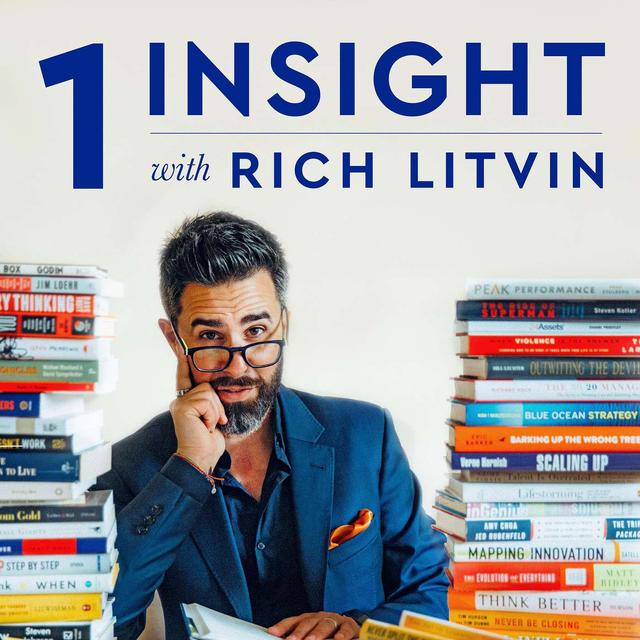



¶ Welcome to One Insight
Welcome to One Insight. My name is Rich Litvin. I grew up in London and I now live in LA. And this is a podcast for extraordinary top performers and their coaches. You see, I've coached some of the most successful and talented people on the planet. I can see what most people cannot see, and I dare to say what most people wouldn't dare to say.
And what I know about success is that on the other side of it, it can be incredibly lonely. You can feel more of an imposter the more successful you become. And when you're the most interesting person in the room, you're actually in the wrong room. Clients who are more successful, more intelligent, and wealthier than you need your support more than they know and more than you can imagine. I coach around insight. Life looks one way, something happens, and the world looks different.
And your entire world changes. It can happen in an instant. And this podcast is called One Insight, because a single insight can change everything. In this season of my podcast, I'm going to share with you some of the interviews that I've done with some of the most fascinating people I know on their podcasts. And I'm also going to share with you some of the most popular episodes of this podcast again. And I have an invitation for you. You see, most people listen for agreement.
I like this. I don't like that. I invite you to listen to these episodes for insight, not agreement. You see, then you can listen to an episode you've heard before, and instead of dismissing it of I know this one, I've heard this one. You can listen for a distinction that you didn't hear the first time around. You can listen for an insight that you could have missed the first time you listened to it. Enjoy.
¶ What Coaching Truly Is
Welcome to Master Your Mind with Marissa. And today we're talking to a dear friend of mine called Rich Litvin. I met Rich dressed as a king in the keep in Croatia at a Game of Thrones party. We were all dressed up and he was the king then. He's very much still a king now. He's what I call a king of coaching. But he was in full costume, running around as a Game of Thrones character and we became very good friends. That was like six years ago.
And here we are today. And I'd love to ask you about coaching because you are really up there as one of the best coaches. And first of all, I want to ask you from the aspect of a coach and a number one coach to boot with number one books on coaching, if someone said but what is coaching? What would you say coaching is?
I'd go back for a second and I'd say for most of history it wasn't called coaching. It was called leadership. Mm-hmm. And great leaders are all automatically great coaches. They know when to mentor, when to advise, when to challenge, when to provoke. When to nurture, when to stand at your side, when to stand in in front of you, when to stand behind you and push you. So Coaching has been
is new to our lexicon, but it's deep in our DNA as lead as a leadership tool. I think the mistake that most coaches fall into is that they think coaching is a tight It's not a title, it's a tool. It's a great tool to use at times. And sometimes I'm coaching, but sometimes I'm teaching, sometimes I'm mentoring, sometimes I'm challenging and provoking.
And so for me, coaching is helping the people I'm with to see possibilities that they can't see from the direction they're looking at in this moment in time. And are you only a business coach? Is that what you do? Do you do pure business coaching? No, I I if I don't describe it this way, but I'd say to you, I'm a mindset coach.
So I work with I've worked with CEOs, I've worked with people who run billion dollar companies, I've worked with people who won gold medals in the Olympics, I've worked with former Navy SEALs and Army Rangers and British Special Forces operatives.
But what I know when anyone sits down in front of me is that there's a way that they see the world and there are parts of the world that they can't see. And I can help them see things that they can't see because I'm bold enough to say things that most people would never dare to say. Can you give me an example of one of those things might be? Yeah. So I worked uh a few years ago with um a British Special Forces operative who had left the military and had this idea
for a a a community of people like him who played in a really rarefied air. He was friends with royalty, he was friends with uh people of very high level in the military, and he wanted to create something called the Extraordinary Adventurers Club. And he was afraid to sell.
He'd done something that most people would never ever dare to do, traveled to places, done all sorts of scary situations. But selling this program was intimidating to him. And I stopped him and said, look Your enrolment, your sales calls must never happen on a phone.
You must ever ha only ever have a sales conversation with someone in a helicopter or swimming across a river or climbing up a mountain. Because that's what makes you feel alive and that's what your people get. And if you're creating the Extraordinary Adventures Club, Then the way that you sell it is the way that you deliver it. And he loved it. He was on fire. And that was it.
¶ A Coach's Own Coaching
So you both are a coach, but do you also have a coach? Do you have regular coaching sessions yourself? Yeah, I have all sorts of coaches. I'm I'm mentored right now by a man who is in his seventies, who helps uh entrepreneurs to build and scale businesses. I'm mentored by a a thought leader, a man who's published sixty five books.
I'm mentored by a woman around intuition, uh, who's uh one of the foremost experts on intuition. I constantly have people who challenge me and coach me. I think we need to. I think this this profession is apprentice based. And if you're not doing the work yourself, how can you look someone else in the eyes and take them through deep work?
So how many hours a week do you spend being coached or working with a coach who's working with you as opposed to being the coach? How much of your week does that take? I don't I have to work that one out. So I the mentor I see around Building My Business, I see him uh a couple of times a quarter. Uh the man who sometimes coaches me around thought leadership uh once maybe twice a month.
Um uh I'm I'm about to start doing this work on intuition and I'll have I'll have two calls a month with this person. Uh I I'm in couples therapy with my wife, which I think is part of this this deep work and we see our couples therapists. once a week. So I spent a lot of time doing work on myself.
Yeah, and I'cause when when you said that I could hear people going, Oh no, that sounds exhausting. It's too much. You know, people have this belief that it just takes so much time out of your day to see all these different coaches and therapists and guides and gurus and advisors and I can almost hear the audience going, Wow, you have all these different people, how do you fit that all in? But you don't see all of them every week.
No, no, no. And I the people I work with coach uh i in in small sessions, 30 minute calls, sometimes an hour make maximum. Uh look, I'm not recommending this for everybody. But I choose to play a big game. And and if you're playing a big game, both'cause I dream big and because I I need to walk my talk. I can't do this work with others unless I'm doing it myself. I want to invest in myself that way.
¶ Evolving Coaching Models and Insight
If someone listening here said, Okay, I I want to have a coach, is that a weekly thing? Do most people have a coach once a week for an hour? How does it work? Traditionally, that's how coaching works. It's not how I work any longer, but I choose to work with a different kind of clientele to where I began. So 15-16 years ago, when I started coaching, I'd always coach once a week.
Uh these days I have uh I have a couple of ways that I work with people. I have a concierge trusted advisor relationship and there people invest uh a bit like I have a concierge medical plan. I pay a lot of money to go and have some CAT scans, MRI scans, blood drawn, all the work's done once a year, with the hope that I'll never see those people again for another year.
But if I need them, they're there for me. I can ask any question about my health, any problem I have, I can go to them. And and concierge advisory work that I do, uh again, it's expensive. You invest at the start of the year and I'm there for you when you need me. We might have one or two calls a year. We might speak every week. It depends what that particular person needs.
I have a way of working with people right now I call a thinking partnership. Uh the kind of people I work with these days don't need an hour of deep coaching every week. We have two 30-minute calls every month for five months. And sometimes people are complete, sometimes people are renewed.
And in thirty minutes they come in with one question, one idea, one concept to play around and sometimes in ten minutes we're done. Because I coach around insight. That's that's the the methodology I bring in these days. And when you work with high performers
One insight, one way of seeing the world slightly differently, and everything changes. They don't need to be held accountable. They don't need to take it turn it into a seventeen step plan. They rub their hands together and they're ready to go.
¶ Deep & Insight Coaching Styles
So tell me, can you give me some idea of how this goes, how the conversation will go back and forth for for you to get that aha moment, that insight, what has to happen in a coaching session for you the client to suddenly go, Oh, I've got it. This is what I came for.
Well, I can't use this metaphor right now'cause we're not on Zoom, but we're so used to being on Zoom that that most people will get this. You see me on Zoom and there's this frame around me. Mm-hmm. Now that every one of us has one of those frames for our life. Beyond those borders, there's the impossible and here's what looks possible. And so I'm interested in where are the hard boundaries about around somebody's life?
Where do they say, oh no, I couldn't do that, or I'm not that kind of person, or that's impossible? And I know we've come up against a hard hard boundary. That there there's life that can be lived from here and here between here and here, and on the other side, there's the impossible. But I've also worked with people who've done impossible things on a regular basis.
And so all I have to do is to provoke, to challenge, to share a new idea, to give an example of someone else who's done something that they feel is impossible, and the lights will sometimes go on. Insight coaching doesn't usually look like Archimedes jumping out of the bath going Eureka and running down the street naked. It often looks like this. They go. And it's that moment of
There's a new possibility that's been created. And we can leave the call. Because I think the most powerful coaching tool that we have is something I call gentle reflection. Sit with that. Let's talk again in a week. Journal on that. Reflect on that. And we'll come back. And then new possibilities, what appears like a crack in the fabric of where the world seemed so solid before, becomes something new, a new way of being, a new way of seeing the world.
What are your different styles of coaching that are kind of unique to you? I think there's there's two things I'd bring up immediately. One is insight coaching, which is what we're talking about right now, where I'm looking for the one insight, the one new possibility that shifts everything. And the other is what I call deep coaching. I'm willing to go deep. I'm I'm willing to I I listen
beneath your words, I listen to the silences and the pauses between your words. I've done a lot of deep work on myself and all sorts of modalities over the years, so I can hold space for you, however challenging the situation might be. And I call that deep coaching. Yeah.
¶ Coaching Beyond Traditional Success
Who are your favourite people to coach? Who do you like to coach? What's the people that think, Oh yeah, I can't wait to work with that one? Yeah, well I'll tell you who I love to coach. Uh I love it when someone comes in with a track record of success behind them. Uh, because I I'm I'm drawn to talented, driven, ambitious people. That's just how I'm wired. It's who I'm driven driven to spend time with. And what I know is that
There's never an end point. Uh I I I'm I'm fascinated by what I call the other side of success. So most people are interested in what it takes to become successful. What I get really curious about is what happens on the other side. So most people are surprised to hear that the most common thing when someone sells a company for millions and millions of dollars is depression. Yeah.
Uh, there are all sorts of challenges that occur on the other side of success. Those are the people I love to work with. And I love to work with them when they're ready to create their next big mission in the world. Yeah, Jo Malone said that that when she sold Jo Malone she went into a bit of a funk and thought, Well, I don't know what to do with myself. It that was like my baby and so she immediately set about creating Jo Loves because
she sort of regretted selling it. And it's a bit like someone who does up a house, they all finish and says, Oh I think I'm gonna go back and start all over again now and do it again because people think the challenge is to get there, but when you've got there, because your potential expands as you move towards it, then you're absolutely right. What do you do on the other side of reaching success? Yeah, that fascinates me. And and m my experience is there's a moment when people
it it kicks in again. Then they realize they can't stop. And that excites me. It's it's me too. That there's never an end to this game. Uh I think life is a game and and and it's meant to be played. And I I love to work with people who are playing on that side of success.
¶ The Future of High-Performance Coaching
So about maybe ten or fifteen years ago I noticed a lot of people coaching and they all asked you the very same questions and a bit like when people were doing N L P and they would ask you the same questions and I found coaches then they were all the same. They all came at it almost packed with exactly the same questions. But I've seen that change now, which I think is good. So what have you seen are the big changes in the coaching world?
I tell you what interests me about the coaching world and it's it's It's more about what's going to happen into the future. So w we we s when I wrote The Prosperous Coach, I I wrote a quote in there back then that eighty percent of coaches are struggling to make twenty thousand dollars a year or or more.
And I think it's probably uh ev even less people are being successful in the world of coaching. We have apps coming in right now with using artificial intelligence. They'll be able to do great coaching with people. You know what, there will always be people who want to invest no more than fifty dollars an hour, looking for an app that will help them coach, uh hope coach them and and and hold them accountable.
I'm interested in what does it look like to be a really high performance coach, to work with a handful of clients a year, to work with the kind of people who are w who are willing to invest deeply in themselves. both financially, emotionally, spiritually, physically, that excites me. And I don't think there'll ever be much competition at that place in the world of coaching. That's the place I like to play.
¶ Coaching in Schools and Leadership
And what do you see as the future of coaching?'Cause I think when it started where it isn't very different, which is a good thing, but where do you see coaching going? Where do you see coaching in the next ten to fifteen years? What's going to be different about it to where it is I think it will be ubiquitous and I think it will be part if you walk into an organization as a leader, as a CEO or a senior manager.
Y as part of your package, you will require coaching. You'll request coaching. If you don't get the right kind of coach, you won't take that deal. Uh it will be just become part of the language of leadership. We we need coaches. I think it's Yeah, I think I can see that every company having a coach because we just did a five day challenge. It's called I Can't Do I Can and it was actually giving children in in a cheerleader. We we had that in
But it is really coaching. It's teaching children how to believe in themselves, how to have an inner cheerleader that says you can, rather than a critic that says you can't. ac mae'n cael ei gweithio'n gweithio'n gweithio'n gweithio'n gweithio'n gweithio'n gweithio'n gweithio'n gweithio'n gweithio'n gweithio'n gweithio'n gweithio.
Funnily enough, my sister-in-law is literally that. That's what she does in schools. She coaches the teachers, she coaches the kids. So it's coming. That model is Where is this in England? In the United States. The States, good. Yeah, it is coming, but it it hasn't come enough. But I can see that. So, what else do you see as the future of coaching? Where else do you see it go?
Remind me'cause I I the only reason I'm a coach is in two thousand and three I was training to be I'm a school teacher by background. I was a vice principal training to be a head teacher or a principal. And I was trained in coaching skills. So that's where I first got my training back in 2003 in coaching skills. And did you did you leave teaching to become a coach?
¶ From Adversity to Personal Breakthroughs
I I didn't so much as leave as forced out. So I went to work for a very inspiring boss. About two weeks later he was fired by someone at a government level and the consultant they brought in, I made it very clear that I didn't I couldn't stand her. And then they made her the head teacher and she had a policy of last in, first out, and I'd been there for a few weeks and she fired me immediately.
So I I like to say I'd like to I'd like to tell you that I I responded with confidence, but I cried and I I begged her not to fire me. And thankfully she stood to me. Stuck to her guns. I went off to to the to Thailand to lick my wounds and began coaching out on a beach at the start of my
And that's funny, isn't it? Because often your worst of times is the best of times. Because I was also going to be a teacher. I got as far as teacher training college and I left and became a therapist instead. And I look back and think that was one of the best things. Yeah. that ever happened to me. But I think many teachers have the ability to coach because you're so fascinated by human behaviour and human development.
Well, I think and that's a great catch because you asked about coaching questions and where they become generic. One of my favorite questions right now is to ask people, what were the jumps and the leaps in your career when you look back? You can see when you did certain things, when you behaved a certain way, there were leaps and and in in your life and career. And often
As we look back, it's some of the most challenging moments that led to our most successful uh achievements. And and I I like to get my clients to reflect on that to see, well, what if they did that consciously? How could they create that moving forward? Uh we often think that success is out there in the future, which is why we read all these books, the self-help book.
But success actually can be mined from your past because your path for success is different to anybody else's. Otherwise, all we'd need to do is give people Richard Branson's biography and they'd all be billionaires in a week. It doesn't work that way. What works is to find out what works for you as an individual, not what's generic for anybody.
¶ Courage, Not Just Confidence
Yeah, I think that's true because it's it's often how you deal with rejection and setbacks and do you have the bounce back factor? But if you started off without that, if you didn't have the bounce back factor, if you were very impacted by rejection, what would a coach do for someone like that?'Cause your coachman have already made it. The people you see have already got a lot going for them. They're they're they're risk takers, they're self directed.
and they come to see you and you make them even better than they already were. But what about the people who are not anywhere near there who say, Oh, I I don't like taking risks, I'm scared of being rejected, I'm not very confident, I'm scared of stepping out of my comfort zone. Well uh uh two things. One, that was me for much of my life. I I spent much of my life trying to prove myself to my dad.
I didn't realize it at the time, but what it looked like is whoever you were, I was trying to prove myself to you. I was hoping you would like me. Uh I I w I lacked confidence. When I first started coaching, I I did a research project. I spent two years travelling around the world interviewing what I called the world's most confident people.
'Cause I figured there were all these people who had what I called natural confidence and there was me who no matter no matter how it looked on the outside, it never felt real on the inside. It always I always felt nervous and insecure. And and I discovered uh a a range of things about confidence. I discovered that confidence is a result, not a requirement. I discovered that courage is much more valuable than confidence. Courage is not
having no fear. Courage is being afraid of what you want to do and doing it even though you feel afraid. And I discovered that real confidence is just feeling comfortable in your own skin, knowing that I look this way, I speak this way, I have these flaws, have these doubts, and this is who I am.
And so it was that willingness to study confidence that helped me grow in my own confidence. I remember years ago I was interviewed on the radio for the first time about this research I'd done on confidence. I was so nervous because I'd never been interviewed before on the radio that s I could feel the sweat dripping down the small of my back.
and my heart was racing. And I decided to call myself out. And so I said to the interviewer, and it was radio, so no one could see me, but I said, I want you to know this is what's happening right now. This is how nervous I am. This is how insecure I am. These are the voices in my head.
And as soon as I said it out loud, we both laughed and then I relaxed because I was being real. I didn't have to pretend anymore. And and again, that's what confidence is, being w being comfortable in your own skin, even with all the doubts and insecurities and flaws that you have.
¶ Unleashing the Inner King
And do you feel that you can coach that into somebody? I I don't think you can coach it into somebody, but I think you can draw it out of them. You know, I'm I uh w my little boys, we have a ritual every night at dinner and I've done it for three or four years now, since they were really young. We say, What was the best part of your day? What was the most challenging part of your day? What are you grateful for? And what was one small act of courage?
I want my boys to know that it's good to look back on the day and see what you're proud of, but also what was challenging. Because challenging things can happen every single day and you can handle it. What are you grateful for? No matter how challenging the circumstances, seeing what you're grateful for, and then knowing that each day you can take a little act of courage to move in the direction of what you want.
So when you say you can draw it out of someone, I mean I believe that, but I see people who say, But I've never had confidence. So where do you start with someone who says, I haven't got it for you to draw it? I it isn't there. You can't draw it out of me because I lack it. Well that's not my experience. I find people like to fight for their limitations.
So I I was I was talking to a woman the other day who said, Well it's all right for you, Rich, you coach these extraordinary people, um, but here I am and I'm just a housewife, I'm just a mother, I'm raising my kids on my on my own. and and I have never done anything significant in life. And so I spent some time with her to help her realise she's a CEO.
She's the chief executive officer of her family. She is doing extraordinary things. She is able to r uh raise kids in challenging circumstances, uh manage a budget, handle adversity. She was doing incredible things. But she was dismissing it because it felt like her life. And and everyone does this by the way, including the high performers I work with, but
Everyone's a high performer. You said at the beginning we met and I was dressed like a king and it it amused me because there's a phrase that I use, I don't use it for marketing, but I use it quietly on my own. And and I say I coach king. But what I mean by that is, whoever you are, I'm looking for the king inside of you. And and and you could fight for that and say that's not me and or Or you can begin to own it as as as as I point out to you where you've done something extraordinary.
E every human being on the planet I've got two little kids. I remember them coming into this world. They could do nothing. They couldn't walk. They couldn't talk. There was nothing they could do. They are walking, talking miracles. And so's everybody. So if you want to fight for your limitations and convince me that you can't do things that look impossible and you have no confidence and and uh there are things outside of your grasp,
You can fight for that if you want to. And I might push back for a while. But I'm not there to do the work for you. At some point, if you're not willing to take a risk, to do something that feels uncomfortable, then you you won't be able to create what you want.
¶ Defining and Striving for Desires
And and everything you want is just usually on that side of feeling uncomfortable. So Yeah, that's true. And to get what you want requires doing what you don't want. It's like saying I want a six pack, but that requires going to the gym and not eating pizza and not drinking beer. So to have what you want you have to also forgo what you want and and people don't really get that that You can have whatever you want if you know what it looks like.
And if you believe you're worth it, and if you know what you're gonna do. So I find with many clients who come in and they they they don't really know what they want and they don't believe they're worth it. And I always say, Look, the first step is decide what you want but then spend all your time deciding unworthy, worthy of love.
Worthy of health means I don't have Pop Tarts in the morning. I I have um I'm avocado on toast. I if I'm worthy of health, I must be worthy of taking the steps to be healthy. If I'm worthy of wealth, what am I going to do to create the wealth? So decide you're worth it.
Then the second step is to really decide what does that actually look like? And I find so many m many mistakes in my people don't know what it looks like. For instance, one of my clients went on a site called Muddy Match who she's a city girl She married a farmer. Two years later she said, You know, I didn't really realise what living on a farm I thought it was a lambs running around in the fields and actually it's always raining, it's mud, it's smelly. Um he's out all day.
at six in the morning and I don't have any friends. I live on a farm in the middle of nowhere. And now I want to go back and live in a city, but I'm married to a farmer. And all of that happened because she didn't think about what is this r what do I want? What does it look like? And then of course the next step is what am I going to do?
to get it. And I find so many people now believe in manifesting. I'm just gonna sit there and manifest. It's like, no, no, no, you also have to do the work. So you might say, I want to write a book and I believe I've got something to say. I've got a message. I think my message is good, so I'm worth writing a book. But what does it look like to write a book? It's a lot of solitude. Did you find that when you wrote you had to be on your own to write for hours at a time?
Here's what I hear behind what you're saying. Number one Knowing what you want is really, really hard for most people on the planet. Because in twenty years of schooling, you're almost never asked what do you want. And if you are ever asked what do you want, you're never asked what else. And so one of the exercises I love to give to clients is to say, make a list of a hundred things you want. And it could be as mundane as a new iPhone um or a new car.
But what happens when you have to write a hundred things down that you want? is the first thirty come out pretty easily. The next thirty a bit of a stretch, maybe it's a nicer car or slightly more vacations, but it's the last third, the third third. That's when you have to get about outrageous and a bit crazy. And and most people have never had an experience of really owning that there are things that they want, that there are some things we want that we
We're not sure it's okay to have them. Mm-hmm. If we told someone else about them, they would judge us for them. There are other things we have on our want list, actually no longer our wants. They're mum's and dad's wants that they wanted when we were kids. And that realization that There are things that you want and it's okay to want them whether or not you get them. So that's that's the first thing that's that's really key for most people. Spend some time reflecting on what you want.
And then there's a question I like to ask which relates to what you say which is What are you willing to struggle for? Because most people don't want to struggle. Well, I'd love a man who has a six pack and he works in this industry and he's home and attentive to me all the time. Well, what work are you willing to do to make that happen?
Uh uh Annie Lamotte wrote a book called Bird by Bird about how to write. And she said, I've trained thousands of writers. The thing is I've noticed is that everybody wants to be an author, but nobody wants to write. And I think that speaks to this. What are you willing to struggle for? and of course you and I both being writers, we know that writing is just the first bit of the game. You can write a book, but now what? Well now you've got to learn to be a speaker. You've got to be able to go to
book signings, you gotta be able to give talks. In the world where there are so many books, it's no longer enough to write. You have to be your own publicist, your own marketer, you have to learn to be a speaker.
¶ Beyond the Gray Zone
And you see that's where coaching really works. Someone comes and says, I wan I wanna write a book and you can say, Well, what are you doing to write a book? which is often not a great deal. Or people say, I've I've already written a book, it's in a drawer, it's been there for five years. I just don't know how to get a publicist. I don't know how to get it published. I'm too nervous to take it out there in case it's rejected. So I can see there that coaching really helps people.
can they realise their dream? What are the steps they need to realise? What are they going to do? I mean, I find a lot of women who say, I want love. What are you doing, going to yoga? Any men there oh no, it's all women. Well, you need to get out of the yoga and into the weight room. If you really are serious about finding a man And you do yoga, perhaps you need to go and do running instead. Well, I don't like running, I like yoga, I know, but people say, I'll do anything.
Anything to get pregnant. I go, Okay, well let's look at your d I no, I don't want to do that. I said, But you just said you do anything anything except that. I'll do anything to lose weight, let's look at what you eat. Oh no, I don't want to give that up. I'll do anything except
change my diet and go to the gym. Which is always interesting. But of course a coach will have a look at, well, why do you not want to go to the diet? Why are you resistant to the gym? Well, I've done it all before and it doesn't work. So
So uh where I like to explore is what I call the gray zone. And the gray zone, I'm always reminded when I used to live in mid-city LA, there was a man who used to run past my house every single day. And his physique never changed. He was this this pudgy man. Yeah. And
Many people say they want to change, but they live in the gray zone. They do just enough that it looks like change will happen, but not enough to make actual change happen. You know, one of the most common things that happen when people start to work out and go to the gym more is they start to treat themselves more. Of course.
And so they wonder, well, I now I'm working out four days a week and I used to only work out once. Why am I not why am I actually putting on weight? Well, because you're treating yourself more. So you've got to look at again, what are you willing to struggle for to create what you want in your life? And what are you willing to do differently to what you're doing today? Yeah.
And and we can't do that for ourselves. Yeah. It's very, very hard to see ourselves. We only see ourselves in reflection. So one of the most powerful tools that you bring as a coach is you reflect a client back to themselves. Yeah, it's a bit like working out. If I work out at home, I only do the bits I like. I d I don't wanna I don't like that one. I'm not doing that. So I do the lunges and I do the leg and but I don't really like the arm exercises very much. But if I get a coach or a trainer
then I have to do the bits I hate'cause they're not gonna go, Okay, we'll just do the bits you love. We'll just keep doing the things that you like. And I guess it's very much the same. A coach makes you do the bits you don't want to do. a coach says, No, no, no, you can't just do the bits you like, you gotta do the bits you actively dislike to get what you want to have.
I think that's right. And I'm gonna differentiate between how majority of coaches work and where I operate when I work with high performers. Because when I work with high performers, my job is to help them become lazier and lazier. Because what I'm doing is helping them to operate in what I call their zone of genius. And your zone of genius is those one, two or three things that only you can do. And when you do those, it has an exponential effect on your life or your business.
And so that's very interesting for me to play out there. And and and you're absolutely right. I have to have a trainer. I there's no point me joining a gym. I'll just never go. But when I have a trainer, they push me and and I do what needs to be done. But up here working with high performers. It's removing everything that's not in their zone of genius. And the trouble with your zone of excellence is it's insidious. It pulls you down to do things that you no longer need to do.
It pulls you back into doing things that will not free you to have an exponential impact on your life, your business, your relationships, et cetera.
¶ Reimagining Education for Impact
So you said something earlier and it really piqued my interest about schools never ask you, What do you want to do? Why do you want to do that? What are you going to do to make that happen? What will happen when you get that? So if you could redesign education What would you do differently?'Cause I also think that the schooling that we know today
I look at the schools in Finland where you only have to go to lessons that you like, don't have to go to any lessons you don't like. And that's actually really working out very well for them. I look at schools where there's no punishment, there's just meditation. or they do mindfulness and they find that that is completely different to I my father used to always say you should never ever have a prize day because
one kid gets a prize and thirty don't and it's it's always the children, not the ones, it's the children who you should you should actually reward effort, not achievement. Because the smart kids who don't work hard get the prizes, the kids who are not so are working really hard. don't get a prize and he was really anti prize day and prizes and top of the class and he hated streaming and he was quite revolutionary in education. But I also think that whole system
is now very outdated. And I see many people taking their children out of school because they just feel it doesn't work. I mean, I I think I mean, I had many, many happy m moments at school. What do you think should change in the school system worldwide? What would you like to see in schools as a performance coach that would turn out not just m brighter kids, but but happier, more balanced children?
That's great. So I spent 15 years as an educator. I taught in Africa, I taught in Southeast Asia, I taught in inner city London. I taught science'cause my got a degree in uh biology and I taught psychology to the older kids. And eventually I was a vice principal running schools, helped to set up an international school in Southeast Asia. And I would always battle with head teachers. Because when I was recruiting new staff
I only ever cared about one question when I was interviewing you. I would ask, What do you love about children? And then one of two things happened. Either their eyes light up or they don't. If your eyes light up, I can train you in everything you need to do to be an extraordinary teacher. If your eyes don't light up, I don't care how many degrees you have in education, I don't want you teaching at my school.
But I used to have to fight the system with head teachers who wanted all the boxes ticked. I became a really good teacher when I was a senior teacher because at that moment Nobody was watching my lessons anymore. I got to observe other people's lessons. No one was observing mine. So what that meant is I would go in and sit down with the kids and we'd talk and I'd get curious about them because I'm a people person. I always have been.
How's your life? What's going on? Where'd you live? Where'd your family come from? And we'd sit in a circle and and have great conversations. And sometimes I'd teach a bit of biology and they'd go away and they'd work really hard because they loved my classes. And the teachers trying to cram the curriculum down their throat. uh they wouldn't study for their classes and I got I'd get great grades from my kids.
So if I was sh doing anything to shift the education system and it's that's very complex, um, but I would bring much more project based work into schools. Uh, you know, there are so many rules in school that don't apply in real life. In school, if I help you, we're both cheating. And it's bad and it's wrong.
But in life, if I help you, we both get to fly. I think it's an extraordinary rule of life that be there for other people, help other people. You're not supposed to do that in school. I bring much more project based work. I bring entrepreneurial projects into school. And if entrepreneurs come and talk to kids, what does it mean to think entrepreneurially?
I I bring leaders into school to talk about leadership and give kids opportunities to lead in different scenarios. I find ways to get kids out of a school and into the wilderness and do other things that outside of just sitting and copying facts down from a textbook. So here's a question for you.
¶ Therapy, Coaching, and Boundaries
What do you see as the difference between therapy and coaching? What's the difference in your mind as a coach between therapy and coaching? Well, I I'll I'll give you my answer and then I'll say I think there's a blurry area in the middle where extraordinary coaches are able to do deep therapeutic work and extraordinary therapists. are able to do really fantastic coaching at the same time. I agree. And and that's that's the realm I think we both play in in the center.
And I think traditionally uh uh a therapist is about doing the work to explore the layers on the inside to reveal your uh uh anything that's holding you back, uh to to free you from some of the baggage that is generational, for example. Um, and a coach is much more about traditional coaching is much more about, well, what do you want to create next and how can I help you?
I'm more much more fascinated by that overlap in the center where great coaching and great therapy can look and seem and feel very similar. Yeah, I think that's true because I would say that therapists deal with a past. They deal with what I call unfinished business. I don't know why I'm like this. I have no idea why I'm messed up. I I don't know why I can't drive or fly or got a fear of dogs or cats or bees. I don't know why I mess up every relationship.
therapy will unravel and unpick that. It almost puts you back to I think therapist is like being a detective'cause you're looking for clues. Then you're rather like a dentist extracting all that old stuff. Then you're like a coder. and wiring in something better. So I see therapy as dealing with a past.
and coaching is dealing with but the present and the future. And in fact, you're correct, because we're now having trained, I think, eleven thousand therapists, we're now training coaches, but w I'm very much looking at therapeutic coaching. So coaching can do some therapy. And as you say, therapists can do coaching, coaches can do therapy. But people a lot of people get very into this black and white, you know, you must never
guide a client or lead a client or suggest anything to the client, both in therapy and coaching. But I've always been a bit of rule breaker and I think you are too. My favourite book on leadership is called First Break All the Rules. Yeah, I I think so. I remember someone saying to me, I was actually do training in Canada. and I had somebody watching me from some C Canadian board who were going to give us a licence and It was a very traumatic session of this gun at the end. Um
I think I think at one stage I held her hand, she was going through she and I held her hand, she was in that and I gave her some tissues. They went, Oh no, that's terrible you made contact with her, you should never have held her hand and we don't allow that. So therefore you can't join our organization.
unless you promise to never do that again. I said, you know what? I'd actually rather not be in your organisation actually than never be able to offer someone comfort. I mean, I know obviously you shouldn't hug your clients, put your arms around your clients, but if someone's in deep trauma
and they're with you and that this I think it was absolutely fine to hold her hand. She was describing losing a baby and how sad that'd be in for her and then she'd lost another baby and she was in so much trauma. I think me just holding her hand. After all I was a female, she was a female. She felt safe. But um I love um some of the so I think some of those rules are rather silly. So what I think you're pointing to is
Those are organizations that are putting the training wheels on. Yeah. New therapists and new coaches. And you need your training wheels. It's great for most therapists to know don't make contact, physical contact with the client. Mm-hmm. It's great for most coaches to know Don't don't lead the client'cause too many coaches come in with a I know better than you as Yeah, that's true.
And so there are some but you know my kids have training wheels on their bikes until they take them And and so yeah, for most coaches, for most therapists, there are some ground rules that are worth really paying attention to. I know when I was training my teacher said to me, Now, if somebody comes in and says, My husband hits me, or could be my wife hits me, and you
do that, you've judge them. And you must never judge them, you must never your facial expression mustn't change. And I remember thinking then, what utter, utter rubbish. How dare you tell someone that? So my first client came in, she's a very sweet little old lady. I mean she really was a little old lady. Her son had said my m mother, my her my dad just beats her.
And she won't leave him and she kept saying, You know, he's a wonderful husband I said, But he's not. He's a wonderful provider. I want you to say
He's a wonderful provider, but you are never again to say wonderful because he hits you. Well, she says, But you see, I I burnt the dinner. I said, But if you went out to a restaurant and the chef burnt the dinner and he went and hit him, do you think they wouldn't call the police and they wouldn't go, Well, well, you burnt his dinner had r had every right to hit you
And she kind of took that in and she said, Um, yeah, I never thought about that. He's not a good husband, is he? I said, No She said, He's never been very kind to me. but he's a very good provider. And off she went, and her son rang me and said, You know, I'm so glad you told her that'cause she's now left him and she's blissfully happy. He's very unhappy. But she needed someone to say
that's not a good husband. He is a good provider. You have a wonderful life. It very much part of her culture that she had three sons, a nice house, a husband, her friends. But when she realized that he was an awful husband, but a good provider But it was also hers. They'd been married forever, that she could still have a nice house and the three sons. He didn't have to be in the picture at all.
But I guess you have to go on the limb to do that because it's breaching all the guidelines that say don't guide, don't need don't give advice but I think when someone's in front of you saying, My husband hits me, beats me, hurts me that you should say, Well, you d you don't have to tolerate that. That that that's not okay.
H here's a distinction I hear behind that, because I use this in coaching and I I i it's it's um a quality of coaching I call leadership. I'm not afraid to lead my client. But I'm not a le I'm not leading from the place of I'm right. No. I'm leading from the place of provoking their thinking. Yeah, exactly. And that's what I heard you were. Yeah and that
You know, I you had some attachment to it'cause it i it was painful to hear someone who else is in pain. Yeah. But you're not telling her, Hey, this is what you need to do, you're showing her new possibilities and in that moment the insight for her is enough and she takes the Yeah. But very much the same when I work with children who are bullied and they tell me
about what the bully does and how ashamed they feel and how they can't tell anyone and I will actually coach them with strategies to say, you know, it's not okay. Not okay to be hurt. It's not okay to be Diminish it's not okay to allow that to happen and I think I think a lot of coaching is giving people a voice. having them say, Well, that's not okay and no, I'm not going to tolerate that. That that doesn't feel comfortable. I've had many people come to see me and say, Wow
I now say to someone, that doesn't feel comfortable to me. I I don't feel good about that. That that that doesn't meet my need. So just giving them a better vocabulary, because it really is, isn't it, being seen, being heard. And having a voice. That's a great way to put it. There's an old Indian phrase, three mysteries to the universe.
birds to the air, fish to water, and humans to ourselves. Yeah. So what we're doing is putting that mirror on, allowing us to see our clients, to see themselves, and then giving them tools such as a voice. to make the changes they would like to have in their life.
Yeah, so I'm I now like therapeutic coaching. Having trained many, many therapists, we're now quite interested in our therapeutic coaches because they're going into coaching.'Cause a lot of people think, Oh, I don't want to be a therapist. I couldn't deal with all the trauma that comes up. But that doesn't mean it doesn't come up for a coat. But they do like to think well I could be a coach. and I could have some therapeutic technique. So
Well, I there there are two things I see to that'cause I've also trained a lot of therapists who've transitioned into coaching. And one of the challenges in in the therapeutic world is simply financial. There are guidelines where people's supervisors will say, well, I charge 120 pounds an hour, so you can't charge more than that.
And so in the coaching model you get to charge what you want to charge and then if you bring enough value, people will pay you. If you don't bring enough value, they won't you can't ask for any number. But that's that's that's a there's a draw there. It's a different way of working, it's not by the hour. It's usually by the package. So you get to work with people over significant time and see shifts. So I've seen a lot of therapists begin to make that shift into coaching.
I've seen it because also the regulations to be a therapist can be very, very limiting in some states. Whereas being a coach you do have a lot more freedom because you're not bound by the same restrictions. that you'd have as a therapist. Tell me what you see there. I I think that's I think that's spot on. I think that's spot on. And the the
Once again, y you can do anything and show up any way you like as a coach. Choose the market you want to work in, choose the kind of clients you want to work with and the tools you like to use. But if you can't create enough value for people, then you won't get clients. So the market finds the place for coaches. Your job as a coach is to put your attention on how can I create value for my clients.
Yeah, and of course you can niche, you could decide I'm gonna just do that coaching or that coaching and you can spend a lot of time specialising. And it is nice that people now see coaching in a very different way. I think they used to see it as in something that was indulgent, rather like people thought therapies and you just go and talk about yourself and how boring is that. But I think
therapy has changed dramatically in what we do and don't say what we can and can't offer. And I think coaching too. And you're right, because we have many therapists who say, I want to coach as well. Now I I've I've got a client to this place where they're over all their issues, but I want to be the one now to coach them. So I've I've
got someone away from their fear of attachment or commitment or fear of success, fear of failure. But now I could coach them to take action. So I see many therapists really benefiting being coaches too. And as you say, many coaches saying, Well, I'd like to be a therapist as well, I'm a coach, but I'd also like to have that string to my bow. So it is really nice they can now sit next to each other and they can actually benefit each other. I think so. They're very complimentary tools.
¶ Coaching Boundaries and Community
Yeah. Yeah, me too. So do you coach your own children? I'm sure you do surreptitiously. Yeah. Um well I definitely don't coach my wife. You cannot coach your partner. Um but I I do my best to bring ways to challenge my kids. And as you say that, I'm reflecting. Th the truth is, I think that's very it's very hard. Uh when when lockdown happened, I was trying to teach my own kids. I don't know how to do it. And you're a T.
I I'm a trained teacher. I've taught in tough inner city schools. I have taught all over the world and it was it was challenging teaching my own kids. So uh I I want to build a community of great people around me uh and great families around us so that there are people who can coach my kids when it's needed. I'll I'll be there for them. Yeah, I think probably not me directly. Um but like you say, surreptitiously probably.
And do you ever coach friends and family or do you do you have boundaries there? Well both. I will coach friends or family by creating really clear boundaries. In fact, the closer we are, the more clear the boundaries. So Steve Chandler, who I wrote a book with, um uh used to joke. Be like a brain surgeon. Because you can be at a party with friends and someone says, You're a coach, hey, can you help me with this issue?
If you're a brain surgeon, someone doesn't say, uh someone says, you know, hey, I'm getting these headaches, can you help? They don't say, Yeah, sit on the couch, let's talk about it. They'll say, Yeah, book an appointment with my receptionist. I'll see you next week. Yeah, cool. And I'll play the same way. And so I have coached friends and helped them create some all all sorts of extraordinary things in their life, but I create a very clear boundary.
This is where our friendship starts and ends. This is where our coaching starts and ends. My friendship is more important than our work here. So if it ever looks like our friendship will be impacted by this, I will end this coaching agreement. And I'm very clear and very strong. I can even hear my voice how I do that because I I my friendship is the priority.
Yeah, I'm the same when I when I've done therapy with friends and family say, look, for this next hour, I'm not your friend, or your daughter, or your sister, or your cousin, or your niece. I'm the therapist and you're a client. And and so you have to end the friendship relationship as the therapy coaching begins and then pick it up again, possibly when that session has ended. Yeah, well that's that's that's the power of coaching. I'm not your friend in that moment.
Because your friends are gonna say all the things that you need to hear because they love you. Yeah. And the trouble with this is this is why it's hard for me as a dad, or it's hard for me to coach my kids. I get nervous when my kids run on concrete. Mm-hmm. But I want my kids to grow up to be confident young men who are are not afraid to speak truth to power, who are are willing to to negotiate for what they want, ask for what they want.
Um and and that's hard because sometimes I need to tell them, No, it's time for bed, go now. So I I I'm very clear to set boundaries and limits when I'm talking to friends and I have coached friends to do all sorts of extraordinary things. Mm-hmm. Yeah, I've done therapy with many friends too. It is extraordinary. People think you can't do that. The old school would say you can never work with friends or family.
used to say you can never work in your own home because it's not professional. People can smell what you're cooking for dinner and they can see your pets or your whatever the way you live. And yet I think all of that's changed dramatically and the very fact that in lockdown, most people were doing therapy and coaching on the screen on and remotely and that's become really acceptable now. In fact, probably more so.
Oh, you know, four years ago, if my kids have bust into the room when I was coaching, I'd have been upset with them, wouldn't have looked professional. We've lived through two years of all of us being at home. So I don't worry anymore. I make that part of my this is my life. I live a very real life. Yeah.
Yeah, me too. And and people like that. When people used to come not to my office, but come to my house when I was in London, they go, Oh, I love coming to a house. It's so much more real. It it's different to your office, it's more normal. I I really like being in your house. I think they felt it was a better relationship, even though it was still therapist and client. It was more more intimate, I suppose. More more connected. Yeah.
¶ Mastering the Mind for Longevity
So we're running out of time. I could talk to you for hours, but because this is called Master Your Mind with Marissa, I'd love you to give our audience three tips on what Rich Lipvin does to master his mind. How do you master your mind? So I think I'm doing it right now. That's the first one. I'm pausing to reflect. I'm not rushing to give you a quick answer or a clever phrase. I'm pausing. And I think there's such power in the pause. Because we live a very reactive life.
And if you pause, you get to respond rather than react. So that's number one. I don't always catch it. That's why I need support and guides and mentors and coaches for myself. But where I can manage to is that pause between something happening to me and me choosing how I respond. Second is this realization that confidence is a result. Not a requirement. I spent so much of my life wishing I was more confident.
And I now realize that confidence will just come. I feel very relaxed being on camera with you. I can look into the camera. I'm used to this. But there's a video online of me. From 14 years ago, maybe 16, where Monique said to me, I just moved to the States. Hey, let's go on the amazing race. You know that T V show where couples travel around the world trying to do adventures and
And it was the last thing I wanted. I was trying to keep my new wife happy. So there's a video of us sitting on a couch. and we're trying to talk into the camera and Monique is full of energy because she's a performer and um she's asking me like, what do you think, Rich? We'll be great, right? And I sit there and I barely say a word and I look embarrassed and I was mortified on the inside.
And you can see I put it up online, uh just just put my Rich Litvin Amazing Race and you'll find that video and see how nervous I was. I found a video a few days ago, a friend of mine sent it to me. We talked together 20 years ago. And she found a video of me in her house when she was clearing out some stuff where she helped me do a practice interview for a deputy headship.
And I seem so quiet and have so few words and I don't really know what to say. And I'm trying to tell people I'm passionate about education. And I say I'm passionate. And you can't feel the passion. And I know how to bring passion in real time on camera and and Confidence is a result. I think there's a secret to success, Marissa, that most people don't ever talk about and it's longevity. It's your willingness to be in it for the long haul, to stick with it. True.
And so I guess that's the third. I I'd leave you with that one. Whatever it is you want to create right now, be willing to be in it for the long haul. Yeah, I think that's so true because success is a long game. It's it's people very much overestimate what they can do. I said no the they they yeah, they overestimate what they can do in a year and underestimate what they can do in three years because it is a lot.
look at myself and think we are all a work in progress and your potential expands as you move towards it. When you move to a new dimension you don't go back again, but it can take a while
¶ Motivation, Balance, and New Endeavors
to move to that new dimension. So what gets you up in the morning? What is your inspiration and motivation that gets you up and gets you to keep going every day? That's interesting. I uh it's not hard to answer that question because I don't have to struggle to it. I can't not wake up full of energy. It's just who I am. I write almost every morning when I wake up. I can't help it. I've been writing every day for ten years. What does that mean? What do you mean? What do you write?
I I I write ideas, thoughts, articles, notes for my book. As soon as you wake up. As soon as I wake up. I wake up around about five each morning and and I write. I just I'm just drawn to write. Oh so you do sit in bed and write. Sometimes I sit in bed at right, sometimes I go this morning I went to sit in the the the other room at the table. Um, but I'm just drawn to'cause I'm working on a book right now, so I'm I'm writing in and uh on a table, but I write every morning.
And and I'm inspired to think about this this realm I'm in called coaching. I'm inspired, I'm on a mission right now. I'm I'm uh have an a a an a a new business called Transition Excellence, where we're helping leaders transition from the corporate world or even successful entrepreneurs into being extraordinary coaches and helping other leaders transition as well.
And I'm I'm on fire. I and and I I yeah, I can see hearing my voice. I I there's nothing that stops nothing that makes it hard for me to wake up in the morning and be full filled with passion. How do you switch off though? How do you have the work life balance where you don't wake up in the morning and do all your writing because you want to be rich dad and partner and at home or out? So I I take more and more time off. I take three months off every summer, I take a month off at Christmas.
I don't work most Fridays. I finish by two PM most days. I've built a team. I've worked very hard to build a team of extraordinary people. I've helped them move more and more into their zones of genius so I can be moved into my zone of genius. So I can do the one, two or three things that I need to do to help my clients, to help my business. And then I'm done for the day. And so I do take a lot of time off, take a lot of time for myself.
And you have a puppy now. I know you're very resistant, but you finally have a dog. Okay. Not yet. She arrives on March the first. But I made this decision uh the other day. I I was in resentment that my kids wanted a puppy because I figured I'd have to spend all my time looking after uh this little dog. And I made this decision the other day. I think it would be great for my kids to have a puppy. I think it'd be really good for them. So I haven't told them this.
I made a decision, oh this is my puppy. They don't know it, they think it's theirs. It's my puppy. So I won't resent them if they don't take care of it. And I'm telling them it's their job and they're gonna take care of it. And Monique was telling me the other day that apparently research shows that the person in the family who's the most resistant to a dog is always the one who spends the most time.
It's the one who loves it the most. Yeah, I see that over and over again. So maybe just one or two more questions. What does success look like to you? How do you define it? How do you know you've got it? What does it look like to you?
Oh, I think that's a really great question and it's a question that I ask every client because I don't think it's for me to define. What I need to find out from you is what does success mean for you? What does it mean financially? What does it mean physically? What does it mean in terms of your health?
However much money you make, you can't take it with you when you go and and i if if you have a lot of money and you're unhealthy, pr health becomes your number one priority. So I want to find out what does it look like for you socially and emotionally and spiritually? And what I do with my clients is help them to define what uh success means in every one of those realms. I think it's really important. Success is multifaceted and it's very individual.
¶ Advice for Aspiring Coaches
So just two more questions, but here's the last but one. What advice would you give to someone who is interested in becoming a coach? I think I'd be provocative to start with. I push them away from it. I push them away. I tell them it's it's it's hard to be successful as a coach.
it's hard to make a lot of money as a coach. Uh, that you've got to l treat this like a start up business and most startups don't make any money for the l the first four three to four years. They have to really uh have a lot of It it's an investment phase. They're gonna be willing to invest a lot in themselves and in their business. And I'd watch what happened.
Because if they said, Okay, all right, I don't care. I'm in. This is what I'm committed to, then my eyes would light up and I'd say, Great, I can help you. But if they got if they got nervous or they got insecure or they said, I don't want that then they're not willing to struggle and do the work and I'm not saying it needs to take that amount of time. I'm saying you have to be willing to give it that.
Yeah, I must admit that when we decided to teach coaching,'cause we have RT T how to be a rapid transformational therapist, but now we have RTC how to be a rapid transformational coach. And uh John and I both realize that our job is to teach you to have a business. We can teach you the most amazing coaching skills in the world, but how do you find clients? How do you market yourself? How do you start a business? Where do you start a business?
And so we decided that a huge part of our course had to be how to market yourself, how to find clients, how to charge, how to price. how to sell packages, how to do the conversion course, because that's that's different to being a coach, but if you have all the coaching but can't convert someone on a call into being your client, then That's h that's hard. Well I I wrote a book on that. And that book has sold a hundred thousand dollars. Copies. Yeah. Yeah, it's a great book.
Word of mouth, that we've never done anything to market that book and and it still sells fifteen hundred copies a month eight years after it's published, because it speaks to that. Yeah. And it speaks to how to build a business. So w what what we said in that book is there is
there's this there's this thing we call coaching that we love. We want to learn more and more about it. And it's this thing we call the business of coaching, which scares us, which frightens us, which feels like rejection if you get lots of no's. And we did something very simple. We said, You need to make those two boxes overlap as much as possible. Serve people so powerfully they never forget your conversation with the rest of their life.
And also understand that when you become a coach you are you are now a business person. You now have your own business. You've got to run that business. You've got to do your advertising, your marketing, your budgeting, you've got to do everything. And also you don't have a boss to go, Hey, well done. You did really well to it. So you've also got to do that job.
you've got to really build your own praise muscle because no one else is doing it. Your clients may do it, but they don't always come back and say, Wow, they sometimes wait three years. Somebody wrote to me once and said, Hey, I saw you ten years ago to stop eating candy. I just ran a marathon, look at me. And it was ten years ago. That's the last day I ate candy was the day I came to your office. And I thought, Gosh, she took ten years. Doesn't matter.
But she didn't tell me how amazing she was. But I still love getting the picture of her in a marathon gear, looking frankly amazing. And I was teaching that. I took it to my class and said, Look at this. I got this letter ten years later. So never don't think that you're not doing great work because clients don't always give you feedback. They think you're busy. They're busy.
But you also have to be the person giving you praise, building you up, saying, Wow done, you did a great job today And people say, I can't do that But you have to do that. So you have to look at the many
aspects of being self employed in the people helping business because it is, I think, the best job in the world. But there are downsides if you need if someone to support you and build you up and praise you and send you home early because you've done a good job or Coaching's a surprisingly lonely profession. Oh, very, yeah.
It's a people profession. You come into it'cause you love people and you you love the training'cause you're surrounded by people and then you seem to be with people'cause you're coaching people all day. But the end of the day comes and you realize there's no connection. There's no one to share with. You haven't left your house. You haven't left your house. How can I share my struggles, my joys, my successes, my uh fears, my insecurities?
That's why I've always built community. I've always built communities of coaches. You don't at the end of go, Hey, let's all go to the bar now. We finished work, let's go out, let's go out for lunch, let's go out for dinner, you're really on your own and you're connecting with your clients, but then they go back to their families and I see many coaches who
work from home who don't always leave the home. They get up, they coach, they have um Uber Eats deliver stuff and then they watch Netflix and they realise, gosh, I haven't really talked to anyone about me. I'm just working and I've I found many coaches who are immensely lonely because their business doesn't make them leave the house. If you're a nurse you meet people. If you're a fireman, a police officer, you meet people.
even if you're a shop assistant, you meet people face to face, but it it can be very lonely. And also it's you you have to be very self directed and self motivated. But if you have those skills, it also gonna be the best job in the world. I think any job where you're changing someone's life is the best job in the world. I think so.
¶ Rich's Upcoming Books and Resources
So tell me about your new book. Well, I'm writing two books right now. Um the working title of the first is called Create Clients Now. It's really an update to the Prosperous Coach. It's almost ten years since that book came out. And I'm and there's three elements to it. There's create your life, create your clients and create your legacy. Uh create your life. You've got to work on yourself first. And what we talked about, do the deep work first.
Then how do you create clients? Exactly what we're talking about now. And then there's the next level. What's the legacy you want to lay leave? What's the difference you want to make in the world? And the second book I'm writing is called A Little Scary Is Good. Mm-hmm. And it's about the ways that I work with extraordinary top performers. A little scary is good. Interesting. Okay, so where can we find you? Rich Litvin dot com
Good to have an unusual surname, isn't it? Or last name. So RichLitbin.com. If you want to train in coaching, by the way, we now have our own training called Rapid Transformational Coach, and you can find that at marsapir.com. And Richard's first book, The Prosperous Coach. It's a great book. I've read it, my husband's read it. My um daughter's fiance was here reading it just a few weeks ago because I left it out for him.
Most of our family have read that it's actually a very, very good book. So thank you for coming on. For most of human history. It wasn't called coaching. If you'd like more than a little bit more than a little bit more you'd like to learn more about dot com